ANS 221 Lab Practical 2
 Call Kai
 Learn
Learn Practice Test
 Spaced Repetition
 Match
Match Flashcards
 Knowt Play
1/131

There's no tags or description
Looks like no tags are added yet.
Name | Mastery | Learn | Test | Matching | Spaced | Call with Kai |
|---|
No analytics yet
Send a link to your students to track their progress
132 Terms
What are the placenta types?
Cotyledonary Placenta
Zonary Placenta
Discoid Placenta
Diffuse Placenta
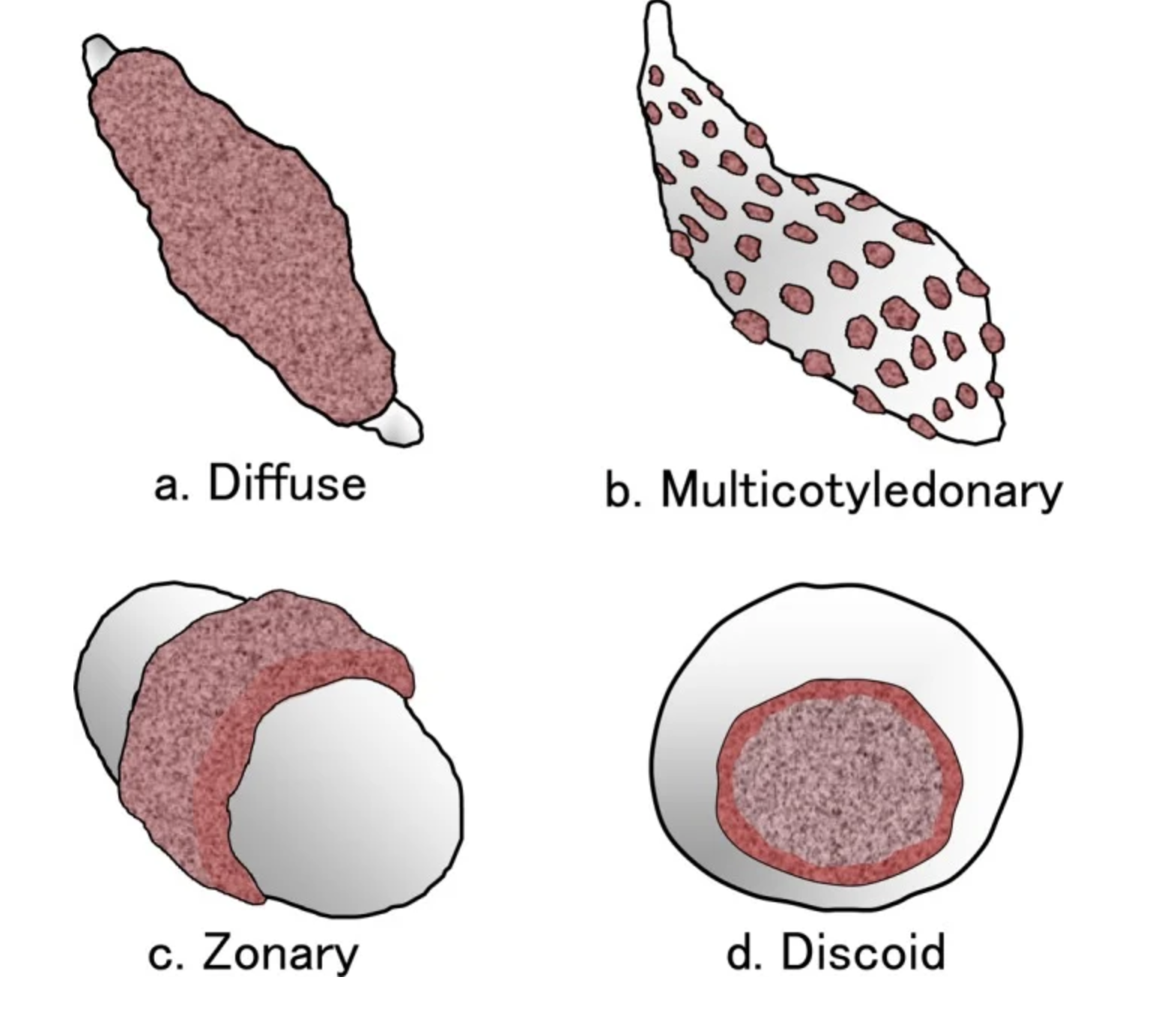
What do you have to identify on the cotyledonary placenta?
Fetus
Caruncle (maternal side) - think moms drive cars
Cotyledon (fetal side) - think baby in cot
Chorioallantois
Placentome
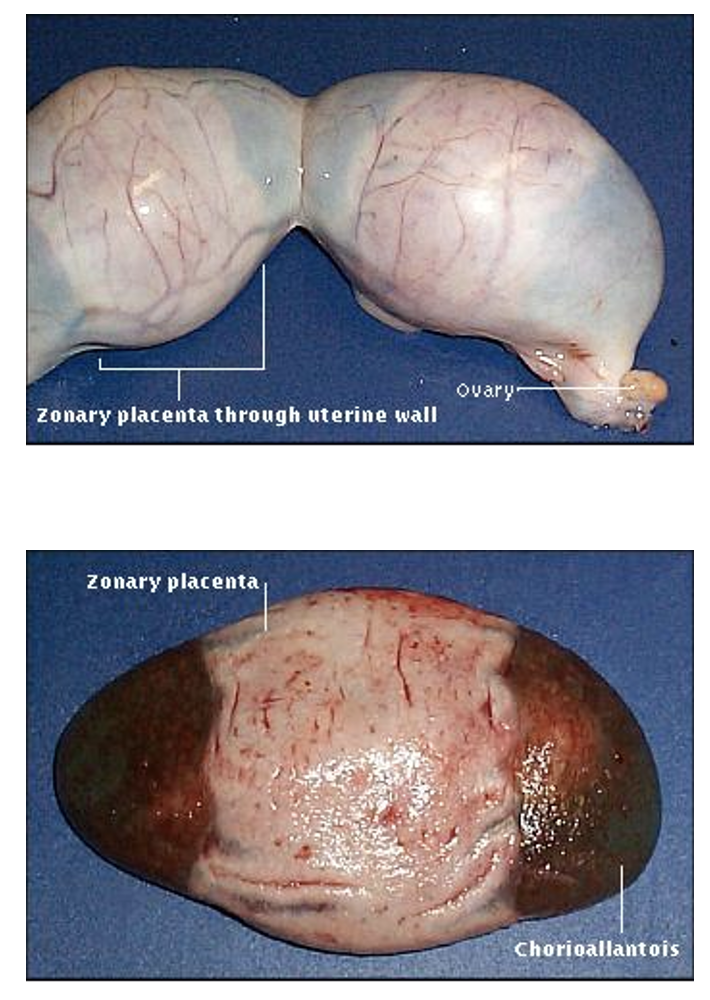
What do you have to identify on the zonary placenta?
Central girdle
Chorioallantois
What to identify on the porcine fetus and placenta?
Fetus
Chorioallantois (outer layer)
Amnion (surrounds fetus)
Necrotic tips
*Porcine fetus is diffuse
Function of chorioallantois and amnion
Chorioallantois: gas exchange and waste
Amnion: fluid-filled protection sac
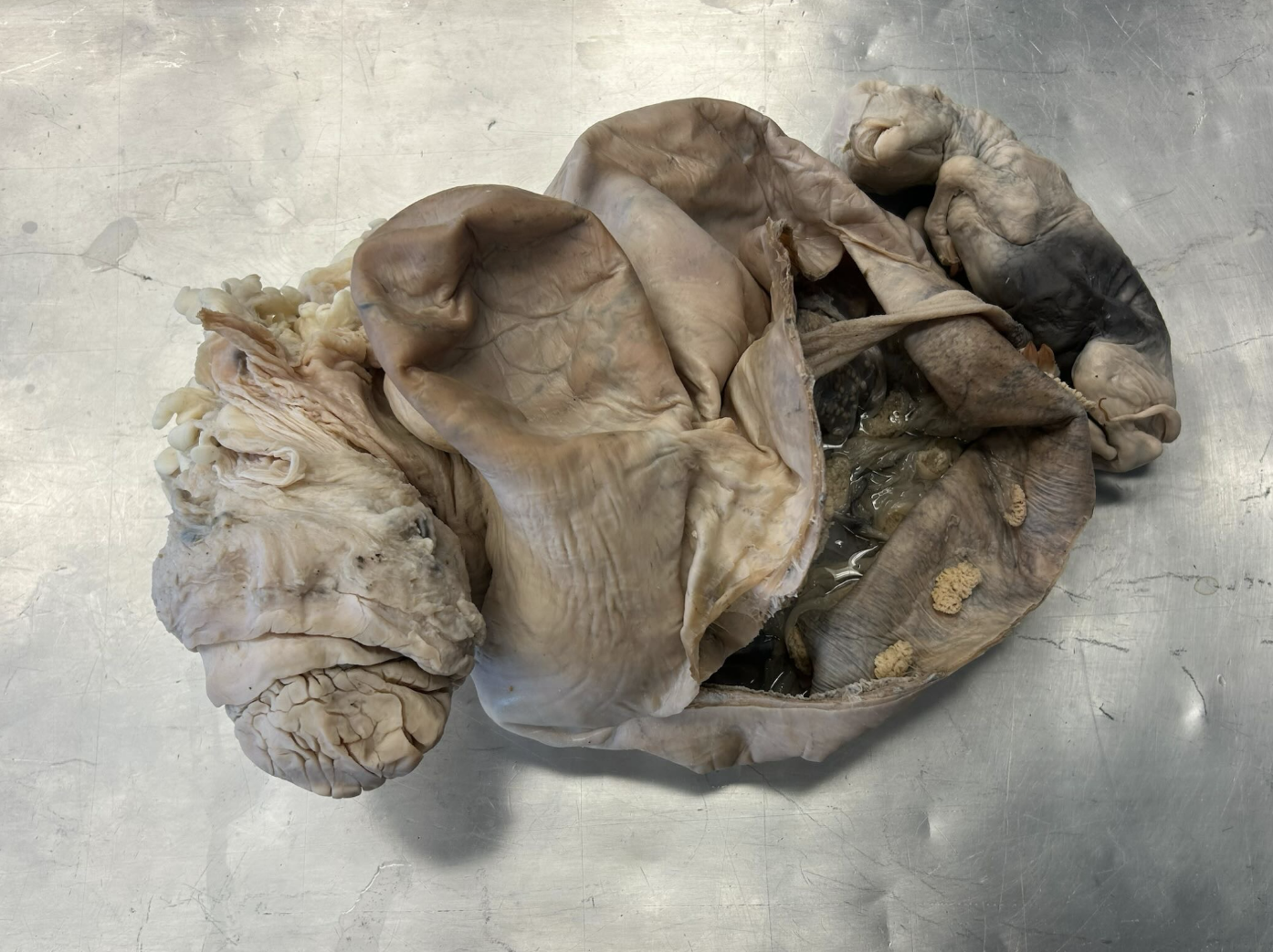
Table 1 1/4
Cow placenta (cotyledonary placenta)
Cotyledons
Caruncles
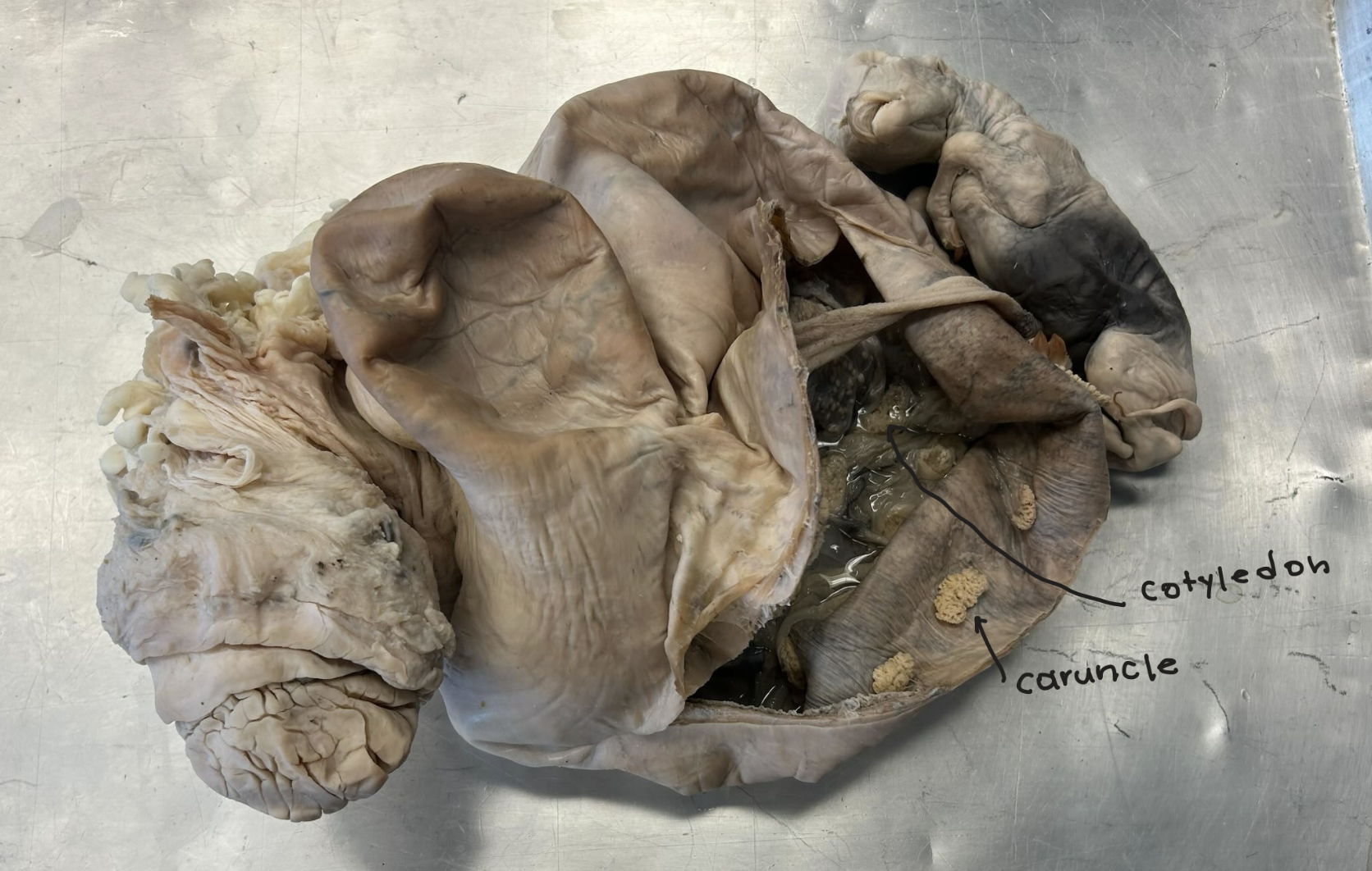
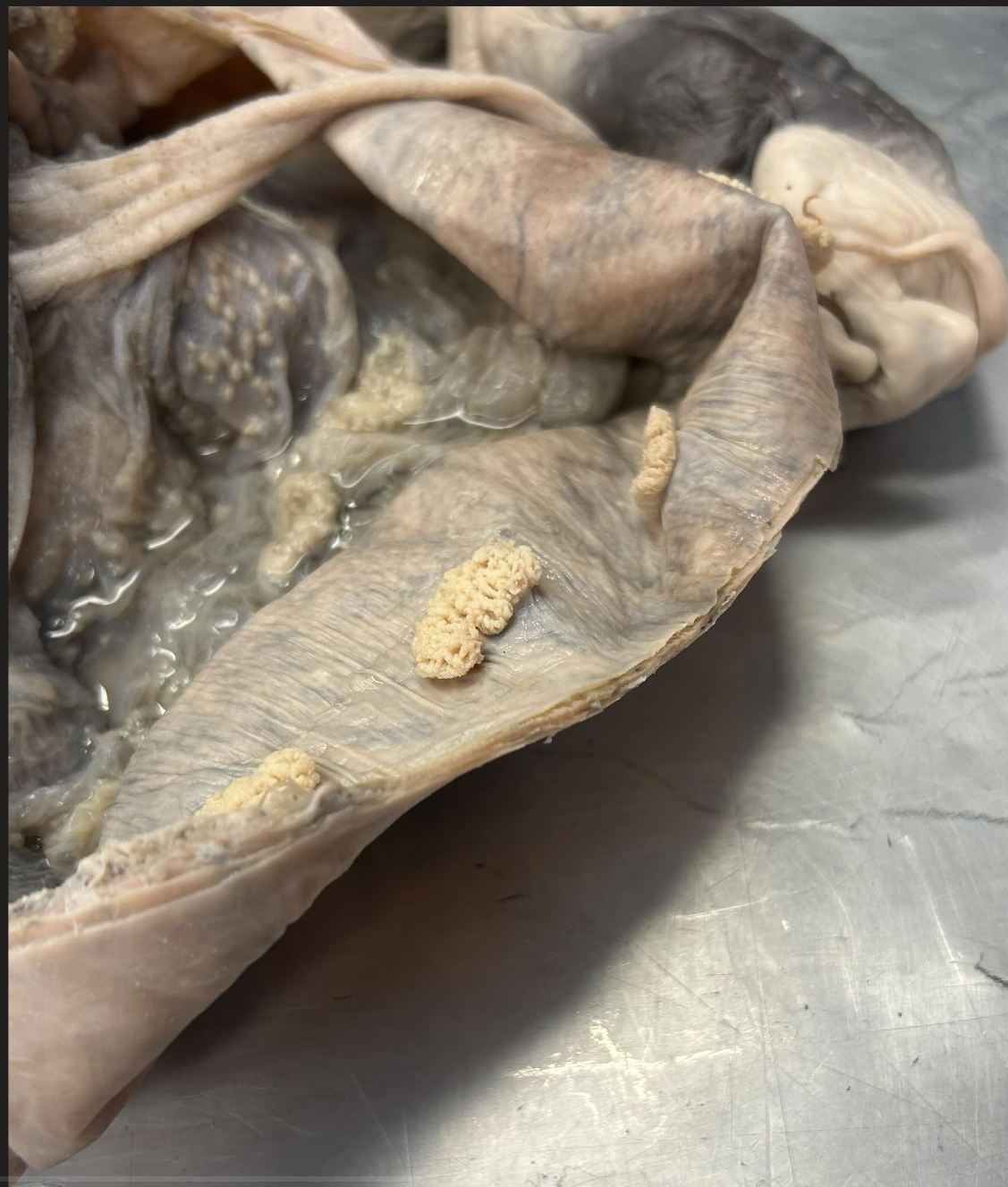
Table 1 2/4
Cow placenta (cotyledonary placenta)
Caruncles
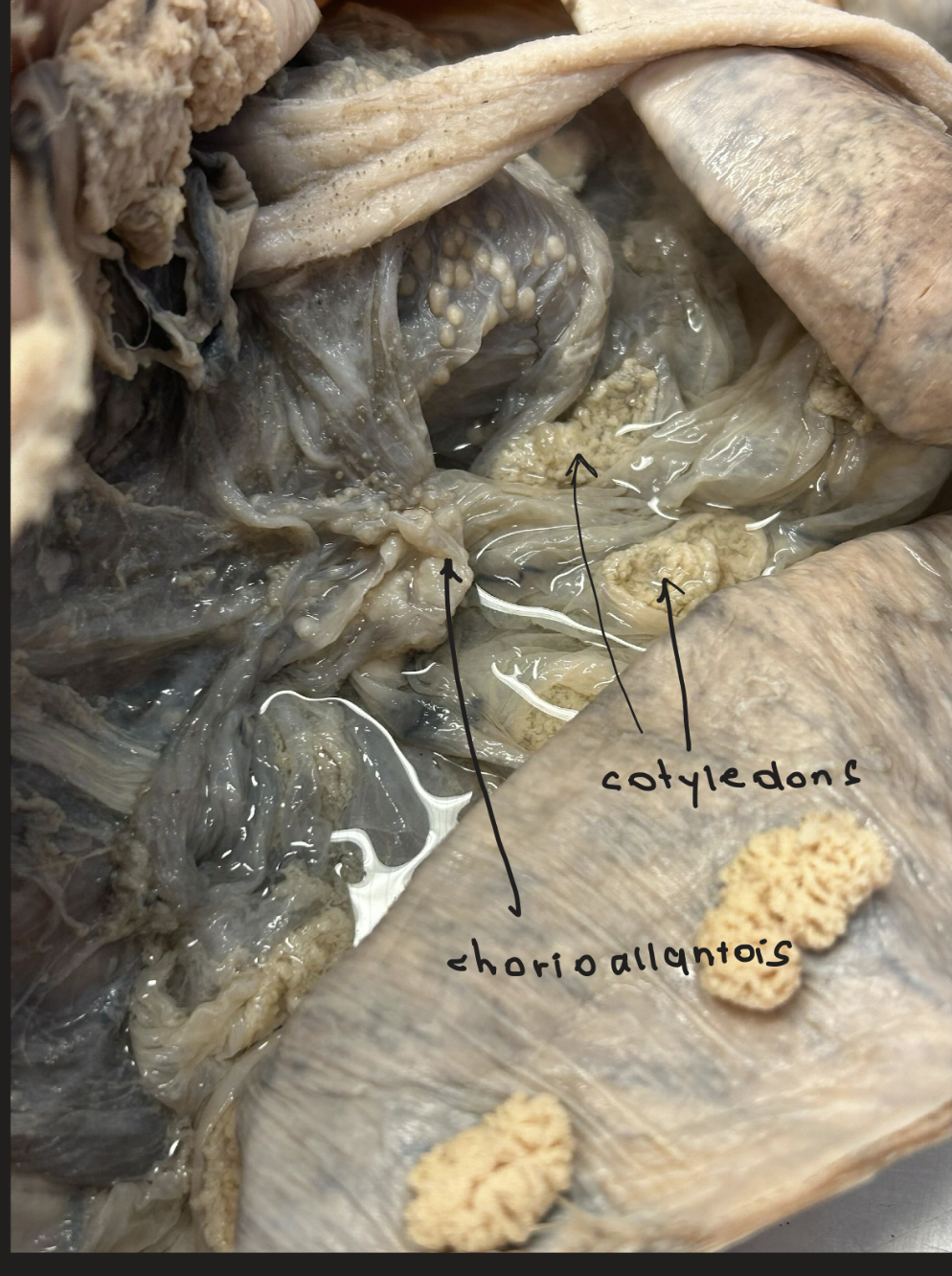
Table 1 3/4
Cow placenta (cotyledonary placenta)
Cotyledons
Attached to chorioallantois
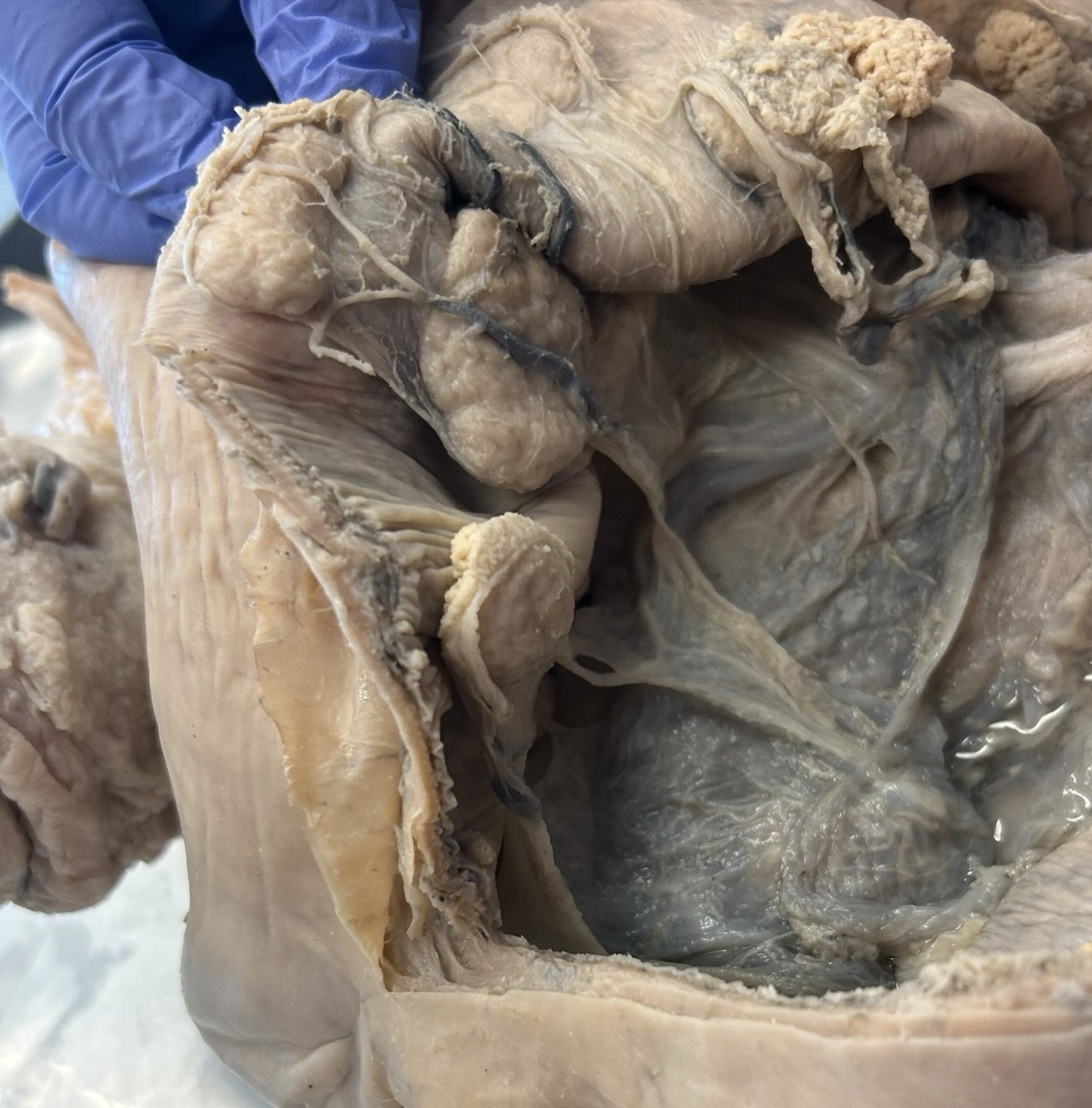
Table 1 4/4
Cow placenta (cotyledonary placenta)
Cotyledons and Caruncles attached = Placentome
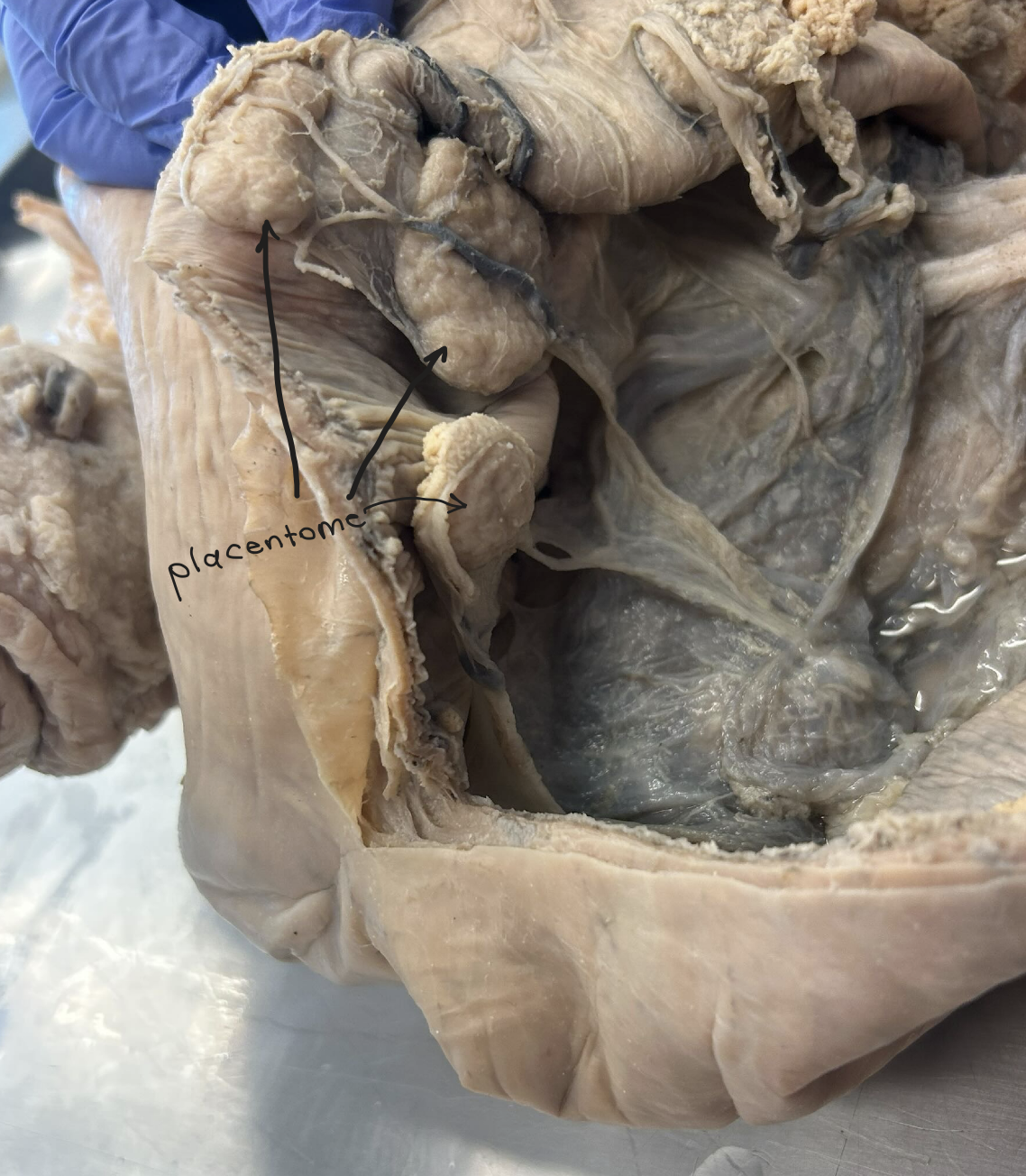
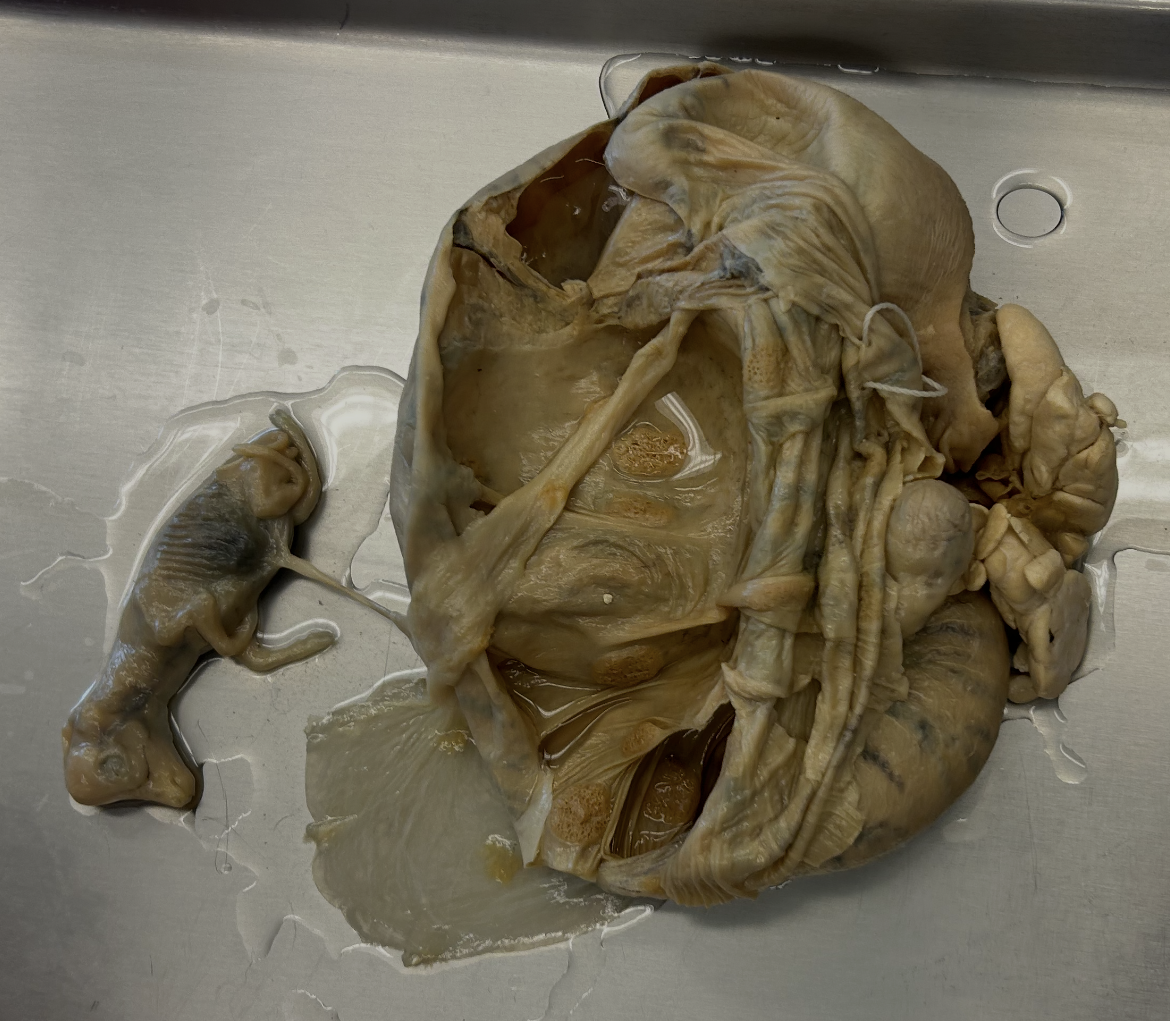
Table 2 1/2
Ewe placenta + fetus
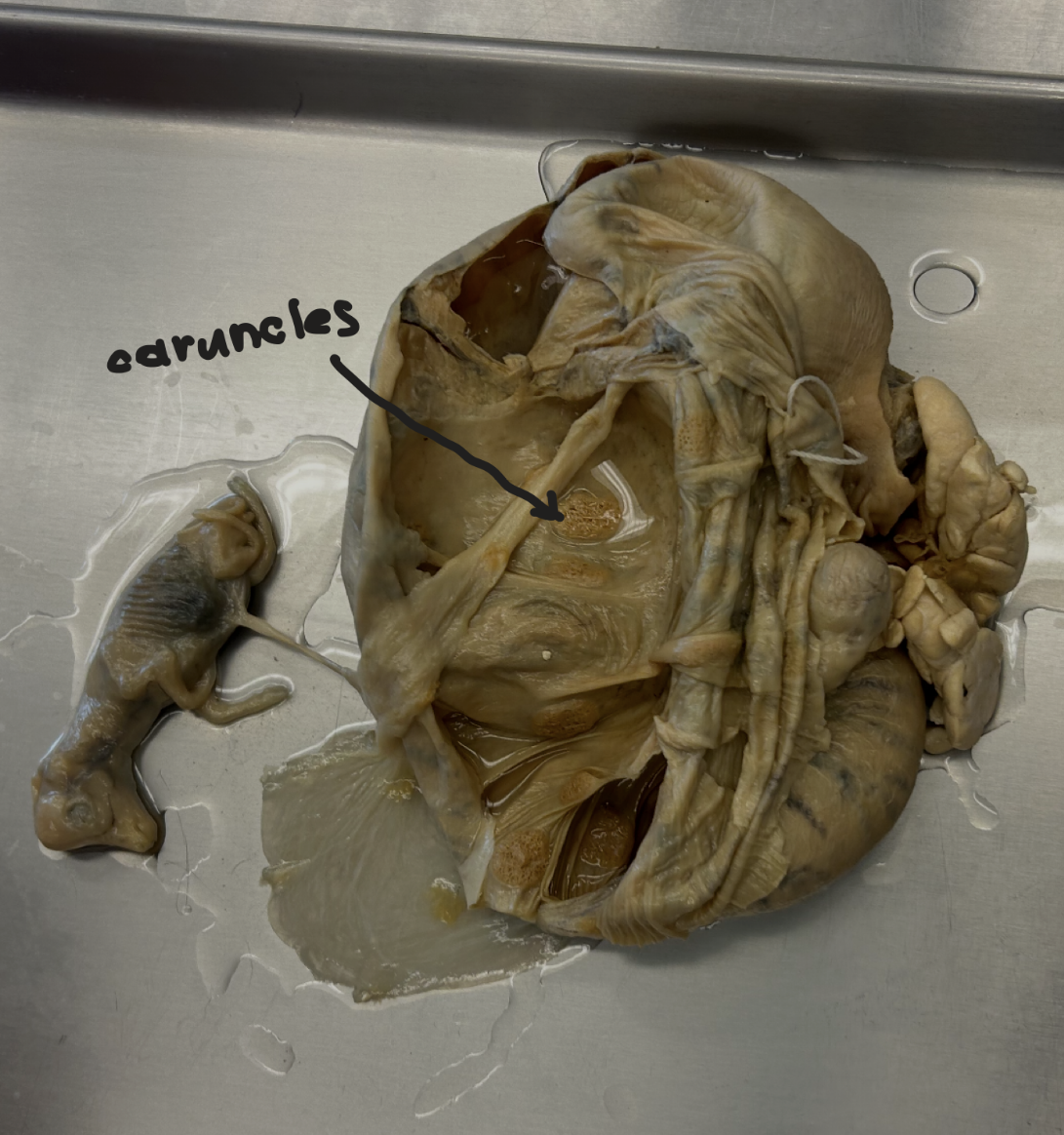
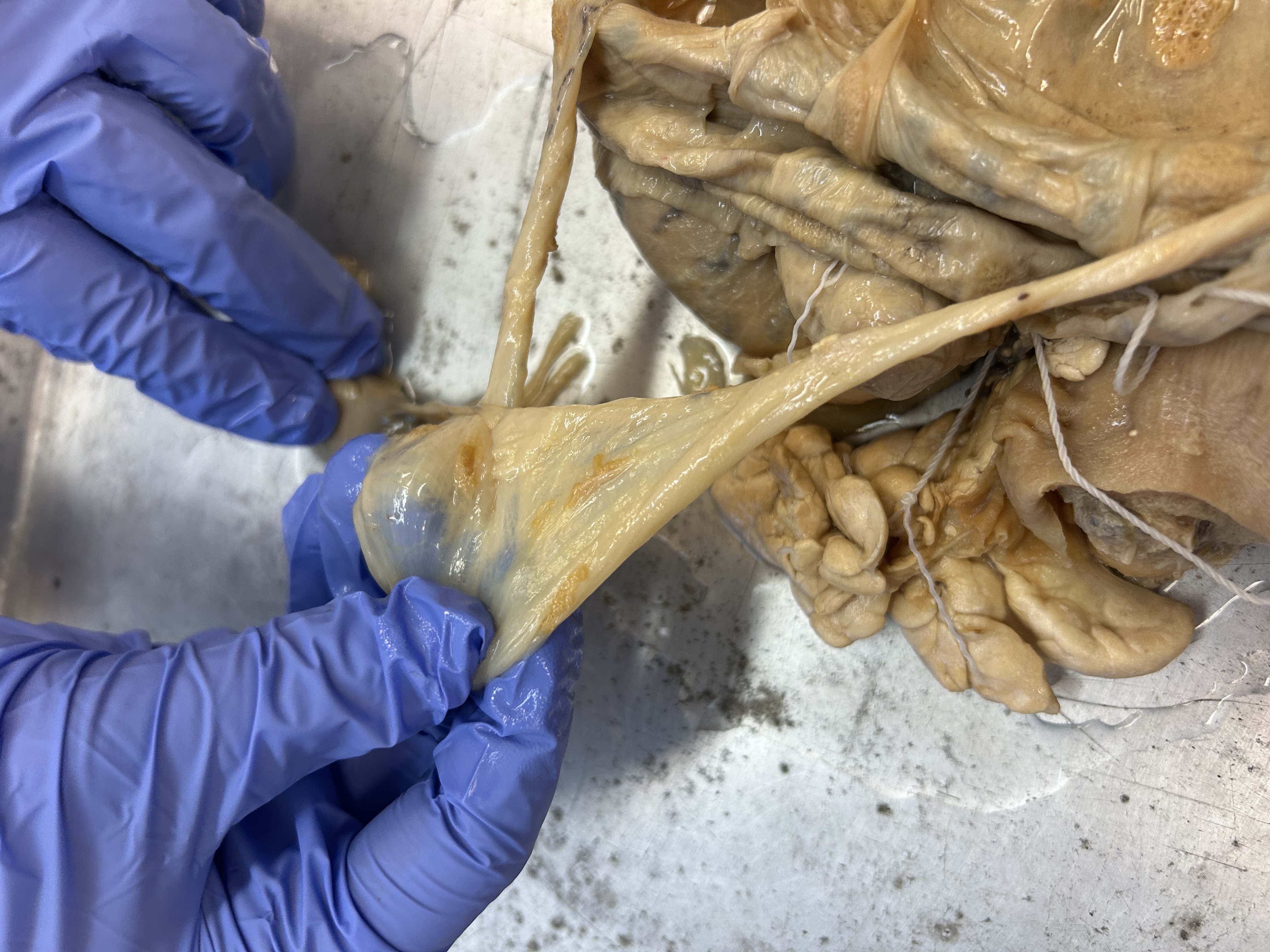
Table 2 2/2
Ewe placenta + fetus
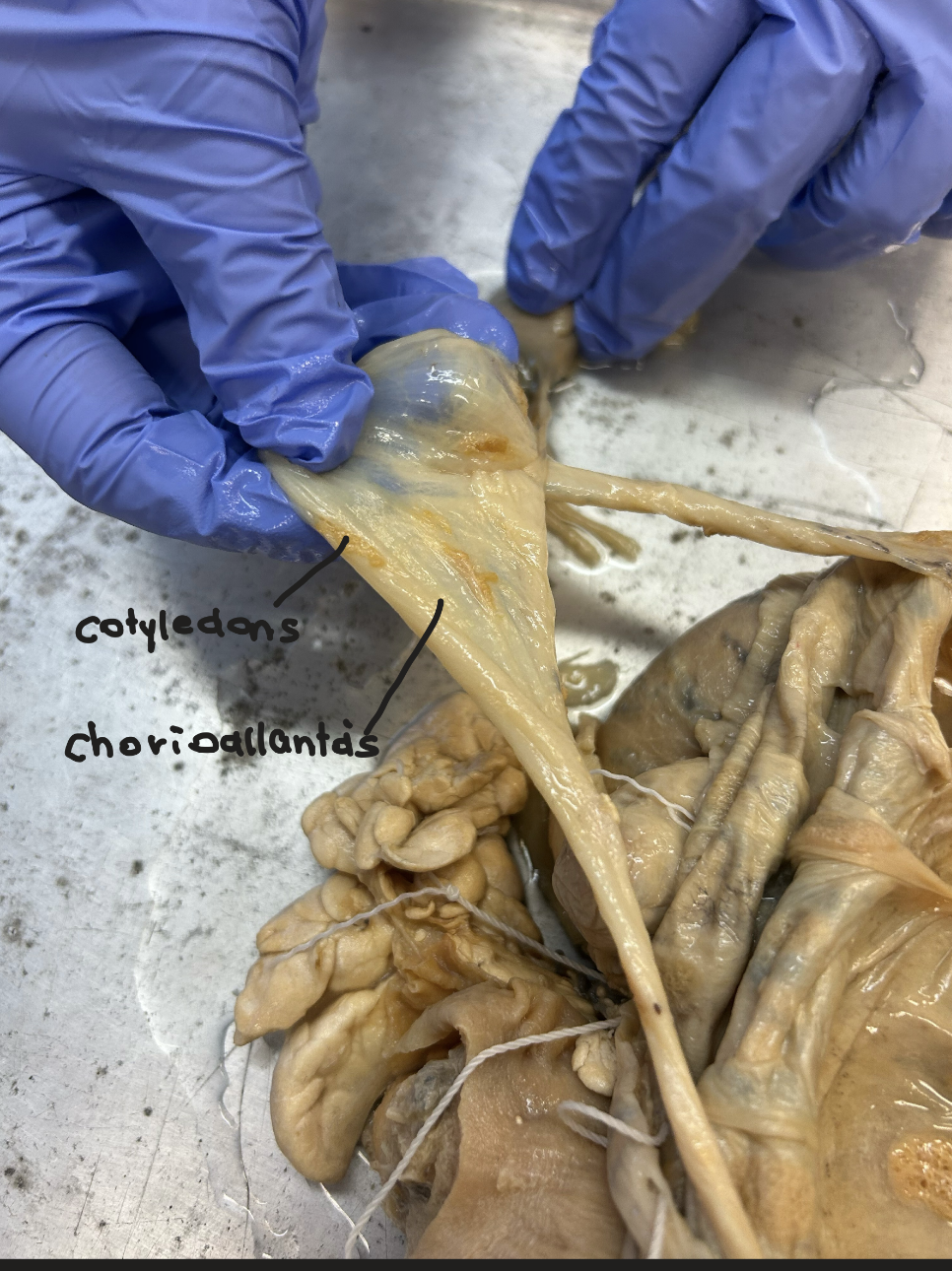
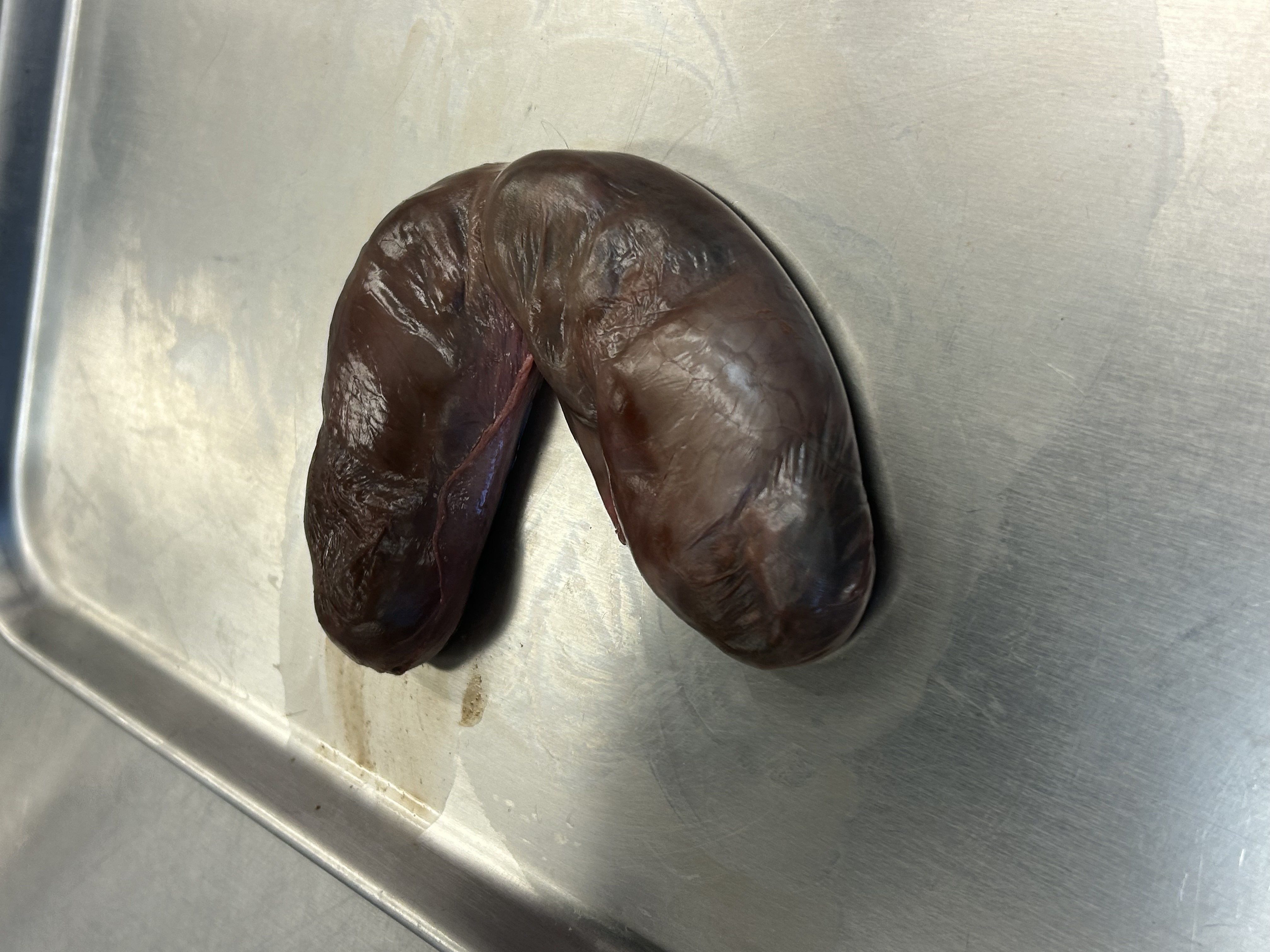
Table 3
Cat (zonary placenta) or dog
2 dif fetuses
Can semi see central girdle - it is lighter band
Chorioallantois is most free tissue - prob won’t be on this
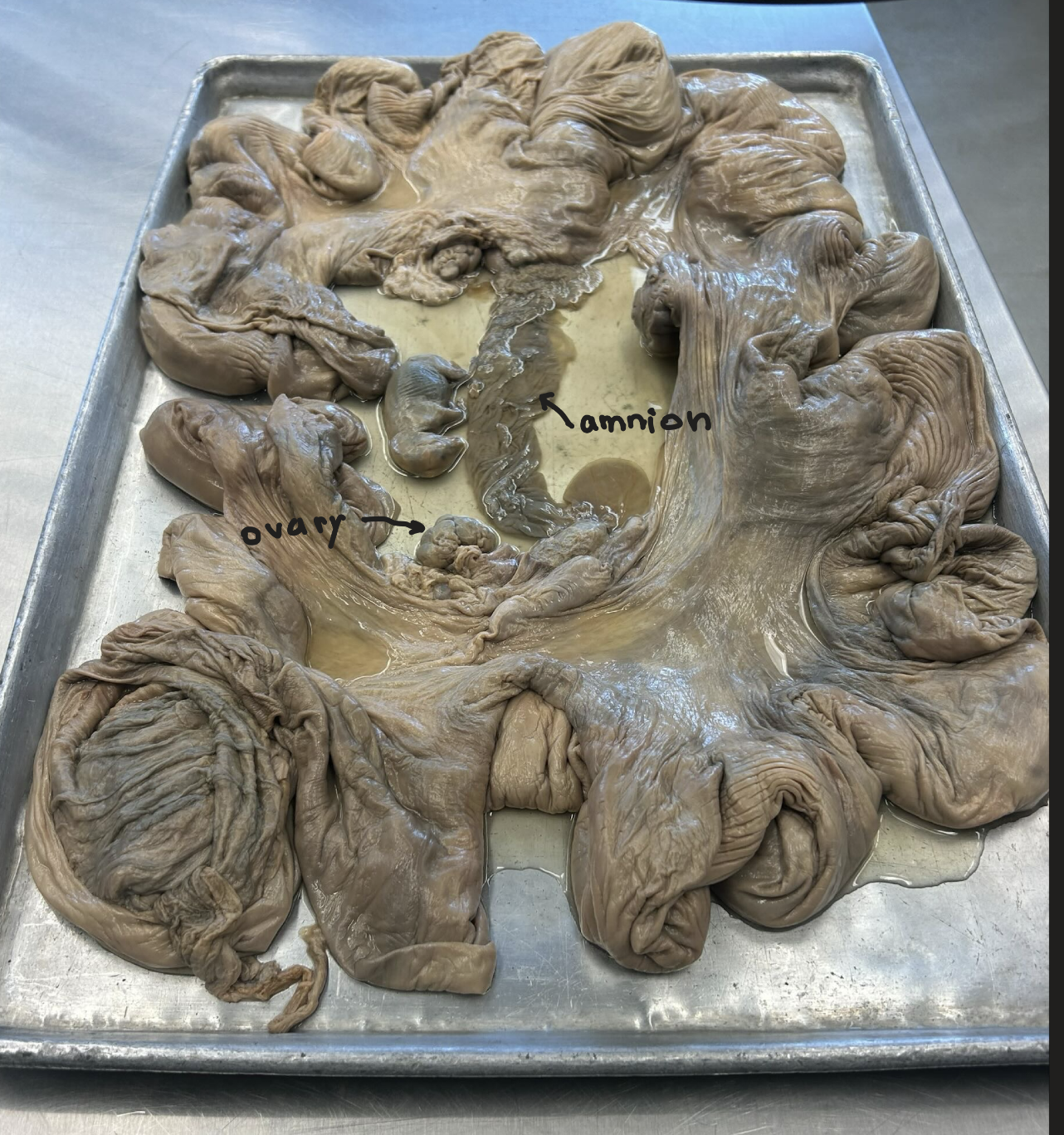
Table 4 1/3
Pregnant sow (diffuse placenta) - uterus
Large uterine horns
Ovary with bunch of CLs b/c pregnant
Necrotic tips between each to prevent disease from traveling to kill litter
Middle thing is amnion
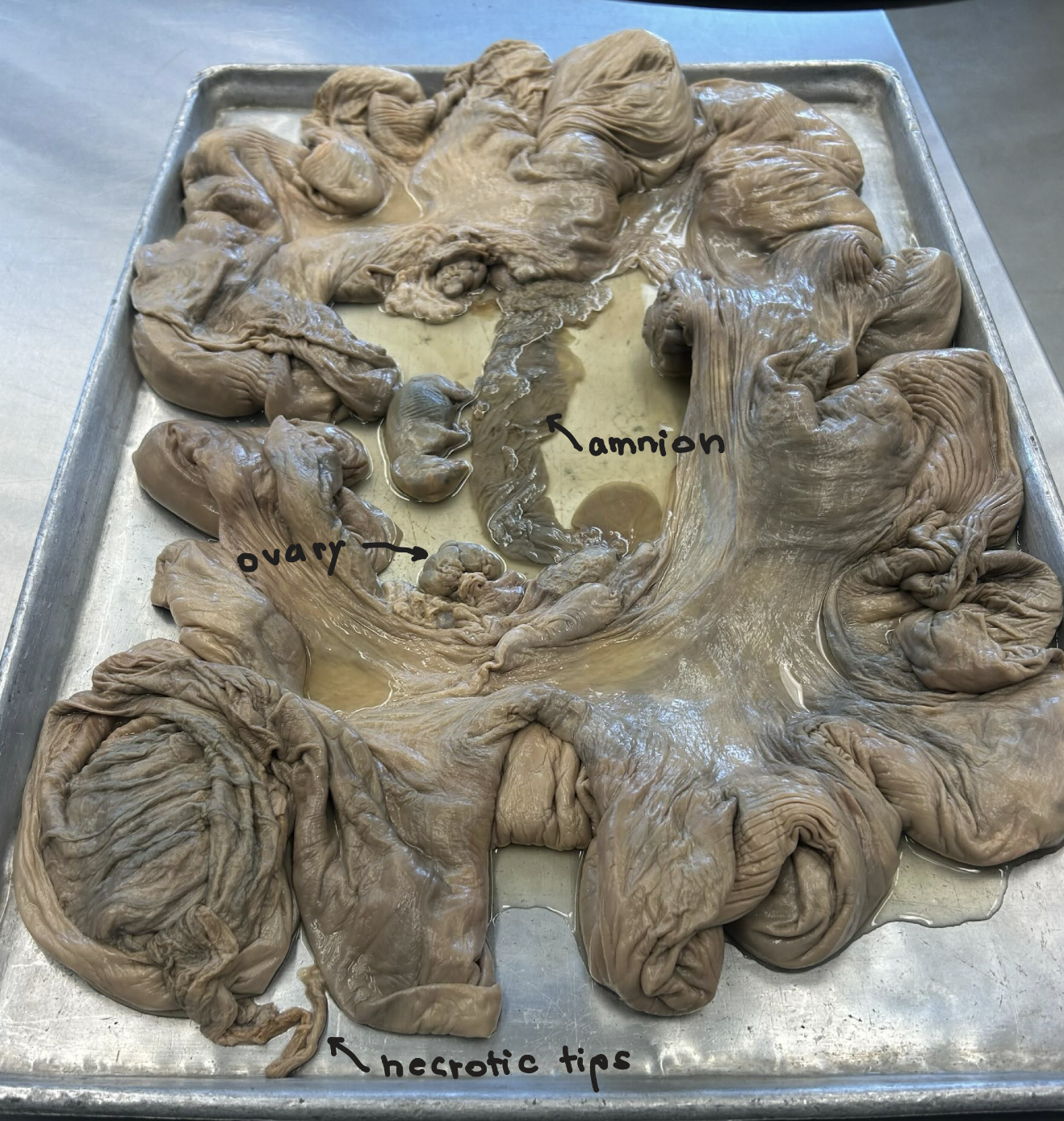
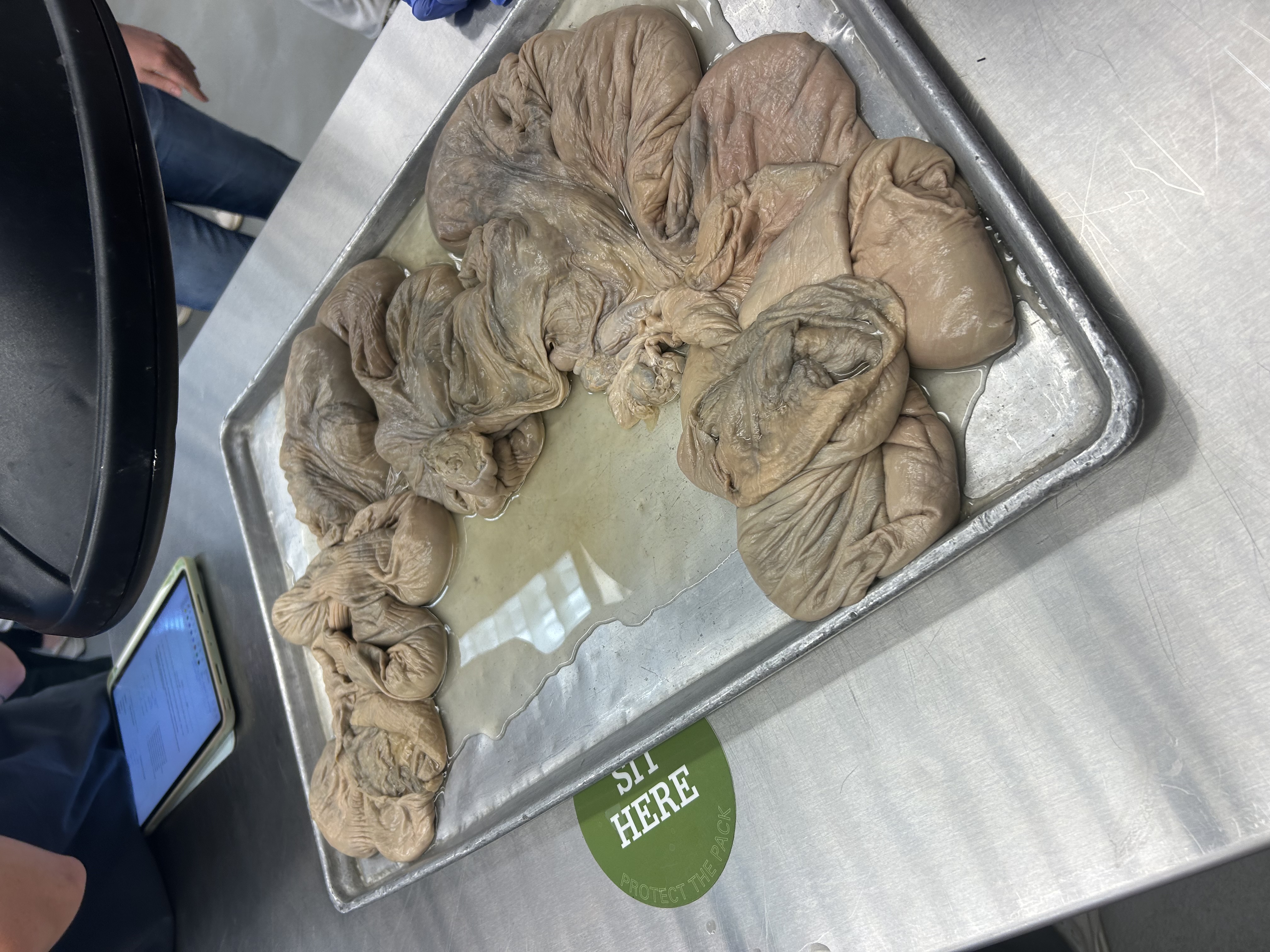
Table 4 2/3
Pregnant sow (diffuse placenta type) - uterus
Rugae: maternal side of placenta in pigs - think moms like reggae
-Textured
Areola: fetal side of placenta in pigs
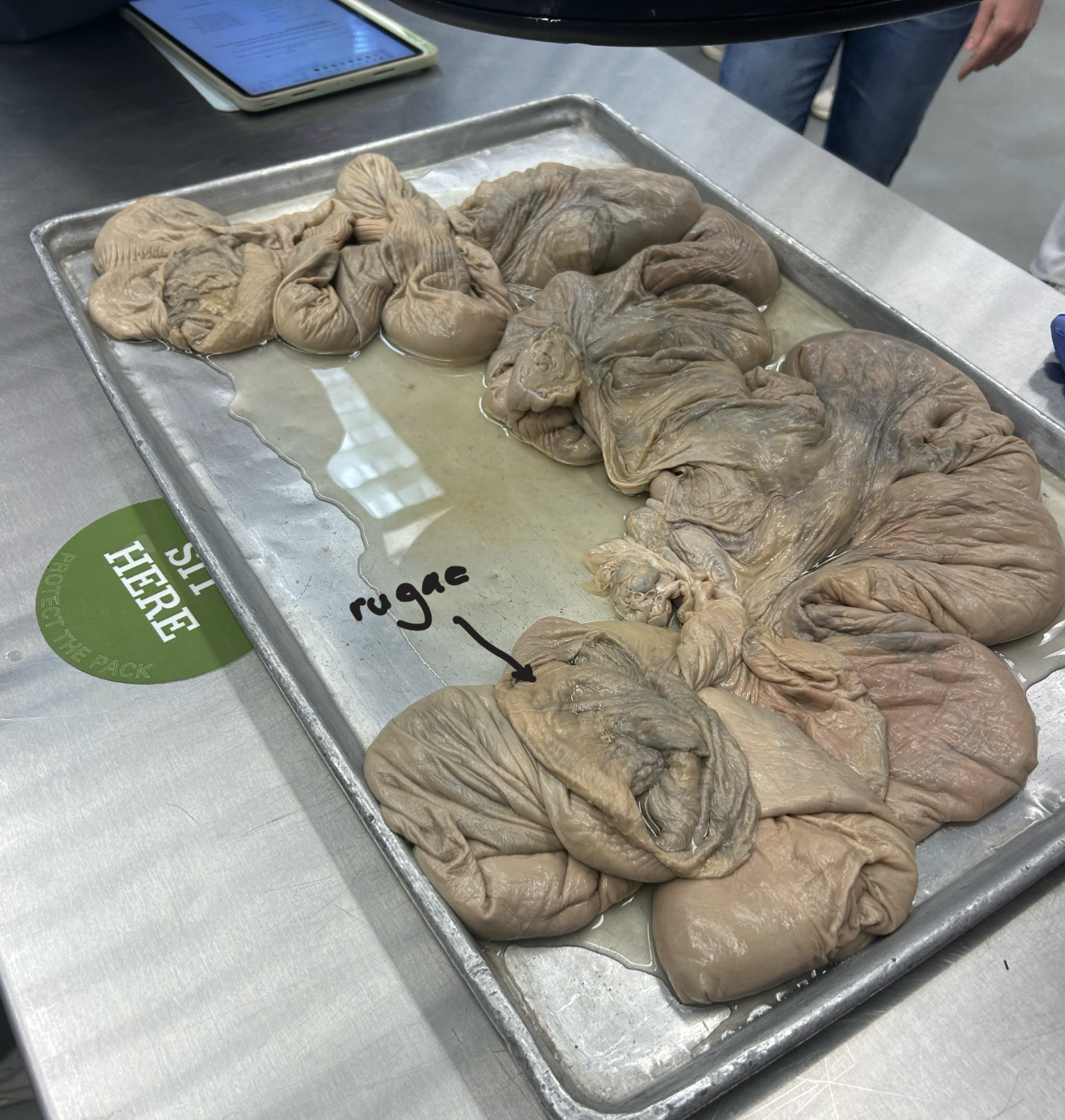
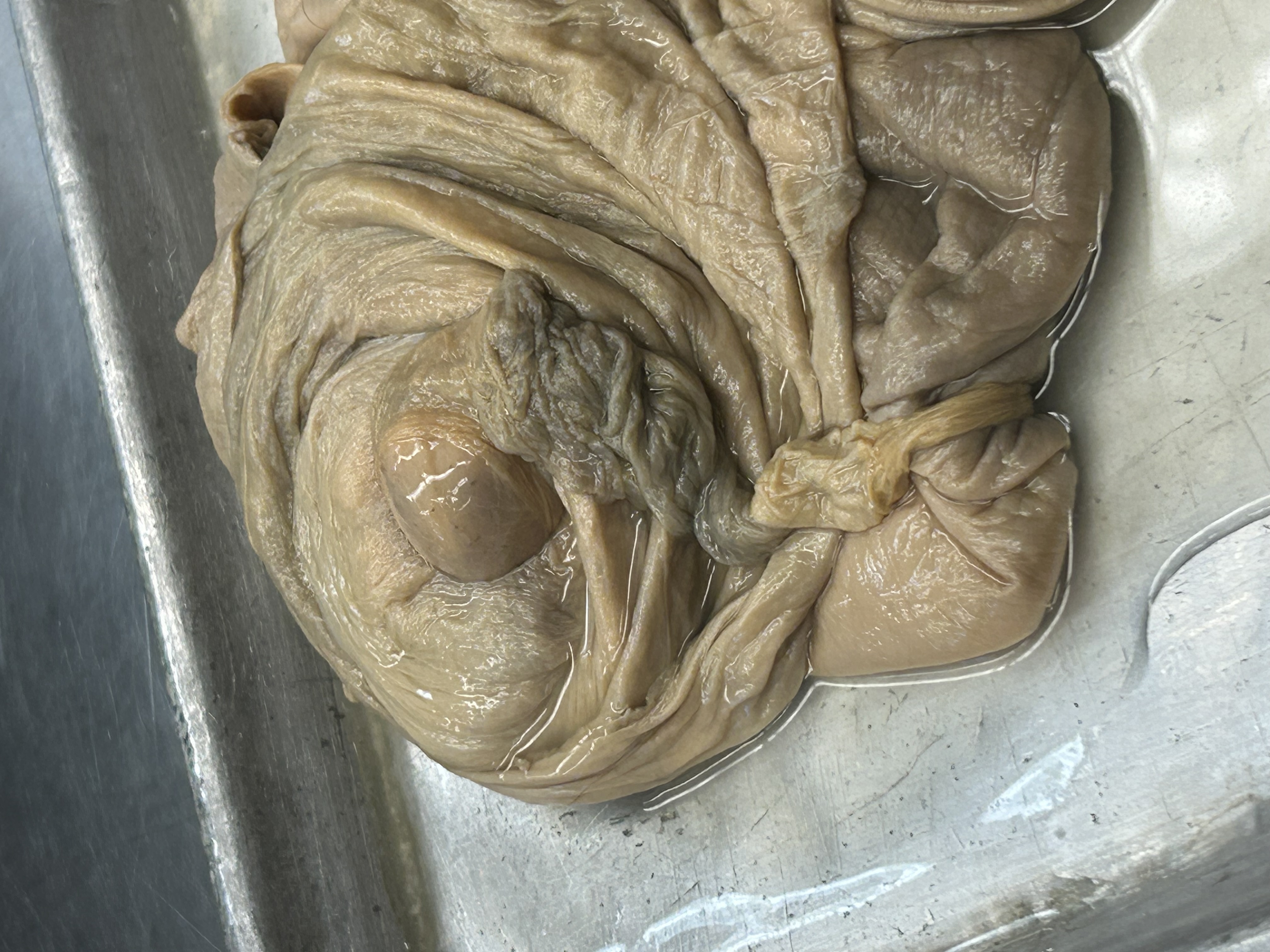
Table 4 3/3
Pregnant sow (diffuse placenta type) - uterus
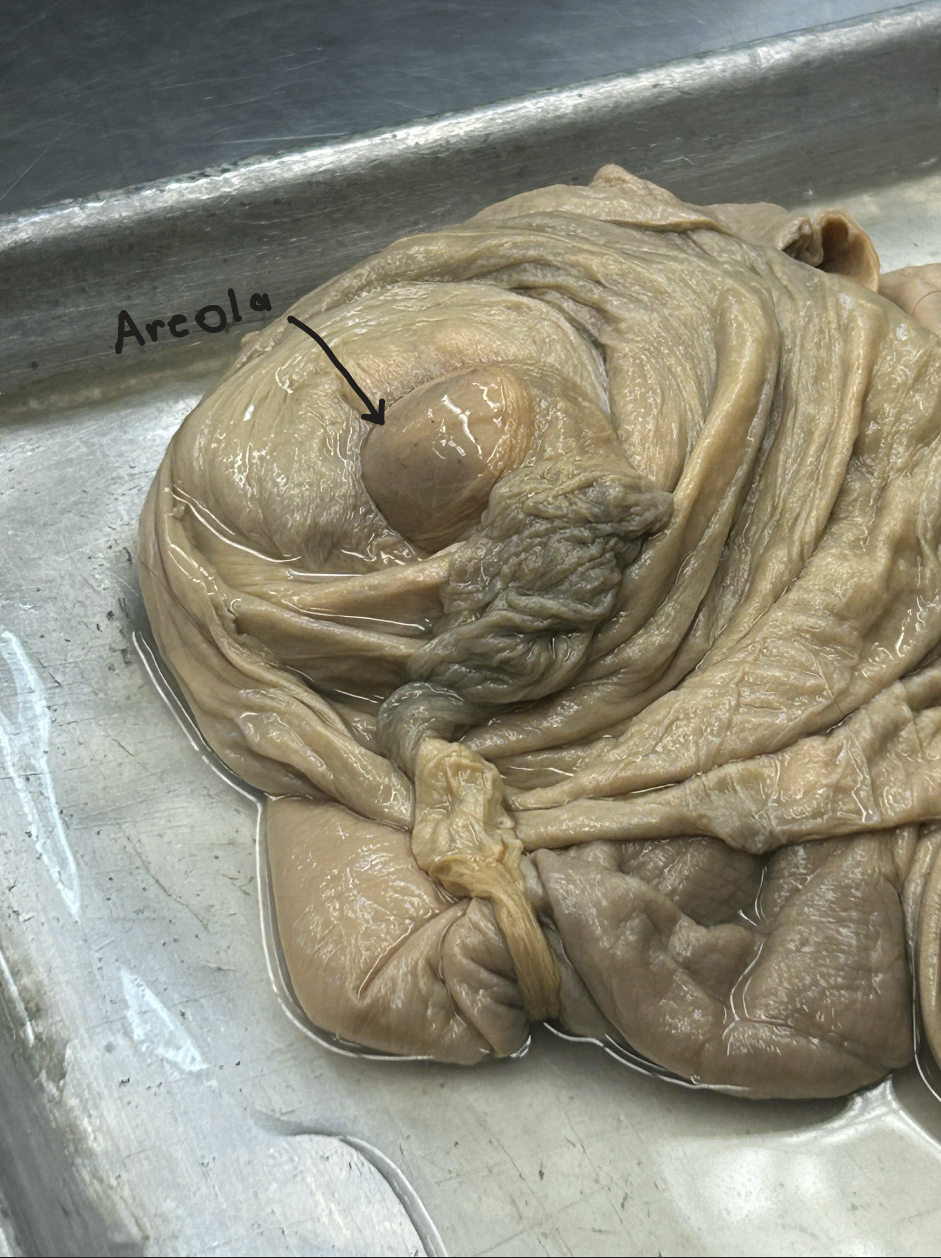
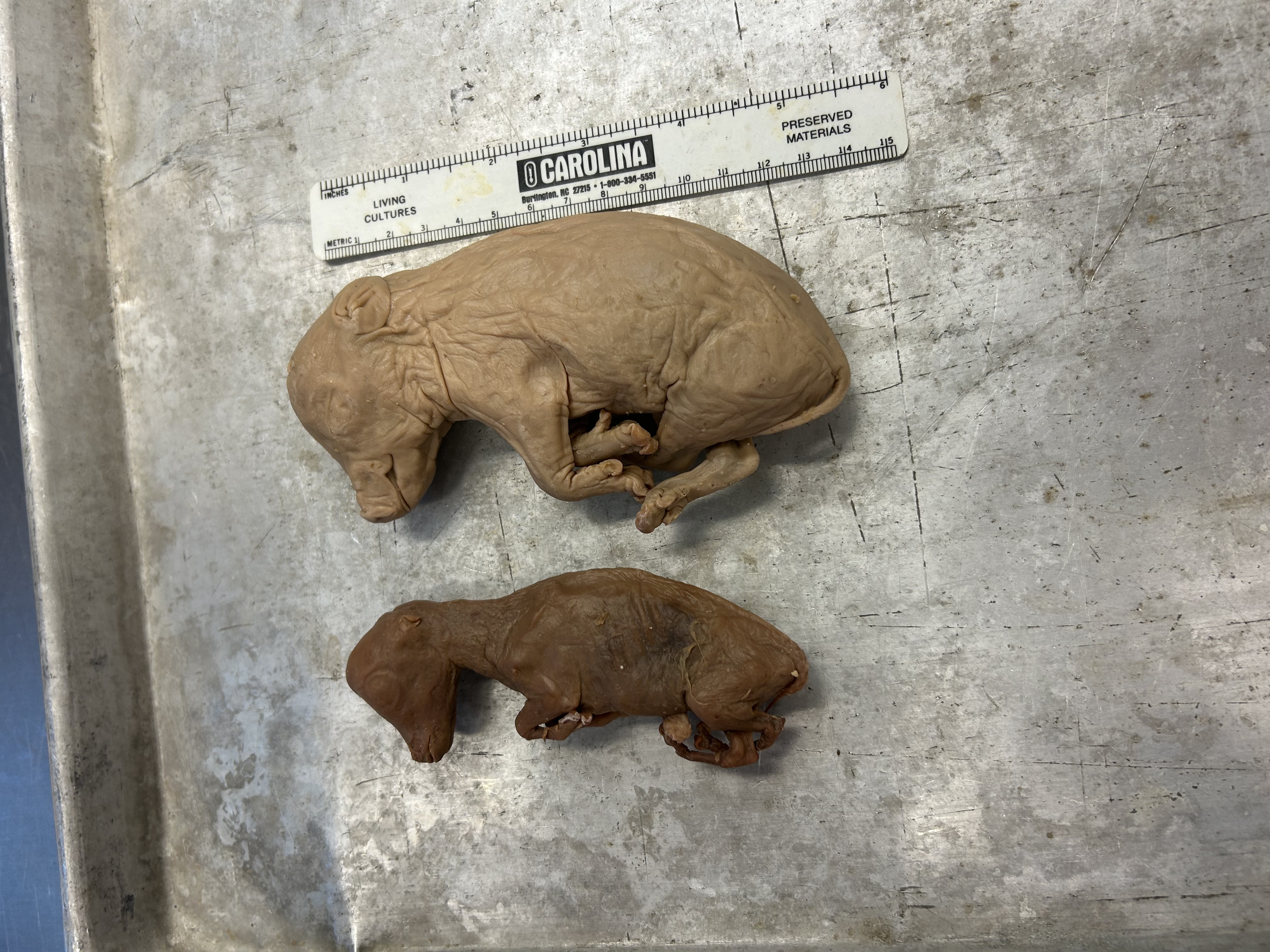
Table 5 1/3
Left is porcine fetus
Right is bovine fetus
Table 5 2/3: Bovine fetal-rump length graph. What measurement? And what is the one that was out?
*This is in cm!
Around 85 days of gestation
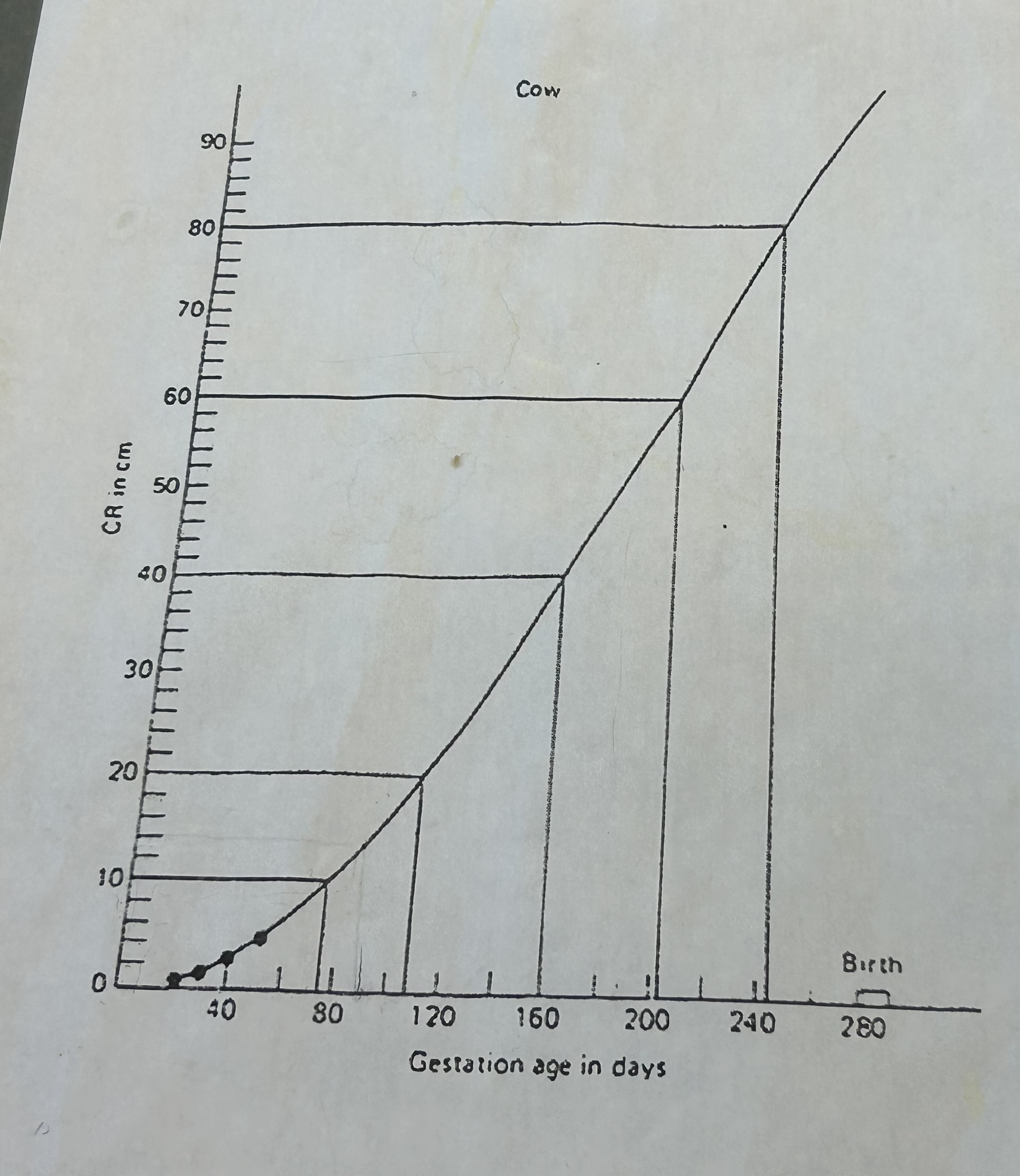
Table 5 3/3: Porcine fetal-rump length graph. What measurement? And what is the one that was out?
*This is in mm!
Around 60 days gestation
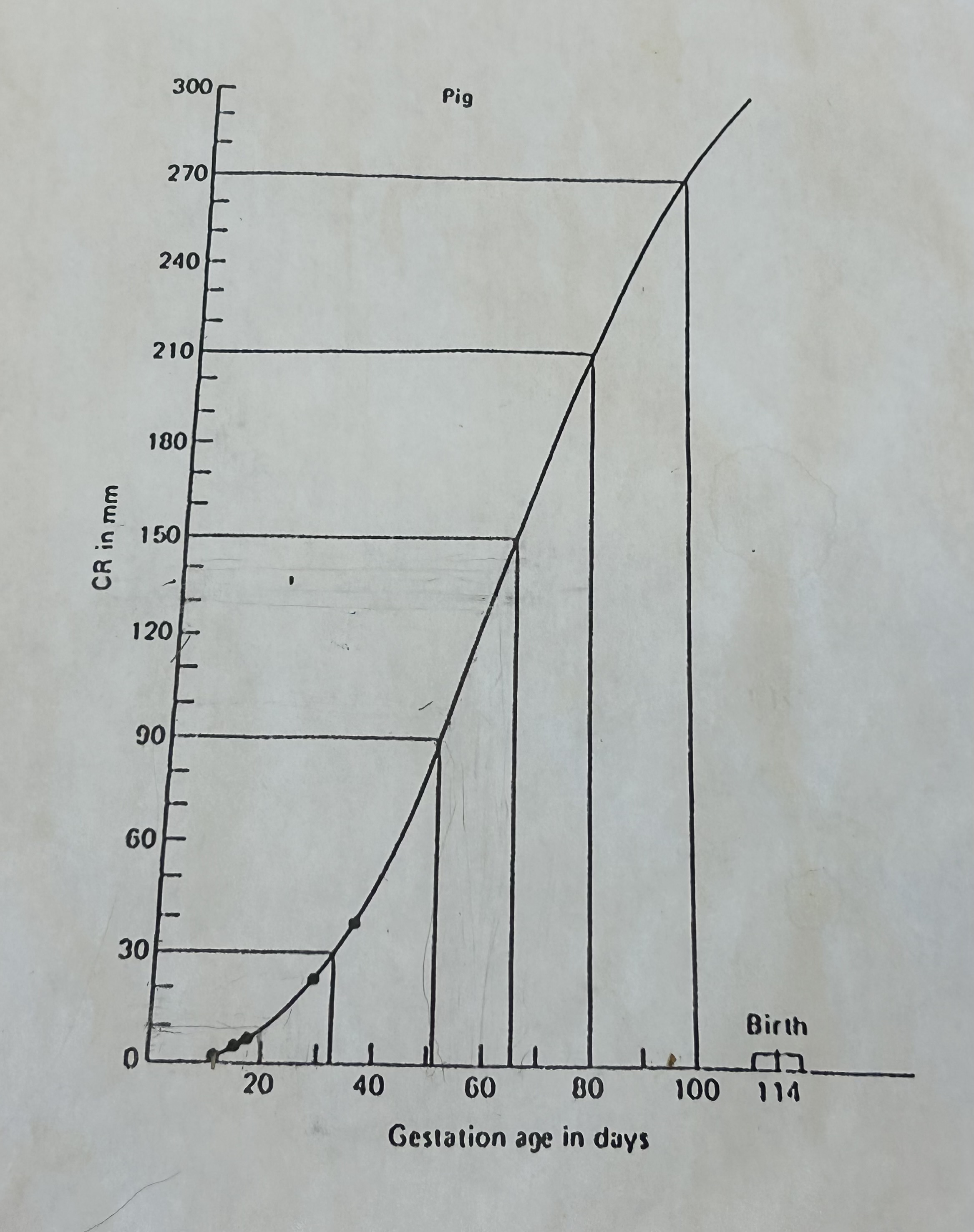
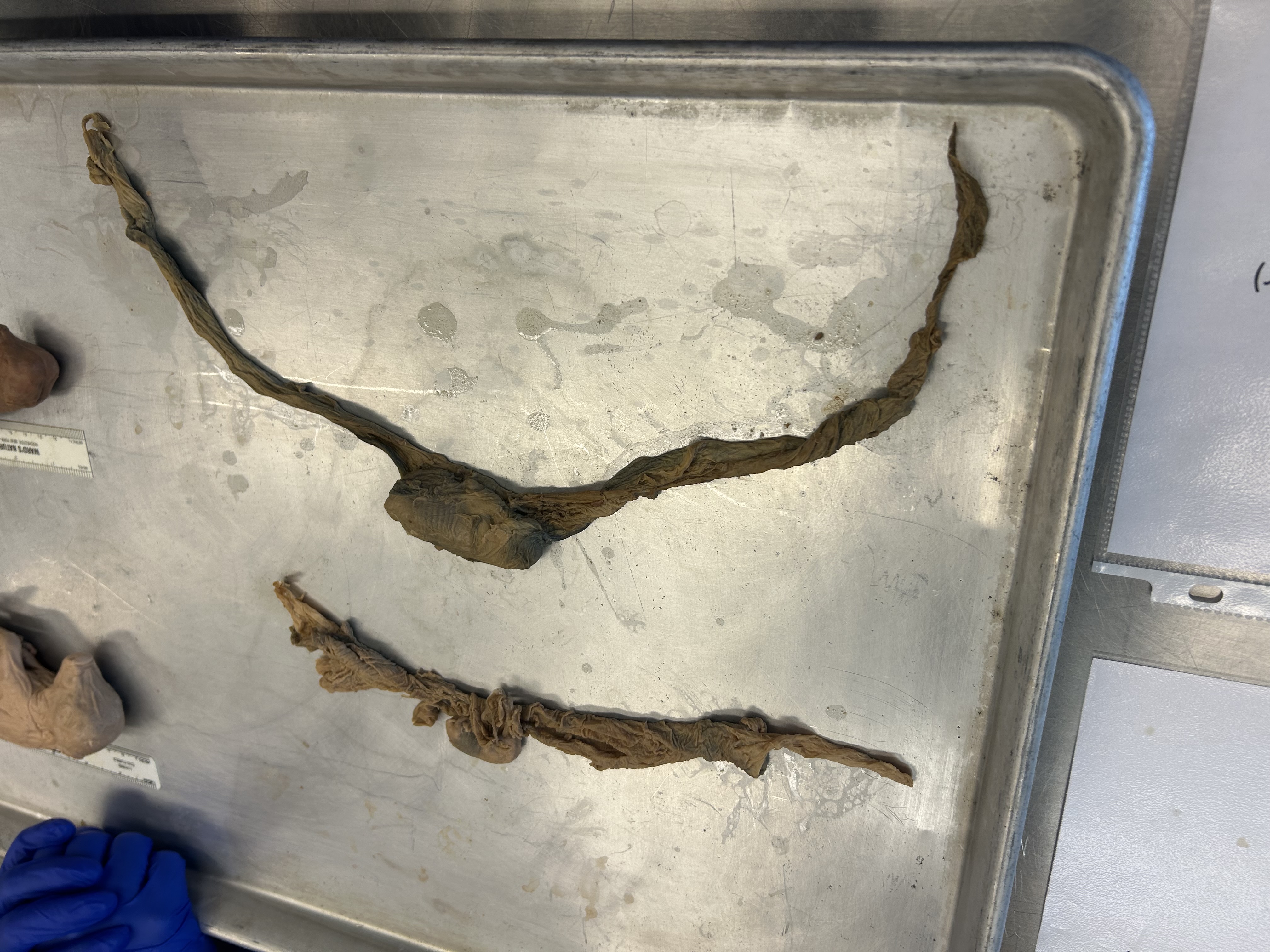
Table 6
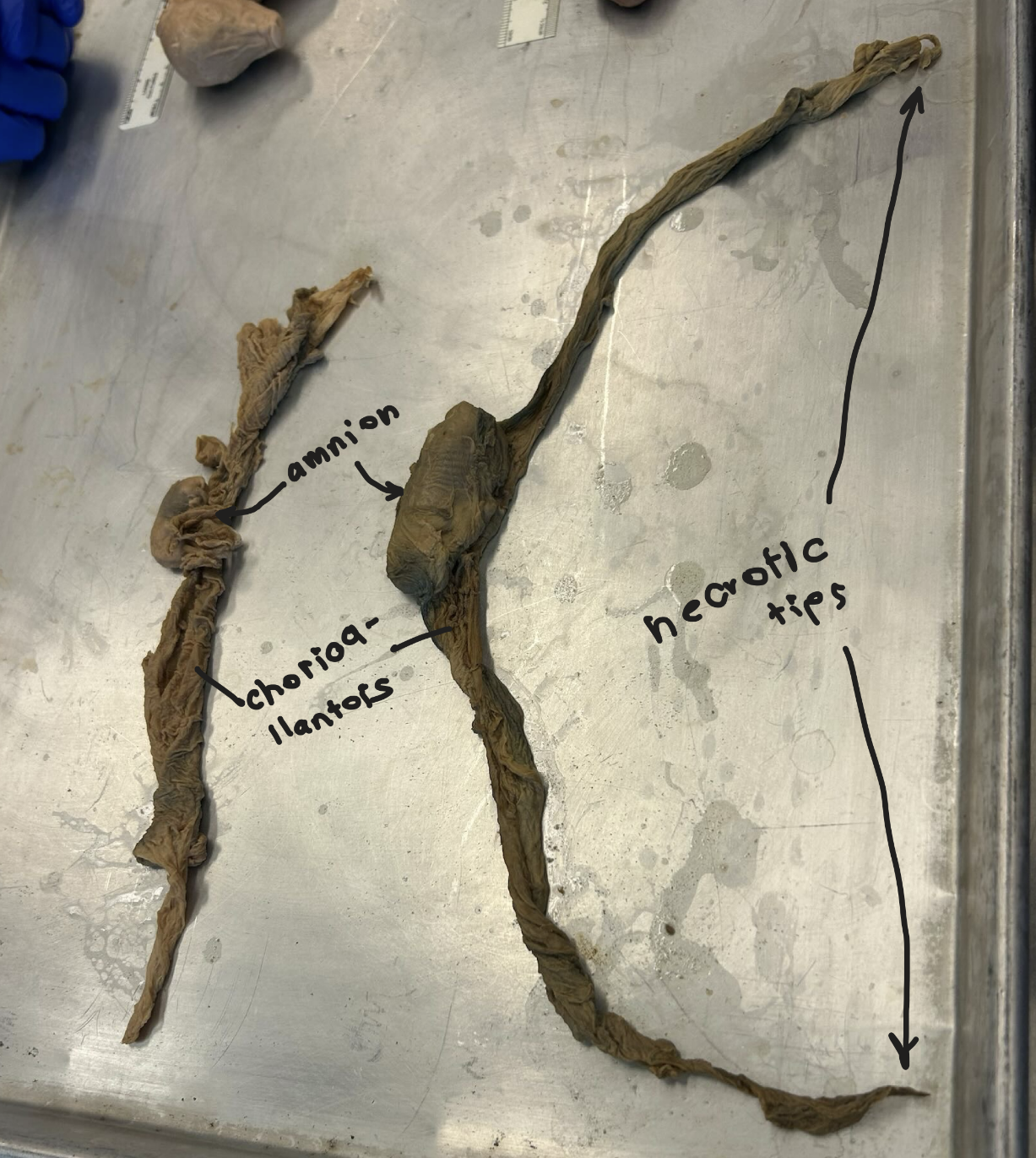
Pigs (diffuse placenta)
Corioallantois is outside fetus + is vascular
Necrotic tips on ends
Amnion directly on fetus
Lab Equipment Table
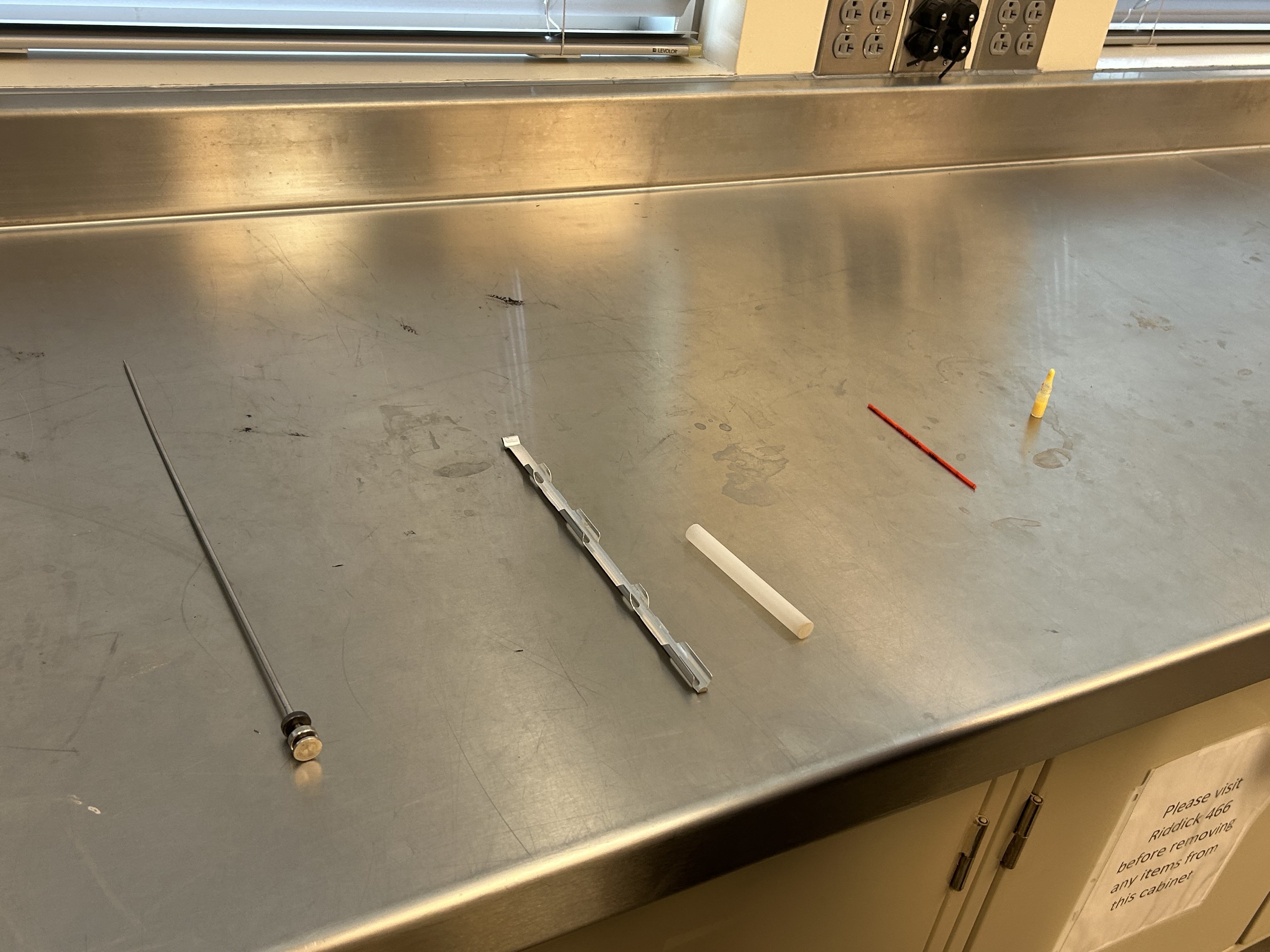
Left to right:
AI Rod; Cane; Goblet; Semen Straw; Ampules
Also liquid nitrogen tank was there
What is embryonic development called?
Embryogenesis
What forms day 7-9?
Blastocyst
Embryonic development stages drawn out
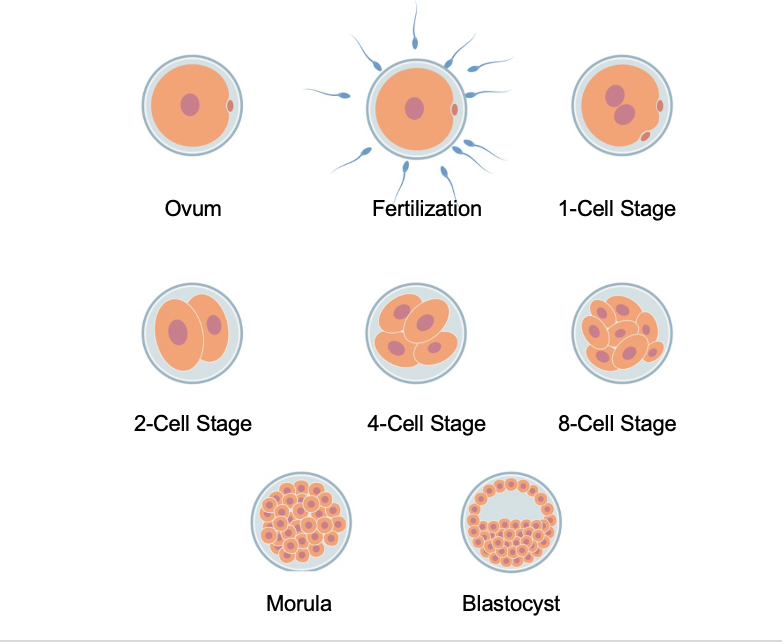
Another diagram with more embryonic stages and days they occur
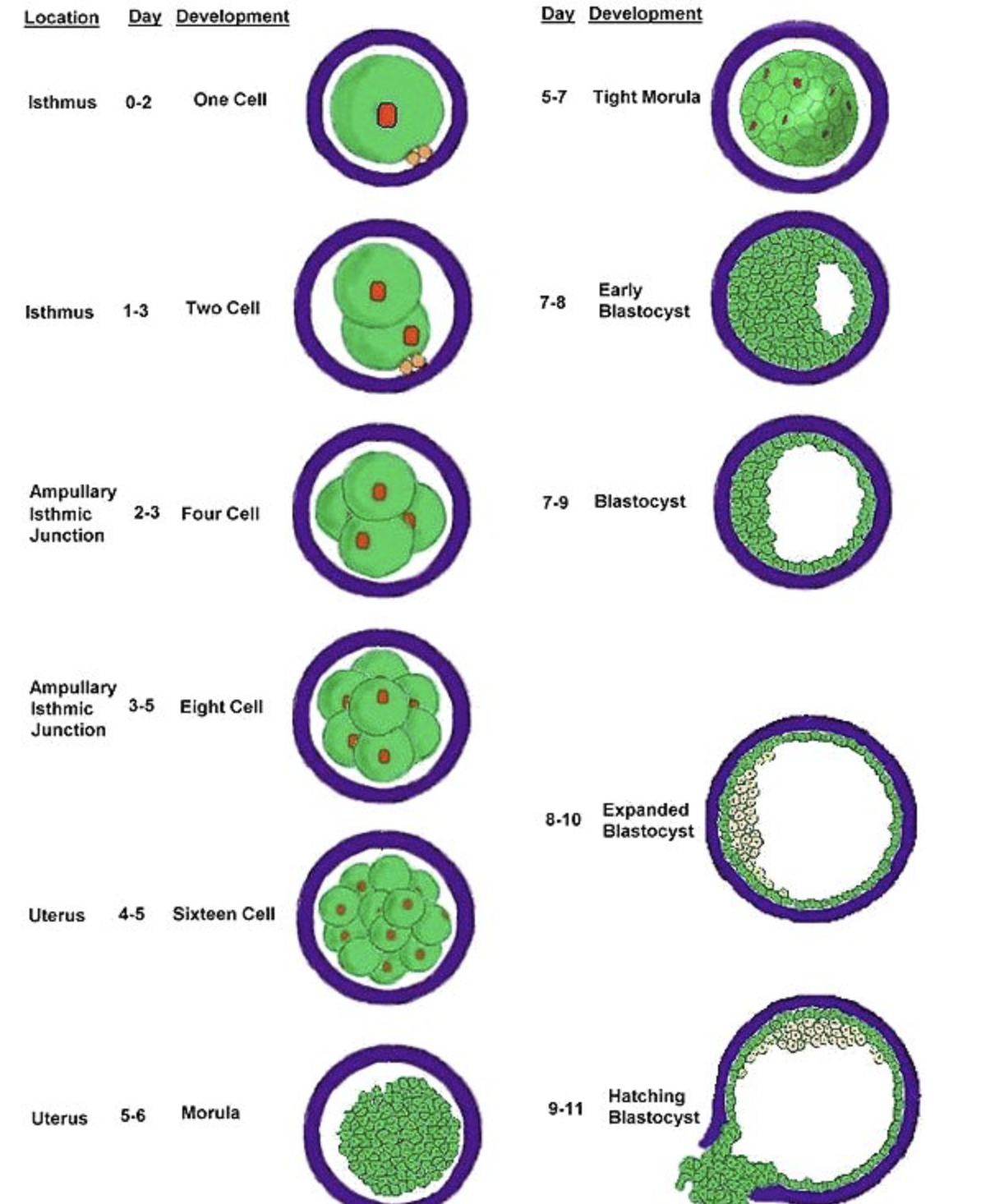
Stages from around around 16 cell stage?
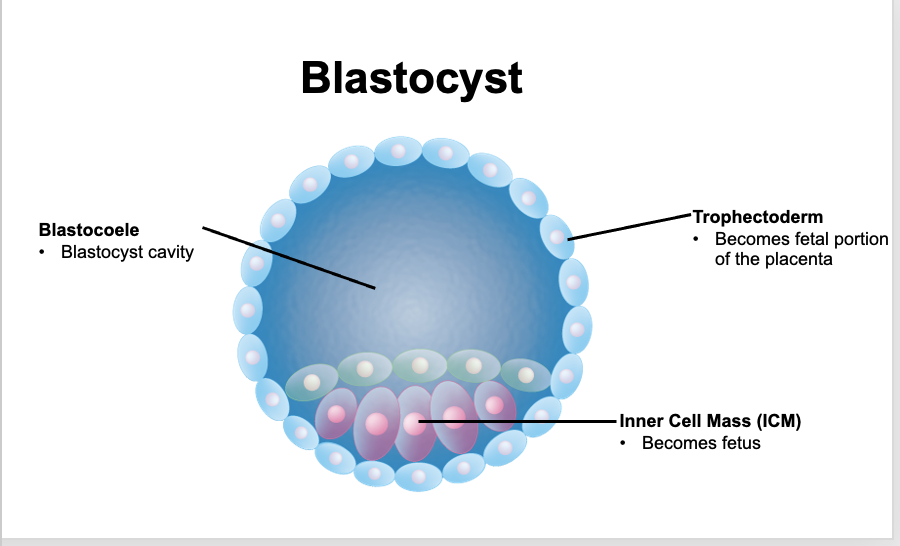
After 16 cell stage: morula forms (packed mass of cells) → blastocyst with inner cell mass (will become fetus) sitting in fluid pocket called blastocoel; edge of blastocyst cells are trophoblast (become placenta); around blastocyst is zone pellucida which blastocyst will hatch out of
Draw and describe parts of the blastocyst
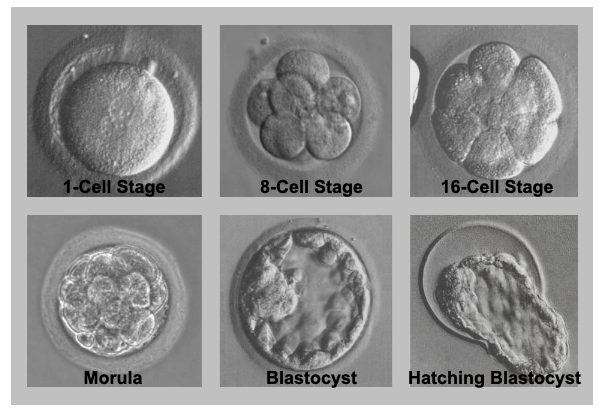
Embryonic development 6 stages - real life
What is pregnancy recognition?
Sign that varies among species that will prevent PGF2a production so preg will continue
What is each species preg recognition signal?
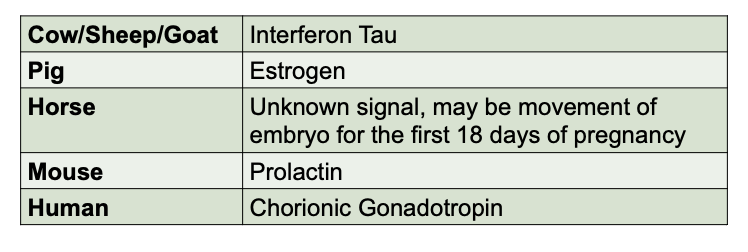
Placenta 4 functions?
Protection
Nutrition
Respiration
Hormone production
Types of placentas and animals?
Diffuse: horse, pig
Zonary: dog, cat
Cotyledonary: sheep/goat, cow
Discoid: primate, mouse, human
Animal species broad names
Horse: equine
Cow: bovine
Pig: swine
Sheep: ovine
Goat: caprine
Cotyledonary placenta features
Placentomes covering the chorion made up of cotyledon (fetal) and caruncle (maternal)
-Blood supply goes through these and they’re attached to endometrium
Non-invasive
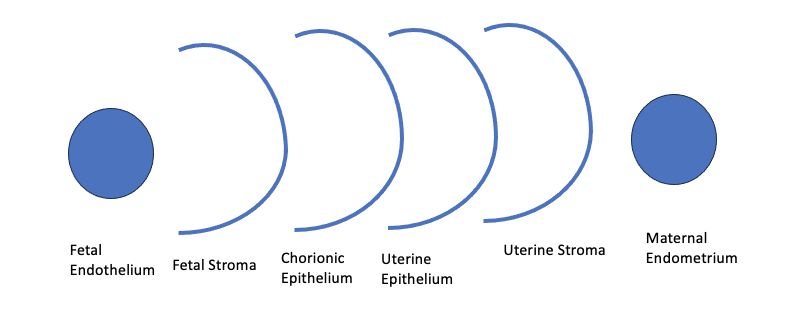
Epithelio-chorial: 6 layers of tissue between fetal and maternal blood supply
Cows (convex) and sheep (concave)
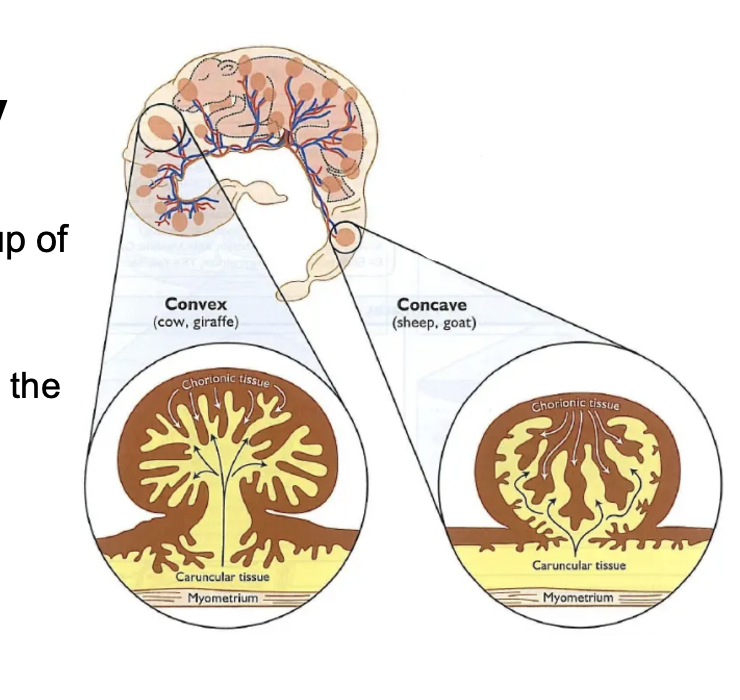
Explain convex and concave placentomes

Epithelio-chorial layers
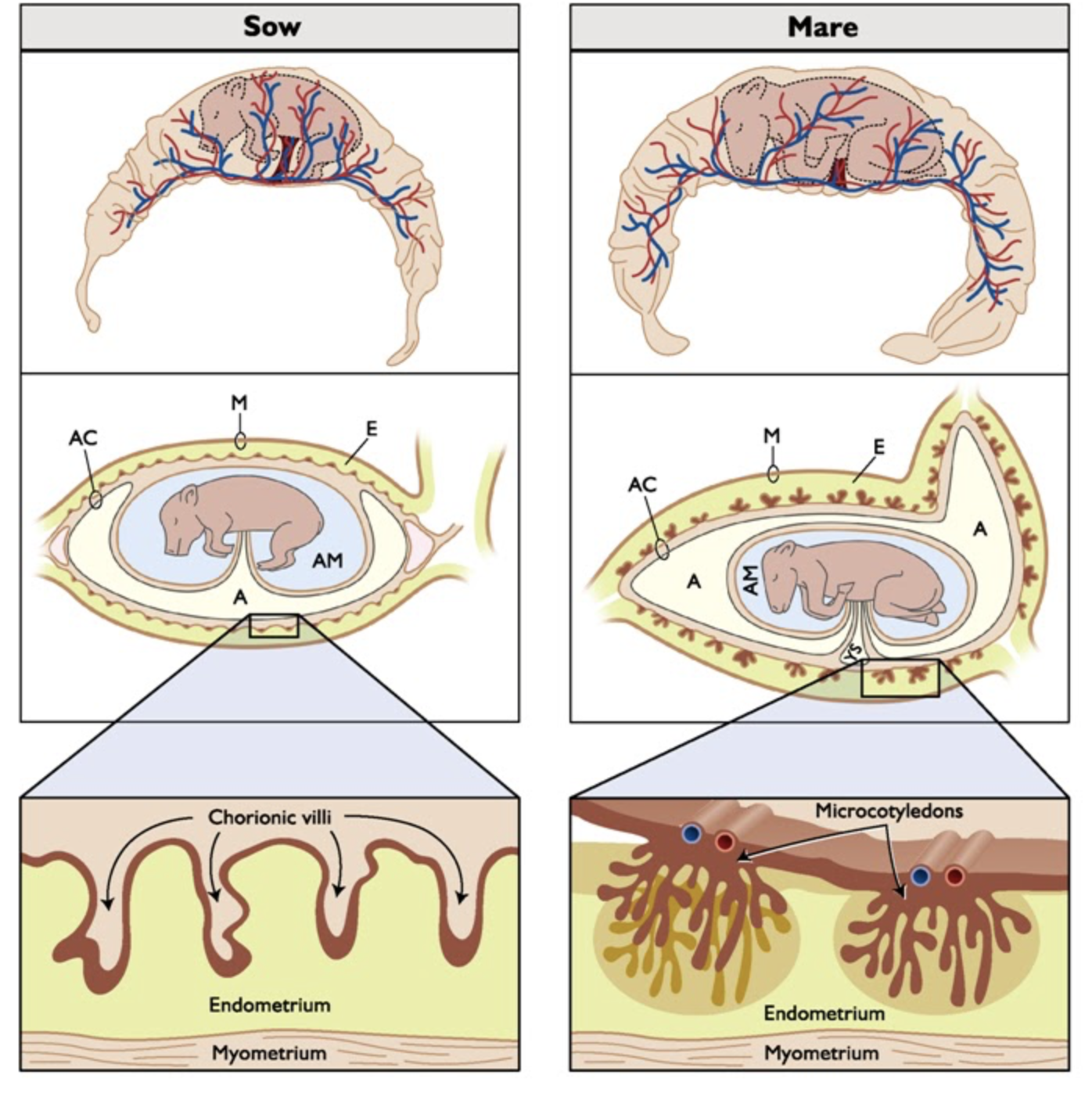
Diffuse placenta features
Velcros to maternal side of placenta (endometrium) with chorionic villi (where blood crosses over in pigs)
Entire surface of chorioallantois attached to endometrium
Chorionic villi = where blood crosses over in pigs
Horses have microcotelydans instead of chorionic villi, this is still where blood crosses over
Rugae: maternal side of placenta in pigs
Areola: fetal side of placenta in pigs
Epithelio-chorial: 6 layers of tissue between fetal and maternal blood supply
Pigs and horse
Zonary placenta features
Central belt/girdle contains blood vessels and attached to endometrium
-Only place where blood can cross over
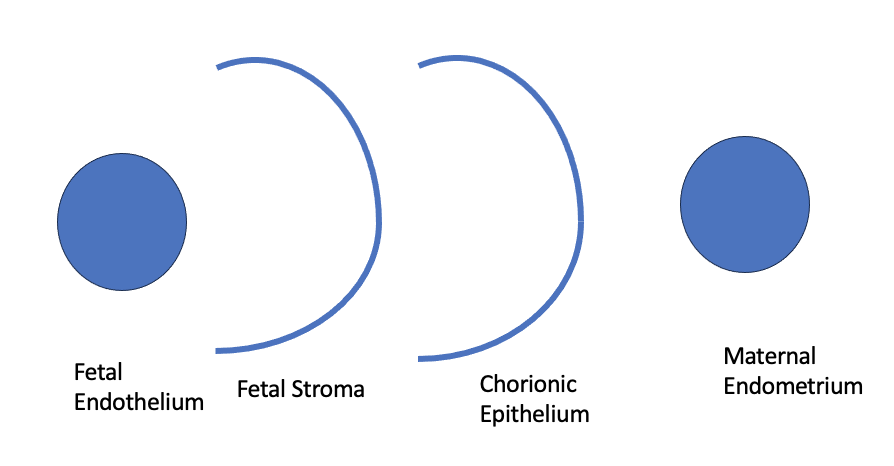
Endothelio-chorial: 4 layers of tissue between fetal and maternal blood supply
Cats and dogs
Endothelio-chorial layers
Discoid placenta features
Disc shaped placenta containing chorionic villi attached to maternal endometrium
Most invasive b/c burrows into maternal endometrium
Blood can only be transferred where the disc is, the placenta creates a large pocket of blood that the disc will float in
-All nutrients go through the disc, then through the umbilical cord, and into the fetus
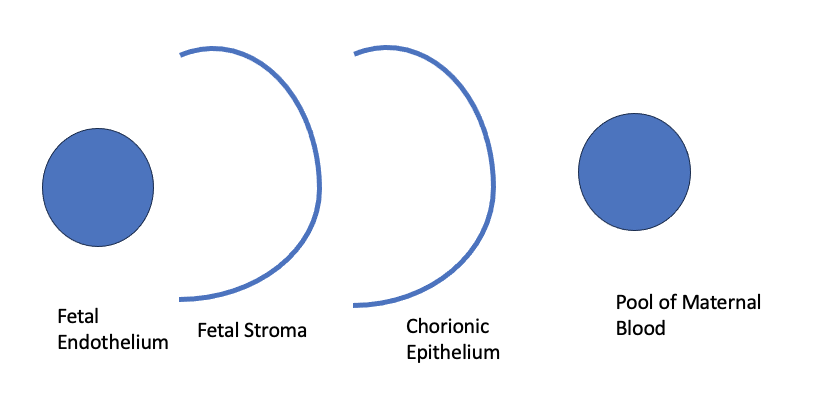
Hemochorial: 3 layers of tissue between fetal and maternal blood supply
Humans and rodents
Hemochorial layers
Which placenta is most and least efficient?
Most: discoid b/c fewer layers (3) for blood from mother to fetus to pass through
Least: cotyledonary or diffuse b/c more layers (6) nutrients have to travel between from mother to fetus
How do we estimate fetal age? Give cow age by animal sizes
Pigs and cows: crown-rump length
Cows: rectal palpation or ultrasound
-2 months: mouse
-3 months: rat
-4 months: small cat
-5 months: large cat
-6 months: medium (Beagle) sized dog
What is used to estimate fetal age for crown-rump length? Talk about rate of growth
Logarithmic chart
Fetal growth is slow in first 2/3 of gestation; grows quickly in last 1/3
-Energy requirement increases during last 1/3
Gestation durations? (7 species)
Elephants – 616 days (2 years)
Mare – 340 days (11 months)
Human – 284 days (9 months)
Cow – 282 days (9 months)
Ewe, Doe – 150 days (5 months)
Sow – 114 days (3 months, 3 weeks, 3 days)
Mice – 21 days – FAST!
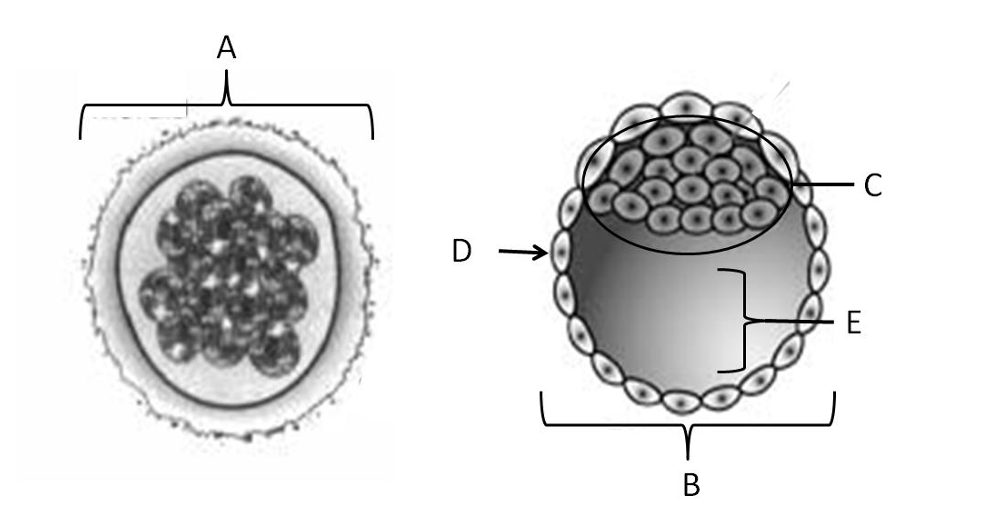
Label
A: Morula
B: Blastocyst
C: Inner Cell Mass (becomes fetus)
D: Trophectoderm (becomes fetal portion of placenta)
E: Blastocoele
What does crown-rump length suggest about energy requirements during gestation?
Low requirement prior to attachment and high energy needed during exponential growth phase in last 1/3 of gestation
Mammary Gland
How many glands on dairy cow and how many teats? Can milk pass between glands?
4 separate glands each with one teat
Milk that has been synthesized in one gland can't pass over into any other glands
How much does udder weigh?
100 lbs
Two ligaments?
Median suspensory ligament: divides the udder into right and left halves, and is located along the center of the udder, it can stretch as the gland fills with milk
Lateral suspensory ligament: acts as the "sling" around the udder, it provides support for the udder and doesn't stretch as the gland fills with milk
Milk is produced from what? How many alveoli per mammary gland?
Milk will be produced in epithelial cells that are grouped together in tiny storage units called alveoli are sac-like structures
Each mammary gland has millions of alveoli
Where does milk from alveoli go?
Empties into ducts which empty into larger ducts until eventually reaching the gland cistern
What is the gland cistern? Size? Location? Separated from teat cistern by what? What happens during milk letdown?
Largest storage area for milk
Located above the teat cistern at the base of the udder, it is separated from the teat cistern by the annular or cricoid fold
Gland cistern will fill rapidly during milk letdown
What is inside each teat? How much does it hold?
Inside each teat is a cavity called the teat cistern
Holds 0.5 to 1.5 ounces of milk
This is where milk will accumulate before being removed through the teat end during milking
Continuously refills during milking
What is located at the end of the teat? Size? Held together by what? Two functions?
Streak canal
1/4 to 1/2 inch in length
The streak canal is held closed by sphincter muscles
Functions:
To prevent the escape of milk between milkings
To act as a barrier to the entry of bacteria
Hormones related to milk
Prolactin: Promotes milk production
Oxytocin: Stimulates milk letdown
Catecholamines (Epinephrine and norepinephrine): inhibits milk letdown
Milk letdown response pathway
Teat stimulation → nerve impulse from the mammary gland via the spinal cord to the hypothalamus → oxytocin released from PP into blood → myoepithelial cells in mammary gland contract → force milk out of alveoli into lacteriferious ducts into gland cistern into teat cistern then out
How often are dairy cows milked per day? NCSU? What does more frequent milk removal do?
Most farms milk 2-3 times per day
NCSU Dairy Unit 2 times per day
More frequent milk removal can increase milk yield
Why is milking schedule important
Cows should follow a consistent milking schedule to minimize stress and maximize milk production
Milking process steps
Teats wiped with paper towel to remove loose soil → pre-dip solution on teats for at least 30 seconds then wiped off → hand milked quickly to open streak canal → attach milking machine that work with vacuum action (don’t undermilk or overmilk a cow so machines with an automatic take-off are an idea) → once the flow of milk drops below the threshold, usually 1.5-2.2 pounds, the milk claw will automatically detach → post-dip (iodine) to prevent mammary infections (most important part of mastitis prevention)
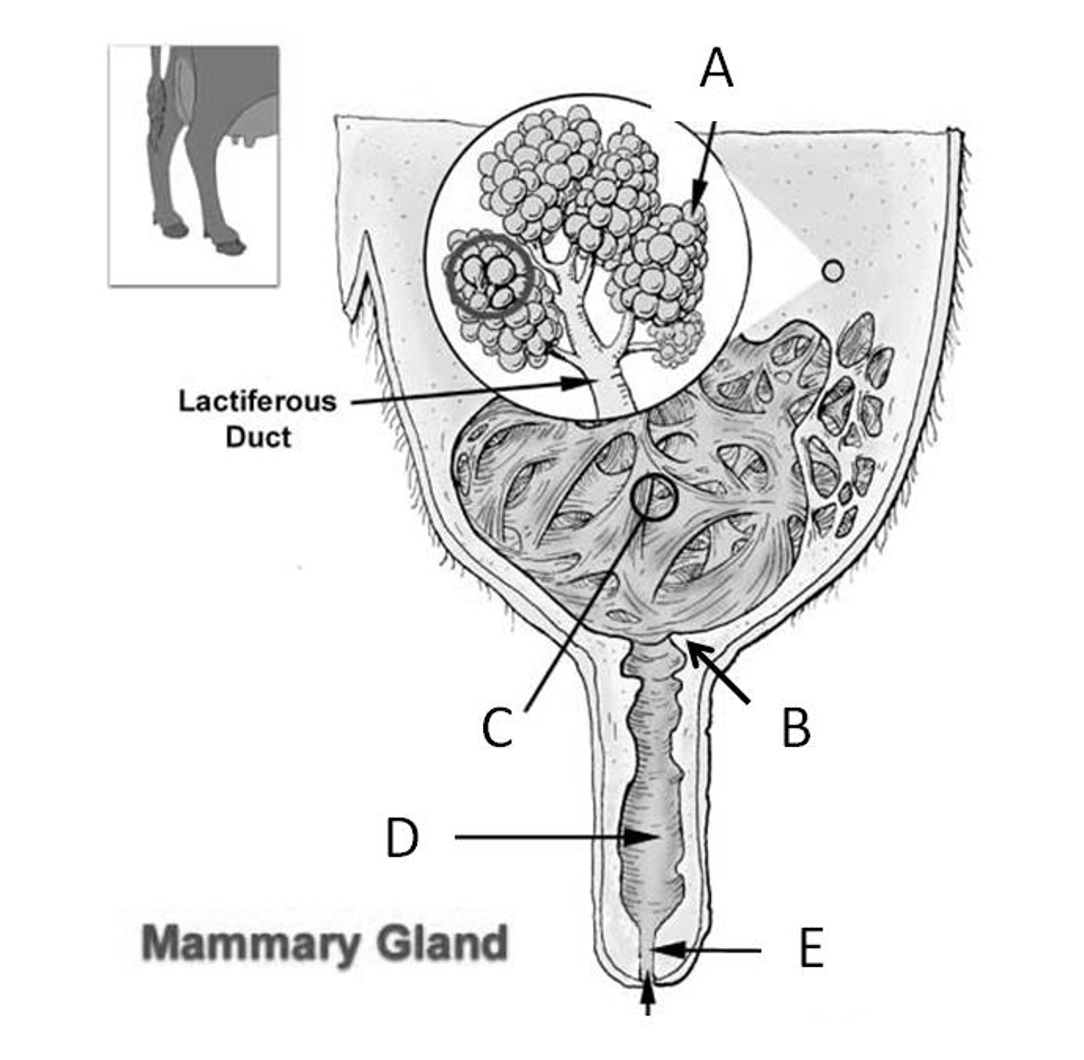
Label
A: Alveoli
B: Annular ring/annular fold/cricoid fold
C: Gland cistern
D: Teat cistern
E: Streak canal
Where is milk produced and stored?
Alveoli and gland cistern
Sows Parturition and Ultrasounding
Sow gestation length
Sows have an average gestation length of 112-114 days
Sow placenta type
Diffuse
Classification of piglets that die
Stillborn: die after day 100, or during farrowing
-Pre-partem stillborn: die before birth process (usually due to stress) (smaller/less vascular umbilical cord b/c not being used)
-Post-partem stillborn: die during birth process (usually due to dystocia)
Mummies: die in utero between day 45/50 and 90/100
-Partially reabsorbed by sow
-If all mummies are same size: acute stress event (vaccine?)
-If mummies vary in size: chronic stress (heat?)
Low viability: die after birth (usually runt)
NCSU Swine Unit Farrowing Schedule. How long do sows spend in farrowing room? When do they go into it and leave?
Week 1 - Wash sows and move into farrowing room prior to farrowing
Week 2 - Sows farrow and process piglets
Week 3 - Castrate piglets
Week 4 - Weaning
Based on this schedule, a sow spends about 1 month in the farrowing room, 1 week prior to farrowing and 21 days for lactation
How many gilts and sows will NCSU Swine Unit farrow in every group and how often?
Will farrow 50 gilts and sows in every group
They farrow one group a month
What is used to induce farrowing? Instead of what and why? When do they farrow after it? What is important to make sure about gestation date and it?
Lutalyse (PGF2a) is used instead of Oxytocin b/c the CL is responsible for maintaining pregnancy in sows; therefore, to induce farrowing we want to lyse all the CLs
Farrow within 24-30 hours after given Lutalyse
Make sure sows are as close to 114 days as possible before giving Lutalyse b/c giving Lutalyse too early can shorten the gestation length and cause a high incidence of stillborns
Signs prior to parturition (7)
Restlessness/nervousness/nesting (begins 24-48 hours prior to farrowing)
Refusal to eat (24 hours prior)
Milk present in nipples (12-24 hours prior)
Laying on her side, heavy "sighing" noises (12-18 hours prior)
Increased respiration rate (begins12 hours prior to farrowing and continues throughout labor)
Kicking or pawing at air while the sow is laying on her side (begins 4 hours prior and will precede birth of each piglet (sign of uterine contractions))
Bloody fluid will drain from the vulva (immediately before birth of a piglet)
When do most pre-weaning losses occur?
Most preweaning losses occur within the first 2 days of birth
When do we anticipate a new piglet
Every 15-20 minutes
Longer means we risk losing piglets to hypoxia in birth canal
What may be necessary if a sow is struggling?
To sleeve her and help remove piglets
Oxytocin may be used to increase uterine contractions
When are piglets weaned
21 days
Where are sows moved next and when do we expect them to come into estrous
Breeding barn
3-5 days post weaning
3 ways to pregnancy check
Detection of estrus with a boar
Progesterone concentrations 17-20 days after breeding
Use of ultrasound machines at day 35 and 56 after breeding
What does estrous with boar involve? What timeline is it done on?
21 day intervals
Simple and quick
Boar walks down aisle in front of sows
-If sow is in estrus and not preg she will exhibit sexual receptivity signs and that means she will need to be rebred
What does determining progesterone concentrations involve?
Effective but expensive
Catching and bleeding animals so labor intensive
Stressful on animals during critical embryo survival time
Preg animals will have higher P4 concentrations than non-preg 17-21 days after breeding
Using ultrasound
Initial investment is expensive
Reliable
Ultrasound for the first time at day 35 (first pregnancy recognition signal) and at day 56 as this is 21 days after day 35 (average estrous cycle length is 21 days)
What culling policy does the NCSU swine unit have
3 chances to get pregnant - if not they are culled
What do you have to be careful with when ultrasounding?
You’re checking for a fluid filled cavity so be careful as a full bladder can give a false positive reading
What does NCSU use vs other farms
At NCSU, the ultrasound machine uses sound waves that are sent out from and then return to a probe then these messages are turned into a visual picture of the reproductive tract
Some farms may use a doppler machine which can detect pregnancy even earlier (around days 25-35)
How accurate is ultrasound?
Very experienced technician using real-time ultrasonography will be accurate around 90% of the time
How to read ultrasound
Hollow organs: dark circles
Solid tissue (bone): will show up as white or gray streaks; will be a very bright object
Bladder: very large, dark, fluid filled object
Follicles: smaller, dark, fluid filled circles
Nonpregnant: dense gray circles that look like a doughnut if the sow is open, it will be very bright and have no fluid pockets
Pregnant: smaller dark fluid filled circles (fetuses)
Dystocia presentation types
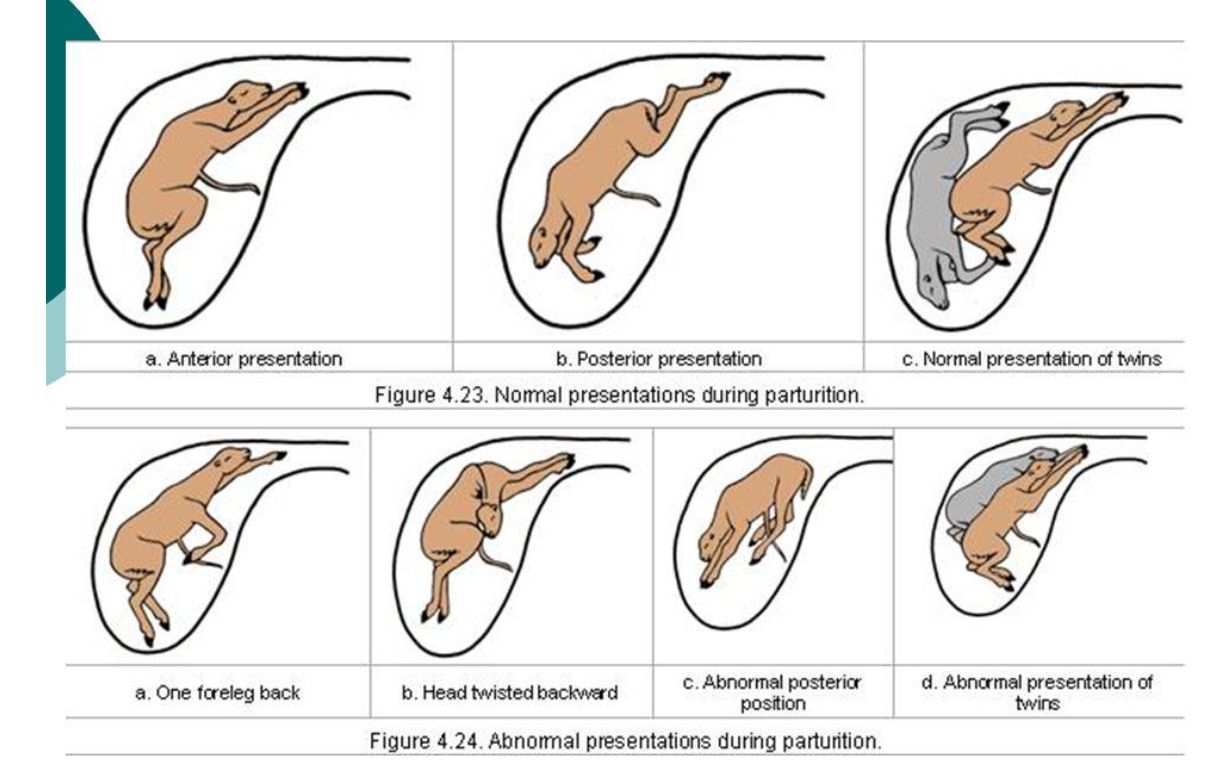
Parturition Preparatory Stage 1
Uterine contractions
Rotation of fetus
Dilation of cervix
Fetal Expulsion Stage 2
Chorioallantois ruptures
-Water breaking
-Lubrication
Fetus forced through birth canal
-Abdominal and uterine contractions
-Remains in amnion
Rupture of amnion
Delivery of fetus
Umbilical cord severed
Delivery of Membranes Stage 3
Chorionic villi loosen and detach
Afterbirth is shed
Retained placentas (especially in ruminants)
-Early delivery
-Disease or vitamin/mineral imbalances
-Twins/triplets
-Can lead to hemorrhage, infection/sepsis
Pregnancy Diagnosis in Ruminants
Ruminant Gestation Length
282 - 284 days (9 months)
Most common preg diagnosis method in cattle?
Rectal palpation
How to perform rectal palpation? Equipment? What is the first thing you feel?
Shoulder length sleeve covered with lubricant (dispose of between cows)
Slowly insert arm into rectum and the first thing you will feel is the pelvic ridge
Pelvis is an excellent landmark for the palpator as it can help determine orientation and location
Then feel for a fetus
How early can preg be detected? And how?
An very experienced palpator can detect pregnancy as early as 28-30 days in cattle by feeling for the either the amniotic vesicle, the fetal membrane slip, or the fetus in the uterus
Advantage and disadvantage of doing preg check so early?
Advantage: identify non-pregnant cattle sooner and go ahead and rebreed them
Disadvantage: can accidentally cause the slipping of the amniotic vesicle which can disturb the implantation, resulting in pregnancy loss
Why do we palpate through rectum instead of vagina
We can rupture the cervical plug allowing bacteria and pathogens to enter the uterine body which can cause termination of the pregnancy
What does ruminant blood preg test check for
Presence of Pregnancy Specific Protein B (or PSPB) produced by the binucleated cells of the trophectoderm
Cattle gestation length
282-284 days
Semen Evaluation, Capacitation, and Body Condition Scoring
Which species has the easiest semen to preserve?
Cattle, especially dairy cattle, are the leading species where AI is used so a lot of research has been focusing on preserving cattle semen
What percent of each species use AI
Turkeys: 100% (all fresh)
Dairy cattle: 95%
Swine: 80% (mostly fresh)
Horses and Beef Cattle: 5%
Chickens: 0%