Lighting Exam 2 study guide
0.0(0)
Studied by 5 people Call Kai
 Learn
Learn Practice Test
 Spaced Repetition
 Match
Match Flashcards
 Knowt Play
Card Sorting
1/44

Earn XP
Description and Tags
Last updated 5:43 PM on 4/5/23
Name | Mastery | Learn | Test | Matching | Spaced | Call with Kai |
|---|
No analytics yet
Send a link to your students to track their progress
45 Terms
1
New cards
In lighting, there are 5 metrics we use to describe lighting. Check all that apply.
### Exitance, flux, illuminance, luminance, and intensity
2
New cards
The density of light (or illuminance) on a given surface is a function of the ______ __and__ _______ of the light source from the surface.
Distance and angle
3
New cards
calculate the illuminance given the following room/luminaire parameters:
Space Dimensions: Width = 20', Length = 10', Height = 8'
Luminaires: 6 downlights. Each downlight has an output of 1200lumens that end up on the floor.
Space Dimensions: Width = 20', Length = 10', Height = 8'
Luminaires: 6 downlights. Each downlight has an output of 1200lumens that end up on the floor.
E=36fc
4
New cards
select the best option listed below for a Light Loss Factor:
0\.85
5
New cards
calculate the illuminance given the following room/luminaire parameters:
Space Dimensions: Width = 20', Length = 10', Height = 8'
Worksurface/Table Height = 3'
Luminaire: We have an accent light directly over the 3' high table. The accent light has a center beam candle power of 1,500 candelas.
Space Dimensions: Width = 20', Length = 10', Height = 8'
Worksurface/Table Height = 3'
Luminaire: We have an accent light directly over the 3' high table. The accent light has a center beam candle power of 1,500 candelas.
E=60fc
6
New cards
Lumen
light output (total amount of light emitted from a light source)
7
New cards
Are more lumens brighter or dimmer than less lumens?
brighter
8
New cards
What does the wattage of a light source NOT tell you
how bright the light is
9
New cards
if lumens are the same…
…wattages will vary
10
New cards
If wattages are the same…
…lumens will vary
11
New cards
Footcandle (FC)
1 ______ is equal to the light produced by one candle at a distance of 1ft away
12
New cards

Luminous Flux
13
New cards

Luminance
14
New cards

Luminous intensity
15
New cards

Illuminance
16
New cards
Luminous Flux
time rate of flow of light
17
New cards
Luminous Intensity
amount of flux (lumens) contained within a solid angle
18
New cards
Illuminance
Flux (or lumens) falling on a surface per unit area
19
New cards
Exitance
luminous flux density leaving a surface
20
New cards
What are the 2 ways to reflect light?
Specular and Lambertian
21
New cards
Luminance
Amount of light leaving a surface in a given direction
22
New cards
Small sources produce a…
higher chance of glare
23
New cards
Bigger sources produce…
less glare
24
New cards
Inverse square law
Light is inversely proportional to the square of the distance from the source of light
25
New cards
What is the inverse square law used for?
To calculate the intensity of any distance
26
New cards
Cosine law for illuminance
The illumination of a surface is directly proportional to the cosine of the angle between the normal to the surface and the direction of incident light
27
New cards
How do you know to use the cosine law for illuminance formula?
Includes a degree for an angle
28
New cards
what is the lumen method calculation used for?
Calculate the light level in a room
29
New cards
==calculate the illuminance given the following room/luminaire parameters:== \n Space Dimensions: Width = 20', Length = 10', Height = 8’ \n Luminaires: 6 downlights. Each downlight has an output of 1200lumens that end up on the floor.
E=36FC
30
New cards
\
calculate the illuminance given the following room/luminaire parameters: \n Space Dimensions: Width = 20', Length = 10', Height = 8’ \n Target Illuminance = 50fc \n Luminaires: If there are 8 downlights – ==how many lumens per downlight?==
calculate the illuminance given the following room/luminaire parameters: \n Space Dimensions: Width = 20', Length = 10', Height = 8’ \n Target Illuminance = 50fc \n Luminaires: If there are 8 downlights – ==how many lumens per downlight?==
1,250 lm/downlight
31
New cards
==calculate the illuminance given the following room/luminaire parameters:== \n Space Dimensions: Width = 20', Length = 10', Height = 8’ \n Worksurface/Table Height = 3’ \n Luminaire: We have an accent light directly over the 3' high table. The accent light has a center beam candle \n power of 1,500 candelas.
E=60FC
32
New cards
\
Instead of solving for Illuminance ( E ), we know we need \n 100fc candles at the table so what is the intensity of light we would need to reach that footcandle. \n Space Dimensions: Width = 20', Length = 10', Height = 8’ \n Worksurface/Table Height = 3’ \n Target Illuminance = 100fc \n Luminaire: ==What is the required intensity of light?==
Instead of solving for Illuminance ( E ), we know we need \n 100fc candles at the table so what is the intensity of light we would need to reach that footcandle. \n Space Dimensions: Width = 20', Length = 10', Height = 8’ \n Worksurface/Table Height = 3’ \n Target Illuminance = 100fc \n Luminaire: ==What is the required intensity of light?==
I=2500cd
33
New cards
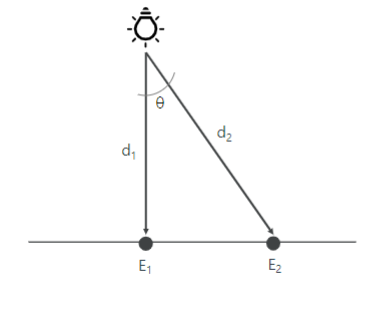
\
In the image drawn, solve for E1 and E2 with the given parameters. \n Intensity of Light = 1500cd \n Cos() = cos(36.87) = 0.8 \n d1 = 4m \n d2 = 5m
In the image drawn, solve for E1 and E2 with the given parameters. \n Intensity of Light = 1500cd \n Cos() = cos(36.87) = 0.8 \n d1 = 4m \n d2 = 5m
E1=93.75 lux
E2=48 lux
E2=48 lux
34
New cards
What is considered the longest day of the year?
Summer solstice
35
New cards
Is the sun higher in the sky during the winter or the summer?
summer
36
New cards
Horizontal light shelves help to minimize direct light into the space and allow light to bounce further into the space. Which orientation do horizontal light shelves have the biggest benefit.
South
37
New cards
Which of the following lighting metrics has the following definition: 'Flux (or Lumens) falling on a surface per unit area' and unit of measure is Footcandle(fc) or Lux(lx).
Illuminance
38
New cards
In studying the Inverse Square Law and Cosine Law we know from the light source, the illuminance is directly proportional to which two factors:
Distance and angle
39
New cards
Which of the following lighting metrics is defined as : 'Amount of light leaving a surface in a given direction' or the perceived brightness.
Luminance
40
New cards
If two light sources have the same lumen output, but the aperture of once source is 4" and the aperture of the other sources is 12". Which light source is going to have a higher chance of glare?
4” light source
41
New cards
If two different light sources(LED and incandescent) have the exact same lumen output (600lm), will they also use the same amount of wattage?
No, the wattages will be different
42
New cards
Benefits of daylight:
Sustainable, natural world connection (circadian rhythm), human benefits, etc.
43
New cards
Daylight hazards:
Heat gain, glare and contrast, damage to belongings, excessive window light, sunburn, etc
44
New cards
Light reflectance value
measures the amount of visible light that reflects from or absorbs into a painted surface
45
New cards
What are common luminaire symbols used for?
Identifying devices on a blueprint or wiring diagram layout