Chemistry ch. 9 vocabs
 Call Kai
 Learn
Learn Practice Test
 Spaced Repetition
 Match
Match Flashcards
 Knowt Play
1/43

There's no tags or description
Looks like no tags are added yet.
Name | Mastery | Learn | Test | Matching | Spaced | Call with Kai |
|---|
No analytics yet
Send a link to your students to track their progress
44 Terms
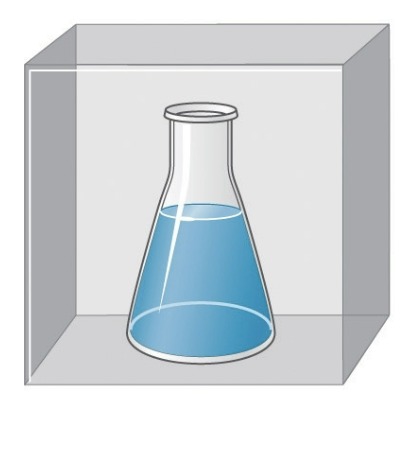
system (sys.)
part of the universe that is our focus
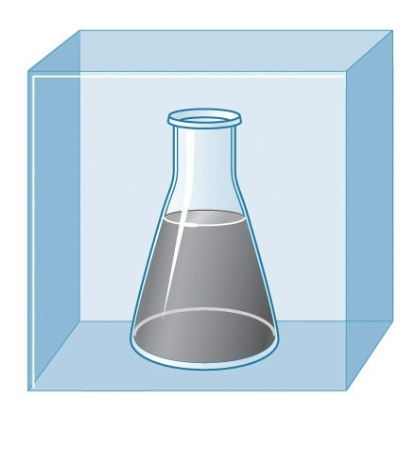
surroundings (surr.)
everything else (around the sys.)
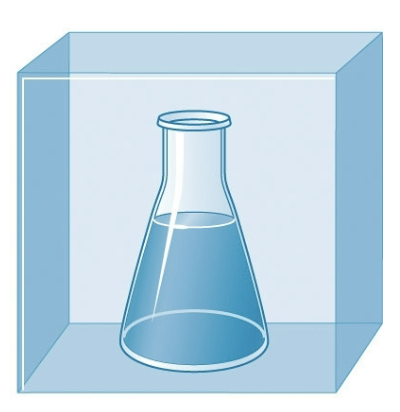
universe
system + surroundings
what are the types of systems in thermochemistry?
isolated system
closed system
open system
what occurs in terms of matter and energy in a isolated system?
nothing, b/c the sys. is isolated, there’s no additional exchange in matter or energy w/ the surroundings
what occurs in terms of matter and energy in a closed system?
there’s a exchange of energy w/ the surroundings; there’s no exchange with matter b/c the system is closed therefore we (surrounding) cannot add or take out any matter from the system.
what occurs in terms of matter and energy in a open system?
both an exchange of matter and energy w/ the surrounding
Energy
capacity to do work(w) or to produce heat(q)
what unit is Energy in?
units of Joules(J)
what are the different broad types of energy?
potential
kinetic
what is potential energy?
energy of position
What are the subunit energies in potential energy?
gravitational
chemical
What increases potential energy?
if w is done to change the position of an object in a field, then its potential E increases
what are some examples that would increase potential energy?
your body in the earth’s gravitational field; when you climb a flight of stairs you DO WORK, and your potential energy increases
What decreases potential energy?
if NO w is done to change the position of an object, the potential energy of the object decreases
what are some examples of decrease in potential energy?
(in chemistry) when two oppositely charged materials come together d/t attractive forces, the potential energy decreases (b/c the bond is from attractive that occurred naturally)
what is kinetic energy?
the energy an object possesses d/t its motion
What are the subunit energies in kinetic energy
thermal
mechanical
electrical
what increases KE?
increase in mass (kg)
increase in speed (velocity; v²)
increase in temperature
falling/descending
what decreases KE
decrease in mass (kg)
decrease in speed (v²)
decrease in temperature
moving upward (going against gravity loses speed → KE decreases → doing work to move up → KE converts to potential energy
work (w)
force acting over distance
heat (q)
energy transfer b/w two objects b/c of a difference in temperature
heat capacity
energy required for a certain change in temperature
specific heat capacity (Csp)
energy required to heat ONE GRAM of a substance by 1˚C (or 1K)
molar heat capacity (Cn)
energy required to raise the temperature of ONE MOLE of a substance by one degree
internal energy (U)
total of all energy present in a substance
sum of kinetic (q) and potential (w) energies of all the “particles” in the system
First Law of Thermodynamics
energy of the universe is constant
energy can be transferred within the universe, but it is neither created nor destroyed
energy is conserved
∆U = q + w
heat of reaction (Hrxn)
heat exchanged b/w sys and sure during a chemical rxn
what types of heats of reaction are there in thermochemistry
endothermic rxn
exothermic rxn
what are ways to determine heats of reaction?
Calorimetry
bomb calorimeter
coffee cup
what’s held constant for a bomb calorimetry?
Volume
what’s held constant for a coffee cup calorimetry?
Pressure
state function
property of the system that only depends on its present state
what are some simplified examples of state function?
two lines labeled, X and Y are drawn on Mt.K to show that both route has the SAME change in elevation (state function, b/c it doesn’t matter what path you take, you’ll have traveled the same elevation); but they have very DIFFERENT distances traveled (not state function; depends on the path)
Hess’ Law
∆H is the same whether a run takes place in one step or in a series of steps (as long as initial and final states are the same)
standard states
states that aa substance is at standard conditions (p=1 atm; T is usually. specified as 25˚C)
spontaneous process
occurs w/o outside intervention
non-spontaneous
requires outside intervention (typically spontaneous in reverse direction
Entropy (S)
a measure of molecular disorder, randomness, or energy dispersal within a system
Second Law of Termodynamics
in any spontaneous process, there is always an increase in the disorder (entropy) of the universe
reversible rxn
takes place I a infinite number of infinitesimally small steps; sys Is at eq. at each step
irreversible rxn
processes carried out in finite time, all real processes are irreversible, no eq
Third Law of Thermodynamics
the entropy of a pure, perfect crystal at 0K is zero
if S=0, then W=1
Gibbs Free Energy
energy ‘free’ (available) to do useful work