Pharmacotherapy of Antifungal Agents 1
 Call Kai
 Learn
Learn Practice Test
 Spaced Repetition
 Match
Match Flashcards
 Knowt Play
 Podcast
1/34

There's no tags or description
Looks like no tags are added yet.
Name | Mastery | Learn | Test | Matching | Spaced | Call with Kai |
|---|
No analytics yet
Send a link to your students to track their progress
35 Terms
Candida species general susceptibilities
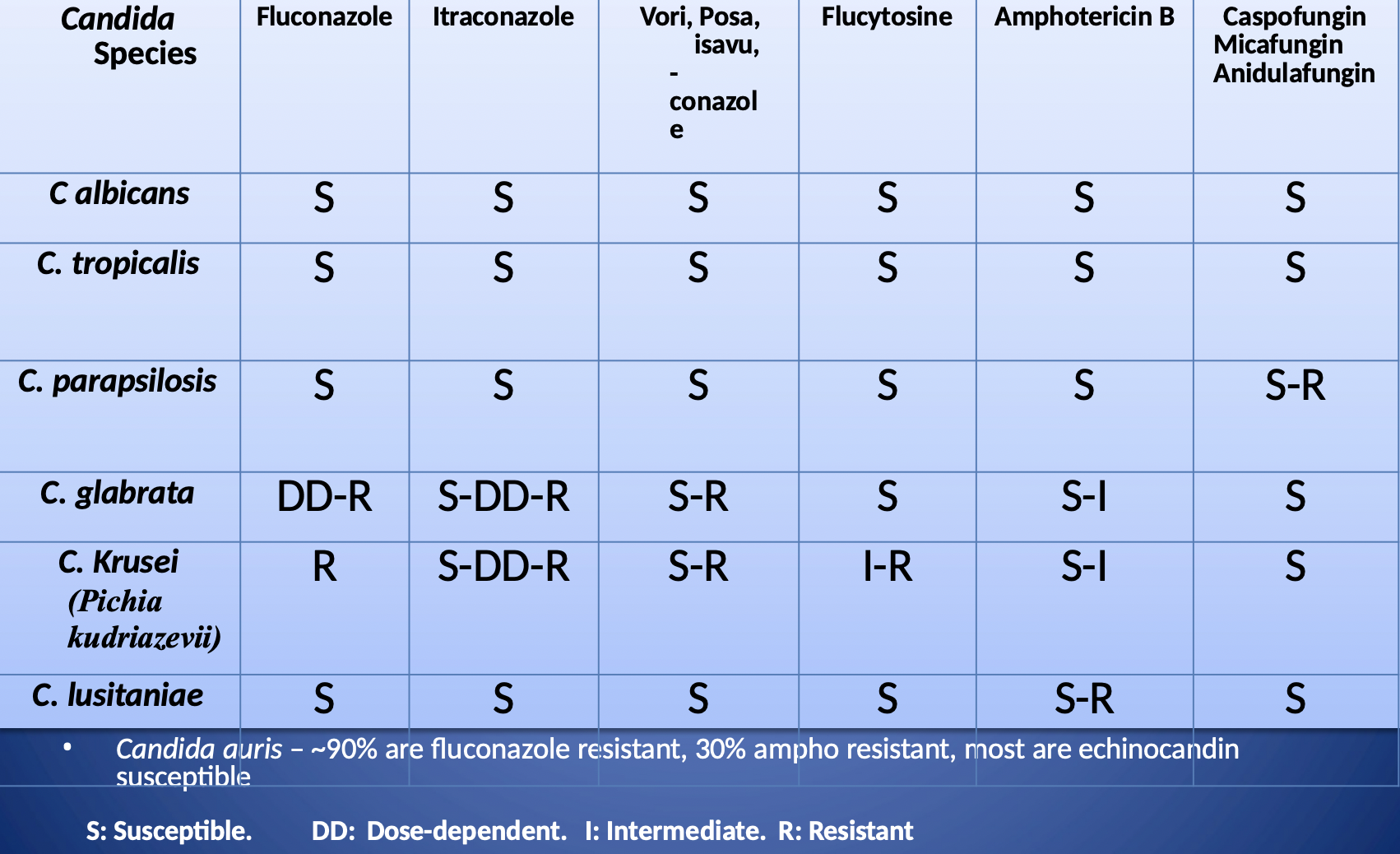
Which candida species are pretty much resistant to everything?
C. glabrata
susceptible to Flucytosine
C. Krusei (Pichia kudriazevii)
Both are susceptible to Echinocandins tho!
What are the different fungal forms?
Unicellular (yeasts)
Single cells, spherical, with rigid cell wall
Filamentous (molds)
Filaments called hyphae; collectively called mycelium
Hyphae are septate (partitioned) or non-septate
Dimorphism
May exist as yeast (>37 degrees C) or as mold
What are characteristics of yeasts?
Round, oval, smooth appearing flat colonies that reproduce by budding
What are characteristics of molds?
Fuzzy appearing, growth through branching
What are characteristics of dimorphic fungi?
Can exist as yeast or mold depending on the environment
What are differences between bacteria and fungi?
Bacteria
Resistance develops rapidly
Fungi
Resistance is stable over time - species predicts susceptibility
What are systemic fungal species?
Infections that invade the internal organs
May be caused by primary pathogens or opportunistic pathogens (require debilitated host)
Regardless of pathogen, infection is more marked and serious in immunocompromised hosts
Systemic mycoses increasing because of more, and more highly immunocompromised patient populations (bone marrow and solid organ transplant, immunomodulatory therapy, etc)
What are some characteristics of Amphotericin B?
Broadest spectrum agent covering:
Candida spp (but not super effect for C. lusitaniae)
Aspergillus (Except Aspergillus terreus)
Cryptococcus spp
Endemic fungi
Mucor
Fungicidal
No dose adjustments needed for renal/hepatic dysfunction
What are some adverse effects associated with Amphotericin B?
Renal toxicity
Electrolyte wasting (Mg, K)
Infusion-related reactions first 3-5 days (fevers, chills, rigors, thrombophlebitis)
Lipid formulations shown to have less renal toxicity compared to Ampho deoxycholate!!!
Liposomal amphotericin (Ambisone)
Lipid complex (Abelcet)
What are drug interactions with amphotericin B?
Avoid with other nephrotoxic agents (tacro, cyclosporine, AGs)
Digoxin: potential for hypokalemia
Amphotericin is the drug of choice for ____ in ____ patients:
Drug of choice for invasive candidiasis in pregnant patients!
What are the triazoles?
ketoconazole (Nizoral®)
itraconazole (Sporanox®)
fluconazole (Diflucan®)
voriconazole (Vfend®)
posaconazole (Noxafil®)
isavuconazole (Cresemba®)
What does Itraconazole (Sporanox) cover?
Endemic fungi
Candida spp with dose-dependent susceptibility or resistance to C. glabrata and C. krusei
Aspergillus spp.
What are adverse effects of Itraconazole?
Peripheral neuropathy
N/V
Increased LFTs (monitor LFTs with all -azoles)
Hypokalemia
Increased triglycerides
Rash
Negative inotropic effect
What is Itraconazole contraindicated with?
STATINS!
Except Pravastatin
CYP3A4 substrate and inhibitor (avoid PPIs and H2RA)
What’s special about the dosing of Itraconazole?
All formulations require a loading dose!
What does Fluconazole cover?
Candida species EXCEPT
C. glabrata (dose-dependent)
C. krusei (Pichia kudriazevii)
Cryptococcus
Endemic fungi
What’s special about Fluconazole?
The only -azole that has Renal dose adjustments
Least likely to have DIs
GOOD urinary penetration
What are adverse effects/monitoring of Fluconazole?
Generally well tolerated
Some N/V, increased LFTs, HA, reversible alopecia
Monitor: LFTs! rash, QT interval
Pregnancy cat. C (ok to use one time dose)
What does Voriconazole cover? (what is the main use of Voriconazole)
Drug of Choice for Aspergillus!
Candida spp. (incl. C. krusei) with dose-dependent susceptibility or resistance to C. glabrata
Fusarium spp. and Scedosporium spp.
What are adverse effects/monitoring/DIs of Voriconazole?
AEs
Visual disturbances (phototopsia, hallucinations), hepatoxicity, skin rash
Photosensitivity
Prolonged QT interval & Torsades
Periostitis
Monitor: LFTs, renal function, visual function
Avoid IV formulation in patients with CrCl < 50 mL/min
What is one specific population Voriconazole is contraindicated in?
PREGNANCY!!!
What does Posaconazole cover?
Candida spp. (incl. C. krusei) with dose-dependent susceptibility or resistance to C. glabrata
Aspergillus spp.
Mucor
Endemic fungi
What is the random drug interaction Posaconazole has?
Cyclosporine
It increases Cyclosporine levels so must decrease dose
What do we monitor in Posaconzole? Pregnancy?
Monitor: LFTs, PO intake, diarrhea, K, Mg, Ca
Pregnancy category C
What does Isavuconazole cover?
Candida spp. Aspergillus spp. (second line1 )
Cryptococcus, Scedosporium,
Mucor,
endemics
Indicated for invasive aspergillosis and mucormycosis
What are AEs/DIs/monitoring of Isavuconazole?
AEs
Nausea, hepatotoxicity, CNS effects (seizure)
Drug interactions: CYP3A4
Rifampin, Atorvastatin, immunosuppressants
Mild P-gp inhibitor
Monitor: LFTs, K, Mg
Teratogenic and embryocidal
What are the echinocandins?
anidulafungin (Eraxis®)
micafungin (Mycamine®)
caspofungin (Cancidas®)
rezafungin (Rezzayo®)
“All pretty much the same”
What do echinocandins cover?
Primary role: Candida species
Including azoleresistant, variable activity against C. parapsilosis)
Aspergillus
Is fungicidal!!!
What are adverse effects/monitoring of Echinocandins?
Increase in liver enzymes!!!
Monitor: LFTs, CBC
Distributes well to major organ sites
Does not significantly penetrate urinary tract
What does Flucytosine (5-FC) cover?
Primarily adjuvant therapy in cryptococcal meningitis
Candida spp (Except c. krusei)
What is special about Flucytosine?
Dosing adjustment is required for renal dysfunction!
not given as monotherapy!
Contraindicated in pregnancy!
What are adverse effects of Flucytosine?
Rash, diarrhea
Liver toxicity
Hematologic toxicity (related to serum concentration >100 mg/L)
Can cause bone marrow suppression!
What is Ibrexafungerp (Brexafemme) used for? What’s special about it?
Vulvovaginal candidiasis
Contraindicated in pregnancy!