Magnetic Materials

0.0(0)
Studied by 0 people
call kaiCall Kai
learnLearn
examPractice Test
spaced repetitionSpaced Repetition
heart puzzleMatch
flashcardsFlashcards
GameKnowt Play
Card Sorting

1/12

encourage image

There's no tags or description

Looks like no tags are added yet.

Last updated 10:51 AM on 6/2/26
Name
Mastery
Learn
Test
Matching
Spaced
Call with Kai

No analytics yet

Send a link to your students to track their progress

13 Terms

1
New cards

What do the letters of MAZE stand for?

  • Magnetostatic Energy

  • Magnetocrystalline Anisotropy Energy

  • Zeeman Energy

  • Exchange Energy

2
New cards

What does the M in MAZE stand for and what does it mean?

Magnetostatic Energy

  • Magnets resist being magnetised

  • Interaction of a magnet with its own demagnetising field

  • Due to the magnetisation inside and outside the magnet having to go from north to south, the magnetisation inside the magnet has to go the antiparallel direction to the magnetising field.

  • This means the field is trying to demagnetise the magnet, this is called the “demagnetising fieldHd

  • Shape anisotropy is where the shape of the magnet determines its energy. If the magnet is magnetised along the short axis, there will be more poles and a higher Hd, that’s why magnets are usually magnetised along the long axis (think bar magnet)

3
New cards

What does the A in MAZE stand for and what does it mean?

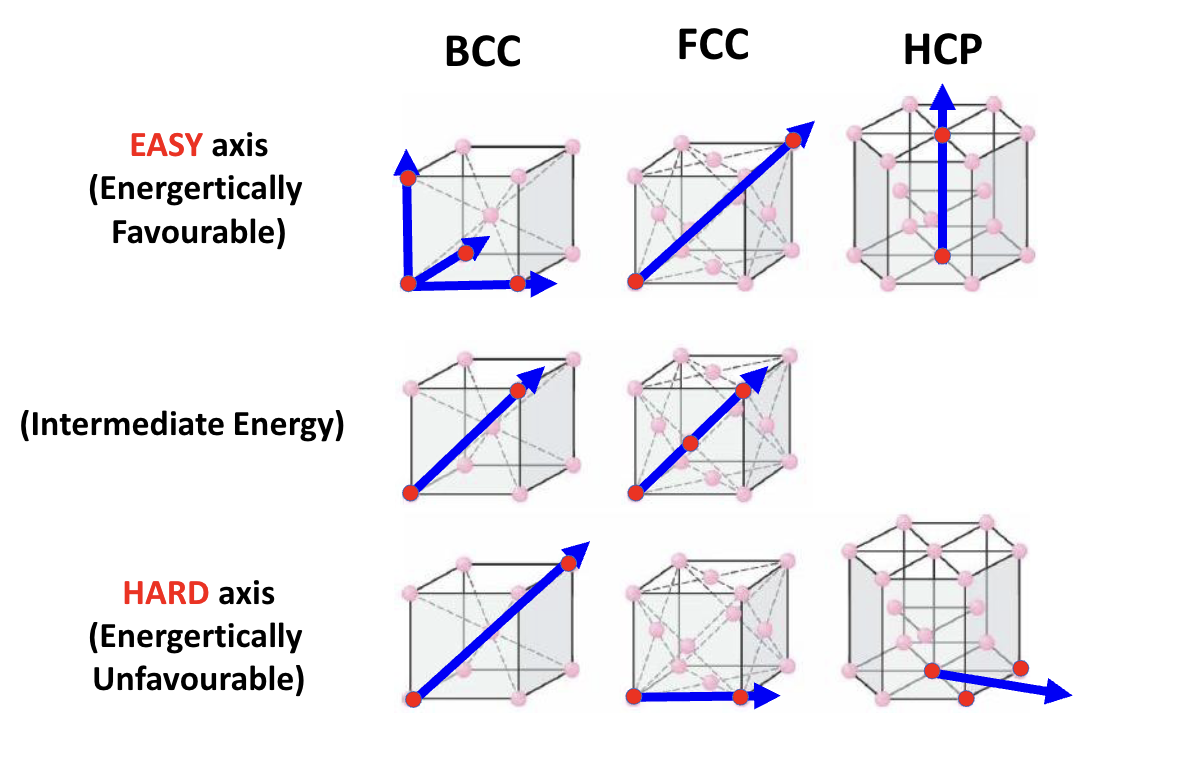
Magnetocrystalline Anisotropy Energy

  • Magnetic moments try to align along the easy axis

  • Interaction of magnetic moments with the crystal lattice, making certain crystal directions energetically favourable

  • There is a preference of which direction the material magnetises along. A less strong field is required to magnetise the material along the easy axis.

  • Therefore, Magnetocrystalline Anisotropy energy is minimised by magnetising along the easy axis

  • The longer the distance that it has to magnetise along, the harder it is

  • If anisotropy is induced, it will (usually) be uniaxial (akin to in HCP) so there will be 90° between the easy and hard axis
<p>Magnetocrystalline <strong>A</strong>nisotropy Energy</p><ul><li><p>“<strong>Magnetic moments try to align along the easy axis</strong>”</p></li><li><p><span><strong> Interaction of magnetic moments with the crystal lattice, making certain crystal directions energetically favourable</strong></span></p></li><li><p>There is a preference of which direction the material magnetises along. A less strong field is required to magnetise the material along the easy axis.</p></li><li><p>Therefore, Magnetocrystalline Anisotropy energy is <strong>minimised by magnetising along the easy axis</strong></p></li><li><p>The <strong>longer</strong> the distance that it has to magnetise along, the <strong>harder</strong> it is</p></li><li><p>If anisotropy is <strong>induced</strong>, it will (usually) be <strong>uniaxial </strong>(akin to in HCP) so there will be 90° between the easy and hard axis</p></li></ul><p></p>
4
New cards

What does the Z in MAZE stand for and what does it mean?

Zeeman Energy

  • Interaction of magnetic moments with external applied fields

  • The interaction of a magnet with external magnetic fields

  • High energy if field is antiparallel to field magnetisation

  • Low energy if field is parallel to field magnetisation

  • At high magnetic fields, Zeeman Energy dictates the magnet’s behaviour
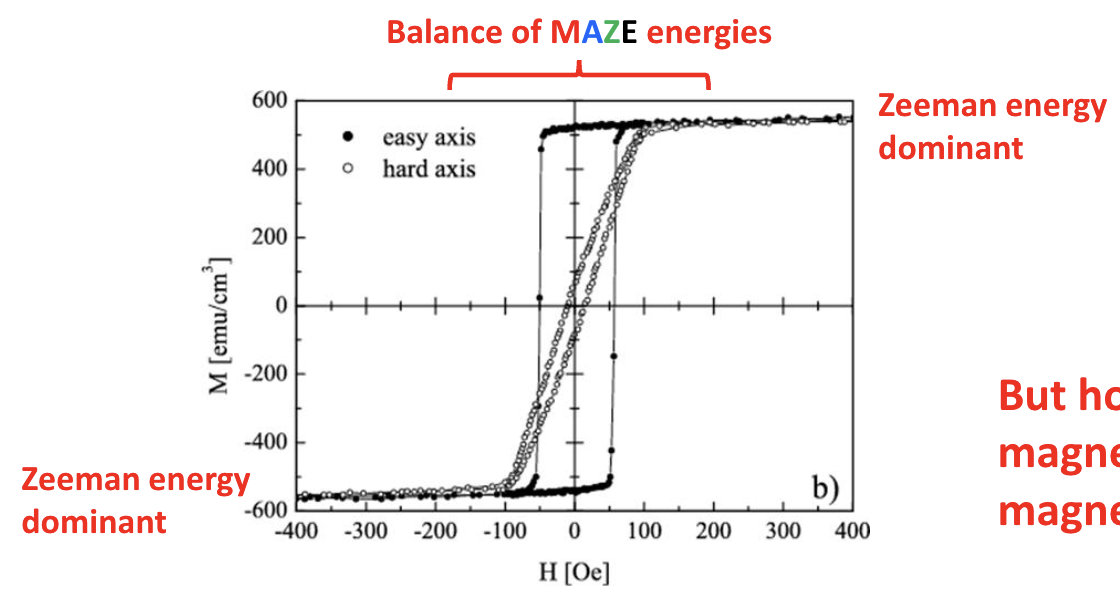
<p><strong>Z</strong>eeman Energy</p><ul><li><p><span><strong>Interaction of magnetic moments with external applied fields</strong></span></p></li></ul><ul><li><p>The interaction of a magnet with external magnetic fields</p></li><li><p><strong>High energy</strong> if field is <strong>antiparallel</strong> to field magnetisation</p></li><li><p><strong>Low energy</strong> if field is <strong>parallel</strong> to field magnetisation</p></li><li><p>At high magnetic fields, Zeeman Energy dictates the magnet’s behaviour</p></li></ul><p></p>
5
New cards

What does the E in MAZE stand for and what does it mean?

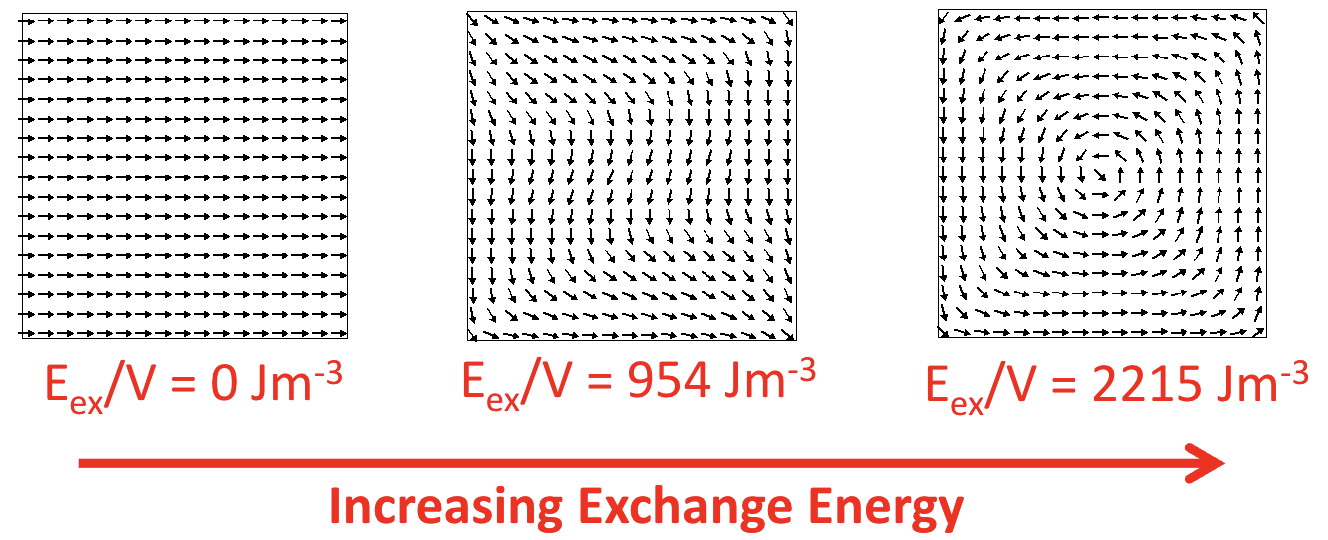
Exchange Energy

  • Magnetic moments try to stay aligned parallel to each other

  • quantum mechanical interaction causing ordering of adjacent magnetic moments

  • The higher the disorder of the alignments of the atoms’ magnetic moments are, the higher the exchange energy, Eex, is

  • If Jex > 0, parallel alignment is favoured (ferromagnetism), if Jex < 0, antiparallel alignment is favoured (antiferromagnetism or ferrimagnetism)

  • Other MAZE energies prefer non-uniform states so exchange energy causes domain walls change over 10nm instead of instantly

  • Aex controls its strength

<p><strong>E</strong>xchange Energy</p><ul><li><p>“<strong>Magnetic moments try to stay aligned parallel to each other</strong>”</p></li><li><p><span><strong>quantum mechanical interaction causing ordering of adjacent magnetic moments</strong></span></p></li></ul><ul><li><p>The <strong>higher the disorder</strong> of the alignments of the atoms’ magnetic moments are, the <strong>higher the exchange energy</strong>, E<sub>ex</sub>, is</p></li><li><p>If J<sub>ex</sub> &gt; 0, parallel alignment is favoured (ferromagnetism), if J<sub>ex</sub> &lt; 0, antiparallel alignment is favoured (antiferromagnetism or ferrimagnetism)</p></li><li><p>Other MAZE energies prefer non-uniform states so exchange energy causes <strong>domain walls change over 10nm instead of instantly</strong></p></li><li><p>A<sub>ex</sub> controls its strength</p></li></ul><p></p>
6
New cards

How does a magnet reverse its magnetisation?

Mechanism 1: Magnetisation Rotation

Mechanism 2: Domain Nucleation

Mechanism 3: Domain Wall Motion

7
New cards

Mechanism 1 of reversing magnetisation

Mechanism 1: Magnetisation Rotation

  • Large volume of magnetisation coherently rotates

  • Example: reversal of magnetisation along hard axis

    • High H in hard axis direction forces magnetisation along hard axis

    • H=0, magnetic moments are aligned antiparallel along easy axis → M=0
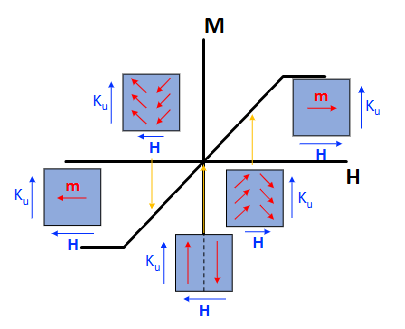
<p>Mechanism 1: Magnetisation Rotation</p><ul><li><p>Large volume of magnetisation coherently rotates</p></li><li><p>Example: reversal of magnetisation along hard axis</p><ul><li><p>High H in hard axis direction forces magnetisation along hard axis</p></li><li><p>H=0, magnetic moments are aligned antiparallel along easy axis → M=0</p></li></ul></li></ul><p></p>
8
New cards

Mechanism 2 of reversing magnetisation

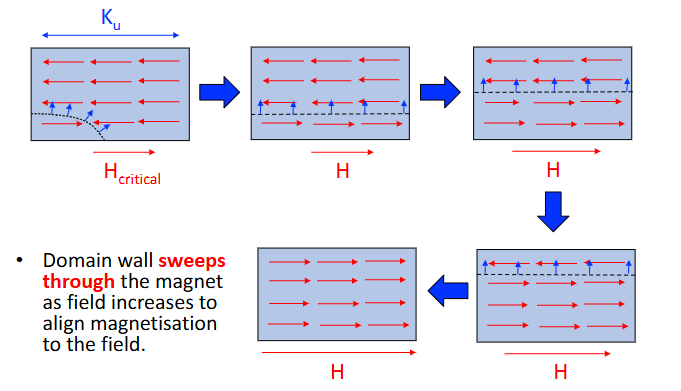
Mechanism 2: Domain Nucleation

  • Increasing field opposite to the magnets direction of magnetisation can cause abrupt, irreversible nucleation of magnetic field

  • This occurs at HCritical

  • Occurs at “weak points” such as defects or material edges
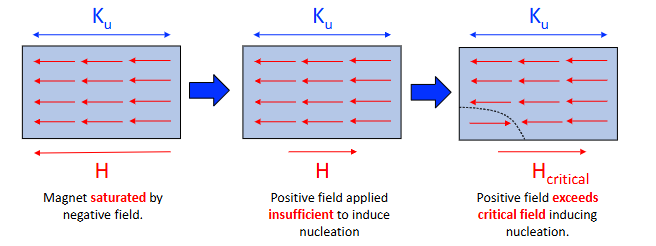
<p>Mechanism 2: Domain Nucleation</p><ul><li><p>Increasing field opposite to the magnets direction of magnetisation can cause abrupt, irreversible nucleation of magnetic field</p></li><li><p>This occurs at H<sub>Critical</sub></p></li><li><p>Occurs at “weak points” such as defects or material edges</p></li></ul><p></p>
9
New cards

Mechanism 3 of reversing magnetisation

Mechanism 3: Domain Wall Motion

  • Occurs after domains are created by nucleation

  • Expand by domain wall motion

<p>Mechanism 3: Domain Wall Motion</p><ul><li><p>Occurs after domains are created by nucleation</p></li><li><p>Expand by domain wall motion</p></li></ul><p></p>
10
New cards

What are all of the types of magnetism?

1. Diamagnetism

2. Paramagnetism

3. Ferromagnetism

4. Antiferromagnetism

5. Ferrimagnetism

(ordered to aid memorisation)

11
New cards

Explain magnetism 1

1. Diamagnetism

  • Occurs in all atoms but is weak so only measurable when individual atoms carry no magnetic moment

  • Weak negative susceptibility

  • Electrons moving (current) through magnetic field generate an EMF, EMF is opposed by generating magnetic moment in opposition to the field

  • Occurs to all electrons in substance causing overall - M

  • Independent of temperature

  • Superconductors are perfect diamagnets
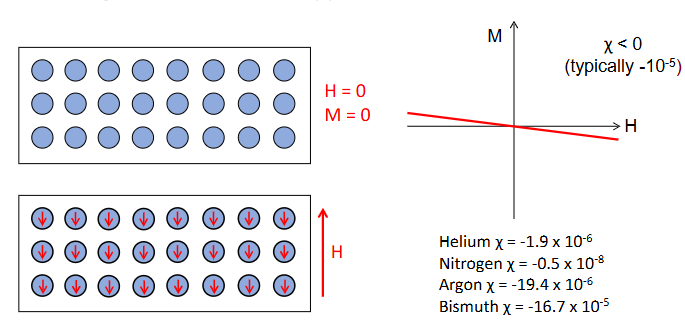
<p><strong>1. Diamagnetism</strong></p><ul><li><p>Occurs in all atoms but is weak so only measurable when <strong>individual atoms carry no magnetic moment</strong></p></li><li><p><strong>Weak negative susceptibility</strong></p></li><li><p>Electrons moving (current) through magnetic field generate an EMF, EMF is opposed by generating magnetic moment in opposition to the field</p></li><li><p>Occurs to all electrons in substance causing overall - M</p></li><li><p>Independent of temperature</p></li><li><p>Superconductors are perfect diamagnets</p></li></ul><p></p>
12
New cards

Explain magnetism 2

2. Paramagnetism

  • Weak positive susceptibility

  • Individual atoms are weakly magnetic

  • As H increases, the magnetic moments of individual atoms align causing M to increase

  • M saturates when magnetic moments are all aligned

  • Increasing temperature increases the disorder in the atoms so reduces M
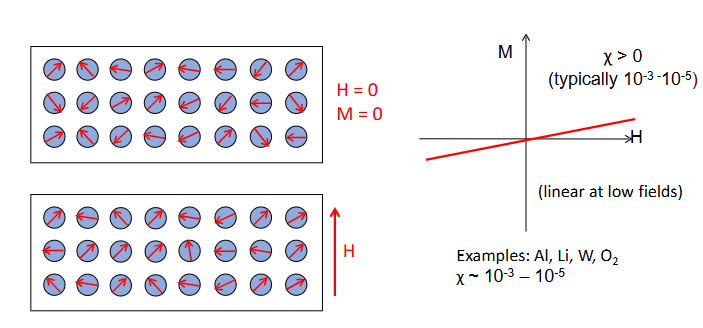
<p><strong>2. Paramagnetism</strong></p><ul><li><p><strong>Weak positive susceptibility</strong></p></li><li><p>Individual atoms are weakly magnetic</p></li><li><p>As H increases, the <strong>magnetic moments of individual atoms align</strong> causing M to increase</p></li><li><p>M saturates when magnetic moments are all aligned</p></li><li><p><strong>Increasing temperature</strong> increases the disorder in the atoms so <strong>reduces M</strong></p></li></ul><p></p>
13
New cards

What is the difference between soft and hard magnets?

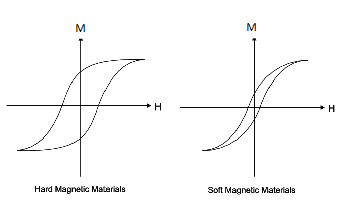
Soft:

  • Easy to change direction of magnetisation

  • High susceptibility

  • Readily form multidomain states

Hard:

  • Hard to change direction of magnetisation

  • High magnetocrystaline anisotropy constant, K, values

  • Low susceptibility

<p>Soft: </p><ul><li><p>Easy to change direction of magnetisation</p></li><li><p>High susceptibility</p></li><li><p>Readily form multidomain states</p></li></ul><p></p><p>Hard:</p><ul><li><p>Hard to change direction of magnetisation</p></li><li><p>High magnetocrystaline anisotropy constant, K, values</p></li><li><p>Low susceptibility</p></li></ul><p></p><p></p>