Lectures 1, 2 (Intro + Membrane Voltage)
 Call Kai
 Learn
Learn Practice Test
 Spaced Repetition
 Match
Match Flashcards
 Knowt Play
1/71

There's no tags or description
Looks like no tags are added yet.
Name | Mastery | Learn | Test | Matching | Spaced | Call with Kai |
|---|
No analytics yet
Send a link to your students to track their progress
72 Terms
Behavioral Neuroscience
The study of the biological and neural mechanisms underlying human and animal behavior ; Neural basis of behavior
Behavior → learning → changes in brain /nervous system → decisions → behavior
what are the 2 major types of cells in the brain?
10% neurons
90% glial cells
neuron
Specialized type of cell that can generate fast electrical impulses (action potentials) or spikes designed to transmit information throughout the body using electrical and chemical signals. As the fundamental unit of the nervous system, they receive, process, and transmit data to muscles, organs, and other neurons
Action potential
rapid, temporary reversal in electrical charge across a cell membrane (from roughly -70mV to +30mV and back) that transmits signals in neurons and muscle cells. It acts as an "all-or-nothing" nerve impulse, driven by sodium rushing into the cell and potassium rushing out
AKA neural signlaling
glial cells (neuroglia)
non-neuronal support cells in the nervous system that provide essential physical maintenance, chemical insulation, and metabolic support to neurons
do not carry electrical pulses, but are crucial for repairing damage, producing myelin, and managing NTs to keep brain functioning
immune responses of nueorns, blood brain barrier, different functions
Schwann cells
specialized glial cells in the peripheral verous system (PNS) that insulate and protect nerve fibers (axons). They are essential for speeding up nerve signal transmission and playing a critical role in repairing damaged nerves
Myelination: Many Schwann cells wrap around an axon layer by layer to form a fatty, insulating substance called the myelin sheath.
Nerve Regeneration: If a peripheral nerve is injured, Schwann cells act like a scaffold.
Ogliodendrocytes
oligodendrocytes perform a similar insulating role in the central nervous system (the brain and spinal cord). Additionally, while one oligodendrocyte can insulate multiple axons at once, a single myelinating Schwann cell wraps around only one segment of a single axon
digital computing
algorithmic manipulation of symbols (AMOS) - the foundational process of computing where input symbols (numbers, letters, or data) are transformed into new output symbols using predefined rules or algorithms. It includes logical reasoning and data restructuring, spanning from simple mathematical calculations (like algebra) to complex Artificial Intelligence (symbolic AI) that models human reasoning
neurocomputing
function approximation with neurons (FAWN) : neural networks -the process of using artificial neural networks to estimate an unknown underlying mapping (function) between inputs and outputs. By adjusting internal weights and biases during training, networks can approximate complex continuous functions. This enables models to generalize from data, rather than needing to know the exact mathematical function
modeling tasks as functions
any task or problem can be formulated as a Function F, that takes one list of numbers X as its input and produces another list of numbers Y as its output
nervous system
the body’s primary communication, control, and regulatory network, responsible for sending electrical and chemical signals between the brain and body. It controls voluntary movements, involuntary functions (like breathing), and mental processes, including thoughts and memory, using billions of neuro
dendrites
treelike arborizations that receive signals from other neurons
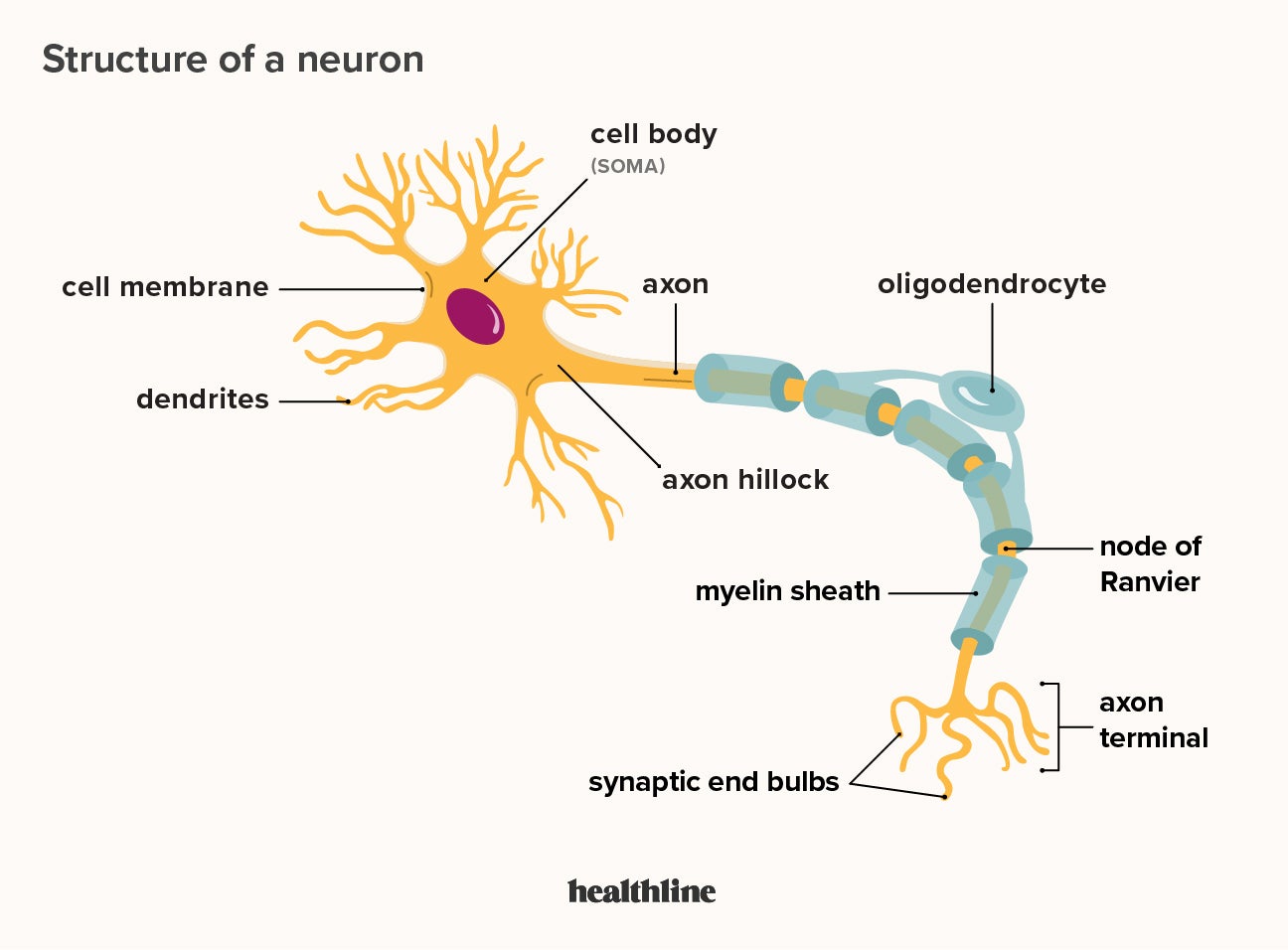
soma
cell body containing the nucleus
cell nucleus
the command center of a eukaryotic cell, housing all of your DNA
* acts like the cell’s brain, storing genetic instructions and coordinating vital activities such as growth, metabolism and reproduction (cell division)
axon
long branched cable that sends signals to other neurons, which is sometimes surrounded by a myelin sheath
axon terminals (synaptic boutons)
tips of axon branches from which NT is released onto target cells
axon hillock
the cone-shaped region where a neuron's cell body (soma) transitions into its axon

how does info flow for neurons
father or neuroscience. - santiago ramon y cajal
info flows from dendrites to the soma, then along the axons to other neuroons
the McCulloch Pitts Model of the Neuron
Y = W1X1 + W2X2 +… + W(n)X(n)
Central NS vs Peripheral NS
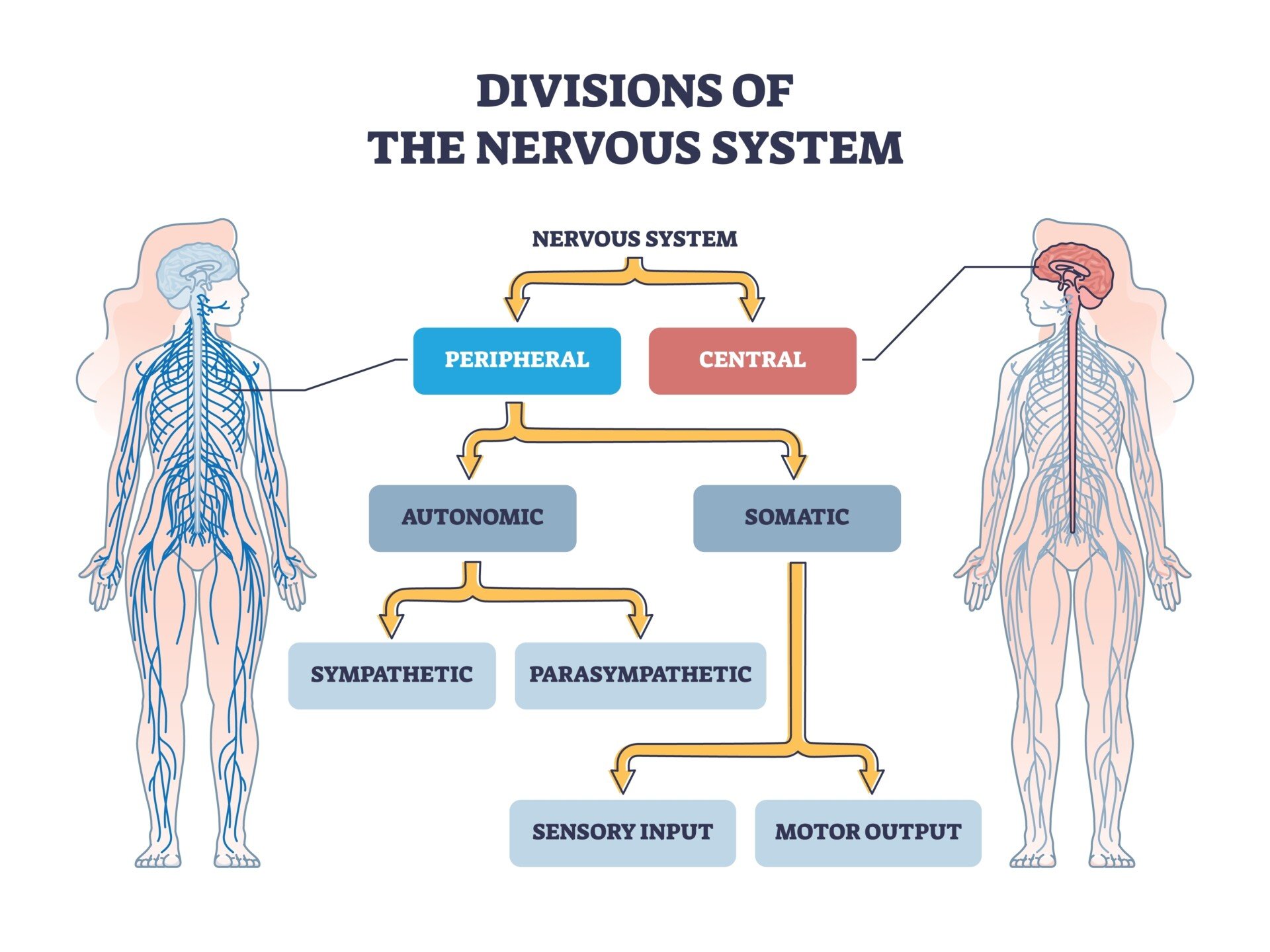
The central nervous system (CNS) = the command center
brain and spinal cord
contains ogliodendropglia cells (inhibits regeneration)
peripheral nervous system (PNS) = the nerves and ganglia outside the brain and spinal cord
serves as the communication network, relaying messages between the CNS and the rest of the body. Together, they govern all bodily functions, movements, and sensations
scwann cells (promote nerve regen)
the NS portable ocean
evolution - move sea to land, bring sea water (CSF)
brain = cerebrum
brain and spianl cord are wrapped in 3 layers of protective membrane called meninges
dura mater (thick outer)
arachnoid (sponge middle)
pia mater (thin inner)
teh whole CNS is floating in CSF, has a chemcial compostion similar to seawater
meningisis
inflammation of the meninges
bacterial infection
fatal
the ventricular system
CSF is constantly manufactured by choroid plexus
resides in hollow tubes and cavities called ventricles that run throughtout the CNS
voltage
difference in electrical charge btw 2 locations
transmembrane voltage = Vm
Vm = C(in) - C(out)
C in = postive charge inside the membrane
C out = postive charge outside the memrbane
we measrue the charge inside of the memrbane
what are the 3 types of ions ?
Monovalent cations: positively charged ion with one more proton than electron (Na+, K + )
Divalent cations : positively charged ion with 2 more protons than electrons (Ca 2+, Mg 2+)
Monovalent anions: negatively charged ion with one more electron than proton (CI-)
what is an ion?
an atom or molecule with a net electric charge due to the loss or gain of one or more valence electrons. Because the number of electrons no longer equals the number of protons, ions are charged particles.
resting ion gradients
when a neuron is not firing Aps or being stimulated, its at rest
the reesting potential is -55 to -80mV, the inside of the cell more negatively charged than outside
selectively permeable ion channels (leak channels)
Many ion channels are generally selectively permeable to only one (or two) types/species of ion
always/permanently open and there are a lot of leak potassium channels == potassium -> free movement
Not a gated channel that can be opened or closed, its a permanently open little hole for the sodium/K+
ion channels
are pores in the cell membrane that allow ions to pass in or out of the cell
made of complex proteins
chemcial force
particle dissovled in solution will diffuse through teh solution until they are evenly distributed
diffusion can be imaged as a chem force, HIGH —> LOW concentraion
Semipermeable membrane = only some particle can go thru, particlaes that cannot pass will diffuse on one side.
CONCENTRATION GRADIENT
electrical force
determined by
membrane potnetial (+ / - )
ion charge (cation/ anion)
electricla froce always pushes an ion toward the side that has opposite charge
cation —> negative charge
anion —> postive
if zero = not move
driving force
the sum of the 2 forces taht push on the ion (electricla and chem)
manitude and direction of both
driving force = the bigger of teh two
electrochemcial equilibrium
chem equilibrium = concentration of ion equal on both sides (chemical force zero bc diffused)
electrical = total charge (summed over all ions) is equal on both sides
combind = driving force = 0
electircl and chem forces are 0
they are equal and oppostie
Membrane potential
teh difference in electirc potentail btw the cytoplasm (inside) and the extracellular fluid (exterior of cell)
Equilibrium potentials of major ions
ion wants membrane/cell at its own EP
if membrane only permeable to one ion, then the Vm will be close
if two, then convererge, relative permeability of each ion
Types
Ek = -80mV
ENa = +60mV
E Cl = -90mV
ECa = +120 mV
aka reversal potentail
Synaptic Integration (step 1)
when a neuron converts a list of No.s (vector) into a single number (scalar)
*
the scalar is the Vm (the membrane voltage stored at soma)
Vm = X1W1+X2W2 +…+XnWn + b (Vrest)
memrbane voltage at rest
presyn neuron releases NT…
the amount of NT = X (postive quantity)
x = 0 , 0 NT released
if the input is active (X1>0) then Vm is depolarized if the input synapse is excitatory (W1>0) and hyperpolarized if the input synapse is inhibitory (W1<0)
Excitatory synapse
depolarization makes the Vm (membrane potential)
( Step 2) activation function