6.5 Policies to Correct Current Account Imbalances
 Call Kai
 Learn
Learn Practice Test
 Spaced Repetition
 Match
Match Flashcards
 Knowt Play
1/32

There's no tags or description
Looks like no tags are added yet.
Name | Mastery | Learn | Test | Matching | Spaced | Call with Kai |
|---|
No analytics yet
Send a link to your students to track their progress
33 Terms
What is the government’s main objective regarding the current account
To maintain a stable current account (credits = debits) and avoid excessive deficits or surpluses.
- If export revenue equals import spending, the country avoids international debt and can still afford foreign goods.
Why is a stable current account important (4)
Prevents unsustainable deficits → avoids rising foreign debt
2. Avoids excessive surpluses → prevents overvaluation of currency
3. Supports economic growth and employment in export industries
4. Maintains confidence in the domestic currency
Why might a government tolerate a current account deficit in the short run (2)
A deficit may be acceptable if it results from importing more raw materials and capital goods that support future production.
It also allows the country to consume more than it produces in the short run.
Why might a government encourage a current account surplus (2)
A surplus raises export revenue relative to import spending, which can boost aggregate demand and provide funds to repay external debt.
What is fiscal policy
Government decisions on spending and taxation.
How can contractionary fiscal policy reduce a current account deficit
Contractionary fiscal policy (higher income tax and lower government spending) reduces households’ disposable income, lowering demand for imports and domestically produced goods.
- Reduced domestic demand may also encourage firms to export more, helping narrow the deficit.
How can expansionary fiscal policy reduce a current account surplus
Expansionary fiscal policy (lower income tax and higher government spending, e.g., on pensions) increases consumer expenditure. Higher spending leads to more imports, and some goods may be diverted away from exports to the home market. This helps reduce a current account surplus.
Why are fiscal policy measures unlikely to correct current account imbalances in the long run
Once policy changes end, households and firms usually return to previous spending habits, including import levels. Therefore, fiscal policy tends to have only short‑term effects on the current account.
What are the drawbacks of using fiscal policy to influence the current account (3)
Higher taxes reduce demand, potentially causing unemployment and slower economic growth.
2. Higher taxation can create disincentive effects, which may reduce aggregate supply.
3. Fiscal measures can have undesirable side effects on the wider economy.
One short sentence on the evaluation of fiscal policy.
Short-term effectiveness but may reduce growth and employment.
What is monetary policy
Central bank control of interest rates and money supply.
How can reducing the growth of the money supply affect the current account
Reducing money‑supply growth may lower spending on imports, helping to reduce a current account deficit — but it is difficult for governments to control the money supply precisely.
How can interest rate cuts affect a current account deficit
Lower interest rates may depreciate the exchange rate, making exports more competitive and reducing imports. This can help narrow a current account deficit — but it may also create inflationary pressure.
How can raising interest rates influence the current account
Higher interest rates reduce consumer spending, lowering demand for imports and reducing inflation. However, they may appreciate the exchange rate, making imports cheaper and possibly worsening the current account.
How can expansionary monetary policy reduce a current account surplus
A government may raise the money supply and cut interest rates to increase consumer spending. Higher spending increases imports and may also lead to an appreciation of the exchange rate, helping reduce a surplus.
Why is monetary policy usually ineffective for long‑term current account problems
Monetary policy does not address structural issues such as low productivity (causing deficits) or strong industrial performance and scarce resources (causing surpluses). These problems persist regardless of interest‑rate or money‑supply changes.
How can monetary policy improve CAB + example
- Higher interest rates → reduce consumption and investment → lower imports → CAB improves
2. Higher interest rates → attract foreign capital → currency appreciation → may reduce exports (negative effect)
Example:
Central bank raises rates → borrowing costs ↑ → imports fall → CAB deficit reduces.
One short sentence on the evaluation of monetary policy:
Effective short-term but may slow growth and investment.
What are supply-side policies
Policies aimed at improving efficiency, productivity, and competitiveness.
How can supply‑side policies help reduce a current account deficit
Supply‑side policies can make domestic firms more price‑competitive and improve product quality, helping them gain a larger share of domestic and foreign markets. Measures such as deregulation and privatisation increase competitive pressure, encouraging firms to keep costs low and respond better to consumer demand.
How can education, training, and investment subsidies improve the current account
Improved skills and better capital equipment reduce production costs and raise product quality. This can increase exports and help domestic firms compete more effectively internationally, improving the current account balance.
How can supply-side improvements attract multinational companies (MNCs)
A skilled labour force and high-quality capital goods attract MNCs to set up branches in the country. These firms benefit from producing high‑quality, low‑cost goods, contributing to the country’s exports and strengthening the current account.
How can trade union reform affect the current account
Reforming unions can increase labour flexibility, reduce strikes, and improve responsiveness to changes in demand. This can make domestic firms more competitive and encourage foreign buyers to purchase domestic goods, boosting exports.
Are supply‑side policies effective for correcting current account imbalances
Supply‑side policies are typically slow to take effect and are not designed for short‑term current account correction. However, over time they can raise productivity, improve competitiveness, and help reduce a deficit in the long run.
Give 2 examples of supply-side policies:
• Workforce training → higher productivity
• Tax cuts for exporters → increase exports
One short sentence on the evaluation of supply-side policies:
Long-term sustainable improvement, but expensive and time lag before effects.
What should be considered when deciding whether a government ought to correct a current account imbalance
A government should consider:
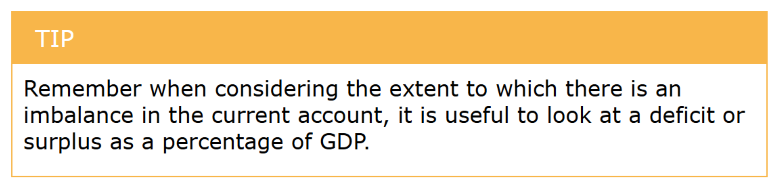
• Size of the imbalance — whether the deficit/surplus is small and manageable or large relative to GDP.
• Duration — whether it is temporary (cyclical) or persistent over many years.
• Cause — whether it results from short‑term fluctuations (e.g., changes in demand) or long‑term structural issues (e.g., low productivity, lack of competitiveness).
These factors determine whether intervention is necessary and what policies would be appropriate.
What are protectionist policies
Policies that restrict imports through tariffs, quotas, or regulations.
How can protectionist policy improve the current account
Protectionist policies (e.g., tariffs) encourage consumers and firms to buy domestic goods instead of imports. This reduces import spending and can improve the current account, especially when high‑quality domestic substitutes exist.
What are the risks of using protectionism to improve the current account
Two main risks:
1. Retaliation — other countries may respond by placing tariffs on your exports.
2. Reduced efficiency — less foreign competition may reduce pressure on domestic firms to innovate and keep costs low.
Evaluation of protectionist policies:
Works short-term but risks retaliation, higher consumer prices, and lower efficiency.
Step-by-step chain of reasoning to correct a CAB deficit:
Identify deficit
2. Fiscal policy → reduce spending/raise taxes → imports fall → CAB improves
3. Monetary policy → higher interest rates → imports fall → CAB improves
4. Supply-side → increase competitiveness → exports rise → CAB improves long-term
5. Protectionism → tariffs/quotas → imports fall → CAB improves
6. Evaluation → short-term vs long-term, growth, employment, retaliation, sustainability
Exam tip:
• Always link policies to imports, exports, and net exports
• Include diagrams: AD/AS shifts, LRAS improvement for supply-side
• Discuss short-term vs long-term effects and evaluate each policy