9- managing and maintaining space
 Call Kai
 Learn
Learn Practice Test
 Spaced Repetition
 Match
Match Flashcards
 Knowt Play
1/21

Earn XP
Description and Tags
Look at clinical cases in this ppt
Name | Mastery | Learn | Test | Matching | Spaced | Call with Kai |
|---|
No analytics yet
Send a link to your students to track their progress
22 Terms
What are the 5 determinants of loss of dental space?
Mesial eruption of posterior teeth
Untreated interproximal decay/premature loss of temp tooth
Agenesia
Ankylosis
Ectopic eruption of upper 1st perm molars
What teeth do untreated interproximal decay or premature loss effect most?
Posteriors and canines distally
If contact point not reconstructed- space is created and invaded by mesial migration
What teeth frequently suffer agenesia?
L2ndPm
ULI
U2ndPm
LowerI
What is ankylosis?
Fusion between root cement and alveolar bone with disappearance of part of PDL- interrupts eruption of tooth
When tooth’s vertical growth stops- antagonist supraerupts and tooth distal to it mesially migrates
What is the ectopic eruption of U1stPermM characterised by?
Atypical and premature root resolution of distal root of U2ndTempMolars
This is caused by eruption of perm molar which conditions a great mesial inclination of the final molar to erupt. Sometimes even with the loss of the second primary molar
What 7 factors should be taken into account to decide where to maintain a space?
Occlusal relationship
Mixed or temporary dentition
Development of the permanent germ
Sector of the arch where the loss has occurred
Arch where the loss has occurred
Amount of space already wasted
Bone-dental discrepancy
When the 2nd primary molar is lost- how does it effect the occlusal relationship in the upper vs lower arch?
Space lost due to…
Rotation of upper 1st perm molar on palatal root
Tipping of lower 1st perm molar
In what dentition is space more easily recoverable?
Mixed over permanent
In case of having more than 2/3rds formed- eruption will be brought forward
The loss of what sector of the arch has the greatest impact?
Loss of incisors- little importance
Loss of canines- must reduce diameter of arch
Of primary 1st molar- not many consequences
Of primary 2nd molar- very important
In what arch where the loss has occurred is it harder to recover space?
Upper- bone less dense, bone loss occurs faster but recovery easier
Lower- bone denser, movement more difficult for recovery
What 3 situations should generate an alarm about space?
Eruption of the second premolars before first ones in the lower arch
Eruption of the canines before premolars in the upper arch
Asymmetries between the right and left side
What are the 3 consequences of premature loss of primary teeth?
Arch length reduction
Occlusal alterations
Malpositions in permanent dentition
How are space maintainers classified?
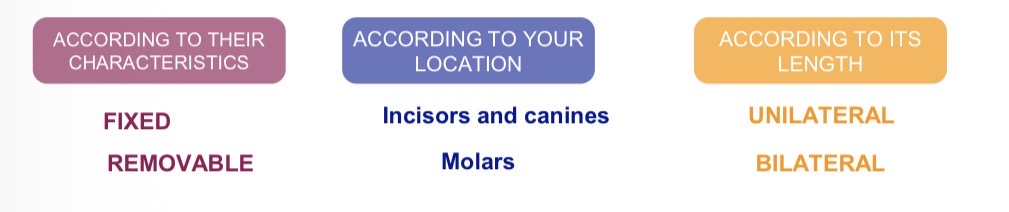
What’s the difference between a space maintainer and space reclaimer>
Space maintainer placed when there’s no previous loss of dental material that leads to shortening of arch
One space is lost with shortened arch- assess need to recover space
Indications of a removable maintainer
In cooperative patients
In patients with poor oral hygiene
When the replacement is far away
Always bilateral for retention reasons
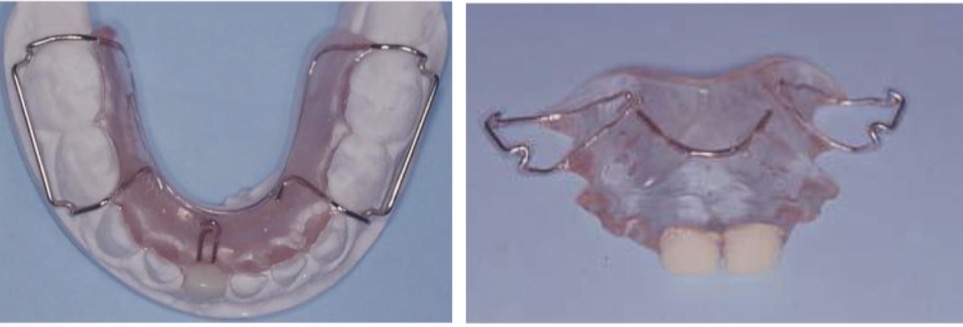
Indications of a fixed space maintainer?
In uncooperative patients
In patients with good oral hygiene
When the eruption of the definitive is very close
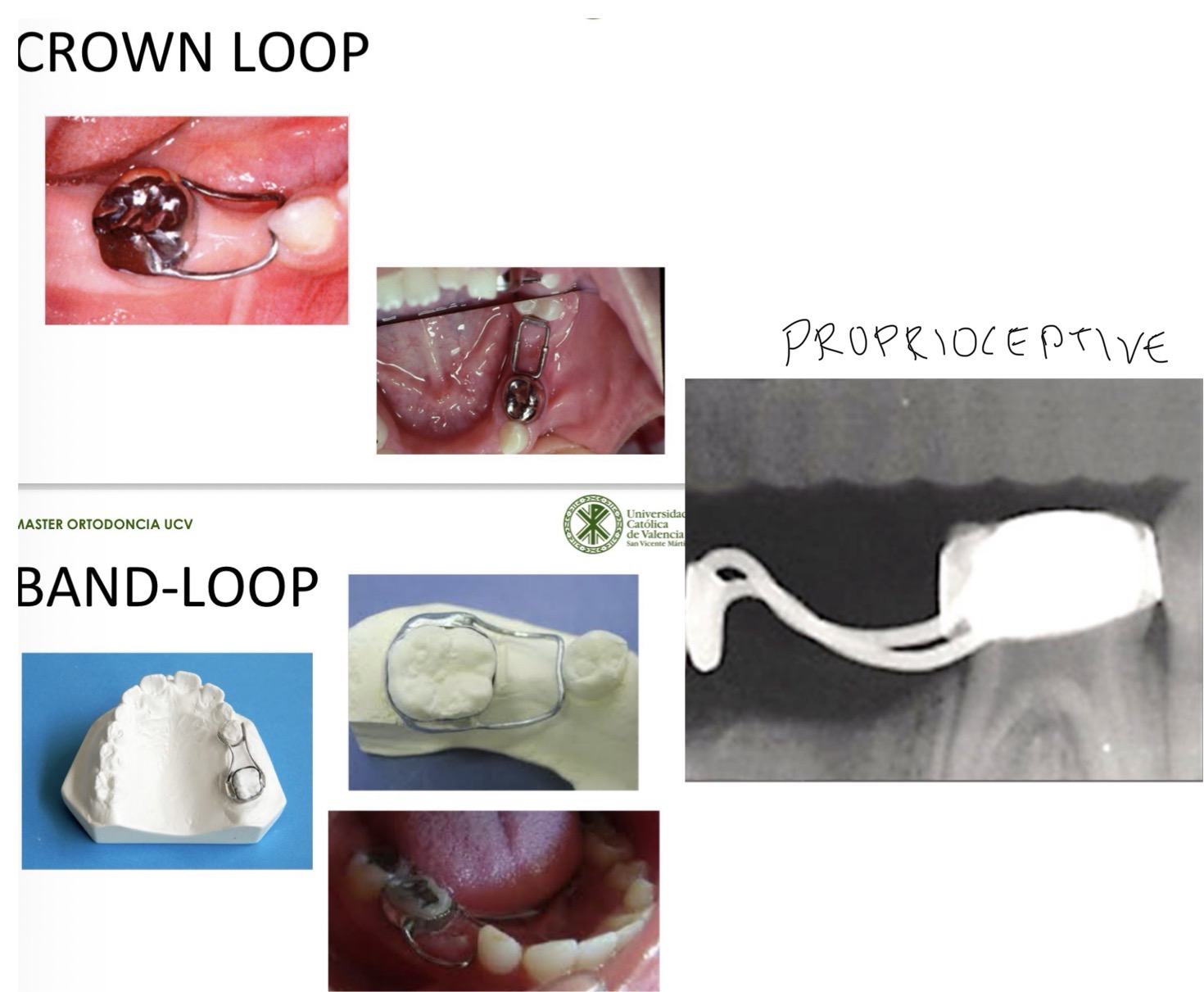
Unilateral fixed space maintainers (3)
Crown loop
Band loop- never for more than 1 absence
Proprioceptive
Bilateral fixed space maintainers (3)
Transpalatal arch
Nance button
Lingual arch
5 Etiologies of premature loss of anterior teeth
Trauma
Ectopic eruption
No space
Cavities
Supernumerary teeth
3 etiologies for premature loss of posterior teeth
Cavities
Ectopic eruption of 1st perm molar
Chronological alterations of eruption
If there’s premature loss of primary 1st molar…
If good occlusion and space distribution- usually no treatment
If primary crowding- assess if need to place maintainer
Premature loss of primary 2nd molar…
Always need treatment
1- Before the eruption of the 1st perm molar:
- Intraosseous molar: wait until there is a gingival protrusion
- Extraosseous molar: place a proprioceptive maintainer
2. After the eruption of the 1st perm molar: usually a maintainer must always be placed