3.2 Weathering
 Call Kai
 Learn
Learn Practice Test
 Spaced Repetition
 Match
Match Flashcards
 Knowt Play
1/26

Earn XP
Description and Tags
Physical weathering processes: freeze-thaw, heating/ cooling, salt crystal growth, pressure release, and vegetation root action.
Name | Mastery | Learn | Test | Matching | Spaced | Call with Kai |
|---|
No analytics yet
Send a link to your students to track their progress
27 Terms
Define weathering
Weathering is the physical or chemical breakdown of rocks in situ on earths surface.
no transport is involved in weathering processes
Moisture usually present
Not involve movement of rock material.
What are the 3 types of weathering?
Physical/ mechanical weathering
Chemical weathering
Biological weathering (plants and animals)
Physical/mechanical weathering
what does it involve?
Examples
the physical disintegration and reduction of side of rocks without changing their chemical composition
Pressure release (exfoliation)
Rocks under great a mount of pressure.
Removal of weight (through erosion of above rocks) mean underlying rocks expand as pressure released → fractures to form on rock surface.
Freeze thaw
Water enter cracks of rocks - freezing temps - freezes - expands 9% →
melting temp → more eater → freezing temp etc.
Cycle puts pressure on rock.
Causing it shatter and break off.
Creates angular pieces of broken rock called scree.
Heating/cooling processes (insolation)
Onion skin/ spheroidal
repeated heating and cooling of rocks - rocks broken down and weathers away.
Rocks expand rapidly when hot
Contract rapidly when cold
P]break apart layers of rock.
Hot desert environments: days extremely hot and night extremely cold. Change in temps cause stress on outer layers of rock. Outer layer peel off in process called exfoliation.
no moisture
Diurnal temps
→ granular disintegration
→if minerals with different heat conductivities are involved.
Temp changes heating / cooling - granular disintergration
formed by same process of heating and cooling
Breaks down to little grains
Different colour mineral absorb and emit different rates
Salt wedging
Due to salt crystal growth inside cracks and pores in rocks
When slain solutions get into cracks and evaporates - leaves behind salt crystals
Salt crystals accumulate over time
Build up pressure and expand gap in rocks
Eventually causes rocks to break off and disintegrate
Vegetation root action
Vegetation grows, such as plants and trees, roots grow and thus need more space.
Growing roots exert pressure onto surrounding rock, eventually causing the rocks to break apart.
What processes are under chemical weathering
hydrolysis
Hydration
Carbonation
Oxidation
Solution
When is chemical weathering most likely to occur
Warm and wet (moist)
High temps - increase rate of reaction
Water for hydrolysis and hydration etc needed for chemical reactions
Explain hydrolysis
Breakdown of rock by acidic water to produce clay and soluble salts I.e granite
Feldspar react with acid water to for, kaolin (china clay), silic acid and potassium hydroxyl.
China clay kaolin end product
Explain hydration
Water is absorbed - causing new substance to form. causing rocks to expand in size and volume - so then disintegrates.
Anhydrite (CaSO4) absorbs 2 water molecules water to form gypsum (CaSO4.2H20)
Explain carbonation
CO2 dissolved in water (carbonic acid) reacts with rocks and breaks them down.
affects limestone
CaCO3 + H2CO3 → Ca(HCO3)2 (calcium carbonate)
Limestone - Karst.
Explain oxidation
Oxygen and water react with iron-rich minerals and weaken the structure of the mineral
Take on rusty colour
Explain solution as type of chemical weathering
Minerals in rock dissolve directly into water
Tell me the different types of biological weathering
organic activity from lichen and algae
Rock disintegration by plant growth
Burrowing and tunneling organisms
Secretion of acids
Explain the biological weathering by lichen, algae and decaying plants
Bio-chemical weathering.
Growing of these plants exert small amount of abrasion .
Can increase temperature - increase chemical weathering (every 10C increase weathering doubles)
Explain how plant roots cause weathering
penetrate into cracks and cause rock to split and break into smaller particles through mechanical weathering
Explain how organism activity is a type of biological weathering (chemical and physical too)
animals burrow cause them to break and disintegrate
Secret acids that chemically dissolve rocks
Explain chelation as type of biólogical weathering
Bio-chemical process - secretion of humid acid to decompose minerals and rocks by removal of cations.
State the factors affecting weathering
climate
Rock type and structure
Relief and aspect
Vegetation
Animals
Explain how climate affects rate of weathering and rate
(Peligres diagram)
hot temps and precipitation = chemical weathering
Cold and fluctuating temps = freeze-thaw - mechanical weathering
Hot diurnal temps = exfoliation, heating and cooling physical weathering
Explain how rock type and structure affect type and rate of weathering
(Granite and limestone)
different rocks composed of different chemicals so susceptible to different weathering
granite: hard and non-porous so less susceptible to chemical weathering
Limestone: porous and chemical weathering due to carbonation and reaction with acids (composed of calcite)
Layered sedimentary rocks with cracks more susceptible to weathering
How does vegetation affect type and rate of weathering
Root action weathering higher rates with higher vegetation.
Where tree roots decay humid acid is produced = biochemical weathering
Lichen and moss growth
How does relief and aspect affect type and rate of weathering
Steep relief = overland flow so weathering reduced
Gentle relief = more susceptible weathering as standing water.
Peak of mountain = fluctuating temps and cold = freeze-thaw
Base = warm and accumulation of moisture so chemical weathering
Aspect - slope facing sun = more vegetation = more biological weathering
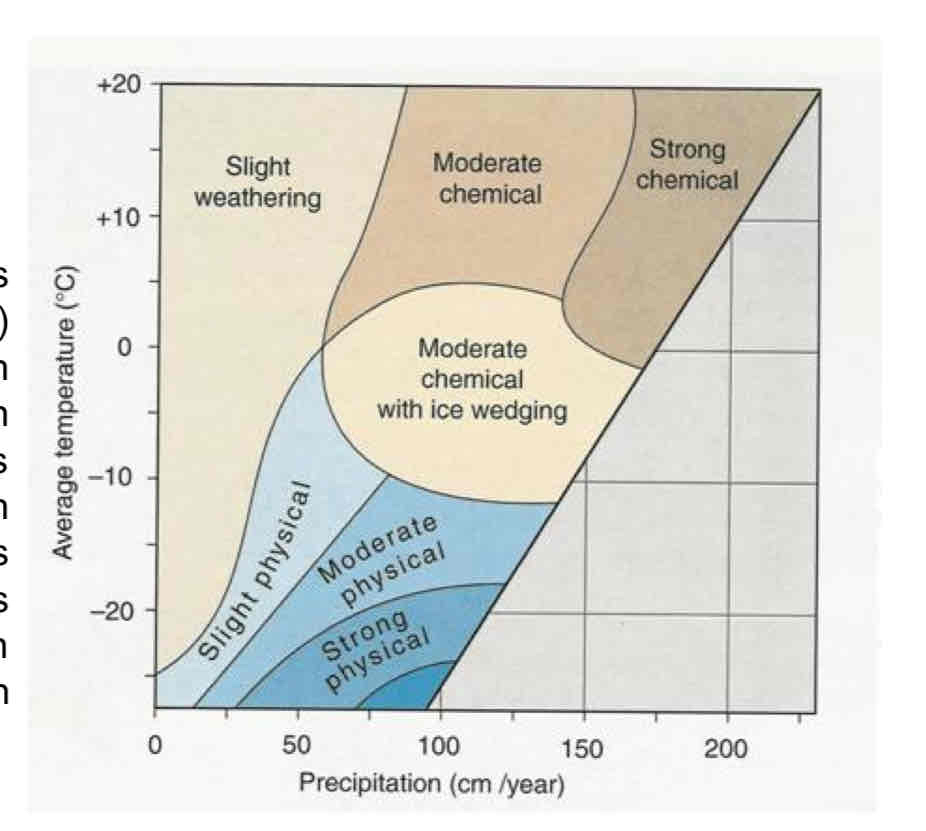
PELTIERS DIAGRAM - LOOK AT IT