Acids and Bases: General Exam Questions
 Call Kai
 Learn
Learn Practice Test
 Spaced Repetition
 Match
Match Flashcards
 Knowt Play
1/15

There's no tags or description
Looks like no tags are added yet.
Name | Mastery | Learn | Test | Matching | Spaced | Call with Kai |
|---|
No analytics yet
Send a link to your students to track their progress
16 Terms
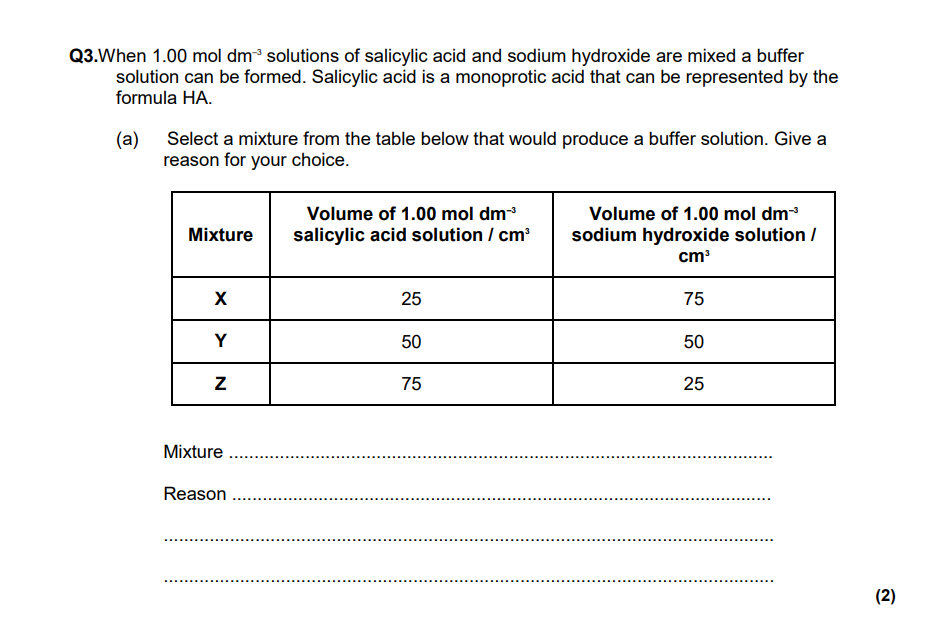
Z, as the solution has both HA and A-.
It wouldn’t be Y, as the solution is at the equivalence point, so in that case there’s no buffer action.
It wouldn’t be X as this is in regards to a strong base, and the pH is governed by OH-.
What are the two essential components of an acidic buffer solution?
A weak acid and the salt of that weak acid (its conjugate base).
In a reaction between a weak acid and a strong base, what condition must be met to form a buffer?
The weak acid must be in molar excess so that some remains unreacted after all the base has reacted to form the salt.
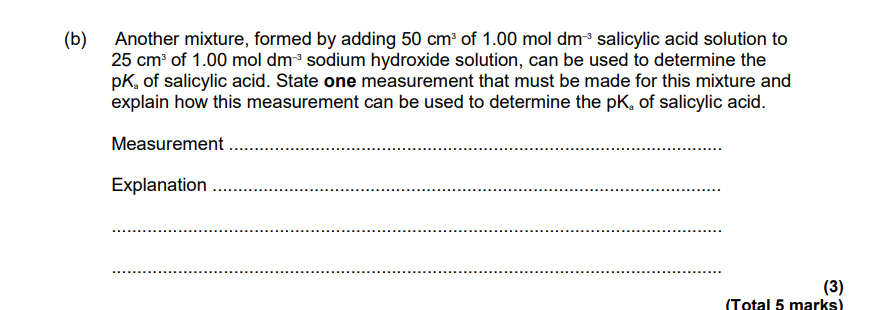
n=C×V=1.00×100050=0.050 mol HA
n=C×V=1.00×100025=0.025 mol OH-
The mols of OH- react completely, forming 0.025 mols of A-(the conjugate salt), so 0.025 mols of HA left
As [HA] = [A-]
pH = pKa
Write an equation for the reaction of propanoic acid with sodium carbonate
2CH3CH2COOH + Na2CO3 2CH3CH2COONa + H2O + CO2
Why must you double the concentration of Ca(OH)2 when calculating pH?
It is a diprotic base; one mole of Ca(OH)2 dissociates to give two moles of hydroxide ions (OH-).
What approximation is made when calculating the pH of a single weak acid solution?
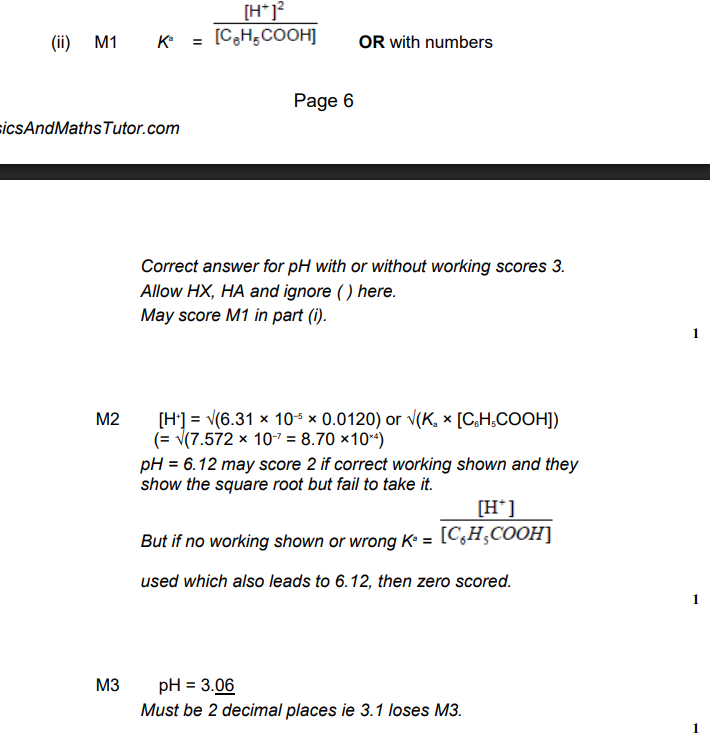
We assume [H+] = [A-] (dissociation of water is negligible) and [HA]equilibrium =[HA]initial (dissociation is very small).

Ka for benzenecarboxylic acid is 6.31 × 10⁻⁵ mol dm-3 .
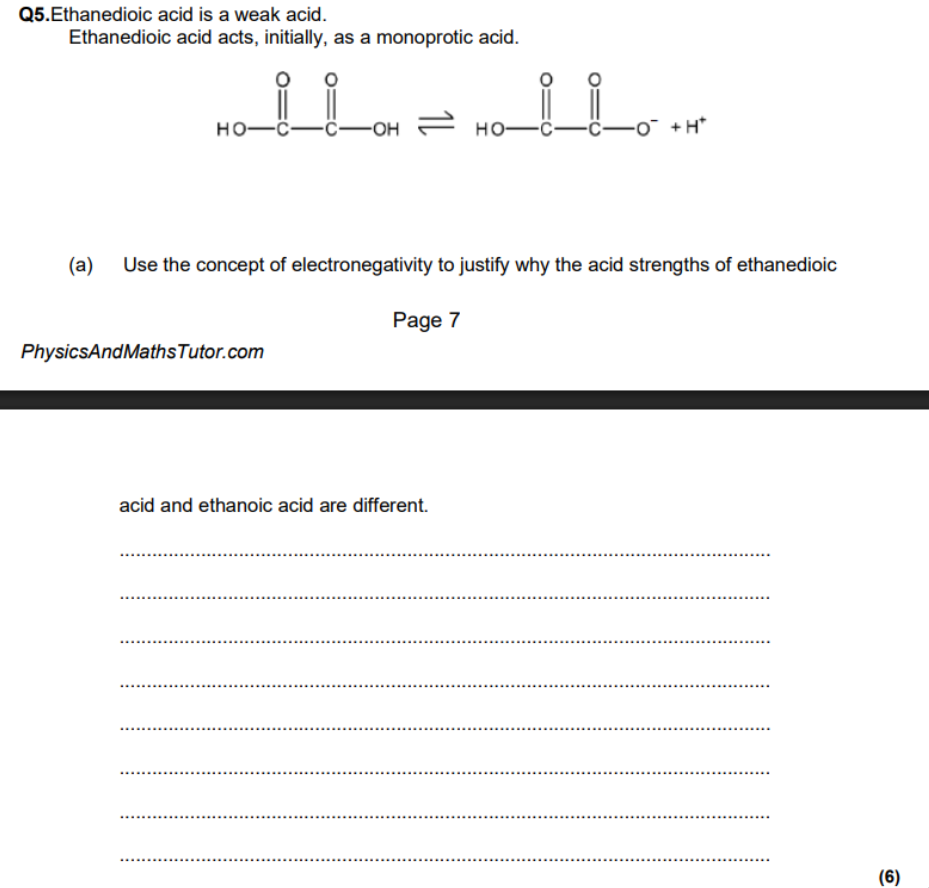
1. The Difference in Structure
Ethanedioic acid has two carboxyl groups (COOH), whereas ethanoic acid has one carboxyl group attached to a methyl group (CH3).
2.The Role of Electronegativity
The second carboxyl group in ethanedioic acid contains two highly electronegative oxygen atoms.
These oxygen atoms exert a powerful negative inductive effect (-I effect), withdrawing electron density away from the O-H bond of the first carboxyl group.
The CH3 group has a positive inductive (electron pushing) effect
Effect on the O-H Bond
This electron withdrawal makes the O-H bond more polar.
Consequently, the H+ ion is lost more easily compared to ethanoic acid.
So Ethanedioic acid is stronger than ethanoic acid.
The second carboxyl group in ethanedioic acid contains two highly electronegative oxygen atoms.
These oxygen atoms exert a powerful negative inductive effect (-I effect), withdrawing electron density away from the O-H bond of the first carboxyl group.
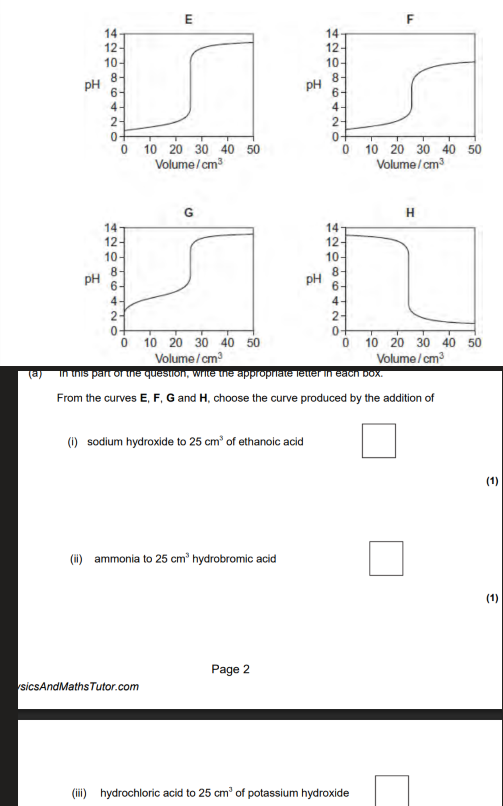
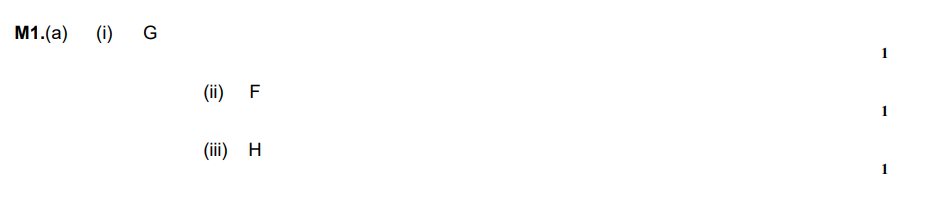
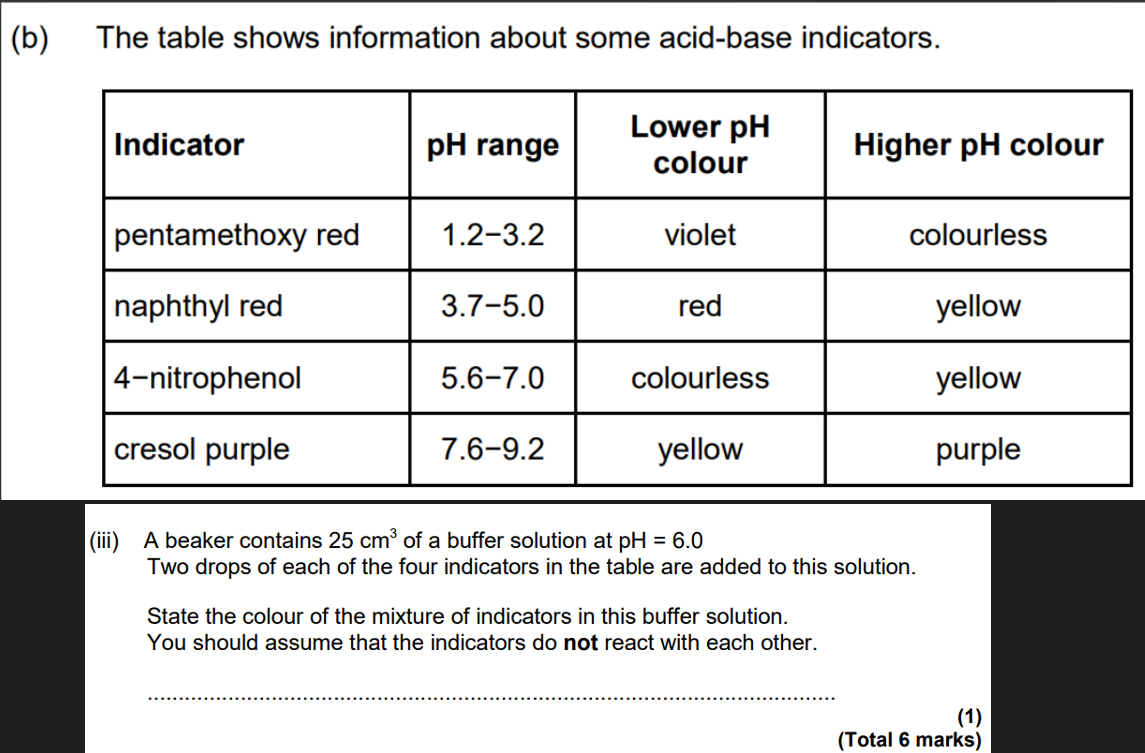
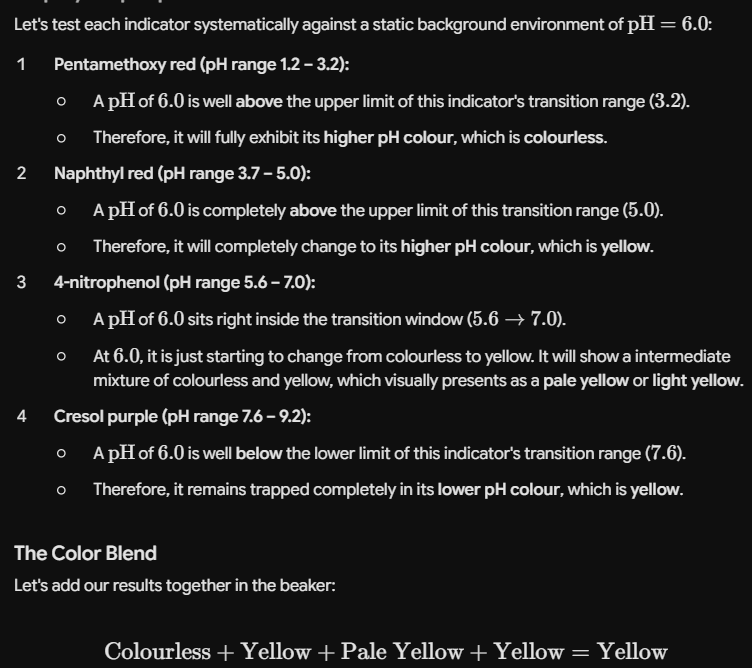
low} + \text{Yellow} = \mathbf{\text{Yellow}}$$
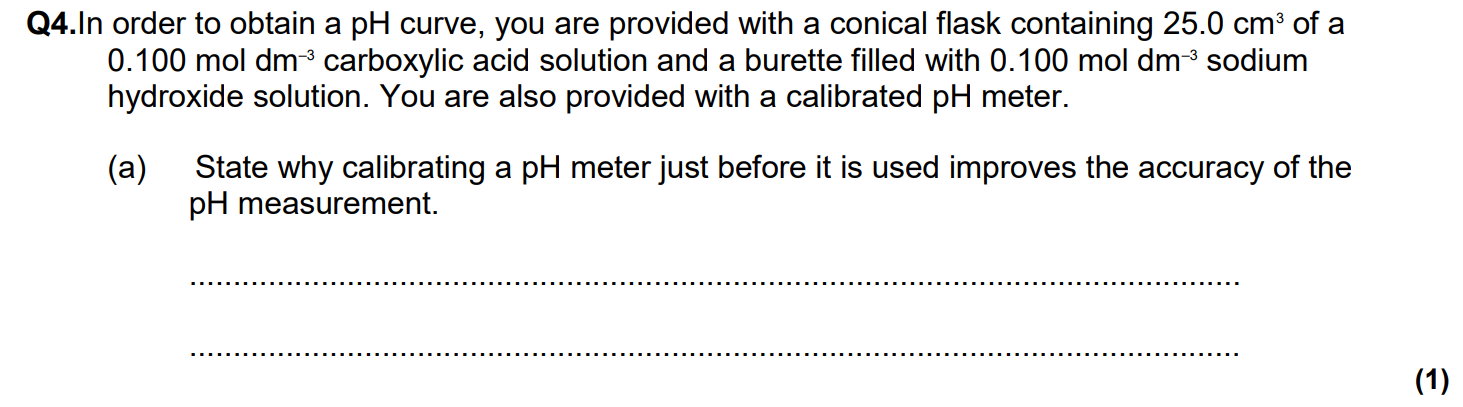

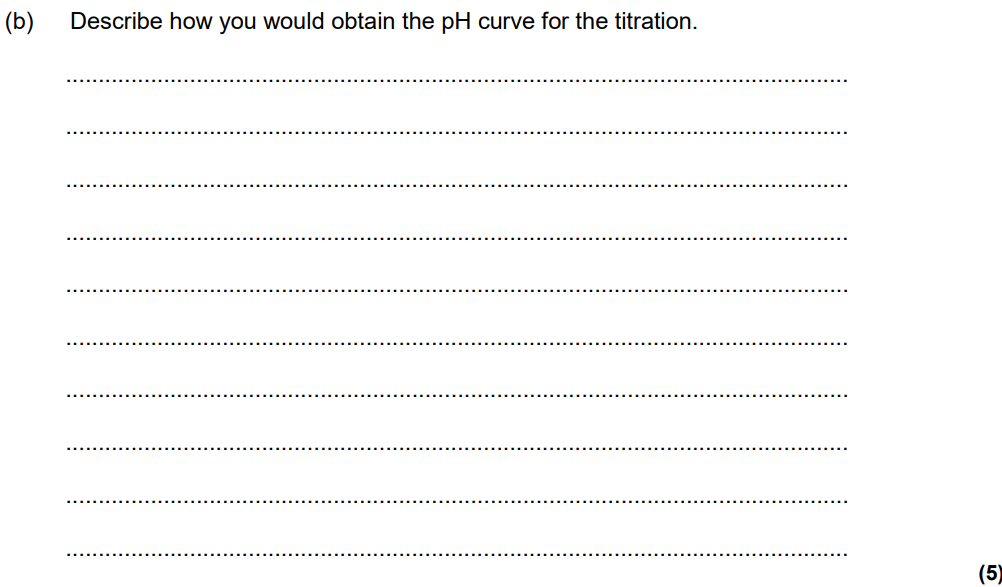
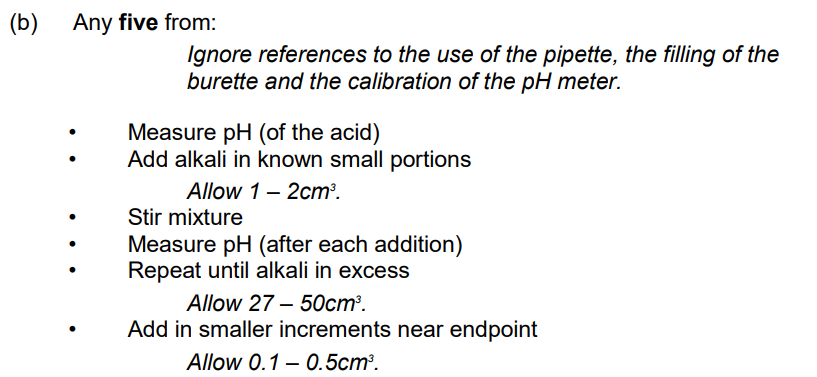
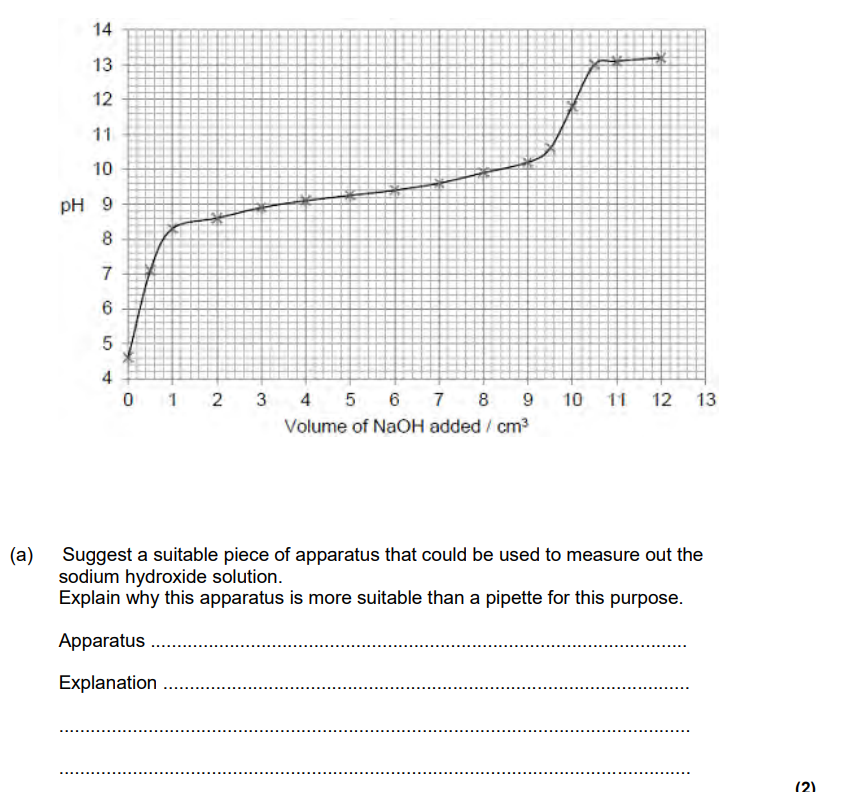
Volumetric Pipette: This piece of glassware is calibrated with a single graduation mark. It is exceptionally accurate, but it is a fixed-volume instrument. It can only transfer one specific volume all at once. If you used a pipette, you could only measure the pH at the very beginning and at one massive endpoint step.
Burette: A burette features a long, graduated tube with a stopcock tap at the bottom. This layout allows you to add small, flexible amounts of liquid sequentially.
Because the experiment requires measuring the pH across a spectrum of different volumes to map out the curve profile, a variable-delivery instrument like a burette is absolutely mandatory.
1. The Standard Rule for Indicators
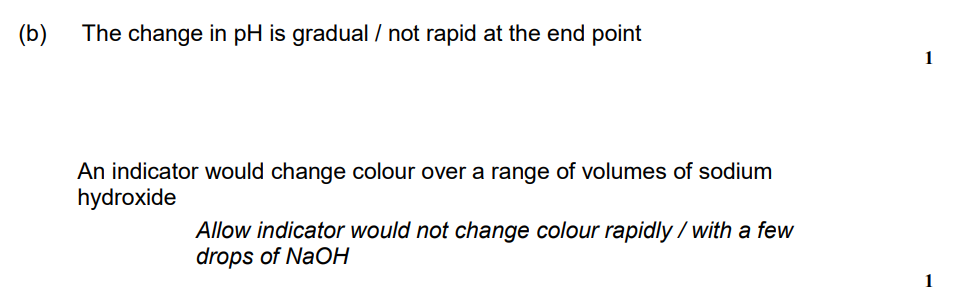
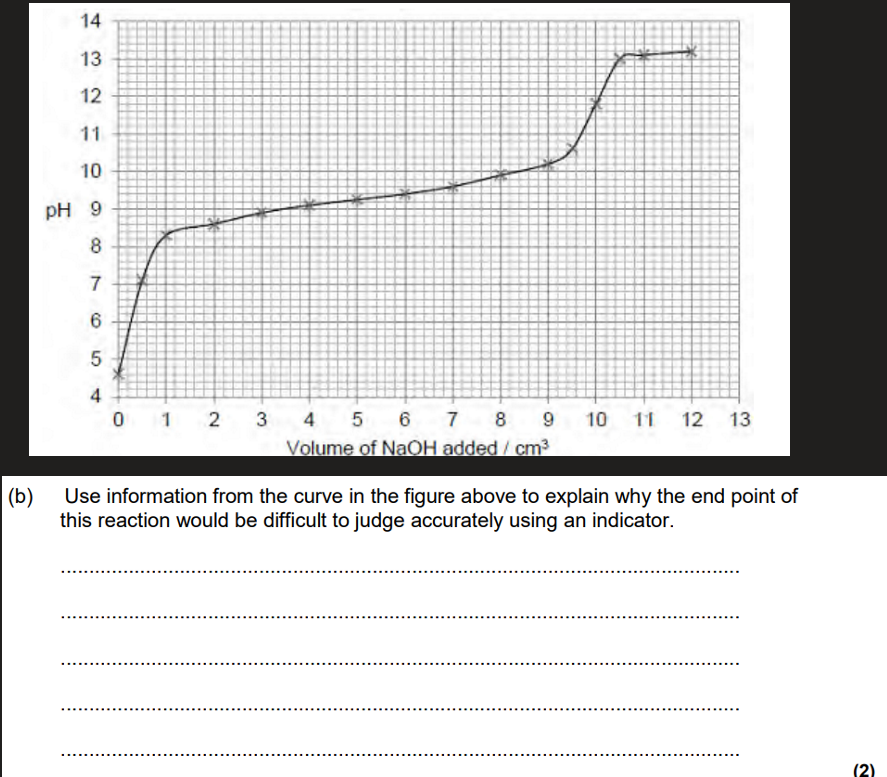
For a titration indicator to work effectively, it needs to experience a massive, sudden surge in acidity or alkalinity. In a normal strong acid-strong base titration, adding just a single drop of base near the endpoint causes the solution to violently leap from around $\text{pH } 4.0$ straight up to $\text{pH } 10.0$. Because an indicator's color transition window fits completely inside this vertical wall, it flips colors instantaneously within that single drop.
2. Analyze this Specific Curve
If you look back at the curve in Figure 4 from the previous image, you'll see a very strange profile:
The starting $\text{pH}$ is quite high (around 4.5), which tells us we are dealing with a weak acid.
The curve climbs steadily, but around the equivalence point ($10.0\text{ cm}^3$), there is no sharp vertical line. The graph simply bends into a gentle, gradual diagonal incline between $\text{pH } 10.0$ and $13.0$.
3. The Visual Consequence
Because the slope is so gradual, as you add the sodium hydroxide from your burette, the $\text{pH}$ will creep up incredibly slowly:
At $9.5\text{ cm}^3$, the $\text{pH}$ might be $10.2$.
At $10.0\text{ cm}^3$, the $\text{pH}$ might be $10.8$.
At $10.5\text{ cm}^3$, the $\text{pH}$ might be $11.5$.
If you put an indicator into this flask, it won't flash cleanly from one color to another in one drop. Instead, it will spend several cubic centimeters slowly fading through a murky, intermediate blended color state. Because you cannot pinpoint the exact drop where the neutralisation finished, judging the endpoint accurately with your eyes is impossible.