FI 301 Exam 3
 Call Kai
 Learn
Learn Practice Test
 Spaced Repetition
 Match
Match Flashcards
 Knowt Play
1/81

Earn XP
Description and Tags
Ch. 6, 9, 17, 19, 23
Name | Mastery | Learn | Test | Matching | Spaced | Call with Kai |
|---|
No analytics yet
Send a link to your students to track their progress
82 Terms
What are money market securities ?
MM securities are debt securities with a maturity of one year or less
What do the yields on MM securities represent ?
Short term-interest rates
Who issues MM securities ?
The treasury, corporations, and financial intermediaries that wish to obtain short-term financing
Who purchases MM securities ?
Households, corporations, and government that have funds available for a short time period
Where can MM securities be sold ?
Sold in secondary market and are liquid
What are the most important MM securities ?
T-bills
Commercial paper
Negotiable certificates of deposit
Repurchase agreements
Federal funds
Banker’s acceptances
T-bills
Issued when the U.S. government needs to borrow funds
issues T-bills with 1-year maturity every 4 weeks
Can periodically issue “cash management bills” when additional cash needs to be raised quickly
maturities of less than 4 weeks
Credit risk of T-bills ?
Backed by Federal government, virtually free of credit risk
Liquidity of T-bills ?
T-bills can be easily liquidated due to short maturity and strong secondary market
Investors in T-bills ?
Depository institutions retain a portion of their funds in T-bills that can be liquidated to accommodate withdrawals
Other financial institutions invest in T-bills in case cash outflows exceed cash inflows
Individuals with substantial savings commonly invest indirectly through money market funds
T-bill pricing
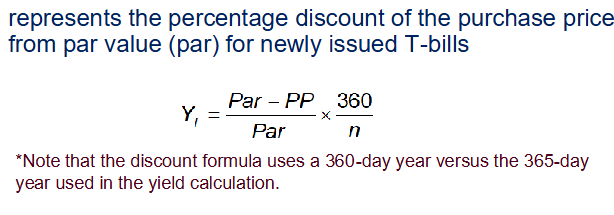
Priced at a discount from their par value
Price depends on investor’s required rate of return
T-bills do not offer interest payments to investors
Value of a T-bill is the present value of the par value
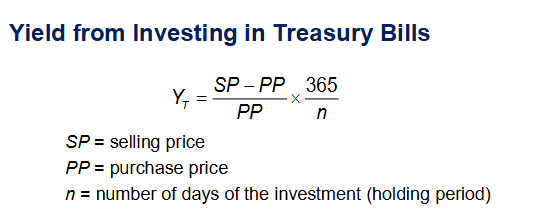
T-bill Yield
T-bill discount
T-bill auctions
Any investor can submit bids online for newly issued T-bills at www.treasurydirect.gov
Competitive bids
Bidders specify maximum price they’re willing to pay, can buy up to 35% of securities being offered
Noncompetitive bids
Bidders guaranteed to receive securities (max $10m per auction per NC bidder), agree to pay whatever price is established by competitive bidders in the auctions
All winning bidders pay the same price in an auction
What is Commercial paper
Short-term debt instrument issued by a large, well-known, creditworthy firm
typically unsecured (no collateral)
there is asset-backed commercial paper which is collateralized
Normally issued to provide liquidity or to finance a firm’s investment in inventory and accounts receivable
The issuance of commercial paper is an alternative to short-term bank loans.
is often a cheaper source of funds than borrowing from commercial banks
Basic characteristics of Commercial paper ?
minimum denomination of commercial paper is usually $100k
typically sold in multiples of $1M
Maturities are normally between 20 and 45 days but can be as short as 1 day or as long as 270 days
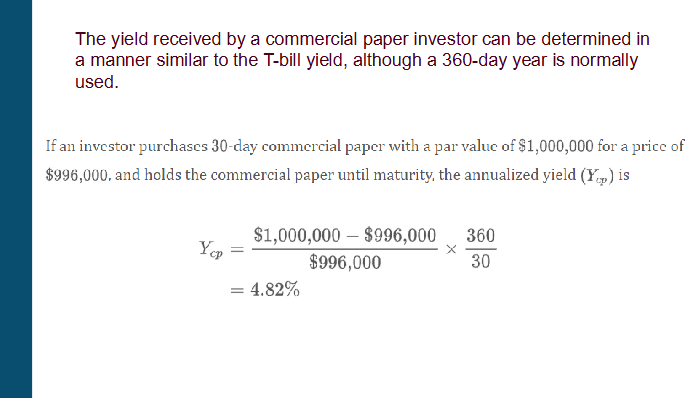
C paper does not offer interest payment, investors can earn return by buying at a discount from par value
Yield on C paper is close to but higher than T-bill with the same maturity
Higher credit risk and less liquidity
C paper yield ?
C paper credit risk ?
C paper is issued by corporations that may be susceptible to failure,
investors face default risk
risk is affected by issuers financial condition and cash flow
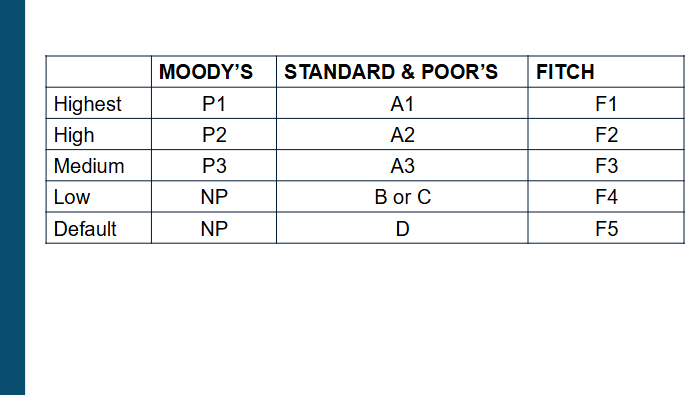
Credit ratings are assigned by agencies such as Moody’s Investors Service, S&P Corporation, and Fitch Investor Service
C paper ratings ?
What are Negotiable Certificates of Deposit ?
Certificates issued by large commercial banks and other depository institutions as a short-term source of funds
The minimum denomination is $100k
Maturities on NCDs normally range from 2 weeks to 1 year
Secondary market for NCDs exists, providing investors with some liquidity
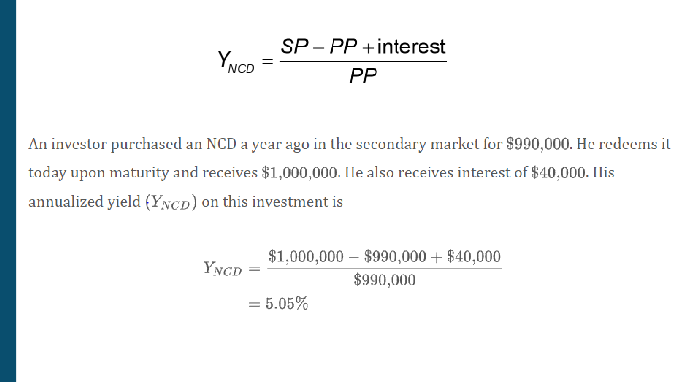
Investors in NCDs earn a return from interest payments and capital gains
NCD yields offer a premium above the T-bill yield to compensate for less liquidity and higher credit risk
Formula for NCDs ?
What are repurchase agreements ?
In a repurchase agreement (repo), one party sells securities to another with an agreement to repurchase the securities at a specified date and price.
A reverse repo is the purchase of securities by one party with an agreement to sell them.
A repurchase agreement represents a loan backed by the securities
Financial institutions often participate in repos
Transaction amounts are usually for $10M or more
The most common maturities are from 1 day to 15 days and for one, three, and six months
Impact of Credit Crisis on Repurchase Agreements
Some financial institutions that relied on the market for funding were not able to obtain funds
Investors became more concerned about the securities that were posted as collateral
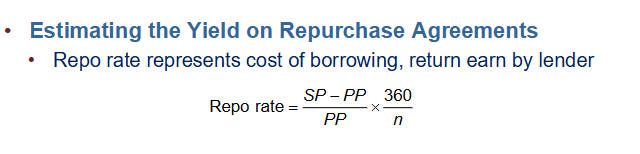
Estimating yield on Repurchase Agreements
Repo rate represents cost of borrowing, return earn by lender
Federal Funds
Enable depository institutions to lend or borrow short-term funds from each other at the federal funds rate
Federal reserve adjusts the amount of funds in depository institutions to influence the federal funds rate
The rate is normally slightly higher than the T-bill rate at any given time
Loans are normally in excess of $5M
Maturity typically 1 to 7 days (can be longer)
Banker’s Acceptances
Indicate that a bank accepts responsibility to make a payment to a seller of goods
Commonly used for international trade transactions where counterparty risk is difficult to determine
Often sold before maturity, active secondary market
Investors who buy banker’s acceptances in the secondary market earn returns buy buying at a discount to face value
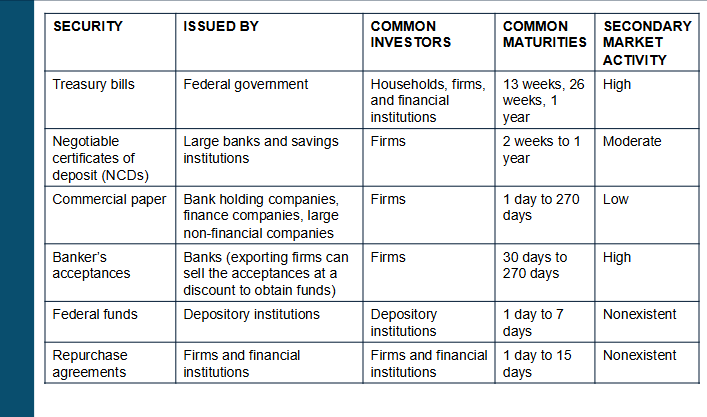
Summary of MM Securities
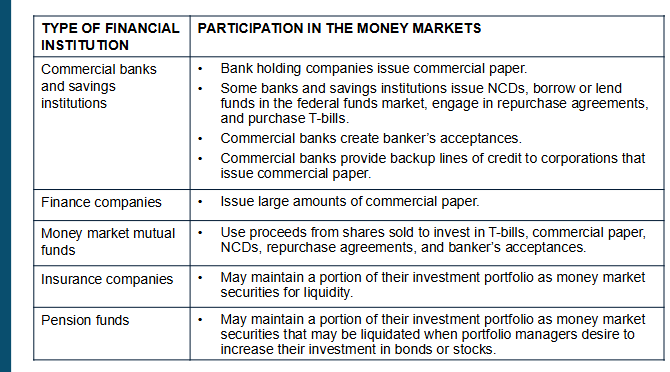
Institutional Use of MM markets
What is a mortgage ?
A mortgage is a form of debt to finance a real estate investment
What does a mortgage contract specify ?
Mortgage rate (interest rate)
Maturity (years)
Collateral
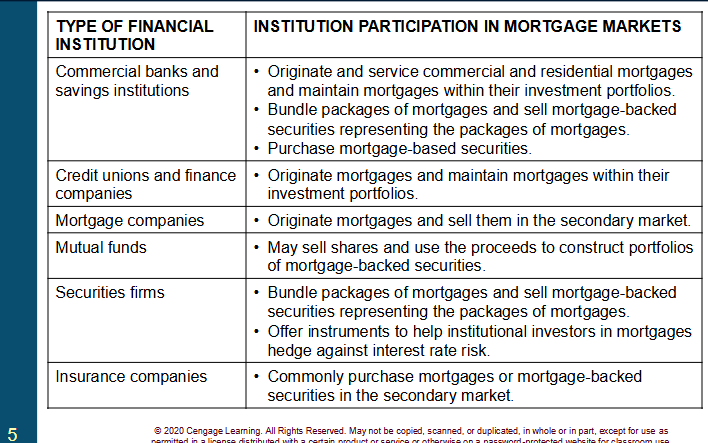
What financial institutions originate mortgages ?
Mortgage companies
Savings institutions
Commercial banks
What financial institutions create and sell mortgage-backed securities ?
Government agencies (Fannie Mae, Freddie Mac)
Commercial banks
What financial institutions invest in Mortgages and MBS ?
Savings institutions
Commercial banks
Insurance companies
Pension funds
Mutual funds
Institutional Use of Mortgage Markets
Criteria Used to Measure Creditworthiness
Level of equity invested by the borrower
Borrower’s income level
Borrower’s credit history
Prime versus Subprime Mortgages
Insured versus Conventional Mortgages
Level of equity invested by the borrower
The lower the down payment, the higher the probability that the borrower will default
Loan-to-value ratio: proportion of the property’s value that is financed with debt. Greater default risk with higher LTV ratio
Borrower’s income level
Borrowers who have a lower level of income relative to the periodic loan payments are more likely to default on their mortgages
Borrower’s credit history
Borrowers with a history of credit problems & low credit scores are more likely to default on their loans
Prime versus Subprime Mortgages
Prime: borrower meets traditional lending standards
Subprime: borrower does not qualify for prime loan
lower income, high existing debt, small down payment
usually higher interest rate
Insured versus Conventional Mortgages
Insured: loan is insured by FHA or VA
FHA - lower income borrowers; VA - veterans
Conventional: loan is not insured by FHA or VA but can be privately insured
Private mortgage insurance (PMI) typically required when down payment is less than 20% of property value
Fixed-rate mortgages
Locks in borrower’s interest rate of the life of the mortgage
Financial institution that holds fixed-rate mortgages is exposed to interest rate risk
value of fixed-rate mortgage decreases when interest rates increase
value of mortgage = PV of remaining payments
lower PV results from higher interest rates
Borrowers with fixed-rate mortgages do not suffer from rising rates, but they do not automatically benefit from declining rates
Borrowers may refinance at lower rates
Results in lower monthly payments, but must pay fees to refinance
Adjustable-rate mortgages (ARMs)
Allows the mortgage interest rate to adjust to market conditions
Contract will specify a precise formula for this adjustment
Some ARMs contain a clause that allow the borrower to switch to a fixed rate within a specific period
Some ARMs are fixed for a period, then adjust once or twice per year
ARMs from a Financial institutions perspective
Mortgages with adjustable rates have values that are more stable, less affected by interest rate increases
Effect of higher discount rates (reduces value of mortgage) offset by adjustment to (increase in) monthly payments when rates increase
Graduated-payment mortgages
Allow the borrower to make small payments initially on the mortgage; the payments increase periodically then level off after 5 or 10 years
Growing-equity mortgages
Monthly payments are initially low and increase over time. The payments never level off but continue to increase throughout the life of the loan
Second mortgages (Home equity loans & HELOCs)
A second mortgage can be used in conjunction with the primary or first mortgage
Offers homeowners opportunity to borrow against home equity
Shared-appreciation mortgages
Allow a home purchaser to obtain a mortgage at a below-market interest rate. In return, the lender will share the price appreciation of the home.
borrower is trading potential upside for lower interest rate
Balloon payment mortgages
Require only interest payments for a 3-5 year period
At the end of the this period, the borrower must pay the full amount of the principal (the balloon payment)
Mortgage Lender Risk
Credit risk
Interest rate risk
Prepayment risk
Securitization
The Securitization Process
Credit risk
The risk that the borrower will make a late payment or will default
Interest rate risk
Mortgage values will fall when interest rates rise
Prepayment risk
Borrowers may prepay the mortgage when interest rates fall.
Lenders get capital back all at once, new loans issued will pay lower interest rates
Securitization
The pooling and repackaging of loans into securities
Securities are then sold to investors
The Securitization Process
A financial institution such as a commercial bank or federal agency combine individual mortgages together into packages
Securities are sold to investors
MBS issuer receives interest and principle payments on the mortgages
Transfers (passes through) the payments (minus fees) to investors that purchased the MBS
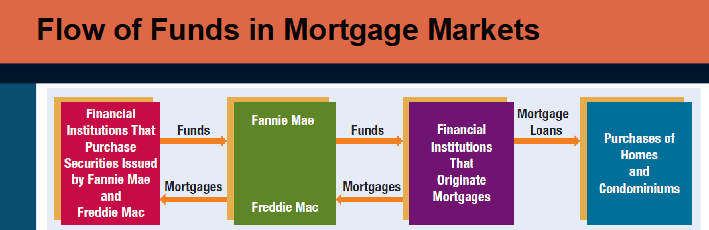
Flow of Funds in Mortgage Markets
Fannie Mae - Federal National Mortgage Association (FNMA)
Created by the federal gov’t in 1938 to develop a more liquid secondary market for mortgages
Converted into a public, shareholder-owned corporation in 1968
Freddie Mac - Federal Home Loan Mortgage Corporation (FHLMC)
Created by federal gov’t in 1970, converted to public company in 1989
Business Model of Fannie and Freddie
Issue securities to investors, use capital raised to buy mortgages, sell MBS
Purpose is to promote affordable home ownership
Classified as a government-sponsored enterprise
Backed by “implicit” guarantee that federal gov’t would not allow these institutions to fail or default on debts, which reduces their cost of capital and increases their security prices
Implicit guarantee effectively became explicit in 2008
FNMA (Fannie Mae) mortgage-backed securities
Mortgages typically purchased from commercial banks
FHMLC (Freddie Mac) participation certificates
Mortgages typically purchased from smaller savings banks
GNMA (Ginnie Mae) mortgage-backed securities
Guarantees payment to investors buying securitized FHA & VHA loans
Ginnie Mae does not actually issue the MBS, done by private institutions
Private label pass-through securities
Packaged by private financial institutions (“Non-agency”)
More flexibility on what kinds of mortgages to package (jumbo, Alt-A, and other non-traditional mortgages)
‘