Abdominal Abnormalities (Ch. 62-63)

0.0(0)
Studied by 10 people
call kaiCall Kai
learnLearn
examPractice Test
spaced repetitionSpaced Repetition
heart puzzleMatch
flashcardsFlashcards
GameKnowt Play
Card Sorting

1/57

encourage image

There's no tags or description

Looks like no tags are added yet.

Last updated 12:03 AM on 6/19/26
Name
Mastery
Learn
Test
Matching
Spaced
Call with Kai

No analytics yet

Send a link to your students to track their progress

58 Terms

1
New cards

embryology review

  • physiologic midgut herniation occurs between 8-12 weeks gestation

    • some of the bowel temporarily migrates into the base of the umbilical cord

    • around 12 weeks gestation, bowel rotates and returns back into the abdominal cavity

  • if this process (normal development of abdominal wall) does not occur correctly, abdominal organs may remain at the base of the umbilical cord, leading to abdominal wall abnormalities
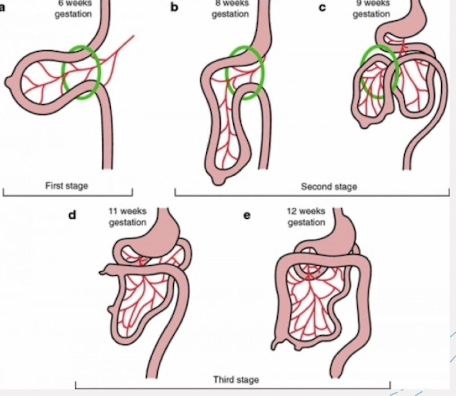
<ul><li><p>physiologic <span style="color: yellow;">midgut herniation </span>occurs between <span style="color: yellow;">8-12 weeks </span>gestation</p><ul><li><p>some of the bowel temporarily migrates into the base of the umbilical cord</p></li><li><p>around <span style="color: yellow;">12 weeks</span> gestation, bowel rotates and <span style="color: yellow;">returns</span> back into the abdominal cavity</p></li></ul></li></ul><ul><li><p>if this process (normal development of abdominal wall) does not occur correctly, abdominal organs may remain at the base of the umbilical cord, leading to abdominal wall abnormalities</p></li></ul><p></p>
2
New cards

how to image abdominal wall

  • image the cord insertion site

    • note presence/absence of defects

    • what is the relation of cord to defect?

  • MC abdominal wall defects:

    • omphalocele

    • umbilical hernia

    • gastroschisis

  • in presence of abdominal wall defects, look for other abnormalities

3
New cards

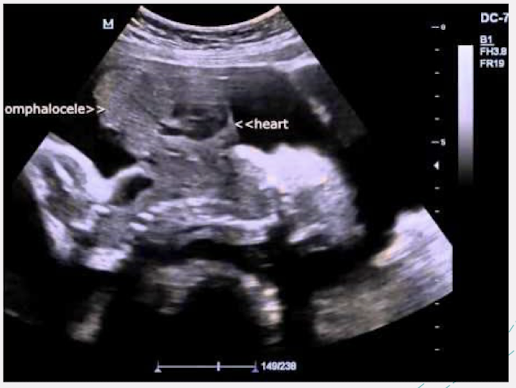
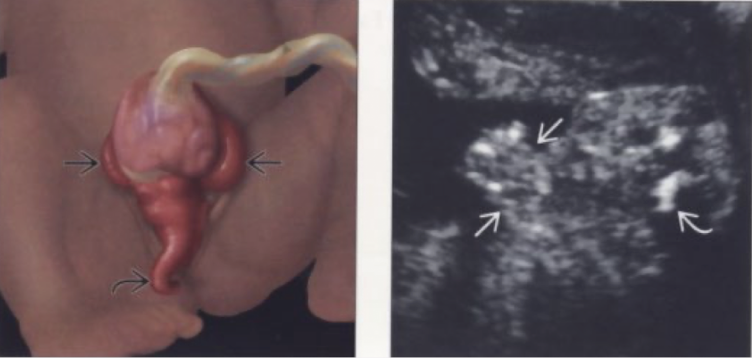
omphalocele

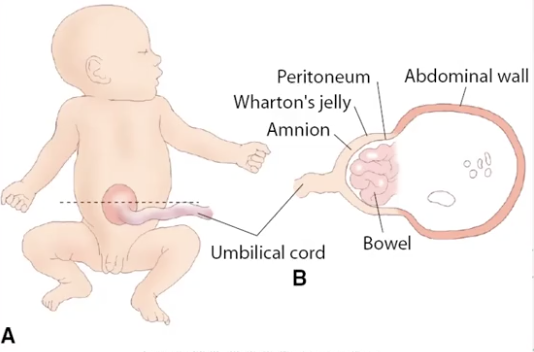
  • during 8-12th weeks of development, fetal bowel normally migrates into umbilical cord from abdominal cavity

    • bowl-containing omphalocele occurs when bowel loops fail to return to abdomen

  • intra-abdominal structures herniate into the base of the umbilical cord

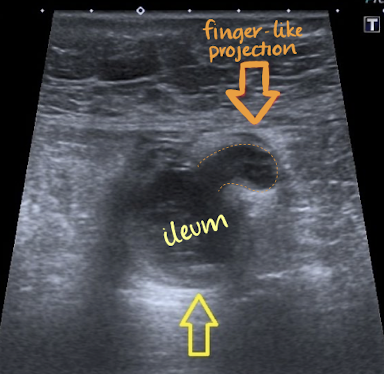
    • herniation is covered by membrane that consists of amnion and peritoneum

    • cord goes through the omphalocele

  • AFP is within normal limits (may be slightly elevated)
<ul><li><p>during 8-12th weeks of development, fetal bowel normally migrates into umbilical cord from abdominal cavity</p><ul><li><p><span style="color: red;">bowl-containing omphalocele</span> occurs when <span style="color: red;">bowel loops fail to return to abdomen</span></p></li></ul></li><li><p>intra-abdominal structures herniate into the base of the umbilical cord</p><ul><li><p>herniation is <span style="color: yellow;">covered by membrane</span> that consists of amnion and peritoneum</p></li><li><p><span style="color: red;">cord goes through the omphalocele</span></p></li></ul></li><li><p><span style="color: red;">AFP is within normal limits</span> (may be slightly elevated)</p></li></ul><p></p>
4
New cards

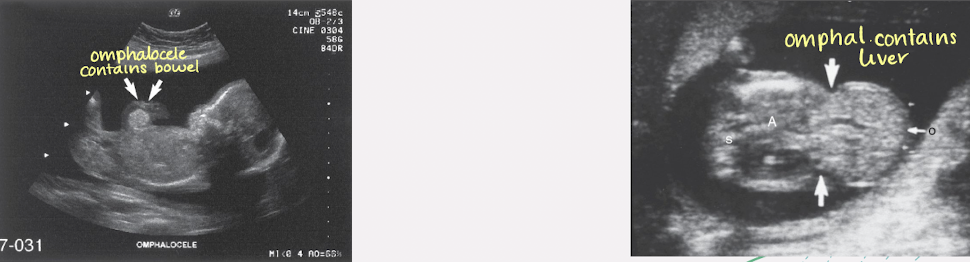
omphalocele: bowel-containing vs liver-containing

bowel-containing

  • intestines fail to return

  • higher risk of associated chromosomal abnormalities and other anomalies

  • variable amount of bowel (only) in the herniation

liver-containing

  • defect affects the abdominal wall closure (closure of muscles, fascia, and skin)

  • herniation includes fetal liver and sometimes variable amount of bowel
<p><strong>bowel-containing</strong></p><ul><li><p>intestines fail to return</p></li><li><p>higher risk of associated chromosomal abnormalities and other anomalies</p></li><li><p>variable amount of <span style="color: red;">bowel (only)</span><span style="color: yellow;"> i</span>n the herniation</p></li></ul><p><strong>liver-containing</strong></p><ul><li><p>defect affects the abdominal wall closure (closure of muscles, fascia, and skin)</p></li><li><p>herniation includes fetal liver and sometimes variable amount of bowel</p></li></ul><p></p>
5
New cards

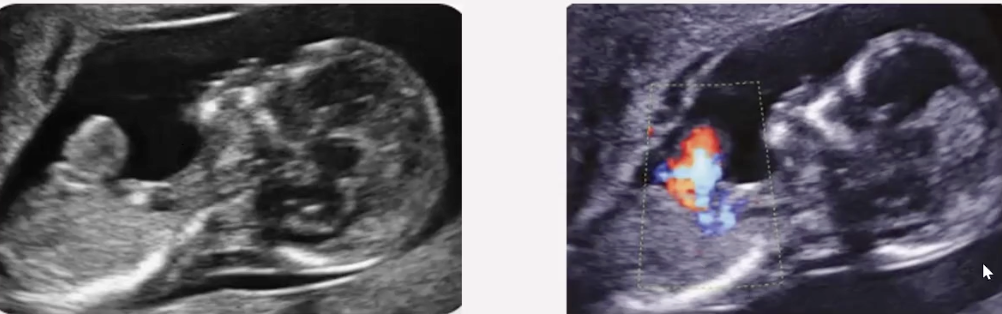
SONO: omphalocele

  • abdominal wall mass should be continuous with umbilical cord

    • Doppler to demonstrate intrahepatic umbilical vein coursing through defect

  • membranous sac should be identified covering contents

    • document size; increased AC

  • identify contents of membranous sac

    • bowel only; liver in and out of sac

  • hydramnios is common

<ul><li><p>abdominal wall <span style="color: red;">mass </span><span style="color: rgb(255, 255, 255);">should be</span><span style="color: red;"> continuous with umbilical cord</span></p><ul><li><p><span style="color: yellow;">Doppler</span> to demonstrate intrahepatic <span style="color: yellow;">umbilical vein coursing through defect</span></p></li></ul></li><li><p><span style="color: red;">membranous sac </span>should be identified <span style="color: red;">covering</span> contents</p><ul><li><p>document size; increased AC</p></li></ul></li><li><p>identify contents of membranous sac</p><ul><li><p>bowel only; liver in and out of sac</p></li></ul></li><li><p>hydramnios is common</p></li></ul><p></p>
6
New cards
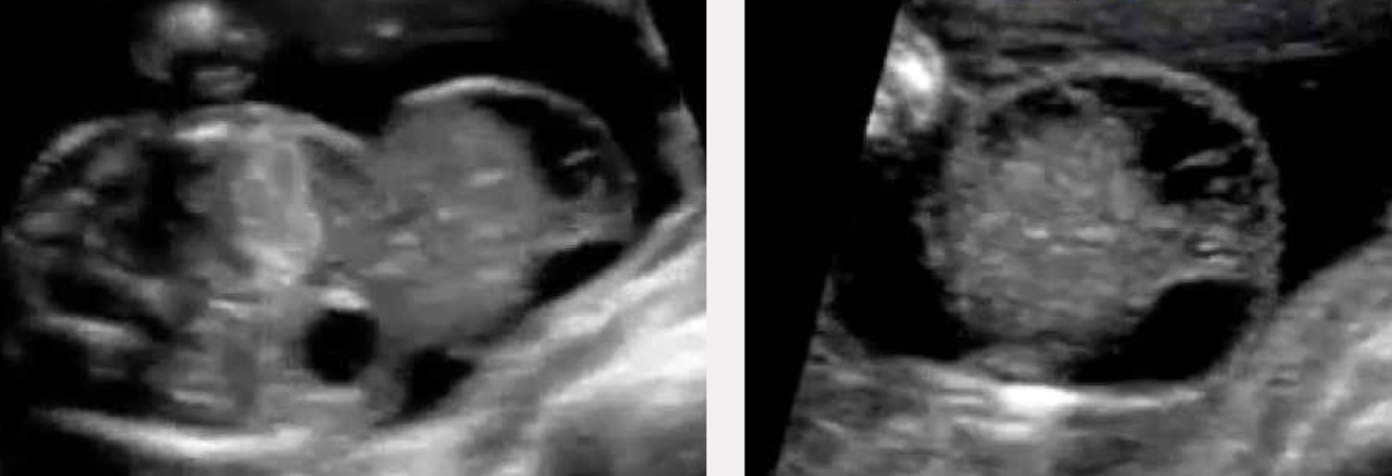
<p>pathology?</p>

pathology?

omphalocele

7
New cards
<p>pathology?</p>

pathology?

omphalocele

8
New cards

gastroschisis

  • periumbilical opening in abdominal wall

    • allows for protrusion of bowel through the defect

    • herniation of bowel and, infrequently, stomach and genitourinary organs (rarely the stomach)

  • defect is nearly always to the right of the umbilical cord

  • umbilical cord insertion is normal

  • no skin or membrane covering the defect or herniated contents

  • AFP levels are significantly higher compared to omphalocele
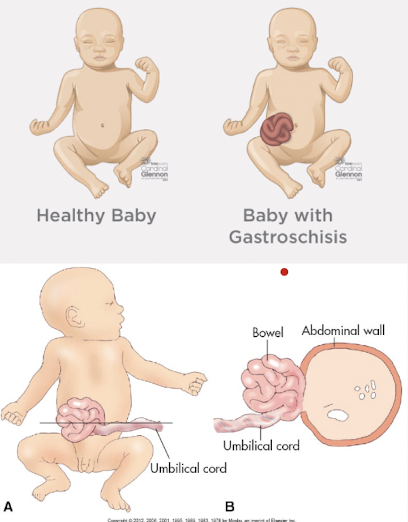
<ul><li><p>periumbilical opening in abdominal wall</p><ul><li><p>allows for protrusion of bowel through the defect</p></li><li><p>herniation of bowel and, infrequently, stomach and genitourinary organs (rarely the stomach)</p></li></ul></li><li><p>defect is nearly alw<span style="color: rgb(255, 255, 255);">ays to the</span><span style="color: red;"> <u>right</u> of the umbilical cord</span></p></li><li><p>umbilical cord insertion is normal</p></li><li><p><span style="color: red;">no skin or membrane covering the defect or herniated contents</span></p></li><li><p><span style="color: red;">AFP levels are significantly higher</span> compared to omphalocele</p></li></ul><p></p>
9
New cards

why are AFP levels higher in gastroschisis?

because it does not have a membrane to cover the internal organs of fetus—organs are exposed

10
New cards

SONO: gastroschisis

  • right paraumbilical defect of abdominal wall

    • rarely a left-side defect

  • normal fetal cord insertion

  • free-floating herniated bowel

    • other organs may be involved

    • herniated bowel may be dilated or thick-walled; may be obstructed
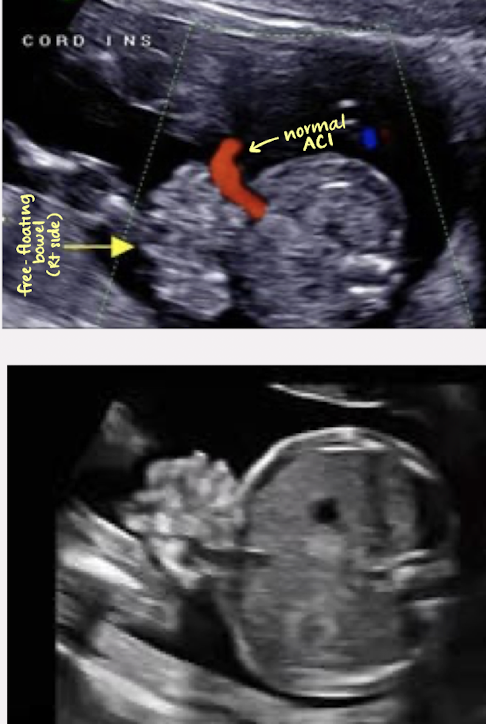
<ul><li><p><span style="color: red;">right paraumbilical defect</span> of abdominal wall</p><ul><li><p>rarely a left-side defect</p></li></ul></li><li><p>normal fetal cord insertion</p></li><li><p><span style="color: red;">free-floating herniated bowel</span></p><ul><li><p>other organs may be involved</p></li><li><p>herniated bowel may be dilated or thick-walled; may be obstructed</p></li></ul></li></ul><p></p>
11
New cards
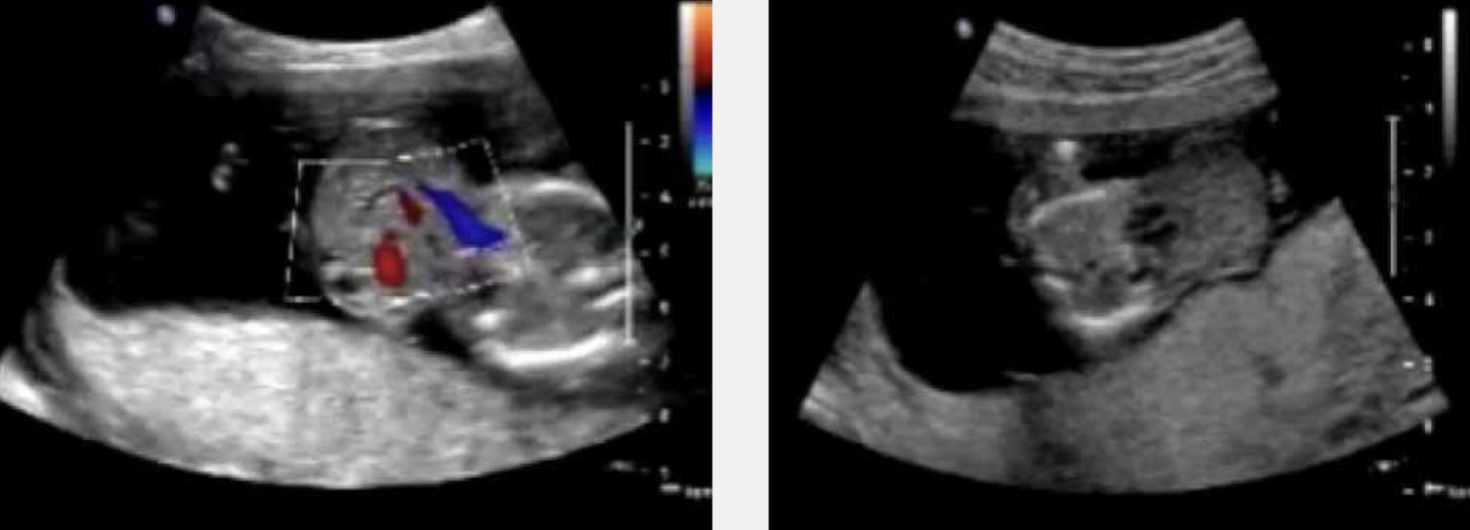
<p>pathology?</p>

pathology?

gastroschisis

12
New cards
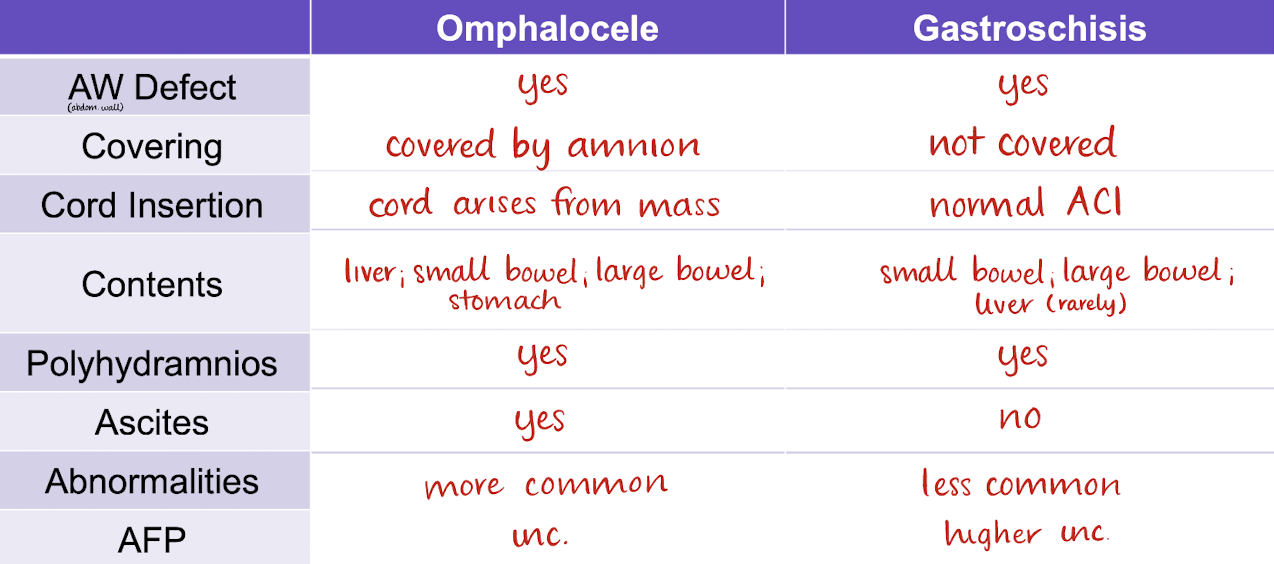
<p>omphalocele vs gastroschisis summary chart</p>

omphalocele vs gastroschisis summary chart
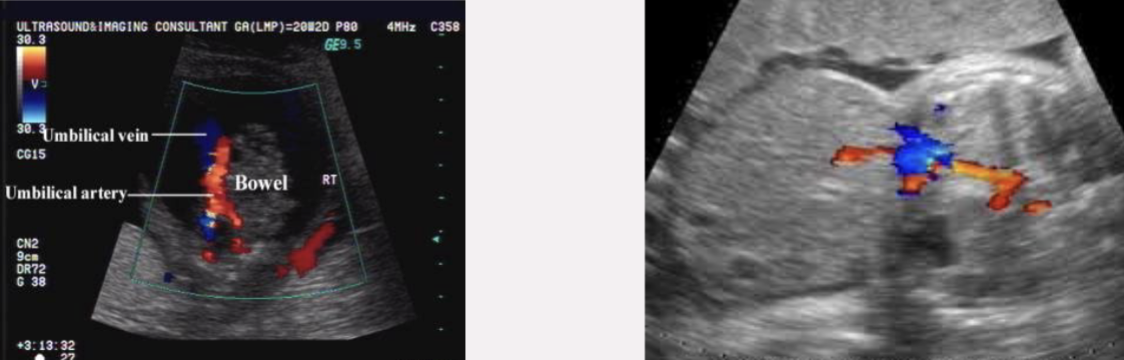
13
New cards
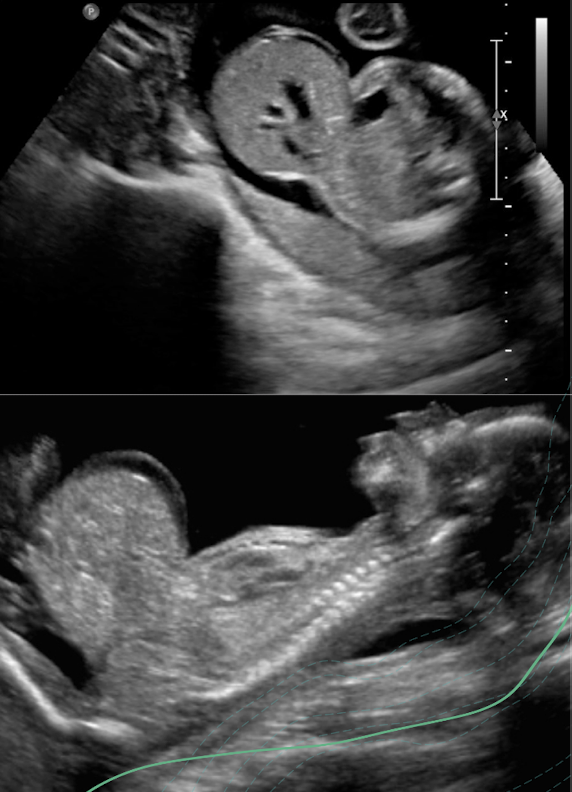
<p>which is omphalocele? which is gastroschisis?</p>

which is omphalocele? which is gastroschisis?
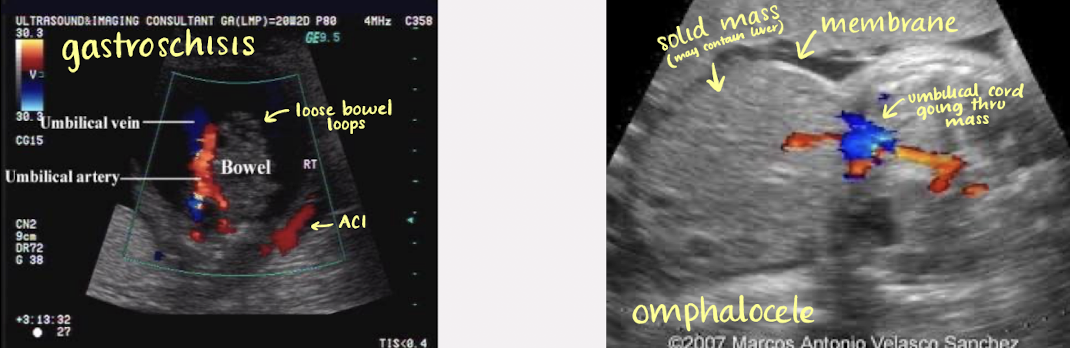
<p></p>
14
New cards

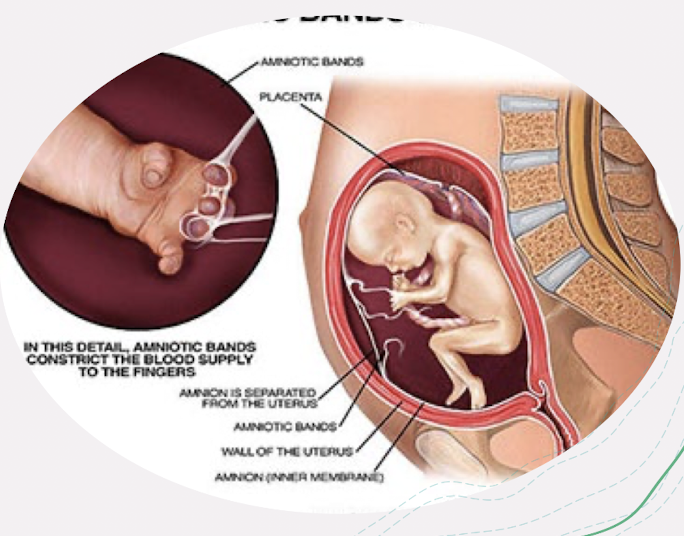
amniotic band syndrome (ABS)

  • rupture of amnion → entrapment or entanglement of fetal parts by “sticky” chorion

    • early entrapment → severe craniofacial defects and internal malformations

    • late entrapment → amputations or limb restrictions

  • increased AFP

  • associated abdominal wall anomalies

    • gastroschisis; omphalocele

<ul><li><p>rupture of amnion → entrapment or <span style="color: red;">entanglement of fetal parts by “sticky” chorion</span></p><ul><li><p><u>early</u> entrapment → severe craniofacial defects and internal malformations</p></li><li><p><u>late</u> entrapment → amputations or limb restrictions</p></li></ul></li><li><p>increased AFP</p></li><li><p>associated abdominal wall anomalies</p><ul><li><p>gastroschisis; omphalocele </p></li></ul></li></ul><p></p>
15
New cards

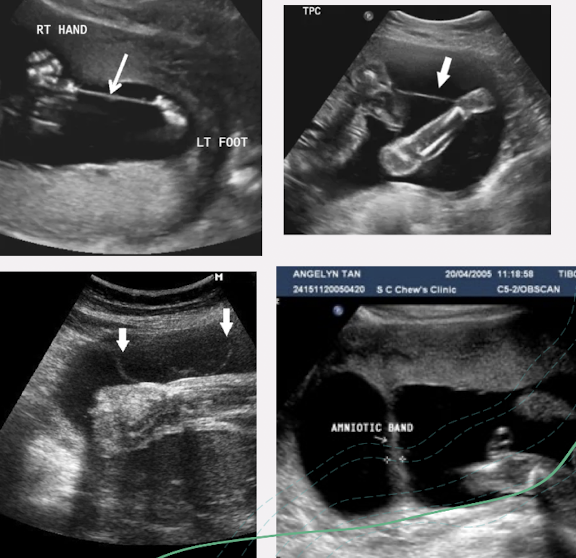
SONO: amniotic band syndrome (ABS)

  • echogenic bands within amniotic cavity

    • follow band from uterine wall to fetal attachment

    • if bands are small, may not be able to visualize

  • any missing extremities or facial deformities should raise suspicion of ABS

  • document normal appearance of extremities and fetal contour

    • help to rule out ABS

<ul><li><p><span style="color: red;">echogenic bands within amniotic cavity </span></p><ul><li><p>follow band from uterine wall to fetal attachment</p></li><li><p>if bands are small, may not be able to visualize</p></li></ul></li><li><p>any missing extremities or facial deformities should raise suspicion of ABS</p></li><li><p>document normal appearance of extremities and fetal contour</p><ul><li><p>help to rule out ABS</p></li></ul></li></ul><p></p>
16
New cards

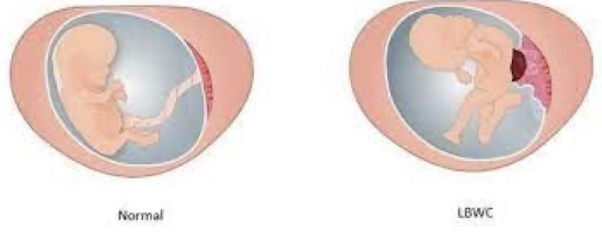
limb-body wall complex

  • aka body stalk anomaly, or short umbilical cord syndrome

    • extends as sheet from margin of cord

  • rare malformation caused by failure of closure of ventral body wall

  • involves: limb or spinal defects, wall defects, thoracic/abdominal defects, craniofacial defects, scoliosis

  • left-sided body wall defects 3x more common than right-sided defects

  • prognosis: fatal

<ul><li><p>aka <span style="color: red;"><em>body stalk anomaly</em></span>, or <span style="color: red;"><em>short umbilical cord syndrome</em></span></p><ul><li><p>extends as sheet from margin of cord</p></li></ul></li><li><p>rare malformation caused by <span style="color: yellow;">failure of closure of ventral body wall</span></p></li><li><p>involves: limb or spinal defects, wall defects, thoracic/abdominal defects, craniofacial defects, scoliosis</p></li><li><p><span style="color: red;">left-sided</span> body wall defects <span style="color: red;">3x more common</span> than right-sided defects</p></li><li><p>prognosis: fatal</p></li></ul><p></p>
17
New cards

SONO: limb-body wall complex

  • large ventral wall defect of abdomen and thorax (usually left-sided)

  • eviscerated organs form a complex mass entangled with membranes

  • cranial anomalies

  • limb defects

  • short umbilical cord

  • fetus is inseparable from placenta (fetus is right on top of it)
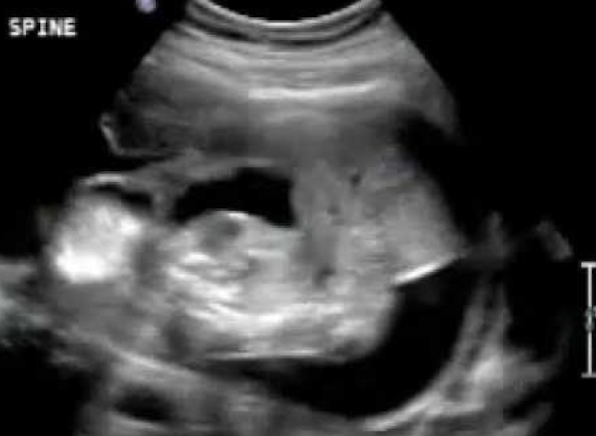
<ul><li><p>large ventral wall defect of abdomen and thorax (usually left-sided)</p></li><li><p>eviscerated organs form a complex mass entangled with membranes</p></li><li><p>cranial anomalies</p></li><li><p>limb defects</p></li><li><p>short umbilical cord</p></li><li><p>fetus is inseparable from placenta (fetus is right on top of it)</p></li></ul><p></p>
18
New cards

pentalogy of Cantrell

  • rare syndrome causing defects involving 5 abnormalities:

    • anterior diaphragmatic hernia

    • high omphalocele (primary finding)

    • intracardiac defect

    • ectopia cordis (cleft defect in lower sternum)

    • defect of diaphragmatic pericardium

  • prognosis: very poor

  • associated with various defects

<ul><li><p>rare syndrome causing defects involving 5 abnormalities:</p><ul><li><p>anterior <span style="color: red;">diaphragmatic hernia</span></p></li><li><p><span style="color: red;">high omphalocele (primary finding)</span></p></li><li><p><span style="color: red;">intracardiac defect</span></p></li><li><p><span style="color: red;">ectopia cordis</span> (cleft defect in lower sternum)</p></li><li><p><span style="color: red;">defect of diaphragmatic pericardium</span></p></li></ul></li><li><p>prognosis: very poor</p></li><li><p>associated with various defects</p></li></ul><p></p>
19
New cards

ectopia cordis

  • exposed heart outside chest wall through cleft sternum

  • most dramatic finding is presence of heart outside thoracic cavity

  • anomalies most frequently associated with ectopia cordis:

    • omphalocele

    • cardiovascular malformations

    • craniofacial defects

<ul><li><p>exposed heart<span style="color: red;"> outside chest wall through cleft sternum</span></p></li><li><p>most dramatic finding is presence of heart outside thoracic cavity</p></li><li><p>anomalies most frequently associated with ectopia cordis:</p><ul><li><p><span style="color: red;">omphalocele</span></p></li><li><p>cardiovascular malformations</p></li><li><p>craniofacial defects</p></li></ul></li></ul><p></p>
20
New cards

Beckwith-Wiedemann Syndrome

  • rare syndrome results in a grossly large fetus

  • characterized by:

    • macroglossia

    • omphalocele

    • embryonic tumors

    • visceromegaly

    • macrosomia

  • associated with hepatic, renal, and adrenal tumors; also ear creases
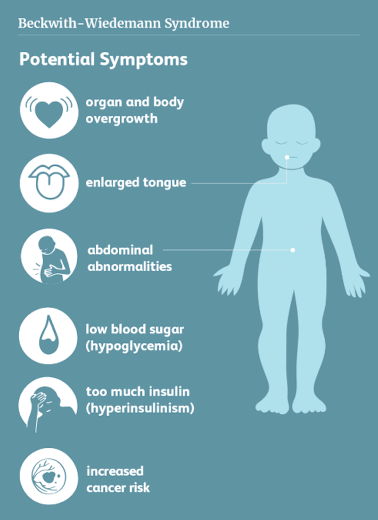
<ul><li><p>rare syndrome results in a grossly large fetus</p></li><li><p>characterized by:</p><ul><li><p><span style="color: red;">macroglossia</span></p></li><li><p>omphalocele</p></li><li><p>embryonic tumors</p></li><li><p><span style="color: red;">visceromegaly</span></p></li><li><p><span style="color: red;">macrosomia</span></p></li></ul></li><li><p>associated with hepatic, renal, and adrenal tumors; also ear creases</p></li></ul><p></p>
21
New cards

SONO: Beckwith-Wiedemann Syndrome

  • large for dates fetus with enlarged kidneys, omphalocele, and macroglossia on 2nd trimester US

  • may have an enlarged spleen, liver, and adrenal glands
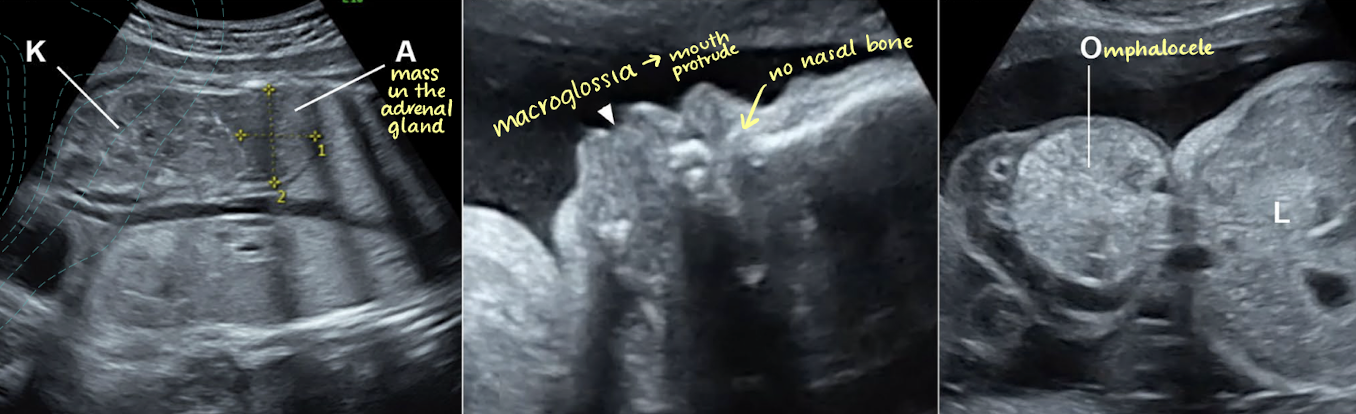
<ul><li><p>large for dates fetus with enlarged kidneys, omphalocele, and <span style="color: red;">macroglossia</span> on 2nd trimester US</p></li><li><p>may have an enlarged spleen, liver, and adrenal glands</p></li></ul><p></p>
22
New cards

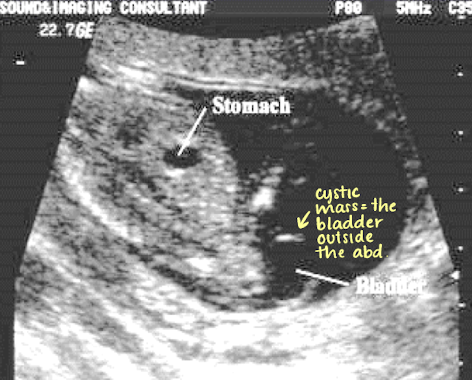
bladder exstrophy

  • defect in lower abdominal wall and anterior wall of urinary bladder

    • caused by incomplete closure of inferior part of abdominal wall

    • causes bladder to protrude outside abdomen

  • defects of the urethra, bladder

  • may be mild or severe (accompanied by omphalocele, inguinal hernia, undescended testes, anal problems)
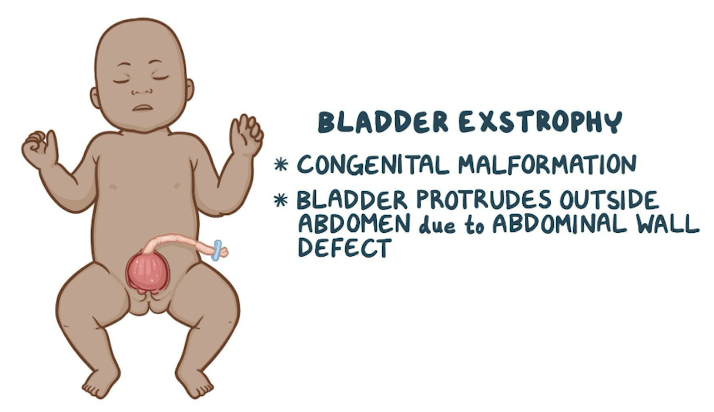
<ul><li><p>defect in lower abdominal wall and anterior wall of urinary bladder</p><ul><li><p>caused by<span style="color: red;"> incomplete closure of inferior part</span> of abdominal wall</p></li><li><p>causes <span style="color: red;">bladder to protrude outside abdomen </span></p></li></ul></li><li><p>defects of the urethra, bladder</p></li><li><p>may be mild or severe (accompanied by omphalocele, inguinal hernia, undescended testes, anal problems)</p></li></ul><p></p>
23
New cards

SONO: bladder exstrophy

  • absence of fluid-filled bladder in pelvis

  • lower abdominal bulge

  • cord insertion is normal or low

  • kidneys and AFI usually normal

<ul><li><p><span style="color: red;">absence of fluid-filled bladder in pelvis</span></p></li><li><p>lower abdominal bulge</p></li><li><p>cord insertion is normal or low</p></li><li><p>kidneys and AFI usually normal</p></li></ul><p></p>
24
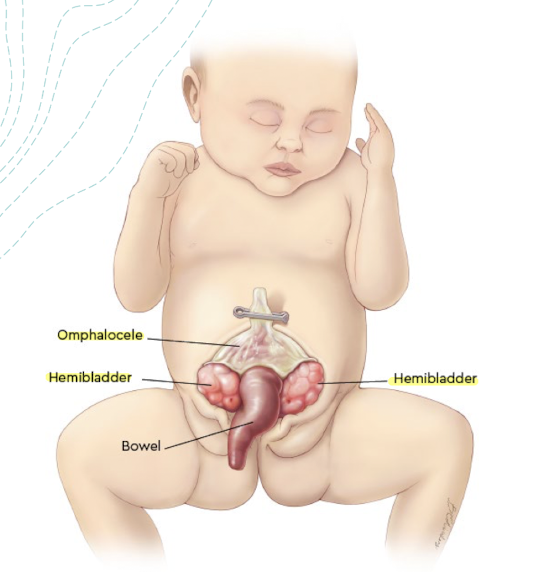
New cards

cloacal exstrophy

  • more rare, complex, and more extreme

  • condition occurs early in development that involves the primitive gut and persistent cloaca

  • defects urethra, bladder, and bowel are present

  • results in:

    • exstrophy of the bladder (with 2 hemibladders separated by muscosa)

    • omphalocele (upper part of defect)

    • lower abdominal wall defect

<ul><li><p>more rare, complex, and more extreme</p></li><li><p>condition occurs early in development that involves the primitive gut and persistent cloaca</p></li><li><p>defects urethra, bladder, and bowel are present</p></li><li><p>results in:</p><ul><li><p><span style="color: red;">exstrophy of the bladder</span> (with <span style="color: red;">2 hemibladders</span> separated by muscosa)</p></li><li><p><span style="color: yellow;">omphalocele</span> (upper part of defect)</p></li><li><p>lower abdominal wall defect</p></li></ul></li></ul><p></p>
25
New cards

SONO: cloacal exstrophy

  • absence of normal bladder

  • lower abdominal defect

  • herniation of bowel between halves of bladder

  • omphalocele

<ul><li><p>absence of normal bladder</p></li><li><p>lower abdominal defect</p></li><li><p>herniation of bowel between halves of bladder</p></li><li><p>omphalocele</p></li></ul><p></p>
26
New cards

liver (hepatobiliary abnormality)

  • rarely affected by isolated hepatic lesions

    • if lesions seen, cysts and hemangiomas are MC

  • fetal liver tumors are uncommon

    • hemangioendothelioma is MC if one is found

  • liver enlarges in fetuses with Rh-immune disease in response to increased hematopoiesis

27
New cards

SONO: liver (hepatobiliary abnormalities)

  • most fetal liver tumors appear as solid masses, sometimes with cystic components; may be calcified

  • liver calcification may be observed as isolated echogenic focus

    • is usually a benign finding

    • if multiple calcifications seen within liver, other organs such as brain and spleen may be affected
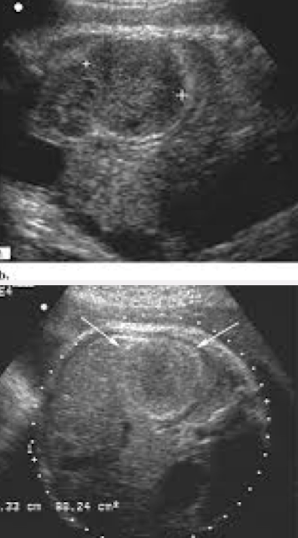
<ul><li><p>most fetal liver tumors appear as solid masses, sometimes with cystic components; may be calcified</p></li><li><p>liver calcification may be observed as isolated echogenic focus</p><ul><li><p>is usually a benign finding</p></li><li><p>if multiple calcifications seen within liver, other organs such as brain and spleen may be affected</p></li></ul></li></ul><p></p>
28
New cards

spleen (hepatobiliary abnormalities)

asplenia

  • absence of spleen

  • accompanied abnormal positions of liver, GB, and stomach

polysplenia

  • more than one spleen

  • associated with situs inversus

  • GB is typically absent

splenomegaly

  • usually associated with Rh-immine disease

29
New cards

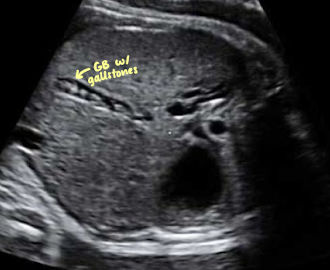
GB (hepatobiliary abnormalities)

cholelithiasis

  • uncommon in fetus; usually resolve in utero or childhood

choledochal cyst

  • dilation of CBD

  • presents as cystic mass adjacent to GB

biliary atresia

  • absence of GB

  • may be associated with polysplenia

<p><strong>cholelithiasis</strong></p><ul><li><p>uncommon in fetus; usually resolve in utero or childhood</p></li></ul><p><strong>choledochal cyst</strong></p><ul><li><p><span style="color: red;">dilation of CBD</span></p></li><li><p>presents as <span style="color: red;">cystic mass adjacent to GB</span></p></li></ul><p><strong>biliary atresia</strong></p><ul><li><p><span style="color: red;">absence of GB</span></p></li><li><p>may be associated with polysplenia </p></li></ul><p></p>
30
New cards

pancreas (hepatobiliary abnormalities)

  • fetal pancreatic anomalies are rare

  • pancreatic cysts are uncommon

    • when present, will appear as midline cystic mass
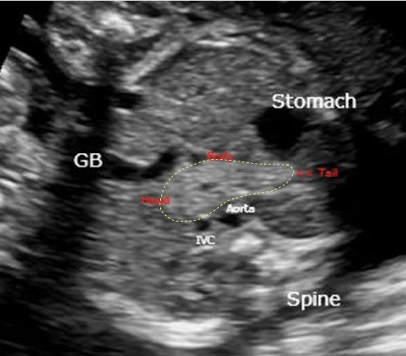
<ul><li><p>fetal pancreatic anomalies are rare</p></li><li><p>pancreatic cysts are uncommon</p><ul><li><p>when present, will appear as midline cystic mass</p></li></ul></li></ul><p></p>
31
New cards

GI tract abnormalities tips

  • check bowel diameter

  • bowel dilation not evident until 20w

  • polyhydramnios commonly with obstruction

    • why? b/c fetus can’t swallow normally due to obstruction

  • lack of stomach: possible “upstream abnormality”

32
New cards

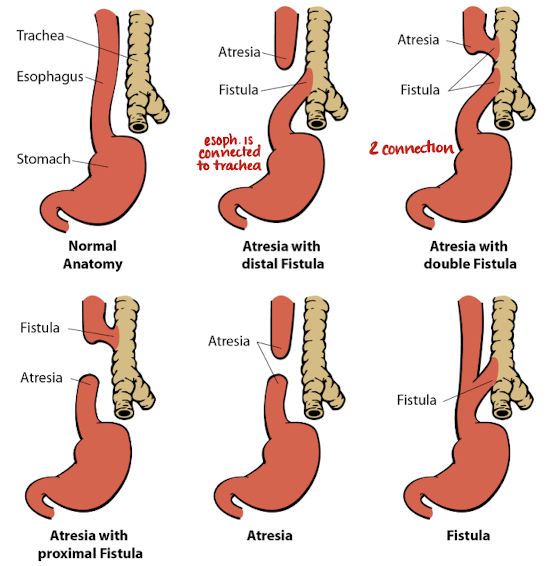
esophageal atresia (GI tract abnormality)

  • congenital absence/blockage of esophagus

    • esophagus fails to develop as a continuous passage

    • trachea and esophagus don’t separate → fistula

  • often occurs with tracheoesophageal fistula

  • associated with trisomy 18, 21

  • often occurs with VACTERL syndrome

<ul><li><p>congenital <span style="color: red;">absence/blockage of esophagus</span></p><ul><li><p>esophagus fails to develop as a continuous passage</p></li><li><p>trachea and esophagus don’t separate → fistula</p></li></ul></li><li><p>often occurs with tracheoesophageal fistula</p></li><li><p>associated with <span style="color: yellow;">trisomy 18, 21</span></p></li><li><p>often <span style="color: red;">occurs with VACTERL</span> syndrome</p></li></ul><p></p>
33
New cards

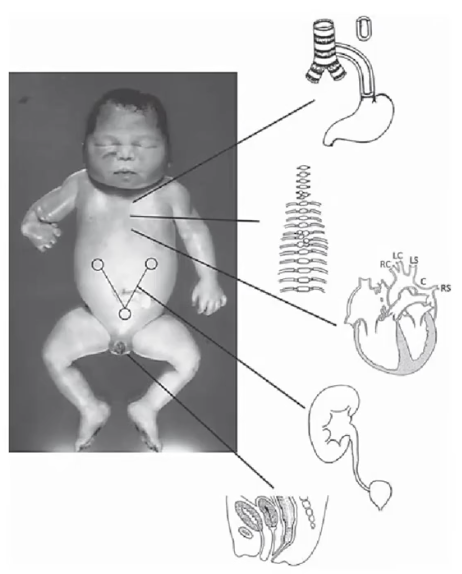
what is VACTERL syndrome?

  • V: vertebral defects

  • A: anal atresia

  • C: cardiac anomalies

  • TE: tracheoesophageal fistula

  • R: renal anomalies

  • L: limb defects

<ul><li><p>V: vertebral defects</p></li><li><p>A: anal atresia</p></li><li><p>C: cardiac anomalies</p></li><li><p>TE: tracheoesophageal fistula</p></li><li><p>R: renal anomalies</p></li><li><p>L: limb defects</p></li></ul><p></p>
34
New cards

SONO: esophageal atresia (GI tract abnormality)

  • stomach not visualized

  • polyhydramnios

  • IUGR appearance (sometimes)

    • not always seen prenatally because TE fistula results in normal size stomach and normal AFI
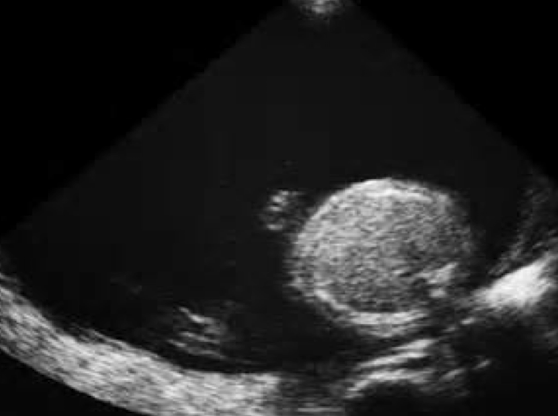
<ul><li><p><span style="color: red;">stomach not visualized </span></p></li><li><p><span style="color: red;">polyhydramnios</span></p></li><li><p>IUGR appearance (sometimes)</p><ul><li><p>not always seen prenatally because TE fistula results in normal size stomach and normal AFI</p></li></ul></li></ul><p></p>
35
New cards

duodenal atresia (GI tract abnormality)

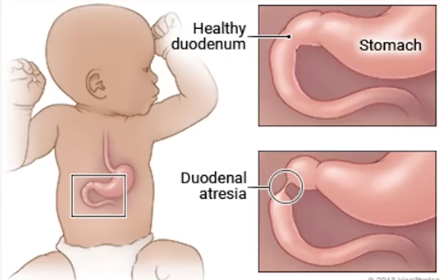
  • constricted duodenum located distal to ampulla of Vater

    • dilation of duodenum due to stenosis/atresia

    • amniotic fluid enters stomach and upper duodenum (dilation of both)

  • MC bowel obstruction in fetus

  • unknown cause

  • associated with T21 and cardiac anomalies

  • prognosis: excellent (if isolated)

<ul><li><p>constricted duodenum located distal to ampulla of Vater</p><ul><li><p>dilation of duodenum due to stenosis/atresia</p></li><li><p>amniotic fluid enters stomach and upper duodenum (dilation of both)</p></li></ul></li><li><p><span style="color: red;">MC bowel obstruction in fetus</span></p></li><li><p>unknown cause</p></li><li><p><span style="color: red;">associated with T21</span> and cardiac anomalies</p></li><li><p>prognosis: excellent (if isolated)</p></li></ul><p></p>
36
New cards

SONO: duodenal atresia (GI tract abnormality)

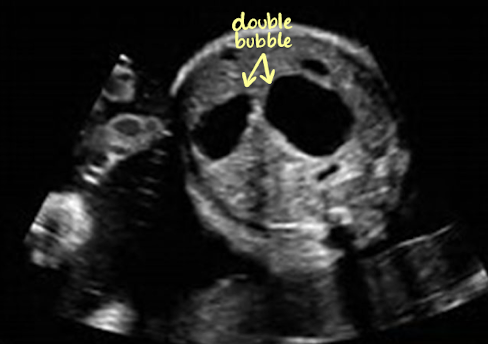
  • double bubble sign

    • dilated stomach and duodenum

  • polyhydramnios

  • AC will be large

<ul><li><p><span style="color: red;">double bubble sign</span></p><ul><li><p>dilated stomach and duodenum </p></li></ul></li><li><p>polyhydramnios</p></li><li><p>AC will be large</p></li></ul><p></p>
37
New cards

small bowel atresia/obstruction (GI tract abnormality)

  • congenital narrowing or obstruction of small bowel

  • MC in proximal jejunum or distal ileum

  • general rule: the more distal the obstruction, the less severe the polyhydramnios

  • causes of fetal small-bowel obstruction
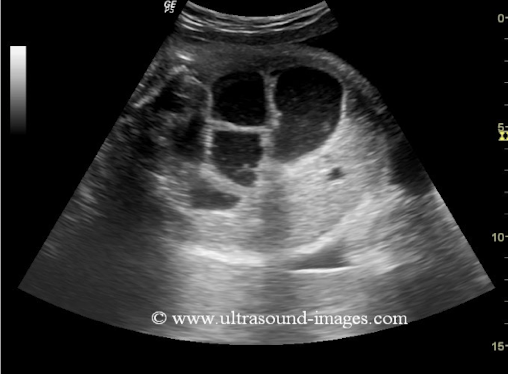
<ul><li><p>congenital narrowing or obstruction of small bowel</p></li><li><p><span style="color: red;">MC in proximal jejunum or distal ileum</span></p></li><li><p>general rule: the more distal the obstruction, the less severe the polyhydramnios</p></li><li><p>causes of fetal small-bowel obstruction</p></li></ul><p></p>
38
New cards

SONO: small bowel atresia/obstruction (GI tract abnormality)

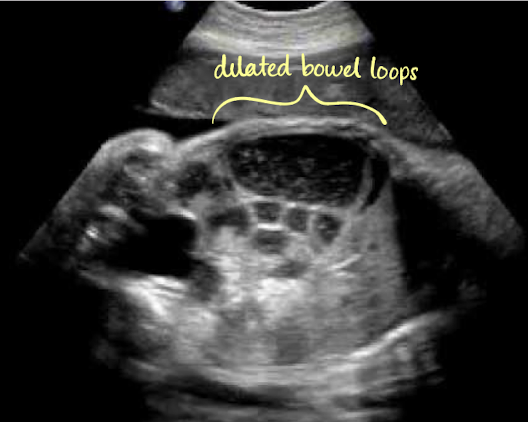
  • dilated loops of bowel (cystic dilation)

  • persistently full stomach and dilated bowel loops

  • absence of peristalsis

    • pay attention to whether or not there’s movement

  • hydramnios

<ul><li><p><span style="color: red;">dilated loops of bowel (cystic dilation)</span></p></li><li><p>persistently full stomach and dilated bowel loops</p></li><li><p><span style="color: red;">absence of peristalsis</span></p><ul><li><p><span style="color: rgb(255, 255, 255);">pay attention to whether or not there’s movement</span></p></li></ul></li><li><p>hydramnios</p></li></ul><p></p>
39
New cards
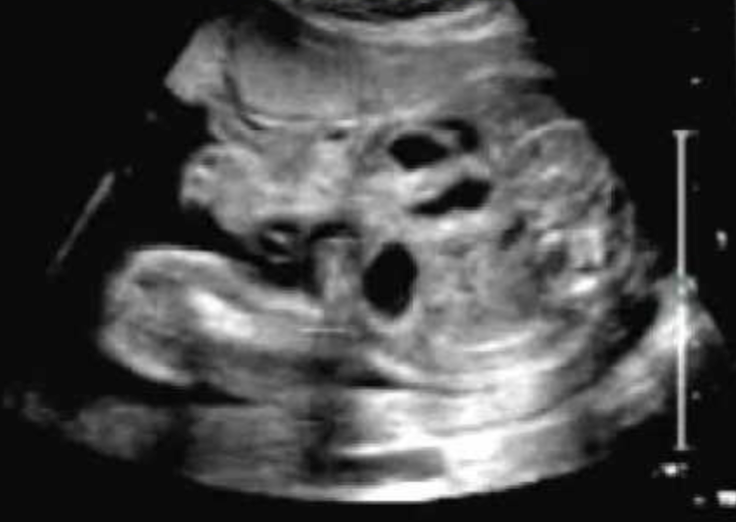
<p>what do you see? pathology?</p>

what do you see? pathology?

small bowel atresia/obstruction
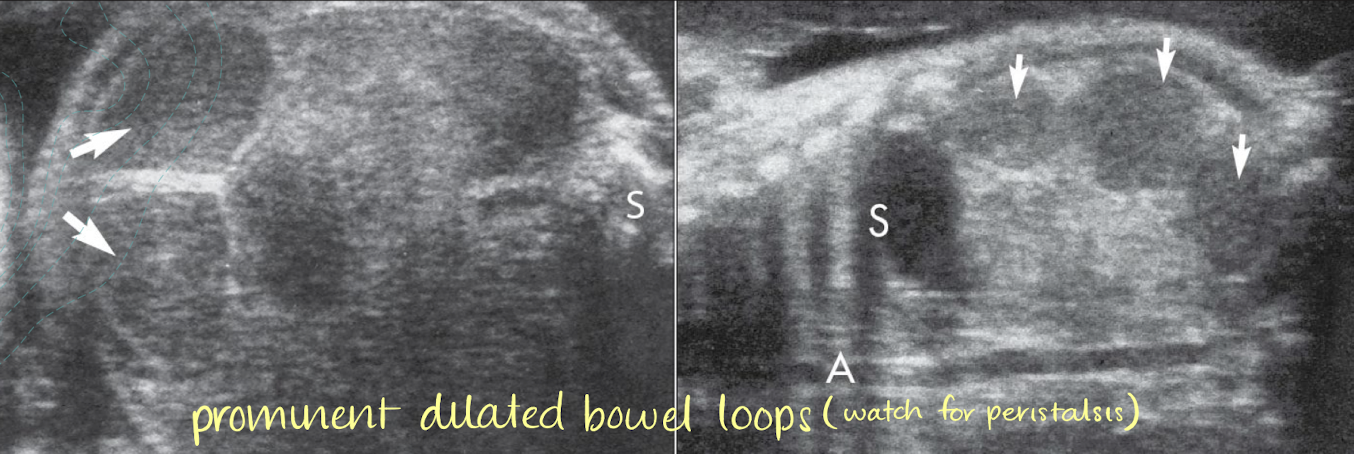
<p>small bowel atresia/obstruction</p>
40
New cards

anorectal atresia (GI tract abnormality)

  • complex disorder of bowel and genitourinary tract

  • imperforate anus (membrane covers anus, prohibiting expulsion of meconium—meconium cant get out)

  • maybe associated with VACTERL or caudal regression

  • poor prognosis

41
New cards

SONO: anorectal atresia (GI tract abnormality)

  • fluid-filled, dilated colon

  • calcified meconium

  • normal AFI

    • can be decreased if renal problems are present
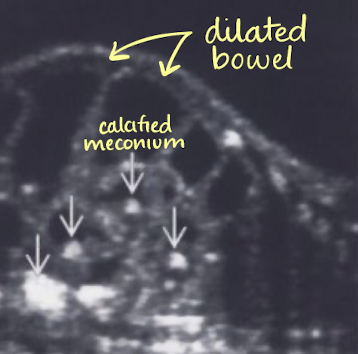
<ul><li><p>fluid-filled, dilated colon</p></li><li><p><span style="color: red;">calcified meconium</span></p></li><li><p>normal AFI</p><ul><li><p>can be decreased if renal problems are present</p></li></ul></li></ul><p></p>
42
New cards

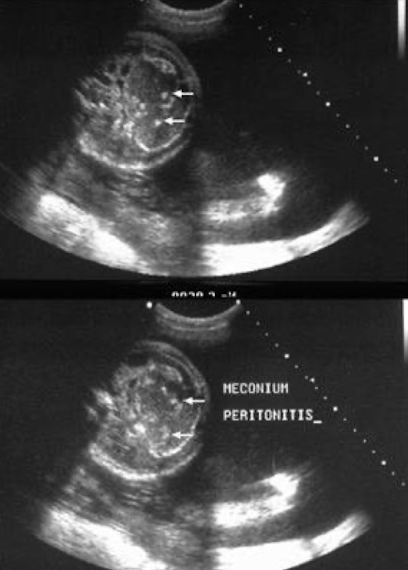
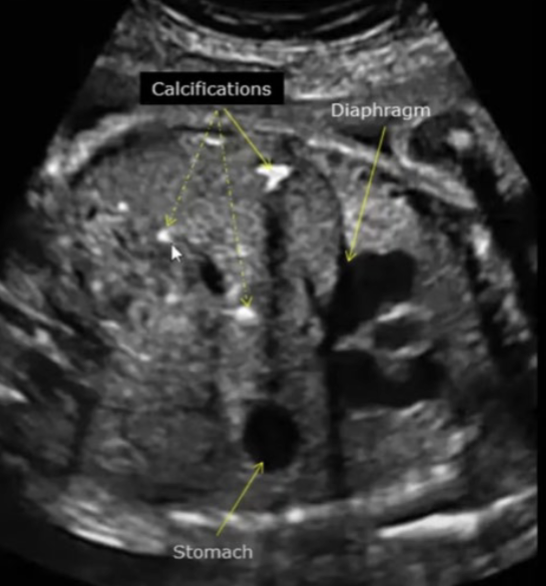
meconium peritonitis

  • fetus has sterile chemical peritonitis secondary to in utero bowel perforation

  • hydramnios present in 65% of fetuses

43
New cards

SONO: meconium peritonitis

  • calcifications seen on peritoneal surfaces or in scrotum via processus vaginalis

  • ascitic fluid may be echogenic

<ul><li><p><span style="color: red;">calcifications seen on peritoneal surfaces </span>or in scrotum via processus vaginalis</p></li><li><p>ascitic fluid may be echogenic</p></li></ul><p></p>
44
New cards
<p>pathology?</p>

pathology?

meconium peritonitis

45
New cards

meconium ileus

  • small-bowel disorder with thick meconium in distal ileum

  • ileum dilates because of impacted meconium

  • most infants with this have cystic fibrosis
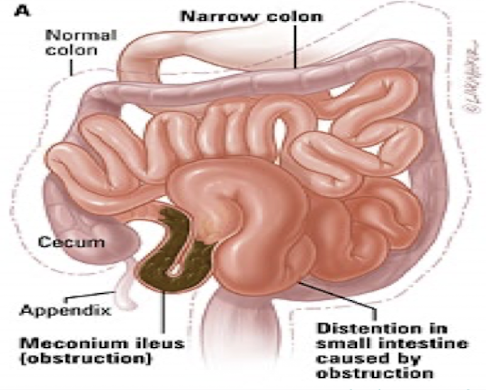
<ul><li><p>small-bowel disorder with thick meconium in distal ileum</p></li><li><p>ileum dilates because of impacted meconium</p></li><li><p>most infants with this have <span style="color: red;">cystic fibrosis </span></p></li></ul><p></p>
46
New cards

SONO: meconium ileus

  • usually apparent in 3rd trimester

  • dilation of small bowel

  • echogenic bowel

  • calcifications may be present

47
New cards

hyperechoic bowel

  • echogenicity similar to bone

  • typically compared to iliac crest

    • grade 1: mildly echogenic and typically diffuse

    • grade 2: moderately echogenic and typically focal

    • grade 3: very echogenic, similar to that of bone structures
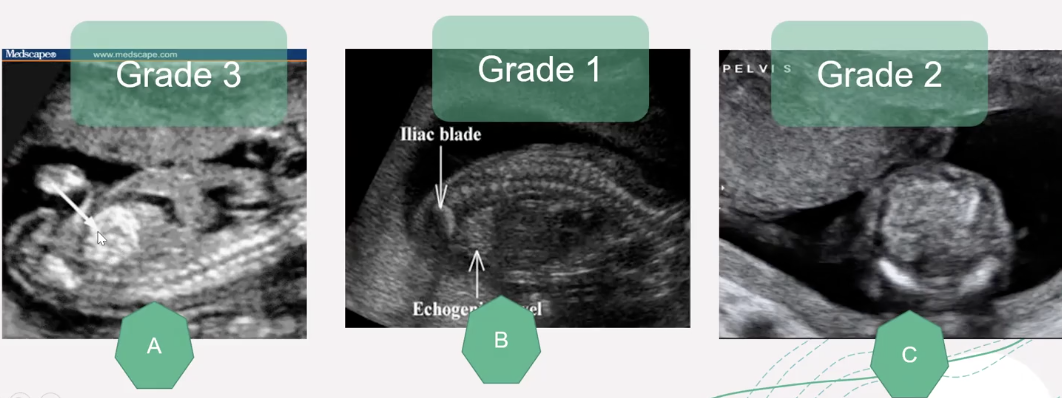
<ul><li><p>echogenicity similar to bone</p></li><li><p>typically compared to iliac crest</p><ul><li><p>grade 1: mildly echogenic and typically diffuse</p></li><li><p>grade 2: moderately echogenic and typically focal</p></li><li><p>grade 3: very echogenic, similar to that of bone structures</p></li></ul></li></ul><p></p>
48
New cards

SONO: hyperechoic bowel

  • usually apparent in the 3rd trimester

  • dilation of small bowel

  • echogenic bowel

  • calcifications may be present

49
New cards

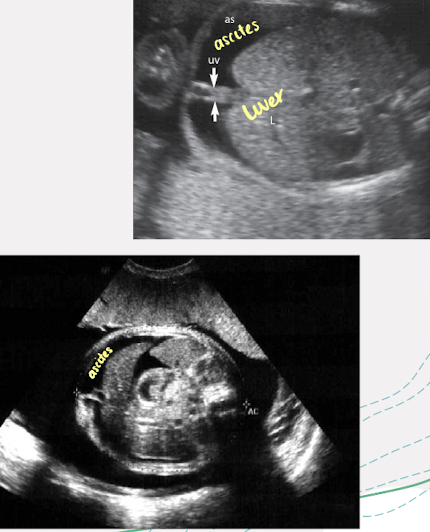
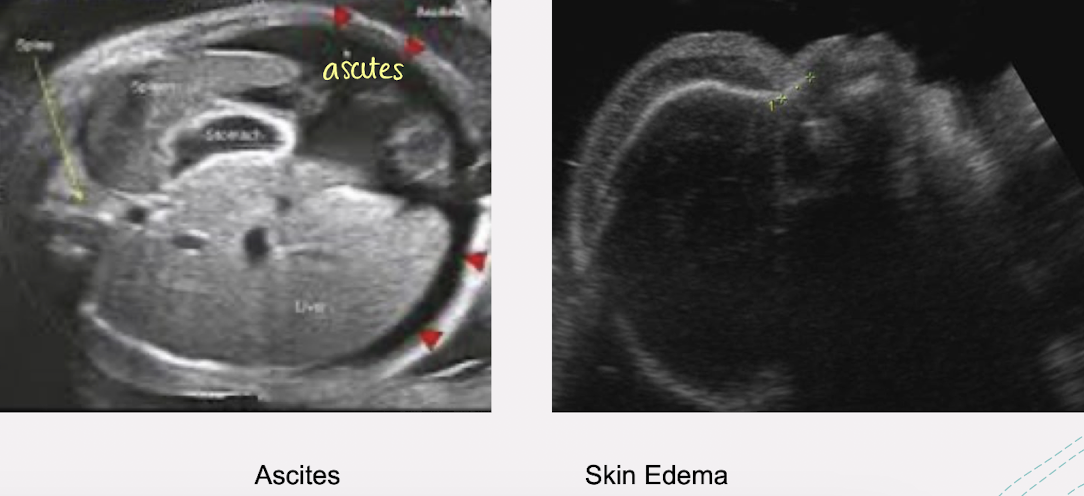
ascites

  • true ascites in fetal abdomen always abnormal

  • other conditions that may cause ascites to develop include bowel perforation or urinary ascites secondary to bladder rupture

50
New cards

SONO: ascites

  • fluid collects between 2 leaves of unfused omentum → cyst-like appearance in abdomen

  • ascitic fluid may be echogenic

<ul><li><p>fluid collects between 2 leaves of unfused omentum → <span style="color: red;">cyst-like appearance in abdomen</span></p></li><li><p>ascitic fluid may be echogenic</p></li></ul><p></p>
51
New cards

Meckel’s diverticulum

  • remnant of proximal part of yolk stalk that fails to degenerate and disappear during early fetal period

  • MC malformation of midgut

  • it is usually a small finger-like sac, about 5cm long, that projects from border of ileum
<ul><li><p><span style="color: red;">remnant of proximal part of yolk stalk</span> that fails to degenerate and disappear during early fetal period</p></li><li><p>MC malformation of midgut</p></li><li><p>it is usually a small finger-like sac, about 5cm long, that projects from border of ileum</p></li></ul><p></p>
52
New cards

hydrops fetalis

  • life-threatening, severe condition

  • abnormal fluid builds up in two or more fetal compartments (e.g. abdomen, lungs, heart), causing total body swelling

  • usually diagnosed via prenatal ultrasound and treated by addressing the underlying cause

  • prognosis: poor

    • often fatal, with about 50% survival rate for live-born babies

    • high mortality rate before or shortly after birth

  • tx: in-utero interventions like…

    • blood transfusions

    • draining fluids

    • early delivery

53
New cards

causes of hydrops fetalis

  1. non-immune hydrops (NIHF): MC type, caused by heart/lung problems, genetic abnormalities, or infections like Parvovirus B19

  2. immune hydrops: occurs due to Rh blood incompatibility between mother and fetus, though this is less common due to RhoGAM treatments

54
New cards

S/S of hydrops fetalis

  • severe swelling

  • severe anemia

  • jaundice

  • heart failure

55
New cards

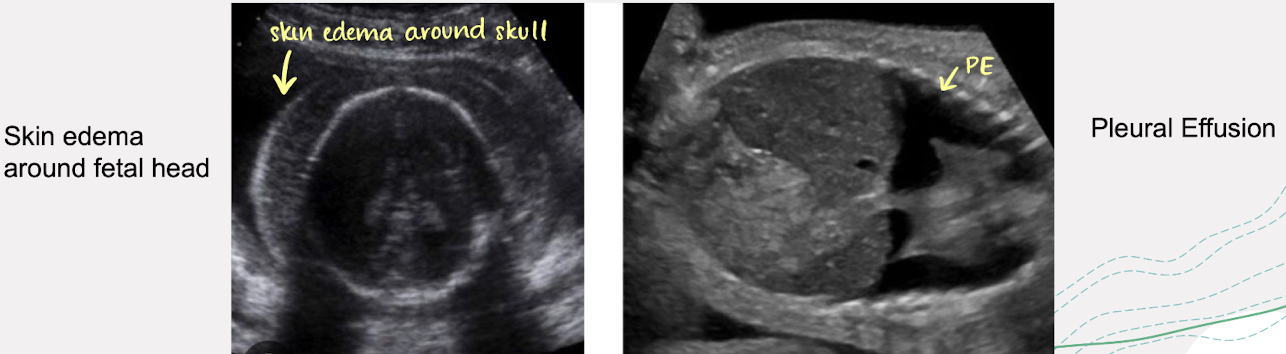
SONO: hydrops fetalis

  • fluid in abdomen (ascites)

  • around the lungs (pleural effusion)

  • around the heart (pericardial effusion)

  • polyhydramnios

<ul><li><p>fluid in abdomen (ascites)</p></li><li><p>around the lungs (<span style="color: yellow;">pleural effusion</span>)</p></li><li><p>around the heart (pericardial effusion)</p></li><li><p>polyhydramnios</p></li></ul><p></p>
56
New cards

fetal anasarca

  • rare, severe, often fatal form of hydrops fetalis

  • characterized by massive, subcutaneous edema (fluid accumulation) in fetus

  • end-stage condition featuring total body swelling, skin thickening, and often visceral effusions

    • intense. widespread swelling throughout the body—including head, limbs, torso

  • typically measuring more than 5mm in tissue thickness

  • associated with non-immune or immune hydrops fetalis (e.g. erythroblastosis fetalis)

  • prognosis: often indicated imminent fetal death

57
New cards

causes of fetal anasarca

  • driven by underlying factors such as…

    • severe fetal cardiovascular impairment

    • chromosomal abnormalities

    • infections

    • metabolic conditions

58
New cards

SONO: fetal anasarca

  • in severe cases, this condition can cause serious complications such as

    • polyhydramnios

    • placental edema

<ul><li><p>in severe cases, this condition can cause serious complications such as</p><ul><li><p>polyhydramnios </p></li><li><p>placental edema</p></li></ul></li></ul><p></p>