Self-Care II: Oral Care
 Call Kai
 Learn
Learn Practice Test
 Spaced Repetition
 Match
Match Flashcards
 Knowt Play
1/19

There's no tags or description
Looks like no tags are added yet.
Name | Mastery | Learn | Test | Matching | Spaced | Call with Kai |
|---|
No analytics yet
Send a link to your students to track their progress
20 Terms
Tooth Hypersensitivity
Etiologic: _____ and _____
Pathophysiology: exposed and open dentin though enamel loss or gingival recession; dentin tubules exposed to oral cavity and pulp AND/OR stimuli (heat, cold, pressure, acid) cause fluid in the dentinal tubules to expand + shrink, stimulating pulp nerve fibers, resulting in pain
Causes: _____ infection, aggressive or improper _____, _____ (attrition, abrasion, erosion), _____ (acidic foods + drink), _____, _____, bruxism (_____)
Sxs: A _____, fleeting, _____, or _____ pain on exposure to thermal, chemical, or physical stimuli, which stops after stimuli are no longer present
Assessment: due to attrition, abrasion, or erosion is not serious and is self-treatable; sensitivity due to fracture, faulty restoration, or gingival recession warrants referral to an OHCP
exposed, open dentin tubules, periodontal, brushing, injury, diet, GERD, bulimia, teeth grinding, quick, sharp, stabbing
Toothache (KNOW DIFFERENCE W/Tooth Hypersensitivity)
Etiologic: _____ extending to the _____
Pathphysiology:
_____ response to invading bacteria stimulates free nerve endings in the pulp
_____ (heat, cold, pressure, acid) cause fluid in the _____ to expand and shrink, stimulating pulp nerve fibers and resulting in _____
Causes:
_____ present in tooth/teeth under existing restoration, tooth/restoration fracture, or trauma to the dentition
Attrition, abrasion, erosion, tooth/restoration fracture, faulty restoration, or gingival recession
Sxs:
Pain that remians even in the absence of stimulus; _____, _____, and _____ pain on stimulation may indicate reversible damage; _____, _____, and _____ pain without stimulation usually indicates irreversible damage
A _____, fleeting, _____, or _____ pain on exposure to thermal, chemical, or physical stimuli, which stops after stimuli are no longer present
Assessment: Requires _____ for resolution
bacterial invasion, pulp, inflammatory, stimuli, dentinal tubules, pain, cavitation/decay, intermittent, short, sharp, continuous, dull, throbbing, quick, sharp, stabbing, dental care
Plaque Removal Devices: Utilize various instruments such as toothbrushes, dental floss, and oral irrigators
_____: Effective for removing dental plaque + promoting optimal oral hygiene
_____: Regular use aids in the removal of interdental plaque, reducing gingival inflammation, and serving as a preventive measure against both periodontal disease + dental caries
_____: Utilize cleaning devices designed to adapt to irregular tooth surfaces (toothpicks, interdental brushes)
_____: These devices direct a high-pressure stream of water through a nozzle onto tooth surfaces for effective cleaning
toothbrushes, dental floss, specialized aids, oral irrigators
Fluoride Use
Increases resistance to enamel _____ by acids
Facilitates remineralization of early carious lesions of enamel
Interferes with the _____ cariogenic process and with plaque adherence
Benefits: fewer _____, _____ or _____ teeth; better tooth retention; lower incidence of _____ (very painful)
Dental Fluorosis: when children ingest an excess amount of any fluoride product for a sufficient period during the time of tooth formation
Avoid fluoride use in children < _ d/t increased risk
demineralization, bacterial, decayed, missing, filled, root carries, 6
Exclusions for Tooth Hypersensitivity
_____
Mouth soreness associated with _____
Presence of _____ or _____
_____ teeth
_____ gums in the absence of trauma
Broken or Knocked out teeth
_____ tooth pain triggered/worsened by _____
Trauma to the mouth with bleeding, swelling, and soreness
toothache, poor-fitting dentures, fever, swelling, loose, bleeding, severe, stimuli
Exclusion for RAS (Canker sores)
_____ associated with underlying pathology
_____ present for ≥ _____
_____ lesions
Symptoms of _____
Failure of _____ (symptoms present for ≥ _____, symptoms _____)
lesions, lesions, 14 days, frequently recurring, systemic illness, self-treatment, 7 days, worsen
Mouth Rinses
Recommended to regularly use mouth rinse with plaque or calculus control properties as an adjunct to proper tooth brushing with _____ toothpaste
Effective for the reduction of _____ and _____
Should be kept out of the reach of children due to accidental ingestion due to possible _____ content contained in rinse (0-27%)
fluoride, plaque, gingivitis, alcohol
Mouth Rinses
Fluoride Mouth Rinses
ACT Anticavity Fluoride Rinse → Sodium fluoride 0.05%
Colgate Phos-Flur Ortho Defense → Sodium fluoride 0.04%
Listerine Total Care Anticavity Mouthwash → Sodium fluoride 0.02%
Plaque/Gingivitis Control Mouth Rinses
Listerine Antiseptic → Eucalyptol 0.092%; Menthol 0.042%;| Methyl Salicylate 0.06%; Thymol 0.064%
Equate Antiseptic Mouthrinse → same as above
Cosmetic Mouth Rinses (HIGH alcohol content)
ClosYS Sensitive Rinses → N/A
TheraBreath Fresh Breath Oral Rinse → N/A
KNOW
Other Pharmacological Options (Active Ingredient)
_____ Chloride
Indication/Purpose: Reduce bad breath, plaque, and gingivitis
Antimicrobial action
May cause brown staining of teeth, tongue, and/or restorations
Essential oils such as _____, _____, _____, _____
Indication/Purpose: Reduce bad breath, plaque, and gingivitis
May be a potential allergen or irritant for some patients
_____ (for dentures)
Indication/Purpose: Tooth whitening
Reduce extrinsic stains
_____ & _____
Indication/Purpose: Reduce bad breath
Chemical prevention of oral malodor
Cetylpyridinium, Eucalyptol, Menthol, Thymol, Methyl Salicylate, Peroxide, Zinc Salt, Chlorine Dioxide
Nonpharmacologic Therapy: Tooth Hypersensitivity
Treatment plans for tooth hypersensitivity should include identification and elimination of predisposing factors, such as _____ and potentially _____ or _____ toothbrushing technique
If correct brushing techniques with a fluoride toothpaste do not yield improvement, consider using a _____ toothpaste
acid exposure, improper, aggressive, desensitizing
Pharmacologic Therapy (Selected Nonprescription Desensitizing Toothpastes)
_____ toothpastes
Diffuses along the dentin tubules to decrease the excitability of intradental nerves and alter its membrane potential
_____ most common
_____, _____, Oxalate, Strontium salt-based toothpastes
Works by occluding the exposed dentinal tubules, prevents fluid from moving into the tubules, which is the cause of hypersensitivity
Potassium Salt-Based, Potassium Nitrate 5%, Arginine/Calcium, Fluoride
Teething Discomfort
Nonpharmacologic Therapy:
_____ the gum around the erupting tooth
Giving a _____ (not frozen) _____, pacifier, spoon, or washcloth
_____ or _____ (if child can tolerate solid food)
Oral Pain Relievers
Pediatric doses of _____ (_____) or _____ (_____)
Topical Anesthetics [_____]
_____ blocks nerve conduction by inhibiting the depolarization of the neuronal membrane, thus blocking the initiation and conduction of nerve impulses
Available 5-20% as topical anesthetic
Caution: _____ is too potent for _____ → cause _____ (drug _____)
FDA and AAP no longer recommend benzocaine for teething due possible interference with _____, causing _____
Massaging, cold, teething ring, dry toast, teething biscuits, NSAIDs, Ibuprofen, APAP, Tylenol, Benzocaine, Benzocaine, Benzocaine 20%, infants, death, OD, gag reflex, choking
Herpes Simplex Labialis
Nonpharmacologic Therapy:
Lesions should be kept clean by gently washing with _____
_____ is important in preventing lesion contamination and minimizing autoinoculation of herpes virus
The involved skin should be kept _____ to prevent drying and fissuring (cracking), which render lesions susceptible to _____
Factors that delay healing (e.g., stress, local trauma, excessive wind or sun exposure, fatigue) should be avoided if known
Patients who identify sun exposure as a precipitating event should be advised to routinely use an appropriate sunscreen product on the _____ and _____
mild soap solutions, handwashing, moist, secondary bacterial infection, lips, face
Herpes Simplex Labialis
Pharmacological Therapy
Topical Skin Protectants:
Protect the lesions from _____, relieve _____, and keep the involved tissue _____, but they do not reduce the _____
Use 3-4 times/day PRN
Topical Oral Anesthetics
Including benzocaine 5%–20%, dibucaine 0.25%–1%, dyclonine hydrochloride 0.5%–1%, benzyl alcohol 10%–33%, camphor 1%–3%, and menthol 0.1%–1% relieve the discomfort of _____, _____, and _____
_____ (Abreva Cream)
Only FDA-approved nonprescription product proven to reduce the duration and severity of symptoms
Inhibits direct fusion between the herpesvirus and the human cell plasma membrane → preventing viral replication
Treatment: reduces the median healing time to healing by approximately _____ (_____ hours); reduces symptom severity by ~20%
Apply at the _____ (prodromal stage), _____, until the lesion is healed, but for no more than _____
infection, dryness, soft, duration of symptoms, burning, itching, pain, Docosanol 10%, 1 day, 18, 1st sign of an outbreak, 5x/day, 10 days
Patient Education (Teeth Hypersensitivity)
Relief may take _____ to _____ (~__), the better the patient is at removing bacterial plaque, the more quickly the sensitivity will resolve
Use the dentifrice for as long as the dentist recommends and then switch to a _____ (_____) fluoride dentifrice
Some cases of tooth hypersensitivity require _____ treatment or several _____ treatments
Do not use _____ or _____ toothpastes in children <_____
Do not use _____ toothpastes, such as cosmetic pastes that whiten or remove stains
See a dentist if pain worsens during treatment or if new Sxs develop
several days, several weeks, 4, low-abrasion, non-whitening, long-term, repeated, potassium nitrate, desensitizing, 12 y/o, high-abrasion
Patient Education (Teething Discomfort)
ADA recommends _____, including a visit within _____ of eruption of the child's _____ and no later than the child’s _____
If a baby is _____ or has diarrhea, fever, nasal congetion, malaise, pain, or other symptoms not typical of teething discomfort, take the baby to a pediatrician or other primary care provider
If neither nonpharmacologic measures nor nonprescription medications are relieving the symptoms within _____, the parent should be advised to take the baby to a pediatrician, pediatric dentist, or other primary care provider (Refer AFTER _____)
regular dental checkups, 6 months, first tooth, first birthday, vomiting, 2 days, 2 days
Oral Debriding & Wound-Cleansing Agents
Cankaid Liquid Oral Antiseptic → Carbamide peroxide 10%
Gly-Oxide Antiseptic Oral Cleanser → Carbamide peroxide 10%
Orajel Antideptic Rinse for Mouth Sores → Hydrogen peroxide 1.5%
Colgate Peroxyl Mouth Sore Rinse → Hydrogen peroxide 1.5%
Counseling Points
Do not use these medications longer than _____ (_____)
Chronic use can cause tissue _____, _____ of enamel
Do not _____ these medications
7 days, 3-4x/day, irritation, decalcification, swallow
Recurrent Aphthous Stomatitis
Nonpharmacologic Therapy
General measures aimed at maintaining good oral hygiene, avoiding exacerbating factors, and reducing pain
If a deficiency of _____, _____, or _____ is suspected, increase consumption of foods high in the deficient nutrient, or take appropriate nutritional supplements
Avoid _____ foods until the lesions heal
Avoid _____-textured foods that may cause increased trauma to the lesion
If desired, apply ice directly to the lesions in _____ increments but for no longer than _____ in a given hour
Do not use _____. If an infection is present, _____ may spread the infection
_____ to help cleanse, debride, and soothe area (1-3 tsp salt in 4-8oz water) or baking soda pastes. Can use BEFORE applying medication
iron, folate, vitamin b, spicy or acidic, sharp, 10-minute, 20 mins, heat, heat, salt rinses
Recurrent Aphthous Stomatitis
Pharmacological Therapy (no preference of which one to generally recommend)
Oral Debriding/Cleansing Agents [Hydrogen Peroxide 1.5%, Carbamide Peroxide 10-15%]
Products that release oxygen can be used as debriding and cleansing agents to provide temporary relief of RAS discomfort (direct application)
Aid in the removal of debris, phlegm, mucus, or other secretions associated with a sore mouth
Cleanse areas of minor gum inflammation and ulcers
1:1 solution of hydrogen peroxide
Topical Oral Anesthetics
Including Benzocaine 5%–20% (2 and up), benzyl alcohol 0.05%–0.1%, Dyclonine 0.05%–0.1%, or hexylresorcinol 0.05%–0.1% generally are recognized as effective for temporary relief of pain associated with RAS
Topical Oral Protectants
Pharmacologically inert substances that coat and can be effective in protecting ulcerations, decreasing friction, and giving temporary symptomatic relief
Available as a patch or dissolving disc must be placed against the sore for 10–20 seconds and creates a barrier by using a paste, an adhering film, or a dissolvable patch to cover the lesion
Systemic Analgesics [NSAIDs/ASA/APAP]
Provide additional relief of mouth discomfort
Dose per usual recommendations
KNOW
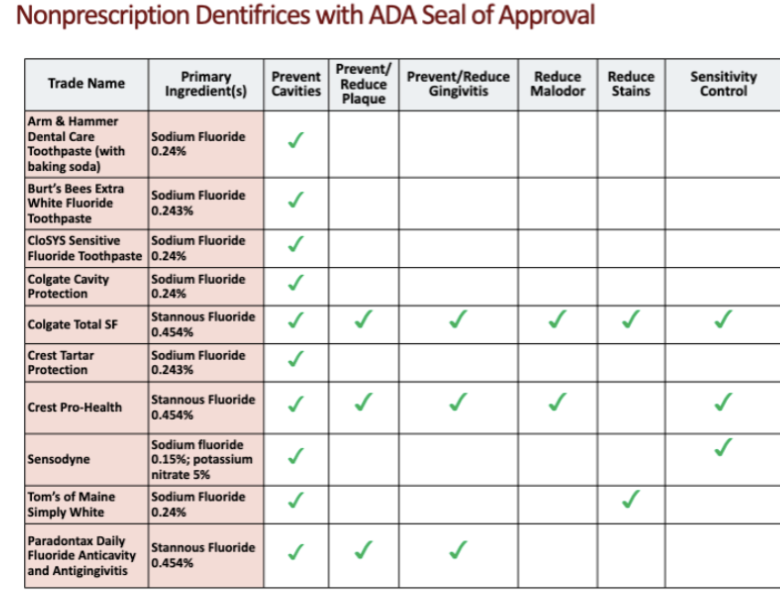
KNOW IMAGE