Wound Healing Terms
 Call Kai
 Learn
Learn Practice Test
 Spaced Repetition
 Match
Match Flashcards
 Knowt Play
1/71

There's no tags or description
Looks like no tags are added yet.
Name | Mastery | Learn | Test | Matching | Spaced | Call with Kai |
|---|
No analytics yet
Send a link to your students to track their progress
72 Terms
infectious agents
bacteria, fungi, viruses
immune reactions
allergies, autoimmune disorders
genetic factors
mutations such as down syndrome
ischemia
lack of blood supply that can result in hypoxia or anoxia
nutritional factors
imbalance of essential nutrients
physical factors
trauma; brain contusions
chemical factors
toxic substances (ex: heavy metals)
pathologies start with ______ to the cells
injuries
reversible cell injury
cell adapts and maintains homeostasis again
irreversible cell injury
leads to cell death (2 mechanisms for cell death, necrosis and apoptosis)
acute injury
cell is able to regain homeostasis and adapt post injury, temporary effects are cellular swelling and changes in ion concentration, normal cell structure and function return after removal of stressor
reversible cell injury (chronic)
stress to cell is maintained by cells can adapt to altered environment
apoptosis
programmed cell death
necrosis
active process of degradation of dead cells
primary wound healing
healing by “first intention” (like sutures, staples, etc.), minimal scarring, usually complete return to function
secondary wound healing
larger tissue loss, healing occurs from bottom of wound and up, larger scar
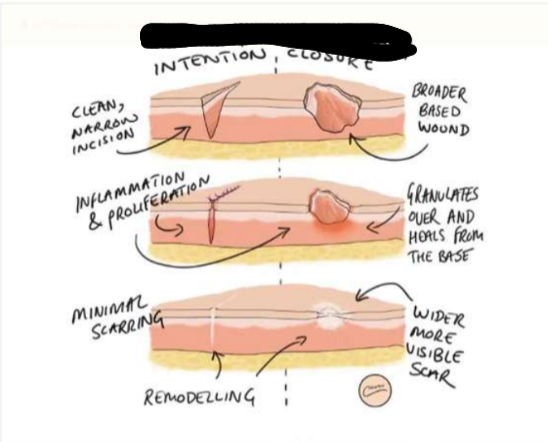
which side is primary healing and which is secondary
left is primary, right is secondary
4 phases of wound healing
hemostasis, inflammation, proliferation and migration, remodeling and maturation
steps of hemostasis
vascular spasm
platelet plug formation
coagulation
clot retraction and repair
fibrinolysis
vascular spasm (first step of hemostasis)
smooth muscle contracts causing vasoconstriction to reduce blood loss
platelet plug formation (second step of hemostasis)
platelets bind to collagen fibers, von willebrand factor acts like glue so that platelets actually stick, platelets release ADP and seratonin which calls more platelets over to come stick, platelets aggregate to form plug
coagulation (step 3 of hemostasis)
we form prothromin activator, prothrombin activator converts prothrombin into thrombin, thrombin converts fibrinogen into fibrin, fibrin makes a mesh by cross linking, this forms a clot
clot retraction and repair (step 4 of hemostasis)
platelet contraction pulls endothelial cells together to stabilize the clot, platelets secrete both platelet derived and vascular endothelial growth factors… these (1) repair collagen and connective tissue, and (2) regulates endothelial lining
fibrinolysis (step 5 of hemostasis)
plasminogen converts to plasmin, plasmin breaks fibrin mesh, clot is broken to prevent blood vessel occlusion
4 characteristics of inflammation
erythema (redness), heat, edema, pain
inflammation ends when _______
injurious agent is removed
acute inflammation
short and sudden onset of heat, erythema, edema, and pain
chronic inflammation
persists overtime/does resolve, lymphocytes and macrophages are present, increase in blood vessels, causes tissue restruction
2 pathways an injurious agent can be removed during inflammation
phagocytosis or complement proteins
first step of inflammation:
mast or dendritic cells degranulate to increase blood flow and move WBC to damaged aeras by releasing histamine, kinins, and prostaglandins
histamines
increase vascular permeability, activate neutrophils and macrophages
kinins
increase vascular permeability and promote chemotaxis
prostaglandins
increase vascular permeability, vasodilation, promote chemotaxis, induce pain
what do hisamines, kinins, and prostaglandins all have in common
they increase vascular permeability which causes smooth muscle relaxation which allows that increased blood flow in the first step of inflammation
increased blood flow in the first step of inflammation causes what symptoms
redness and heat
in inflammation after the histamines, kinins and prostaglandins cause smooth muscle relaxation, what do the endothelial cells do?
endothelial cells contract to create space and the p-selectins are activated
after smooth muscle relaxaion and p-selectin activation more WBCs are entering the damaged area, next we see what 3 things?
margination
diapedesis
chemotaxis
margination
slowing of WBCs in the blood vessel
diapedesis
WBCs squeeze through endothelial cell gaps
chemotaxis
WBCs move towards chemical (follow chemical gradient) where foreign invader is
in diapedesis WBCs are squeezing through the gaps created by the endothelial cells contracting to create space… what else happens at this step to cause what other symptoms of inflammation?
plasma can also squeeze through these gaps, this causes edema from the excess water and pain from this excess plasma rubbing up against nociceptors
step 1 of phagocytosis
WBCs from pseudopods are used to pull in bacteria
in phagocytosis what happens after the WBCs are used to pull in bacteria (aka what’s step 2)
macrophage engulfs bacteria to form a phagosome
in phagocytosis what comes after he creation of a phagosome (aka what is step 3)
phagosome and lysosome fuse together inside cell to form a phagolysosome
in phagocytosis what comes after the formation of the phagolysosome (aka what is step 4)
the lysosome digests the bacteria leaving only the antigens
what happens after the lysosome digests the bacteria in phagocytosis (aka what is the last step)
the macrophage spits out the antigens through exocytosis into the ec fluid
what is the tumor necrosis factor (TNF)
this is secreted by macrophages and mast cells and induces proinflammatory effects
what are interferons
these are produced by virus infected cells and interfere with DNA and RNA replication
what are cytokines
signalling proteins that help control inflammation in your body (ex: interleukins, interferons, tumor necrosis factor)
what is an interleukin
a specific cytonine that has a certain job in chemical messeging (ex: IL-4 and IL-5 have very important jobs in humoral immunity for stimulating proliferation and differentiation)
overall goal of proliferation and migration
generate and repair blood vessels and connective tissue
in proliferation and migration, what is step 1
fibroblasts arrive at wound site by following macrophages via growth factors (fibroblast proliferation)
in proliferation and migration, after fibroblasts arrive at wound site, what do they do (aka what is step 2)
fibroblasts repair connective tissue damage and make new collagen, elastin, and proteglycan molecules
how do the fibroblasts go about repairing the connective tissue in step 2 of proliferation and migration (we know they make new collagen, but more detail then that)
they produce granulation tissue made up of type III collagen, elastin, and protoglycan which fills the wound with enw tissue and protects it from further microbial invation. the way it restores the ECM is thorugh connecting the 2 sides of the wound back to each other via wound conraction. this produces the inital scar and if there are granulation formation errors then the scare ends up being fucked a little
wound contraction
actual contraction with the pulling of the edges of the wound towards the center hence making the wound smaller
note: myofibroblast is used to help accomplish this as it has contractile proteins to pull on the new collagen
what comes after the formation of granulation tissue and wound contraction (aka what is step 3 of proliferation and migration)
angiogenesis: the formation of new blood vessels while also supplying oxygen and nurients to currently healing tissue in preparation for remodeling
what comes after angiogenesis in proliferation and migration (aka last step of this phase)
re-epithelialization
basal cells are laid down at the wound
the basal cells on the magin undergo mitosis horizontally while the ones behind the margin grow vertically
what is the final part of wound contraction
the covering skin of the wound is stretch/thinned while the dermal thickness surrounding it is maintained
what are the 3 basic steps of remodeling and maturation
tissue contraction
tissue regeneration
tissue repair
goal of remodeling and maturation
scar tissue being reduced and remodeled; tissue becomes smoother, stronger, less red, and less dense
what is the first step of remodeling and maturation
more tissue contraction: newly formed ECM contracts and shortens but we still want to avoud excessive shortening (aka contracture)
what happens after tissue contraction in remodeling and maturation (aka what’s step 2)
tissue regeneration: replacement of dead cells with new cells to restore normal tissue structure and function (but this only occurs is the cells in question can undergo mitosis)
what happens after tissue regeneration in proliferation and migration (aka what is step 3)
tissue repair: we remove and replace the original tissue with fibrous connecive tissue. this starts with type III collagen getting replaced by type II and then eventually type I which is the strongest
Note: we will see some scarring here but we are trying to minimize it so it doesn’t interfere with organ funcction,,, so after the wound closes collagen degratation and resynthesis continues
wounds usually heal in ____ (amount of time)
4-6 weeks
a wound that lasts for _______ (amount of time) is considered a chronic non-healing wound
1-3 months
list the local factors that affect tissue healing
oxygenation and infection
why is oxygenation important for wound healing
it’s needed for cell metabolism since ATP is used in the healing process, also early wounds are hypoxic meaning they use up a lot of oxygen in the healing process from poliferation, migration, and re=epithelialization so if oxygen is not restored, healing becomes impaired
list the systemic factors that can affect wound healing
age and sex, obesity, medications, alcohol, smoking, nutiron, stress
obestiy can cause impaired wound healing because…
we have reduced blood flow to adipose tissue
skin fold harbor micro-organisms
skin-on-skin friction increases risk of ulceration
how can glucocorticoid steriods supress wound healing
they suppress proliferation phase, collagen synthesis, and increase risk of infection
how can chemotherapy impair wound healing
it’s designed to inhibit rapid cell divison and angiogenssis, it inhibits wound healing pathways, and weakens general immune function
why do smokers have delayed healing
micotine stimulates sympathetic nervous system which causes weaker vasoconctrucition and reduces oxygen supply to tissues; carbon monoxide in cigarrette smoke causes tissue hypoxia; hydrogen cyanide impairs cellular oxygen metabolism; and it impairs WBC migration