Social & Cognitive - Lecture 7
 Call Kai
 Learn
Learn Practice Test
 Spaced Repetition
 Match
Match Flashcards
 Knowt Play
1/50

Earn XP
Description and Tags
Number cognition
Name | Mastery | Learn | Test | Matching | Spaced | Call with Kai |
|---|
No analytics yet
Send a link to your students to track their progress
51 Terms
two non-numerical symbol cognitive systems
analogue magnitude system (also known as "approximate number system" or "number sense")
object individuation system (also known as "parallel individuation" or "subitising").
wynn - introduction
do young children actually understand what numbers mean when they count out loud, or are they just reciting a memorised list of words like a song?
wanted to find out exactly when and how children learn the “cardinal principle”
the mathematical rule that the very last number you say when counting a group represents the total size
tells us whether humans are born with an innate understanding of counting rules, or if we have to slowly piece the logic together
wynn - methodology
age: 2.5 - 3.5 years old
give-n task
gave the children a pile of toy animals and asked them to produce a specific amount (e.g. “can you give the puppet 3 dinosaurs?”)
how many task
asked the children to count pre-made sets of items and then asked “how many are there”
give-n task is much harder than simpling pointing and reciting numbers
forces child to prove they actually know what the word “three” means
wynn - results
the “grabbers”
children learn numbers one by one
first they become “1-knowers”, months later they become “2-knowers”, and eventually “3-knowers”
if you asked a 2-knower for four items, they just grabbed a random handful
the “counters”
older children behave entirely different
when asked for higher numbers, they don’t grab, they carefully counted out the exact amount requested
the disconnect
many children who could perfectly recite their numbers up to 10 still completely failed the give-n task for numbers larger than 2 or 3
wynn - conclusions
children memorise the sequence of counting words (“one”, “two”, etc.) long before they understand what those words actually mean in terms of quantity
children don’t slowly learn 4, then 5, then 6
after spending months figuring out 1, 2 and 3, they have a sudden moment where they grasp the cardinality principle
once it clicks, they can instantly apply the counting rule to any number in their vocabulary
learning to count is not a simple memorisation trick
it is a complex, multi-stage cognitive leap where a child must painfully map abstract words onto real-world quantities
video - the analogue magnitude system
Characteristics: It is "coarse" or "fuzzy." As the number of items increases, the representation becomes less precise.
In Infants: Experiments show that 5-to-6-month-old infants can notice the difference between sets of dots (e.g., 8 vs. 16) through habituation studies.
In Animals: Rats in "Skinner boxes" demonstrate this by pressing a lever an approximate number of times to get a reward. They might press 8 or 9 times for an 8-press reward, but as the target number increases (e.g., to 16), their accuracy decreases.
video - the object individuation system
Characteristics: It is instant and precise. You don't "count" the items; you just know how many there are immediately.
Calculations in Infants: Infants show surprise (looking longer) at "impossible" mathematical outcomes. For example, if they see one puppet placed behind a screen and then another, they expect to see two when the screen drops. if only one is there, they notice the error.
In primates, rhesus monkeys have shown the ability to track small numbers of food items (like grapes) even when they are moved between containers behind a screen, consistently choosing the container with the larger amount.
what is a count list?
A count list is the memorised sequence of number words (e.g., "one, two, three, four...") that children learn to recite.
It is a linguistic sequence that many children learn early on, sometimes even before they fully grasp what the words represent.
does reciting a count list mean a child knows what each word means?
No.
Researchers have found that learning the count list is a separate process from understanding what numbers actually mean.
A child might be able to recite the sequence perfectly but still be a "pre-number knower," meaning they don't yet associate specific words with specific quantities.
what is the give-n task?
The Give-N task is a classic test used by researchers and parents to measure a child's "number-knower level".
what is the give-n task used for?
It determines how many number words a child actually understands as specific quantities, rather than just words in a sequence.
what does the give-n task consist o?
You simply ask a child to give you a specific number of objects (e.g., "Can you give me two rocks?") and observe how many they actually provide.
what stages do children go through when acquiring words?
Pre-number Knower: The child may recite the count list, but gives a random handful of objects regardless of the number requested.
One-knower: The child understands "one" perfectly but gives a "handful" or a random amount for any number two or higher.
Two-knower: The child can reliably give one or two objects but treats "three" and above as meaning "a lot" or "a bunch".
Three-knower (and sometimes Four-knower): The child understands the specific meanings of these small numbers but cannot yet apply the logic to higher numbers.
Cardinal Principle Knower: This is a major conceptual leap.
The child suddenly understands the "counting principle"—that each subsequent number in the count list represents exactly one more than the previous one.
At this stage, they can give any number requested by counting them out.
two non-symbolic number systems
analogue magnitude system
yields noisy representations of approximate number that capture the inter-relations between different numerosities that are distant enough
e.g. it allows us to tell 10 from 20, but not 20 from 21
object individuation system
tracks small numbers of individuals (up to about 4 in adults) and supports very precise representation of the numerosity of small sets
e.g. it allows us to tell very quickly and without counting 2 from 3 but cannot support us from telling 8 from 9
two non-symbolic number systems overview & link to animals
the human mind has access to two distinct non-symbolic number systems for representing numerosity
these systems operate without counting. enabling us to track numerosity without thinking of or even knowing number words
they are also available to non-human animals…
…suggesting that human intelligence or language (i.e. the ability to use number words) are not necessary to represent numerosity
methods to study whether and how infants represent numerical information
looking time methods
violation of expectation
preferential looking
manual search - search for hidden objects, how long they search
choice (via crawling to the selected location or object)
spelke & xu - what is easy for infants - methods (analogue magnitude system)
preferential looking paradigm
infants age: 6 months
infants shown a slideshow of different sets of objects - habituation
8 dots for one group of infants
16 dots for another group of infants
then presented with two groups of objects, one being novel
should display a preference to a novel set of dots
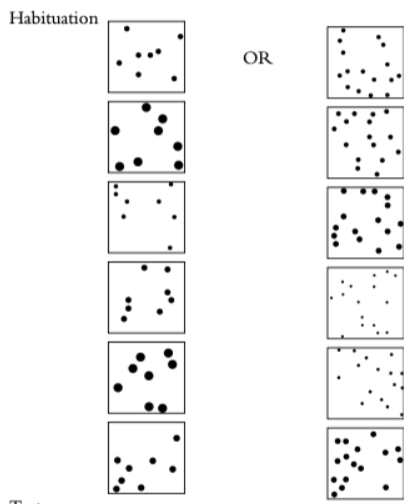
spelke & xu - what is easy for infants - test/results (analogue magnitude system)
infants dishabituated when presented with a different number of dots
i.e. with a new numerically novel array
they responded to the number change
spelke & xu - what is easy for infants - conclusion (analogue magnitude system)
infants can represent numerosity via the analog magnitude system at around six months of age
why is this not evidence for the object individuation system?
too many dots (> 4)
spelke & xu - what is easy for infants - how they maintained validity
kept the number of dots the same, but change size/location/etc. of dots
carefully controlling parameters
izard et al. - what is easy for infants - methods (analogue magnitude system) audio-visual
modality: audio-visual
familiarisation (auditory)
4 vs. 12 sounds
no. of sounds links to no. of visual objects/items
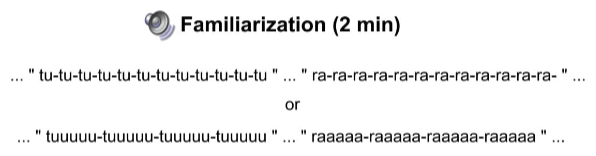
izard et al. - what is easy for infants - test (analogue magnitude system)
test (visual)
same/matching number of items
different number of items
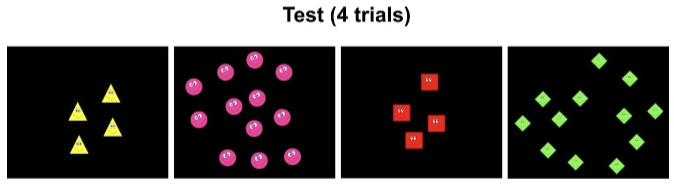
izard et al. - what is easy for infants - results/conclusions (analogue magnitude system)
Infants looked reliably longer at the matching visual arrays.
Infants can match numerical arrays across modalities at birth.
Newborns display sensitivity to abstract aspects of numerosity, suggesting that humans have access to the analogue magnitude system at birth and can represent abstract numerical properties of the world.
izard et al. - what is hard for infants (analogue magnitude system)
newborns
4 vs. 12 items - 1:3 ratio ✓
6 vs. 18 items ✓
4 vs. 8 items 1: 2 ratio ✗
6 months
8 vs. 16 items - 1:2 ratio ✓
16 vs. 32 items ✓
8 vs. 12 items - 2:3 ratio ✗
16 vs. 24 items ✗
system present very early on
resolution matures throughout first year of life
wynn - what is easy for infants? - methods (object individuation system)
infants age: 5 months
looking time violation
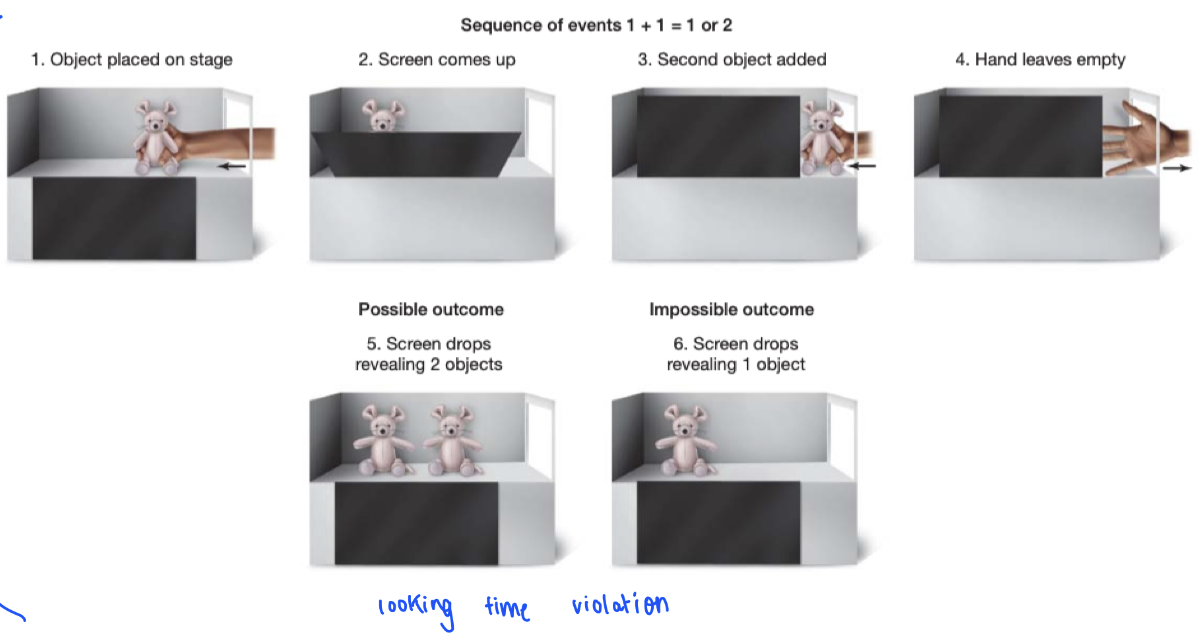
wynn - what is easy for infants? - results (object individuation system)
Infants displayed surprise (i.e. looked longer) when the screen was lowered to reveal the wrong number of puppets.
Infants were able to keep track of how many objects were behind the screen, thus interpreting events involving addition and subtraction.
feigenson et al. - what is easy for infants - methods (object individuation system)
age: 10-12 months
two buckets in the opposite side of the room in the corners
shake the buckets & put in a number of crackers
which bucket has more crackers?
mum releases baby, which bucket they crawl to
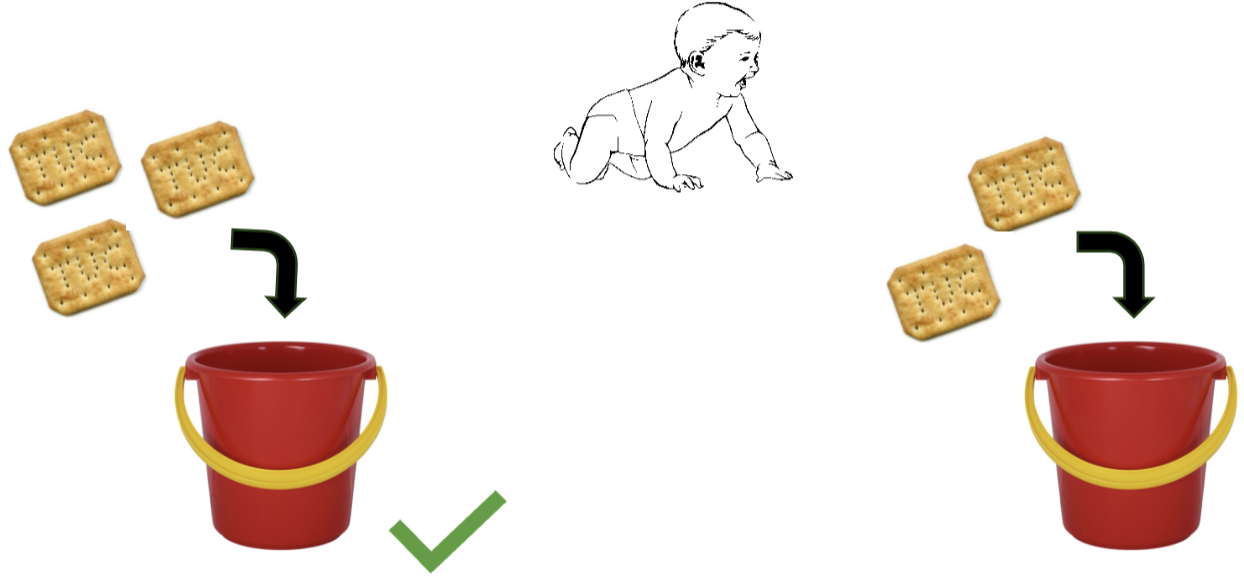
feigenson et al. - what is easy for infants - results (object individuation system)
infants track the precise number of the hidden crackers
they also use this information to guide their choice
do not have continuous visual access
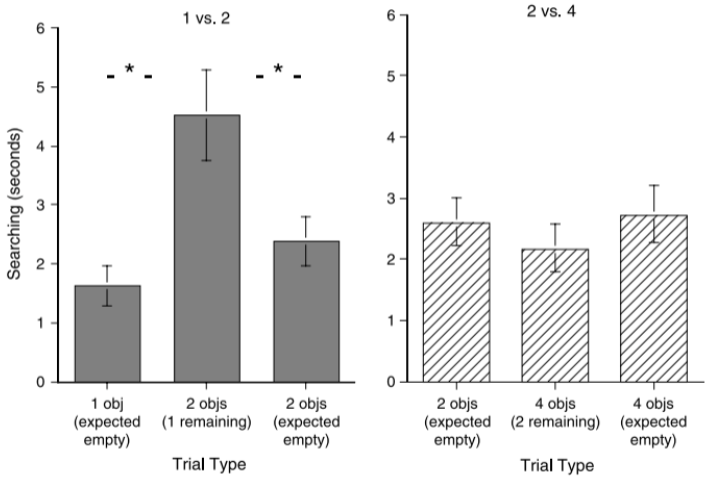
feigenson & carey - what is easy for infants - methods (object individuation system)
infants age: 12-14 months
if babies can track the no. they should search longer if they believe one object is still remaining
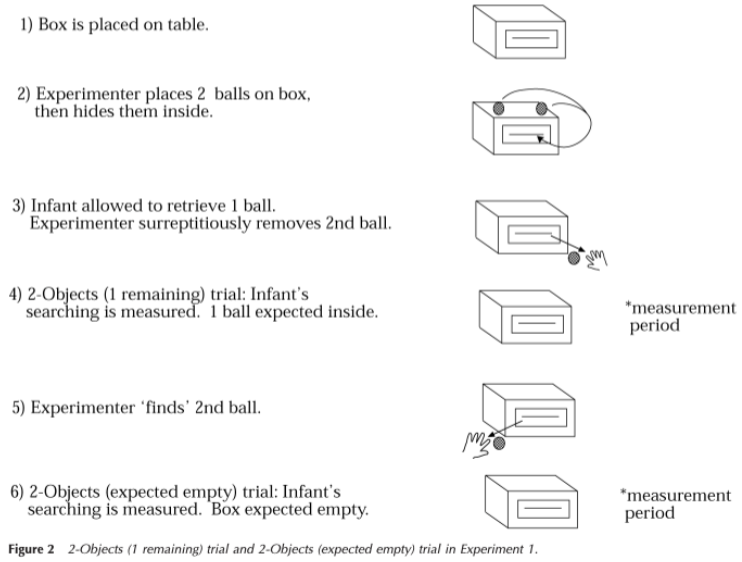
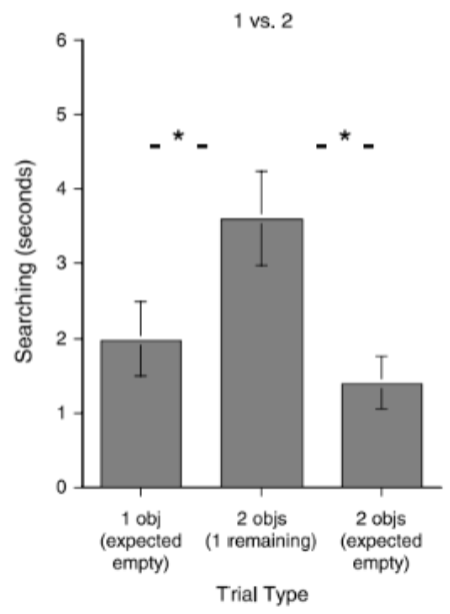
feigenson & carey - what is easy for infants - results (object individuation system)
aligns with predictions - search longer if there is one believed to be remaining
what is easy for infants? - overview
feigenson et al. (2002)
infants crawled to the bucket containing the higher number of crackers
feigenson & carey (2003)
infants searched longer when they expected one of the two hidden objects to be in the box
infants can set up precise representations of small numerosities that then guide their behaviour (choice, search)
starkey et al. - what is easy for infants - intermodal preferential looking - methods
infants age: 6-8 months
Visual modality:
two visual displays side by side, each containing a different numerical array (2 versus 3)
Auditory modality:
in one condition, sets of 2 drumbeats were presented via a loudspeaker; in the other condition, sets of 3 drumbeats
Will infants match the number across modalities?
starkey et al. - what is easy for infants - intermodal preferential looking - results
Infants reliably looked longer to the visual displays that matched the simultaneously presented drumbeats.
starkey et al. - what is easy for infants - intermodal preferential looking - conclusions
Infants extracted and matched the numerosity across two different modalities (audio & vision) and formats (temporal / sounds & spatial / pictures).
Infants seem to have cross-modal number representation
feigenson et al. - what is hard for infants? - methods and results (OIS)
infants age: 10-12 months
showed babies contrasting numerosities
Infants can track 1 to 3 objects in parallel, e.g. given 1+1, they expect 2 objects; given 1+1+1, they expect 3 objects.
But their number representation in this context collapses when there is more than 3 objects involved.
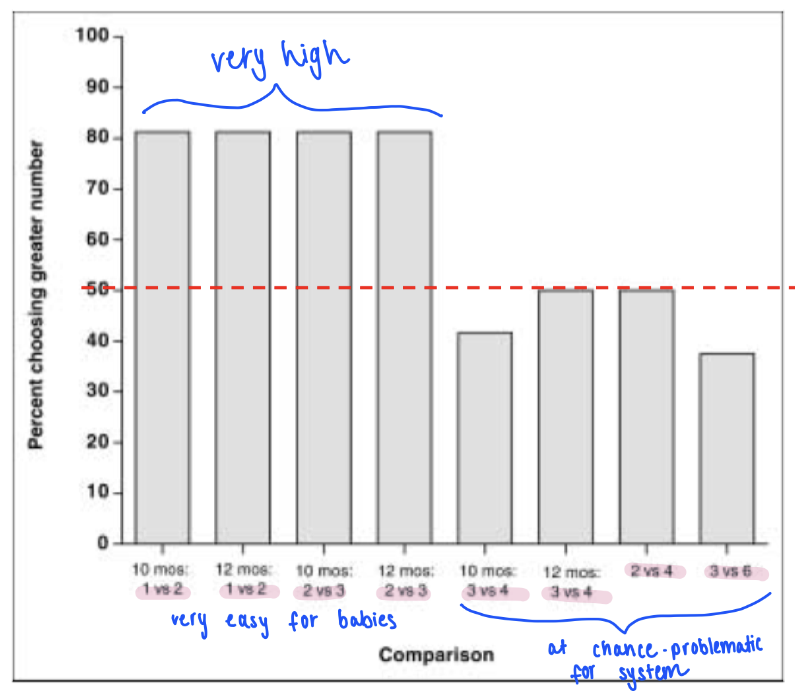
feigenson & carey - what is hard for infants?
infant’s age: 12-14 months
Infants can track 1 to 3 objects in parallel, e.g. given 1+1, they expect 2 objects; given 1+1+1, they expect 3 objects.
But their number representation in this context collapses when there is more than 3 objects involved.
symbolic number system - overview
In addition to the two non-symbolic number systems, humans, but not other species, developed a symbolic system for representing numbers.
We developed number words and counting that allowed us to very precisely represent and record numerical information, even very large numbers.
symbolic number system - background observations
Infants begin to learn language in utero.
Newborns can distinguish their native language from a foreign language (Mehler et al., 1988).
By 6 months, infants have learned the meanings of many common words (Bergelson & Swingley, 2012).
By 2 years, most children learn to recite the count list (”one”, “two”, ”three”, “four”, etc.) and use the number words when asked, “how many?”
early “counting”
Toddlers seem to know something about counting, namely that:
stable order ~ counting involves using the same labels in the same order (even if the label use is idiosyncratic),
e.g. a two-year old may consistently recite the following count list “1, 2, 3, 5, 6, 11” (Gelman & Gallistel, 1978)
one-to-one ~ counting involves using one label per object (Gelman & Meck, 1983);
the puzzle with infant number learning
can count the number (recited count list)
but cannot correctly say how many when asked
can rapidly pick up the meanings of object labels and can recite the count list
struggle with the last word in the count list is how many objects
do not figure out what number words mean and how counting works until they are about 4 years old
lee & sarnecka - results of give-n task
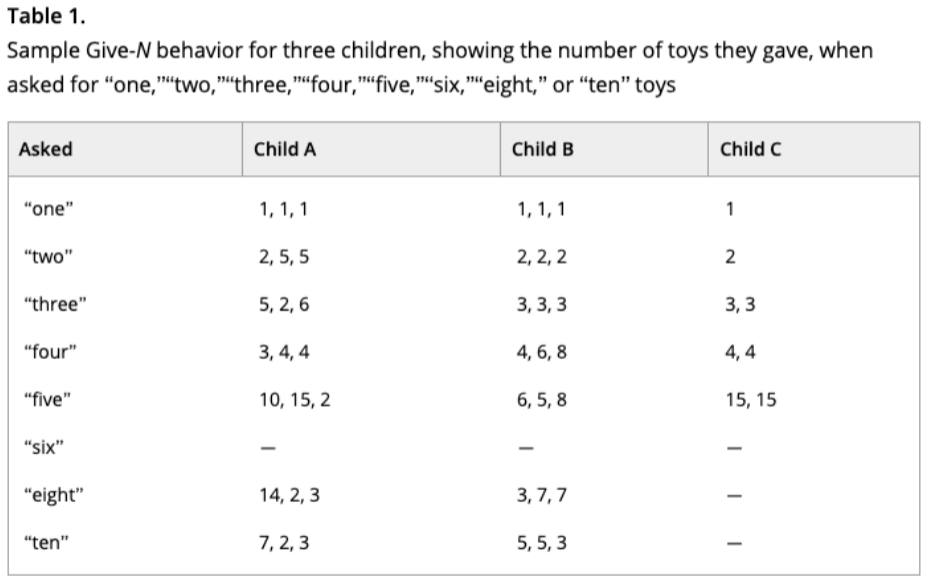
levels of number knowledge
Children learn number words in stages.
Each stage may spanup to several months.
First, they learn gradually the exact meanings of individual number words without knowing how counting encodes number:
“one-knower” stage
“two-knowers” stage
“three-knowers” stage
for some children “four-knowers” stage
Then, they make an inductive leap and figure out how the counting algorithm works, they grasp the cardinality principle and the successor function:
”cardinal principle knowers” stage
cardinality
the number of elements in a set
cardinality principle
the number word applied to the final item in a set represents the number of elements in the set
successor function
tells us what are the relations between the numerals, i.e. if numeral “N” represents cardinality N, then the next numeral represents the cardinality N+1
jara-ettinger et al. - levels of number knowledge
This stage-like process of discovering how counting words seems to be universal, i.e. independent of children’s culture and mother tongue.
All children seem to go through the same stages, albeit the timing may vary across cultures.
why is counting so hard?
Number words work differently than other words (e.g. “cat”, “Joe”), i.e. number words refer to sets and not to individuals.
Counting relies on an algorithm (i.e. cardinality principle, successor function) that children need to discover.
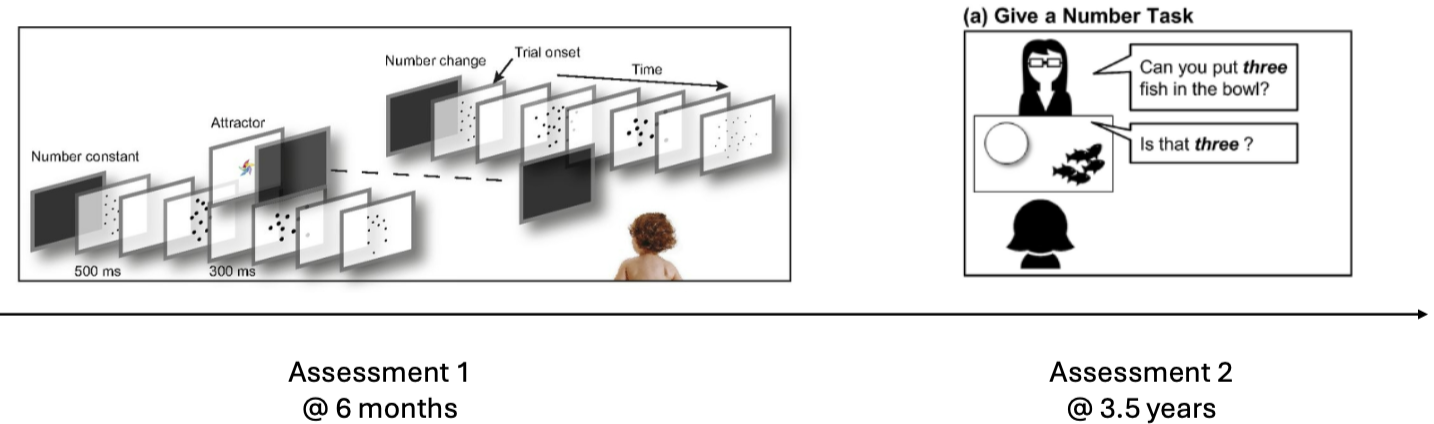
starr et al. - links between early numerical skills & later maths skills - method
two different dot streams
1 constant number
1 changing number
baby should look longer at the changing
come back 3 years later
those who looked longer at changing had improved math achievement at preschool
starr et al. - links between early numerical skills & later maths skills - results
Starr et al. (2013) used a longitudinal design to test whether infants’ abilities to represent approximate numerosity matter for their later maths learning:
6 months ~ a preferential looking task to assess the resolution of infants’ numerical discrimination (plus further tasks).
3.5 years ~ a suite of tasks to assess maths performance
Infants who showed more robust numerical discriminations when presented with arrays of dots at 6 months were better at maths in preschool (at 3.5 years)
what about symbolic number representation?
children showing greater symbolic mathematical abilities at 3 years go on to show greater learning of symbolic number in schools
continuities and discontinuities in early number representation and learning
Do children lose the access to the non-symbolic number systems?
No, they retain them
> continuity
Does infant numerical skills predict later maths success?
Yes, we have seen evidence for a link between infants’ approximate number skills and their maths learning at 3.5 years of age.
> continuity
Do non symbolic and symbolic number systems represent the same information?
No, they represent different kinds of numerical information, symbolic representation allows for precise unlimited representation of any number
(while both symbolic systems have different limitations).
> discontinuity