Lecture 11: Hearing, Multisensory Interactions
 Call Kai
 Learn
Learn Practice Test
 Spaced Repetition
 Match
Match Flashcards
 Knowt Play
1/37

There's no tags or description
Looks like no tags are added yet.
Name | Mastery | Learn | Test | Matching | Spaced | Call with Kai |
|---|
No analytics yet
Send a link to your students to track their progress
38 Terms
Hearing Summary
Pinna & auditory canal collect & amplify sound
Eardrum vibrates in response to sound
The ossicles transmit & amplify these vibrations
This produces movement on the oval window & vibrates the basilar membrane inside the cochlea
The organ of corti sits on top of the basilar membrane & contains hair cells that transduce the vibrations to neural signals
Auditory nerve carries neural signals
The Cochlea As an Acoustic Prism
Basilar Membrane inside the cochlea
Different parts of the cochlea respond to different frequencies
A prism refracts light, a prism also refracts light by different amounts for different wavelengths
Different wavelengths get refracted by different amounts as they enter a prism.
Splits light into different frequencies
Cochlea does the same with sound frequencies
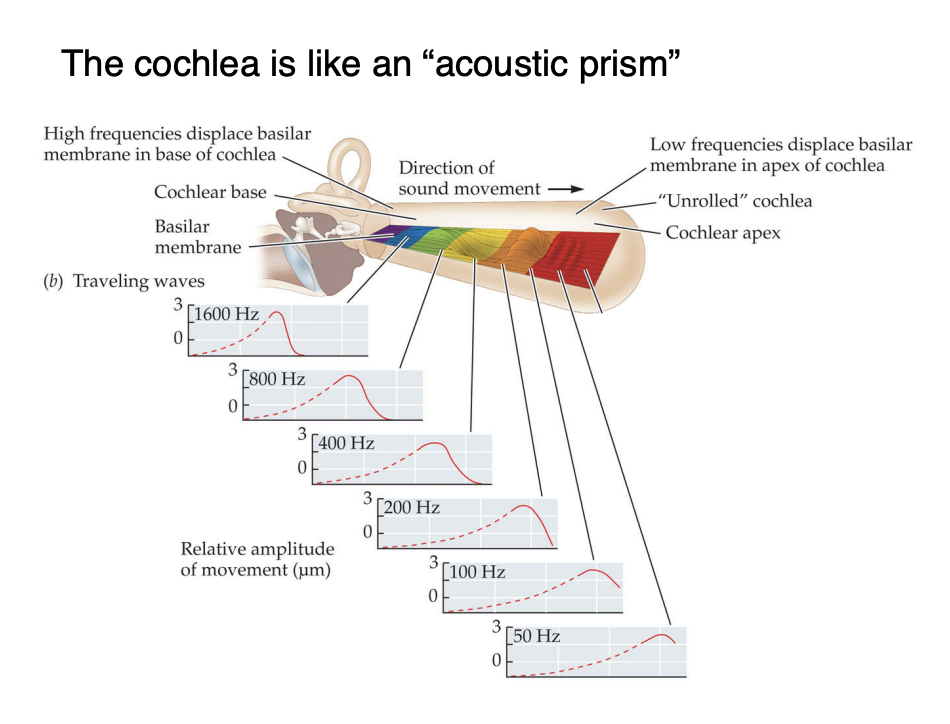
Different parts of the basiliar membrane vibrate to different frequencies
Lower frequency sounds displace the membrane more towards the apex & higher frequency sounds displace the membrane more towards the base
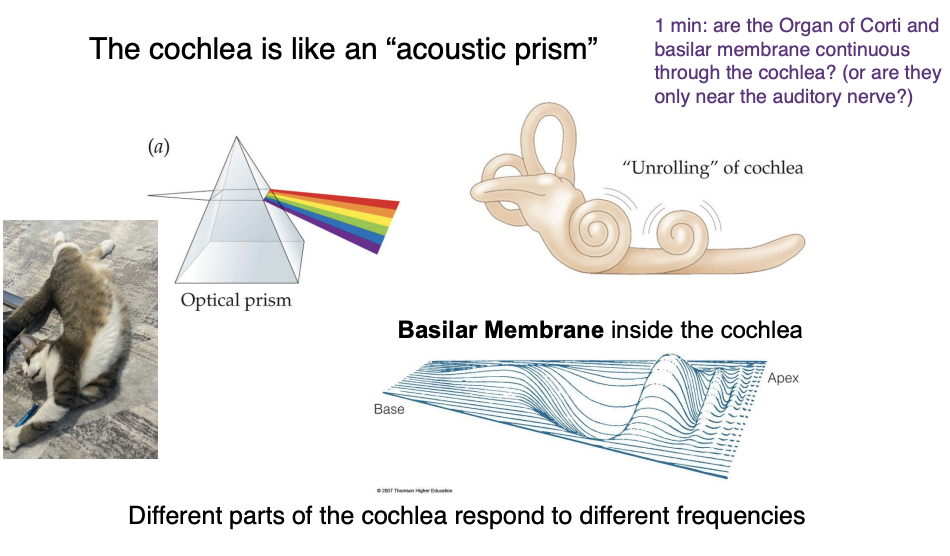
The Cochlea As an Acoustic Prism
Apex of cochlea, low frequency (right)
Base of cochlea: high frequency (left)
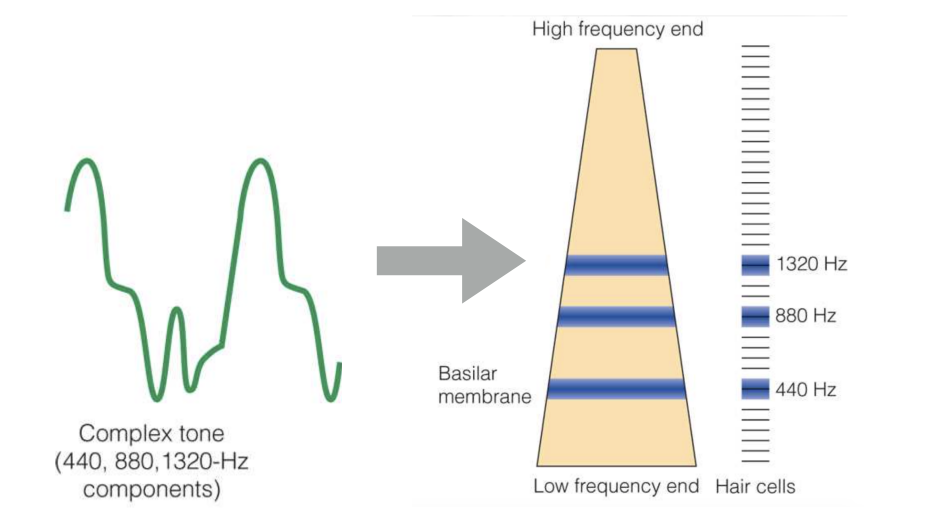
Basilar Membrane breaks down frequency components naturally (Fourier analysis)
What is Auditory Localization? How do we localize sounds in the real world?
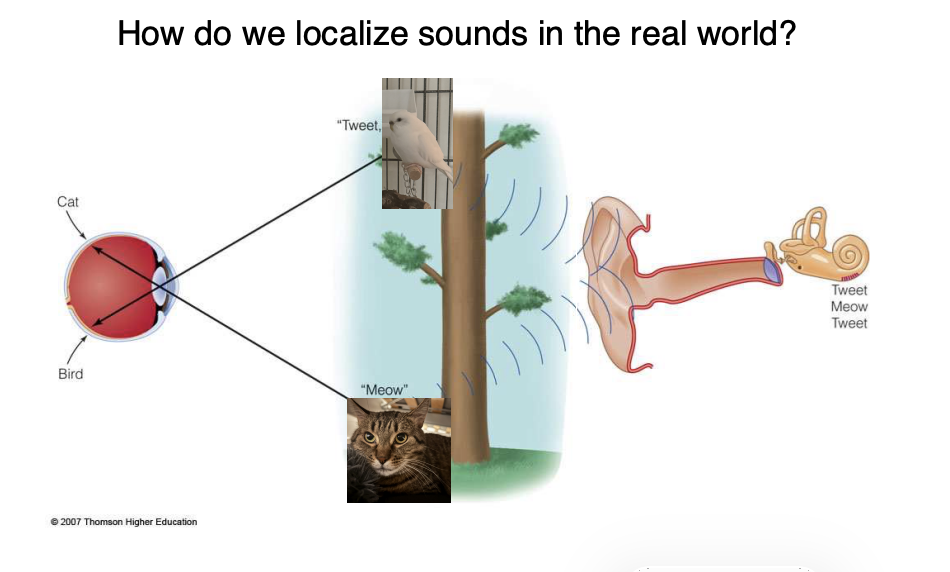
Auditory Localization
Our displaced ears provide 2 location cues:
Interaural time differences (ITDs)
Interaural level (intensity) differences (ILDs)
Auditory Localization- Interaural Time Differences
Sound travels at 340 m/s (in air)
Physics dictates that most sounds will arrive at each ear at slightly different times (microseconds)
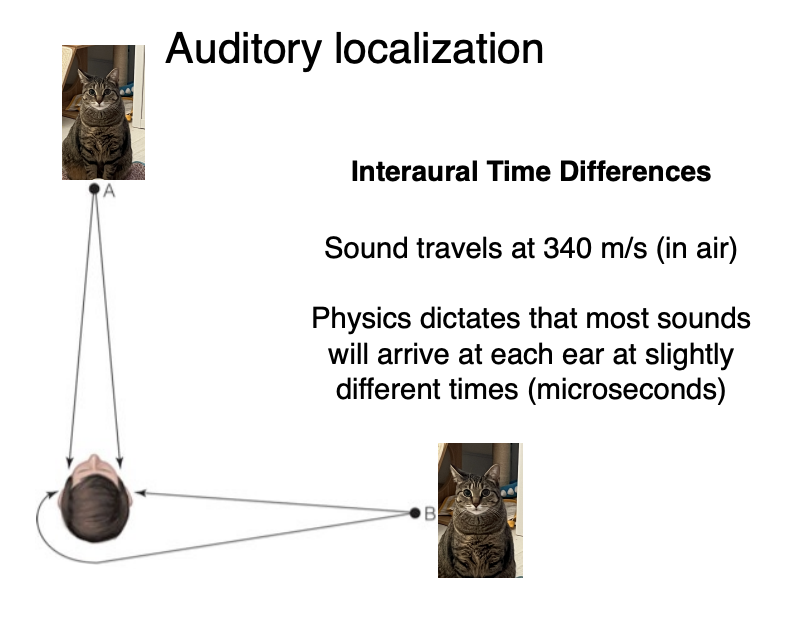
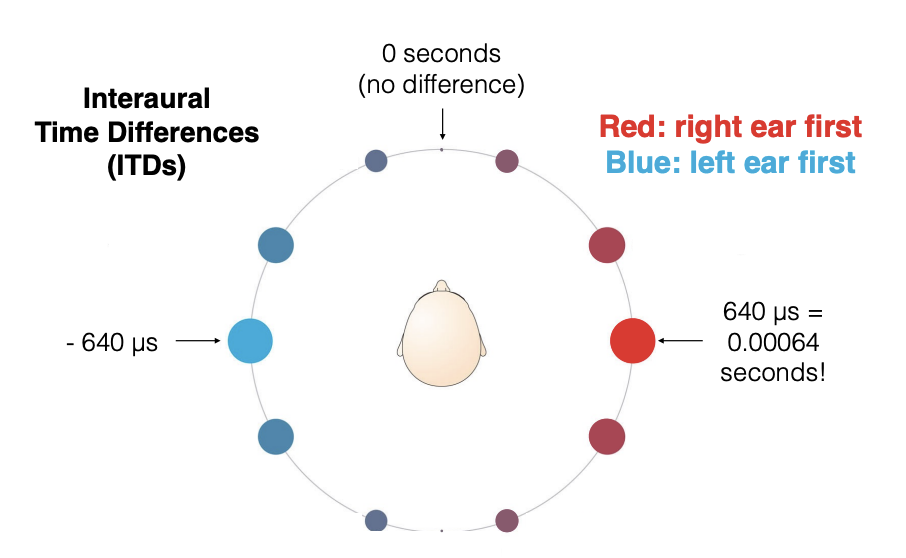
Interaural Time Differences (ITDs)
Binaural neurons sensitive to ITDs are located in the brainstem
First place where auditory information from both ears is combined
Interaural time differences are smallest for locations directly in front or behind
Largest for locations that are directly to your left & to your right
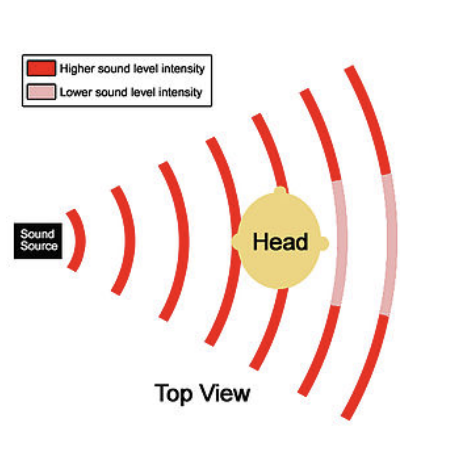
What are Interaural Level Differences (ILDs)?
Differences in the intensity of the sound hitting each ear
The sound that hits the closer ear is always more intense (ie. louder)
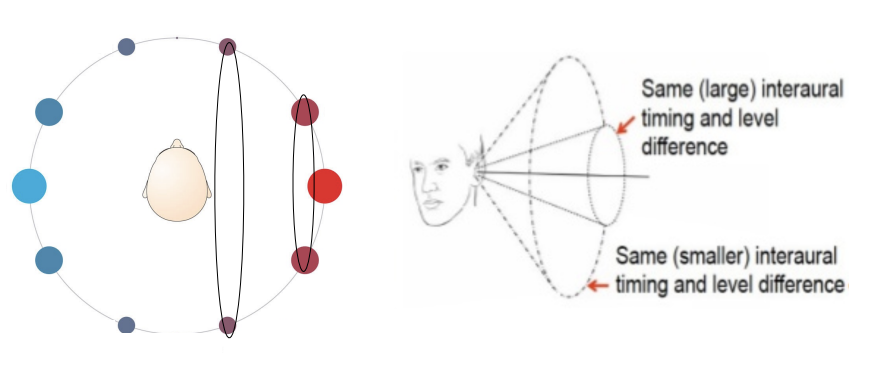
Which locations have the same ITDs & ILDs?
ITD and ILD cues are not perfect
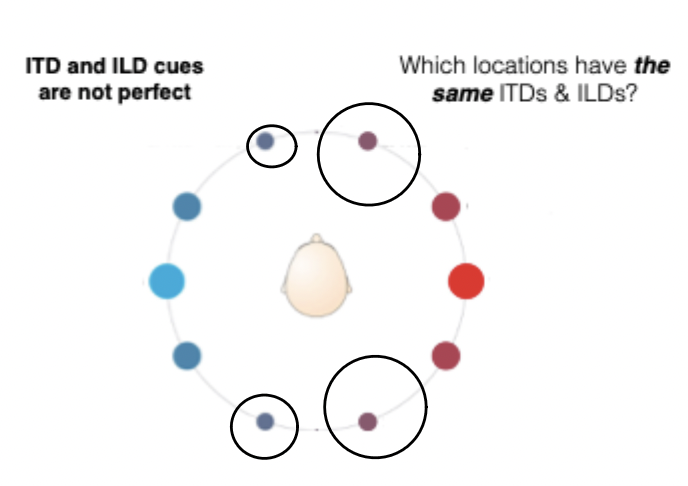
Cones of Confusion
Not often a concern because our heads are rarely stationary
Summary
Physiology of Hearing
Organ of Corti sits on basilar membrane; different frequencies are coded by different locations on the membrane
Auditory localization
Combination of multiple cues (ITDs and ILDs)
What is auditory scene analysis?
Breaking down the summed auditory signals into its component parts. Can distinguish one thing from many
Relies upon cues analogous to visual depth cues and Gestalt grouping rules.
Heuristics (shortcuts) don’t just apply to vision
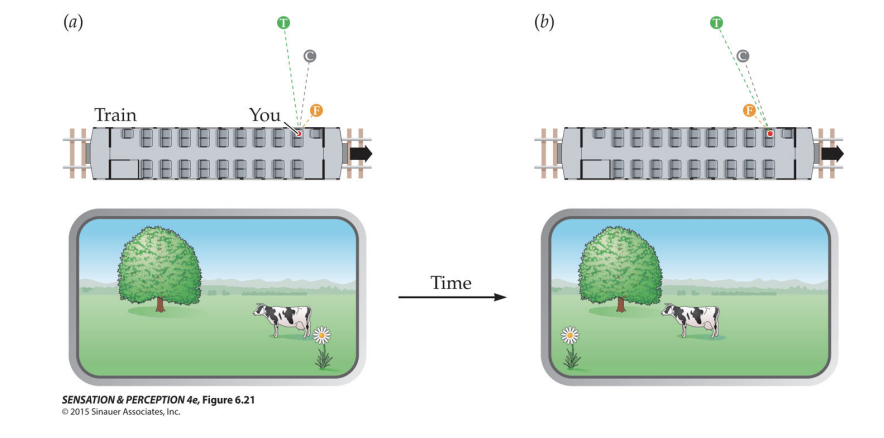
Heuristics for auditory scenes- What is Motion Parallax?
Motion parallax: determine distance by moving - further sounds don’t change as much as close ones
Closer objects change more
Heuristics for auditory scenes- What is Atmospheric Interference?
Atmospheric interference: muddier sounds are further away. Higher frequencies get blocked —> changes in frequency composition.
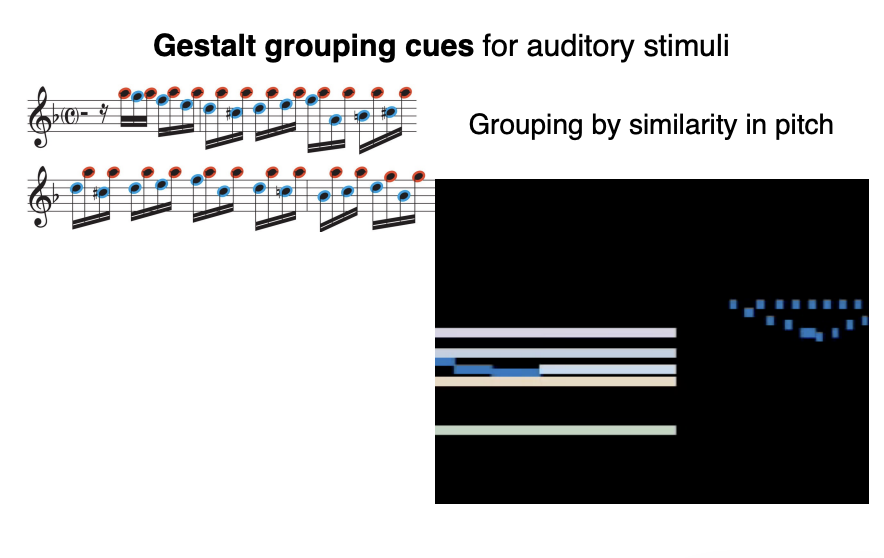
Gestalt Grouping Cues for Auditory Stimuli
Grouping by similarity in pitch
Group higher frequencies together & lower frequencies together
Auditory scene analysis- Similarity
Timbre allows us to follow a single instrument in an ensemble, even when it crosses frequency with another instrument
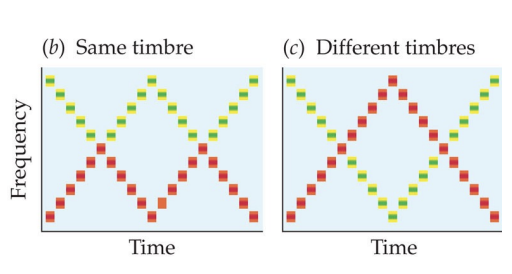
Auditory scene analysis- Good Continuation
Auditory completion: restoring the sounds when it is temporarily interrupted (occluded). Easier to hear/complete sentence when gaps filled with noise than with silence
Example: Beatboxing
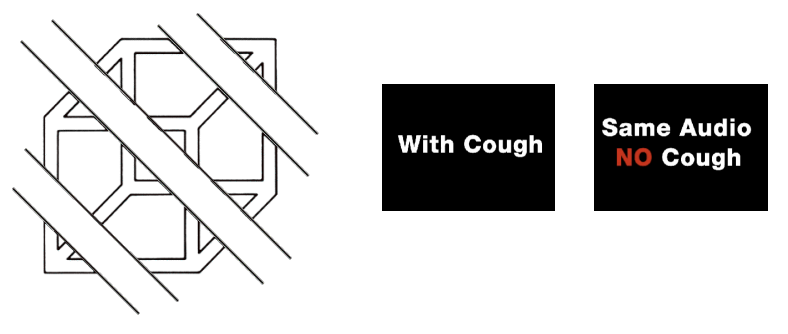
Importance of context in vision
Auditory Object Recognition
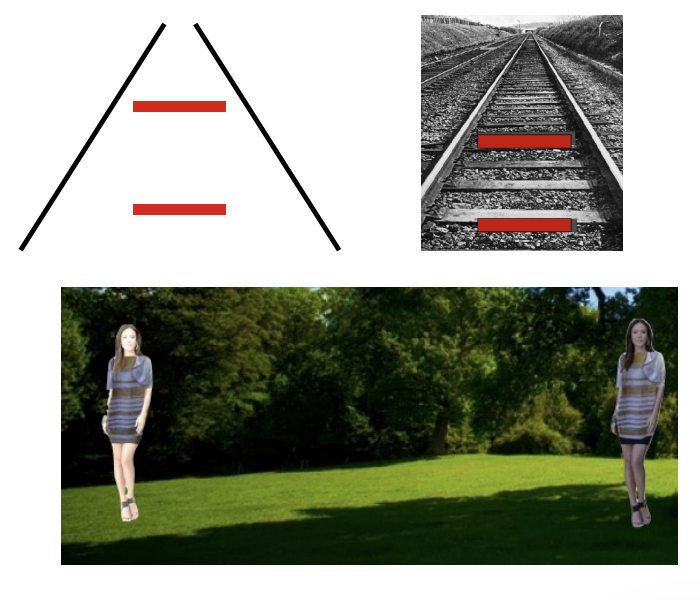
Context matters
Context also matters for audition Interpreting sounds, speech, phrases depends on surrounding information
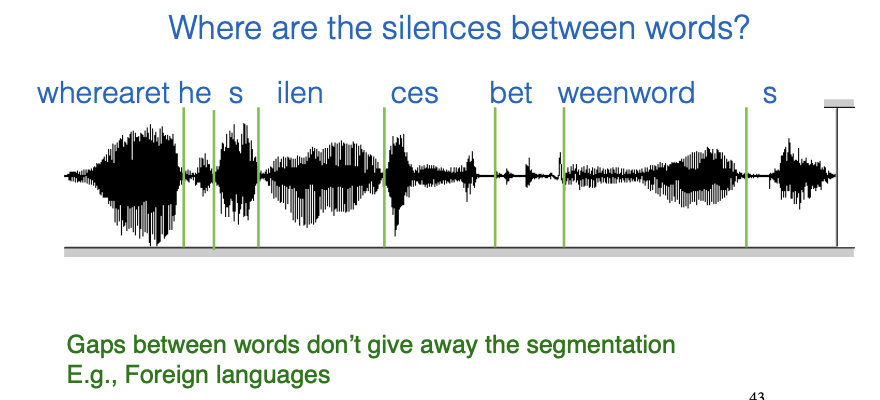
Where at the silences between words?
Gaps between words don’t give away to segmentation
E.g. Foreign languages
Context helps interpret sentence meaning. Ambiguous cases arise when lacking context Sentences: must assign or infer object, subject, verb In vision, must assign or infer figure, ground, motion, etc.
Translations and ambiguous words or phrases
In a Bangkok dry cleaner's store
"Drop your trousers here for best results.”
In a Cocktail lounge, Norway
“Ladies are Requested Not to have Children in the Bar” In an Acapulco hotel
“The manager has personally passed all the water served here.
Context
Visual context can influence interpretation of auditory information
McGurk effect
Sound /ba/
Lips /da/
Hear /da/
What is the McGurk Effect?
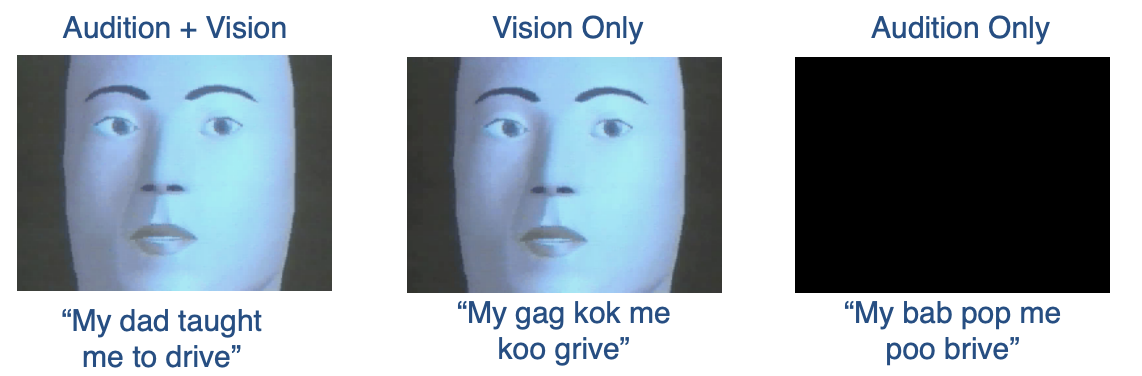
Sometimes vision dominates, sometimes combination of vision + audition
McGurk Effect: Often combine auditory and visual information into new interpretation /gag/ + /bab/ = /dad/
Visual cues can support auditory perception
Summary: Auditory Scenes & Objects
Many of the concepts we learned in vision apply in analogous fashion to hearing
Distance cues, grouping principles
We use context to segment words and to interpret meaning
Rely on combinations of multiple cues (e.g., hearing + vision)
Resolution limits for different senses (2:16:08)
Position - vision best, audition & touch worse
Where is it located?
Time - audition best, vision second, touch worst
When did it happen?
Intensity - vision, audition, touch all relatively good How loud, bright, painful was it?
Implications of resolution limits:
If you lose vision, you lose spatial resolution
Rely on vision most for locating objects
Rely on audition but only if there’s noise around or you have echolocation (bars, dolphins)
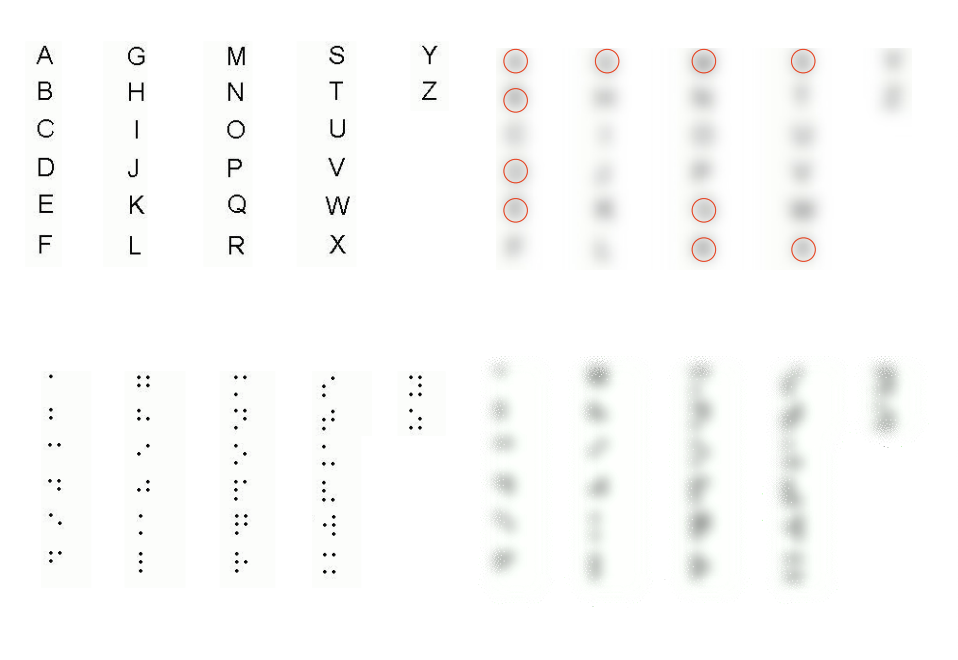
Rely on touch (e.g, Braille) but touch has poor spatial resolution
Why does Braille use dots rather than letters?
What is Cue Integration?
Brain processes information from many senses simultaneously to interpret the world around us
Much of the information is not modality (sense) specific
E.g., Person on TV has a visual image and an audible sound. How does the brain bind or integrate visual and auditory cues? What if our brains couldn’t bind the information?
Cues would conflict.
Investigating cue integration- What happens when cues conflict?
Depends on reliability of cue & sensitivity of the system
What is Ventriloquist Illusion?
When watching TV & Movies, the sound doesn’t come from the person or character talking. But it seems to… Why?
Brain weighs the more sensitive system and more reliable cues more heavily when interpreting scenes. Vision is reliable for detecting positions. So visually perceived position of the person or character captures sound.
Vision dominates.
Why would the brain want vision to capture audition? (Is the ventriloquist illusion beneficial?)
Image and voice processed independently. Brain needs to bind/integrate Spongebob’s face with his voice. This would seem to require precise timing; is this possible?
Solution: brain picks one cue (the most likely--vision in this case) over the other
Auditory Capture of Vision
Audition more sensitive than vision to temporal structure (timing differences)
When faced with ambiguous timing of stimuli, the brain takes auditory information more seriously.
Audition trumps vision.
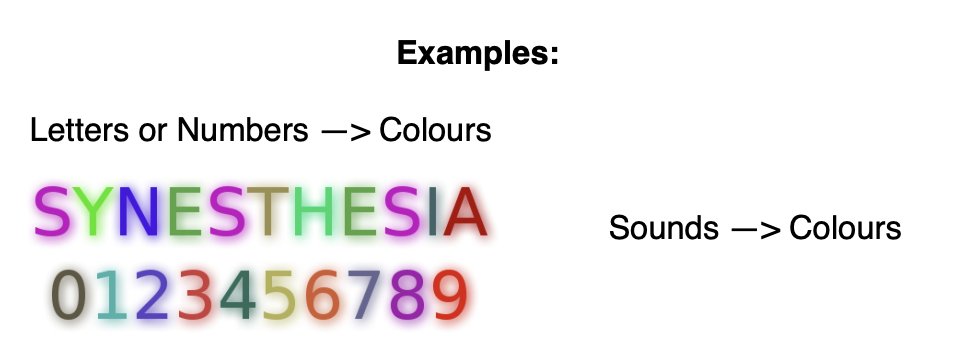
What is Synesthesia?
Synesthesia: a different kind of sensory crosstalk
Sensory input in one modality produces automatic experiences in a different modality
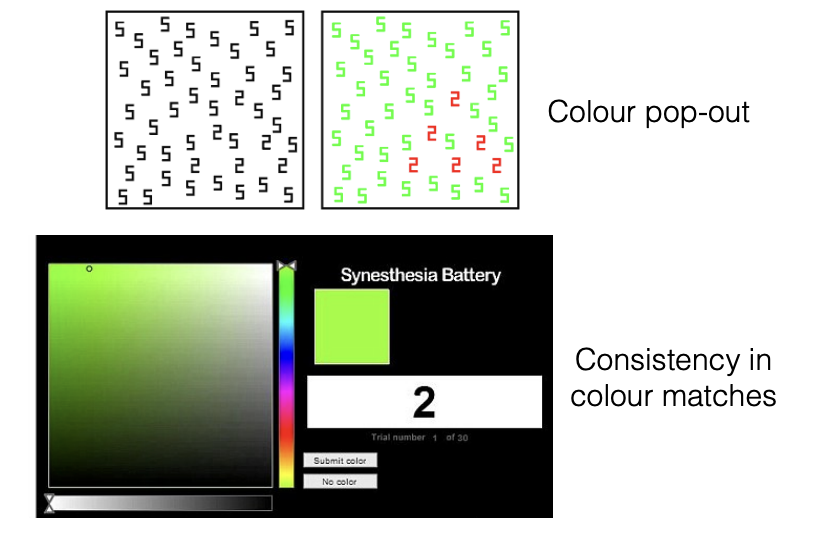
How do you test for Synesthesia?
Cause of synesthesia? Many theories, none conclusive
Plasticity: The Brain’s Ability to Change & Adapt
Audition & blindness
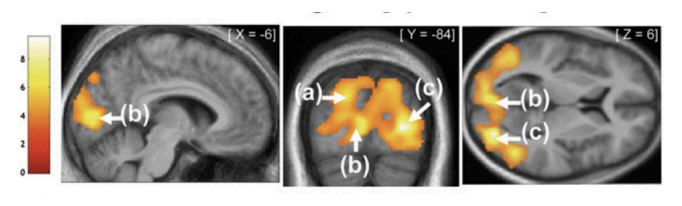
Early blindness can produce remapping of auditory information in occipital lobe.
Cortex normally reserved for vision is recruited by auditory system to improve spatial resolution (vision is normally most spatially precise modality).
Audition & Blindness
Echolocation in humans
Vision still better spatial resolution
Partial compensation by audition
Touch & Blindness
Recruitment of visual cortex for other uses
Touch uses visual cortex in the blind, more so in early blind than late.
In sighted individuals, activity of the visual cortex goes down in a tactile task
Visual system can also be recruited by touch (somatosensation) in blind individuals.
Summary
Cue integration:
Sensory modalities have different resolution limits (spatial precision, temporal precision)
Integration of cues: integration is based on cue reliability (which sense gives me the most precise information?)
Synesthesia: Another form of sensory crosstalk
Plasticity, remapping:
The brain can reorganize itself to cope with changes in sensory input (V1 for touch, hearing)
The brain is most flexible early in life, but can still cope with changes in sensory input later on in life
Vision
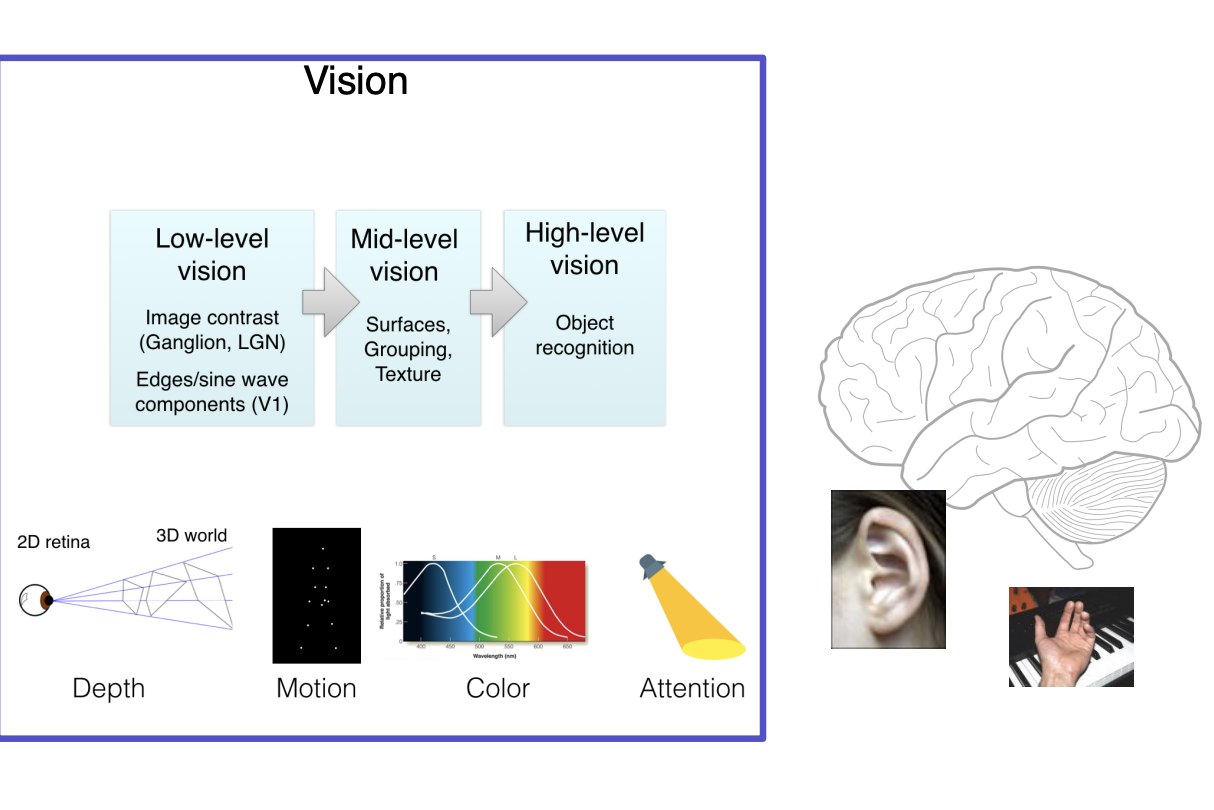
General Principles
Adaptation or Autocalibration
Our brain quickly adapts to the changing state of the world
Heuristics/Rules of Thumb
The brain uses ‘shortcuts’ to solve computational complexities
When these shortcuts fail, its called an illusion (and its rare)
Bet on the familiar or non-accidental
Go with most likely interpretation