OM Week 3
 Call Kai
 Learn
Learn Practice Test
 Spaced Repetition
 Match
Match Flashcards
 Knowt Play
1/32

There's no tags or description
Looks like no tags are added yet.
Name | Mastery | Learn | Test | Matching | Spaced | Call with Kai |
|---|
No analytics yet
Send a link to your students to track their progress
33 Terms
Parallelization Formula
Combined Capacity = Capacity 1 + Capacity 2 + … + Capacity N
For parallel resources add [BLANK]
Cycle Times
Output Rates
Step-by-step Parallelization Method
Express each parallelized resource as output rates (same time basis)
Add the output rates
Convert to cycle time
Every operations decision ultimately comes down to
How does this affect our profit?
In the short run Labor is a [BLANK] cost and in the long run it is a [BLANK] cost
Fixed/Variable
Fixed\/Variable
PBIT Formula
PBIT = (p-v) x Q - FC = CM x Q - FC
p =
v =
FC =
Q =
Price
Variable cost
Fixed costs
Flow rate/Volume
Break-Even Volume Formula
Q* = FC/CM = FC/p - v
The minimum volume at which we do not lose money
Each unit sold contributes CM = p - v toward fixed costs
We need enough units to “fill the FC hole”
Number of units needed: Q* = FC/CM
Below Q means we are at [BLANK]
Loss
Breakeven
Proft
Loss
At Q means we are at [BLANK]
Loss
Breakeven
Proft
Break-even
Above Q means we are at [BLANK]
Loss
Breakeven
Proft
Profit
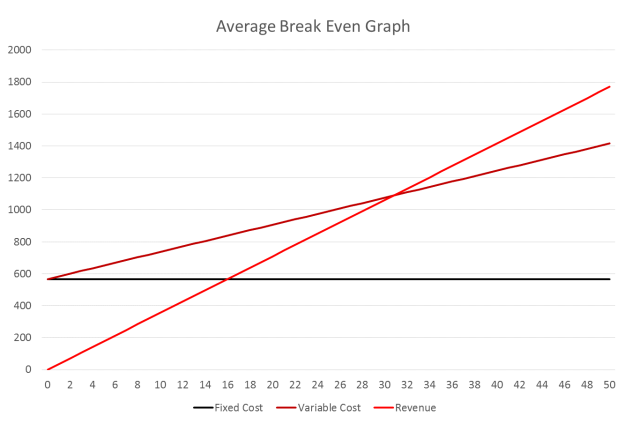
Where on this graph are we at a Loss, Break-even, and Profit
Loss
Under the dark red line but above the light red line
Breakeven
Where the two lines intersect
Profit
Under the light red line but above the dark red line
Cost reductions [BLANK 1] for FC, and [BLANK 2] for VC
help 1:1/are multiplied by volume
help 1:1/are multiplied by volume
help 1:1
are multiplied by volume
When does Parallelization make financial sense?
If additional units exceed Wage/Contribution Margin
Break-Even Condition for Parallelization Formula
Change in Q > w/CM
Change in Q = additional units/hr after adding worker
Additional revenue: change in Q x p
Variable Cost: change in Q x v
Labor: w
What are the two questions we must ask ourselves before adding a worker (Parallelizing)?
Are we capacity constrained (If not, don’t add)
Will we gain enough units to cover the wage?
Change in Q > w/CM
What is the significance of queues?
Understanding queues lets you predict and manage how long things take and how much stuff piles up
Affects both customer experience and your costs
When arrival rate > service rate the system is [BLANK]
Stable/Unstable
Unstable
What are the three perspectives on why queues matter?
Customer experience
Longer waits = frustrated customers = lost business
Inventory costs money
Every item “in the system” ties up capital
Operational planning
How much space do we need for WIP?
How many orders are “in progress” right now?
When will the last patient be done today?
Little’s law Formula
I = R x T
I = Average Inventory (work in process)
R = Flow Rate (throughput)
T = Flow Time (throughput time)
Little’s Law holds true for what type of processes?
Stable
How must the average input rate compare to the average output rate in order for a system to be stable?
They must equal each other
If Demand > Capacity
Queue grows infinitely
System is unstable
Little’s Law applies with R = Capacity
If Capacity > Demand
No growing queues
system is stable
Little’s Law applies with R = Demand
What is the practical rule for stable systems?
use R = min(Demand, Capacity) = actual flow rate though the system
Assumes excess demand is lost/turned away, so arrivals = departures at steady state
What are the three forms of Little’s law?
What do they all intuitively mean?
Which unknown must you solve for?
I = R x T, solve for Inventory, “How much WIP should I expect?”
T = I/R, solve for Flow Time, “How long until an order is done?”
R = I/T, solve for Flow Rate, “What’s our actual throughput?”
Inventory Turns Formula
Turns = 1/T = R/I = COGS/Average Inventory
Inventory Turns
How many times per year we “turn over” our inventory
Why are higher inventory turns better (3 reasons)?
Less capital tied up in inventory
Fresher products (important for food, tech)
Lower holding costs
Days of Inventory Formula
Days of Inventory = T = 365/Annual Turns
Days of Inventory
How many days worth of inventory we hold on average
How is Days of Inventory connected to Little’s Law?
Days of Inventory is just Flow Time (T) expressed in days
T = I/R = Avg Inventory/Daily COGS = Days of Inventory