3.13 - methods and effects of government intervention in markets
 Call Kai
 Learn
Learn Practice Test
 Spaced Repetition
 Match
Match Flashcards
 Knowt Play
1/24

There's no tags or description
Looks like no tags are added yet.
Name | Mastery | Learn | Test | Matching | Spaced | Call with Kai |
|---|
No analytics yet
Send a link to your students to track their progress
25 Terms
7 ways the government can intervene in markets
Indirect taxes
Subsidies
Direct provision of goods and services
Maximum prices
Minimum prices
Buffer stock schemes
Provision of information
Indirect tax
a tax levied on goods and services (e.g. VAT)
regressive in nature
2 main types of indirect taxes:
Specific taxes - taxes that are charged as a set amount per unit
e.g. tax per litre of fuel
Ad valorem taxes - a tax that is charged as a given percentage of the price
e.g. VAT
WHY?
Indirect taxes are often used to discourage production and consumption of demerit goods e.g. cigarettes and high-sugar drinks
These taxes are imposed on the producer, although they are passed on to the consumer in the form of higher prices
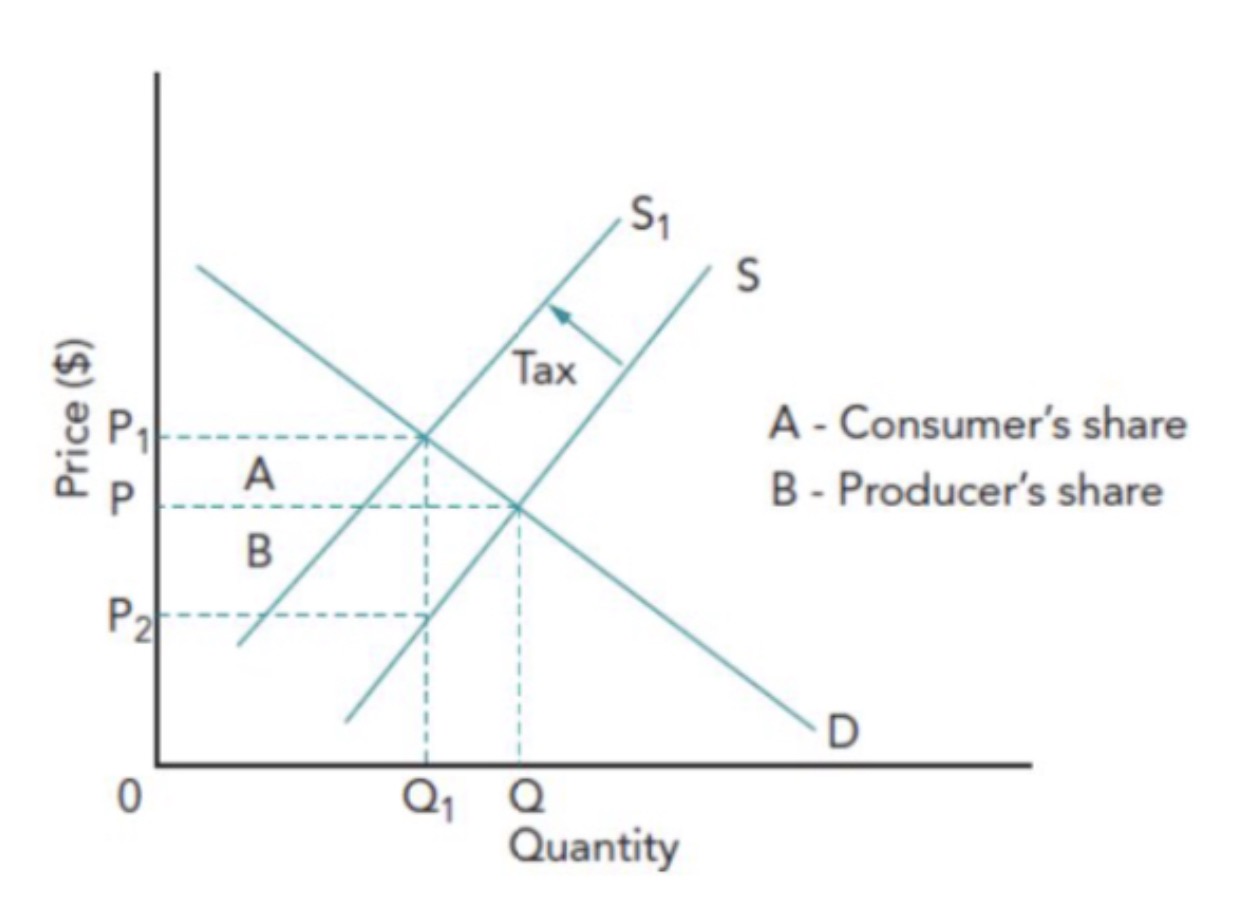
A specific indirect tax will cause a shift of the supply curve to the left by the amount of the tax
The market price is now higher (at P1) than the original equilibrium price (P)
The quantity traded is lower at Q1
Specific taxes
taxes that are charged as a set amount per unit
e.g. $10 per item whatever the price
Shifts the supply curve parallel leftwards
Ad valorem taxes
a tax that is charged as a given percentage of the price
e.g. VAT
10% of the price
Shifts the supply curve leftwards but not parallel
Incidence of tax
the extent to which the tax burden is borne by the producer or the consumer or both
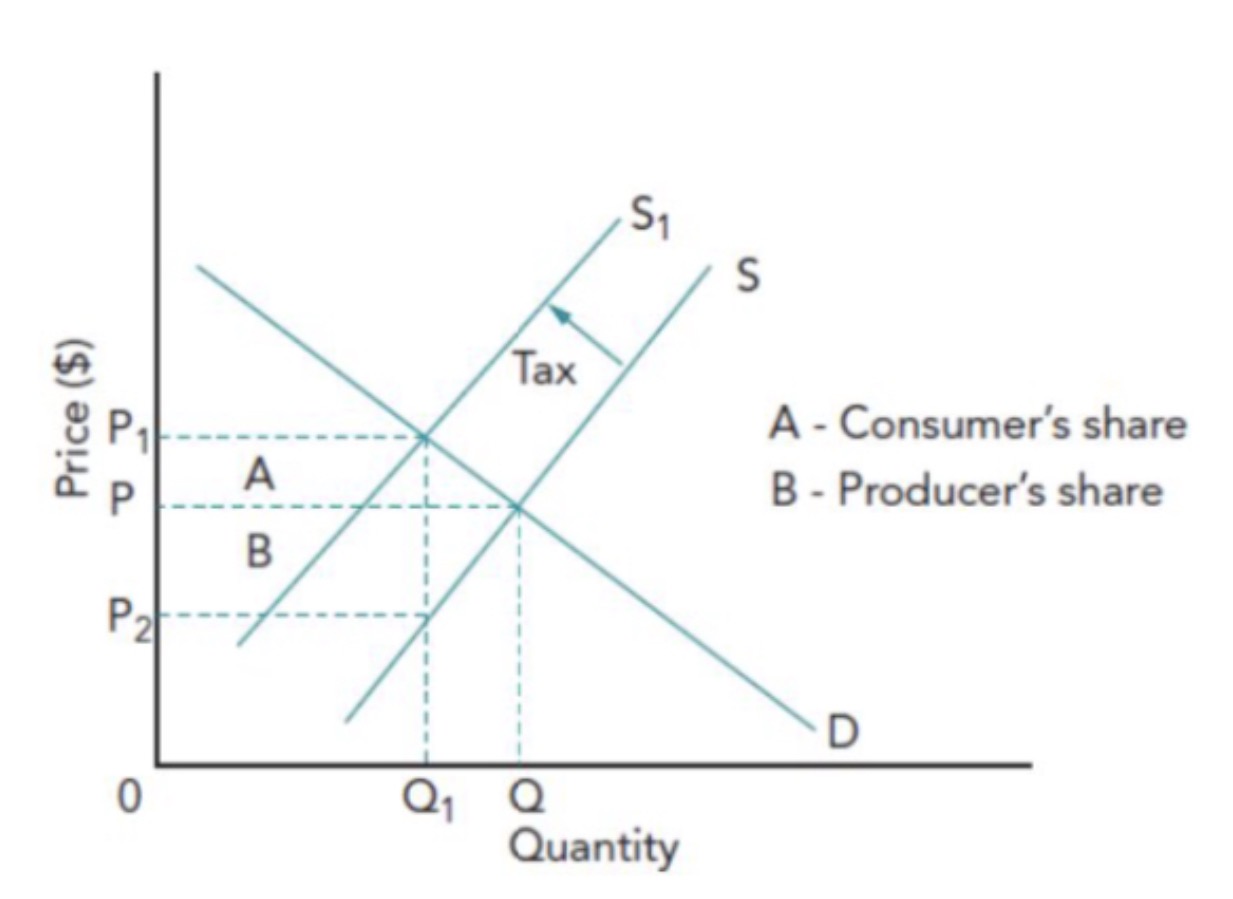
In the diagram, the producer bears a slightly higher burden than the consumer - shown as area B is greater than area A
The producer now receives a lower price at P2
The consumer now pays a higher price at P1
The overall tax revenue to the government is the area A+B
What does the incidence of tax depend on?
The extent to which the producer is able to pass the tax on to the consumer depends on the price elasticity of demand and supply
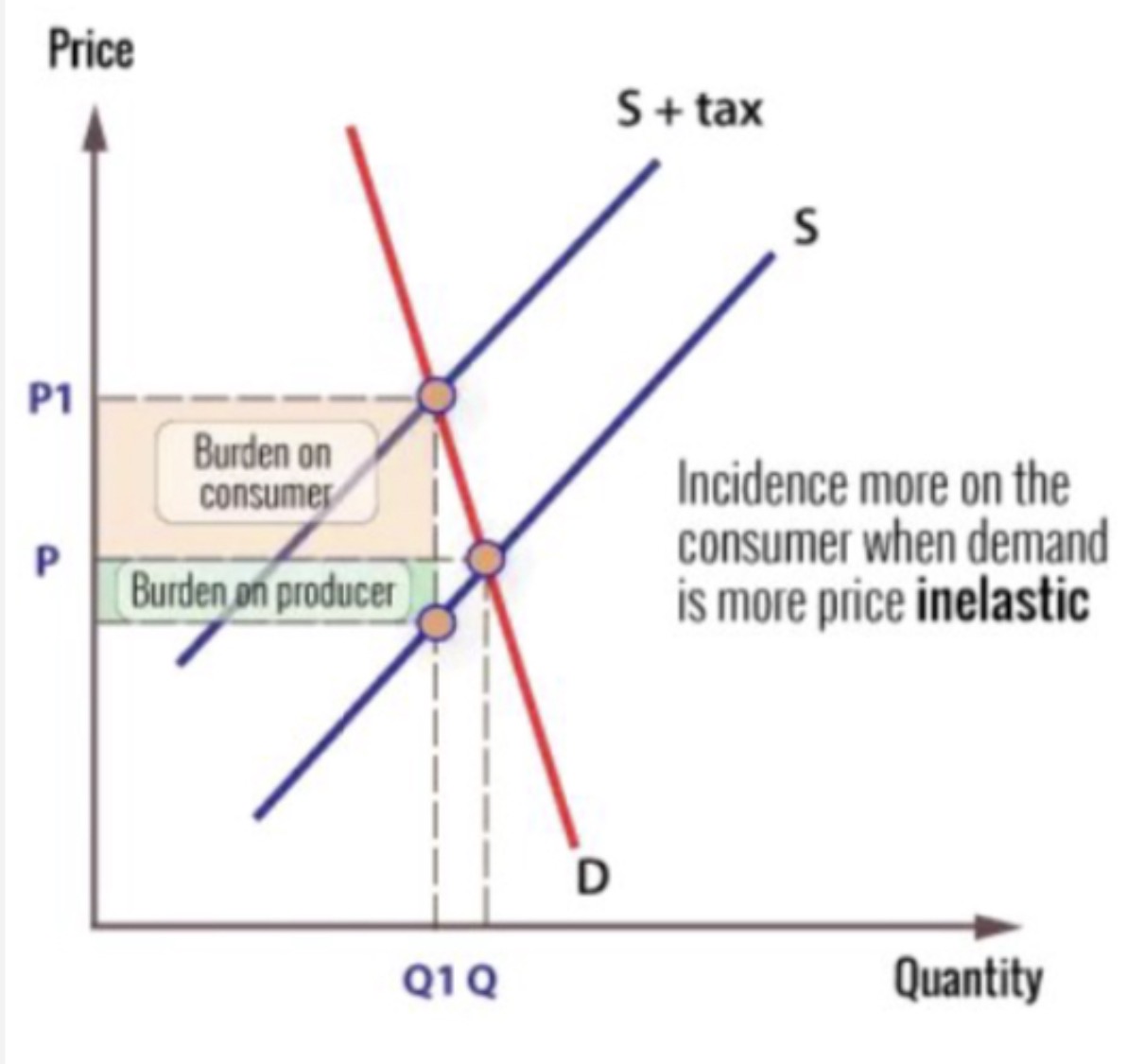
Price inelastic demand
it is easier for the producer to pass on the tax to the consumer in the form of higher prices
e.g. essential products such as petrol
The consumer bears the greater burden of the tax
Price elastic demand
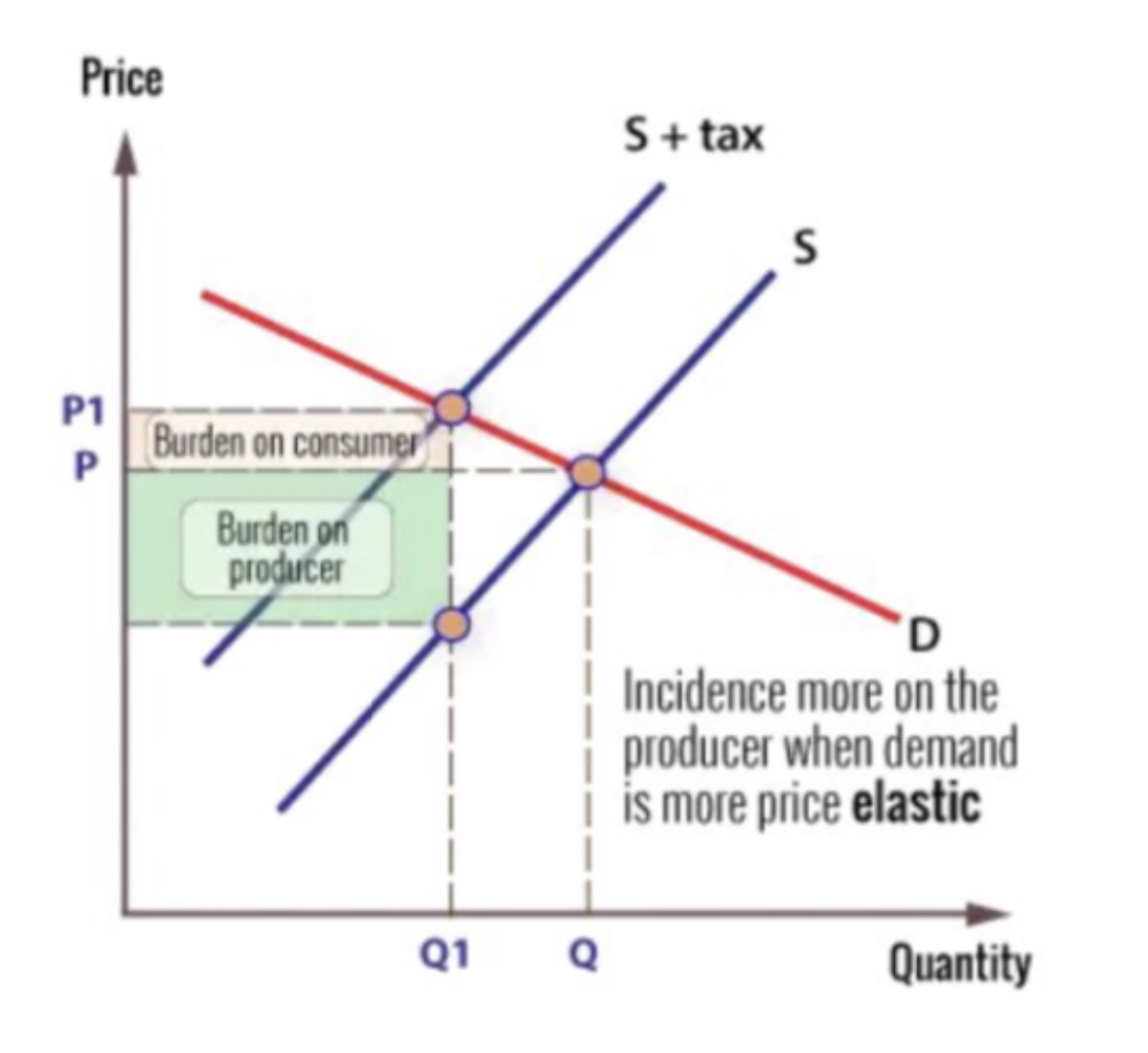
it is more difficult for the producer to pass on the tax to the consumer in the form of higher prices
The increase in price leads to a larger percentage fall in quantity demanded
The producer bears the greater burden of the tax
Why do many low-income market economies struggle to collect taxes?
One reason is that many people in the working population are paid in cash and do not submit a tax return
Forcing businesses to adopt a more digital means of receiving payments can help avoid this
In emerging market economies, government therefore feel more confident about collecting indirect rather than direct taxes
Subsidy
a direct payment made by the government to producers of goods and services
Reasons for subsidies include:
To keep down market price of essential goods e.g. bread
To encourage greater consumption of merit goods e.g. education
To contribute to a more equitable distribution of income
To provide services that would not be provided by the free market e.g. postal services
To raise producers’ income, especially in the case of farmers
To provide an opportunity for exporters to sell more goods
To reduce dependence on imports by paying subsidies to domestic producers of close substitutes
Incidence of subsidy
the extent to which the benefit of the subsidy is shared between the producer and the consumer
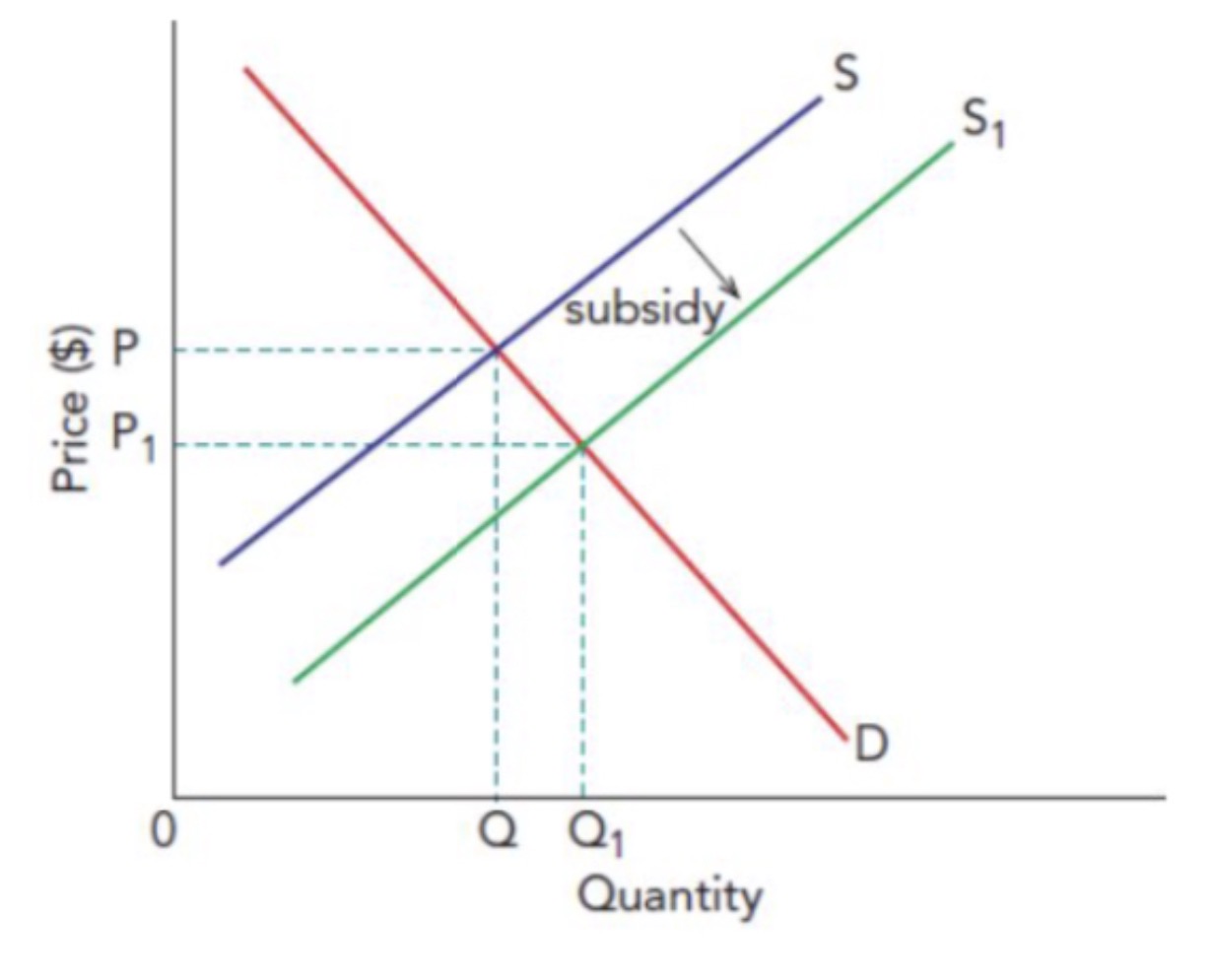
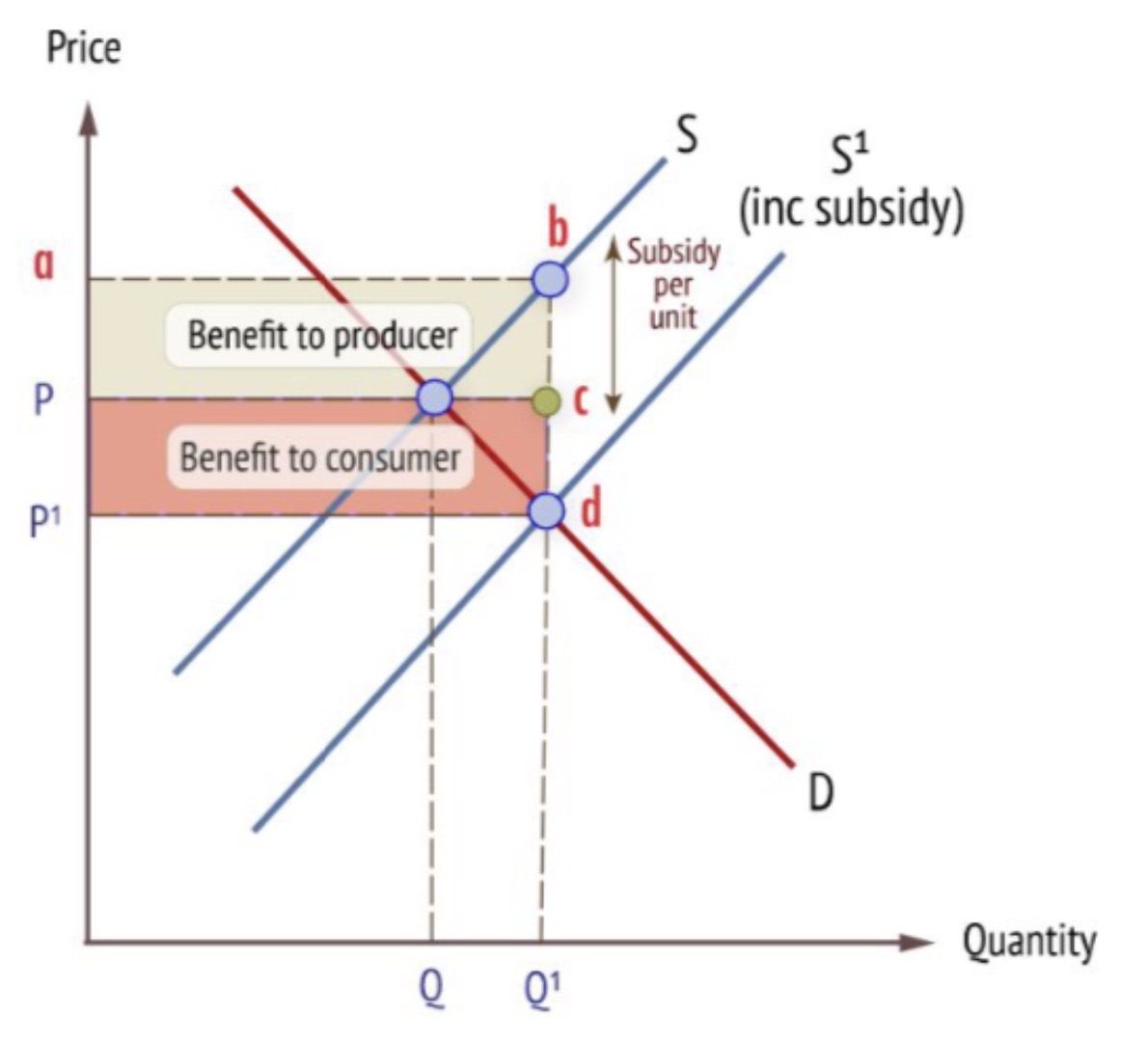
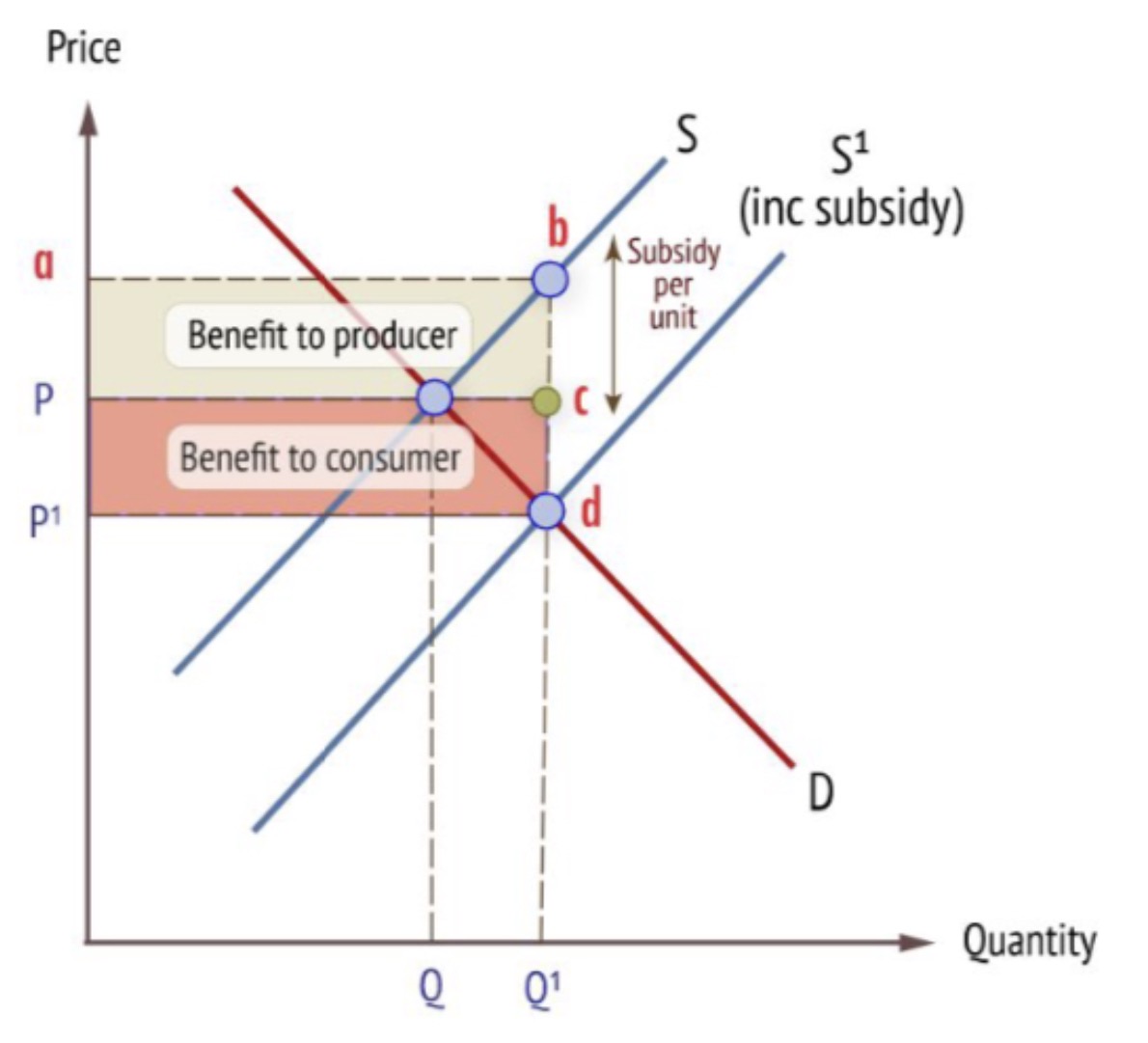
Consumers benefit from a lower price (P1) rather than the free market price (P)
Producer benefit through receiving a higher price (a) than they would selling an increased supply
The overall cost of the subsidy to the government is the area abdp1
What does the incidence of subsidies depend on?
The extent to which the subsidy benefits the producer and the consumer depends on the price elasticity of demand and supply
Why is the allocation of subsidies from a limited government revenue a controversial issue?
Subsidies interfere with the price mechanism and also create an opportunity costs since this funding could have been used elsewhere in the economy
Estimating the size of a subsidy required is difficult
Subsidies are ‘blanket’ or lump sum payments - both high-income and low-income earners pay the same amount per unit consumed
Examples of subsidised goods and services and why they are subsidised
Staple foods such as rice, bread and cooking oil
This is to support the lowest income earners in the economy
High income earners pay the same amount for the good as low income earners, though they could afford to pay more
Shortages may be created since demand is greater than supply
There is no incentive for inefficient producers to improve
There is no certainty that the money received as a subsidy will be used for its intended purpose
Public transport
This is to give low-income earners access to employment opportunities, to provide social mobility for elderly, to reduce road congestion and environmental problems associated with traffic
The benefits are to individuals and to the community as a whole
The direct provision of goods and services
Governments provide certain important services free of charge at the point of use or consumption e.g. public goods and merit goods
The funding for these services will come from tax revenue
It may lower inequality as those on lower incomes will benefit more as a percentage of their income
Merit goods e.g. education and healthcare are sometimes provided for free
However, many economies provide these partly free of charge (government provision) and partly by charging a price at the point of use (private sector provision)
The main view is that everyone should have an equal access to a certain level of education and healthcare, regardless of income
Public goods e.g. streetlights are provided by the government and paid for out of tax revenue
These goods will not be provided for by the free market and consumers will not be willing to pay for them
An argument is that this leads to inefficiency as the costs are higher than would be if it were provided by a competitive market
Differences between economies’ healthcare provision (UK and USA)
UK - free healthcare
USA - free healthcare is limited with those who can afford to pay having to take out medical insurance
Most low-income countries - a charge is usually made for healthcare provision
Only a basic system of healthcare may be provided free of charge
Why is provision of goods and services is controversial issue?
It is argued that it leads to over provision (inefficient allocation of resources), especially if there is no direct charge
If consumers were charged, demand would fall
It would also reduce the tax burden allowing for government spending on alternative uses
Maximum prices (price ceiling) -
a price that is fixed and the market price must not exceed this price
May be imposed by the government if the price of a good is too high in the free market
It is a way of assisting those on low incomes, reducing income inequality, or when the benefits of consuming a product are not fully appreciated
To have any effect, the maximum price must be set below the equilibrium price of the free market
It is not legally possible for sellers to charge a price higher than the maximum price
Governments use legislation to enforce maximum prices for:
Staple food items e.g. rice, cooking oil, flour
Petrol and diesel fuel
Rents in certain types of housing
Services provided by utilities e.g. water, gas and electricity
Transport fares, especially where a subsidy is being paid
Example: maximum price for cooking oil
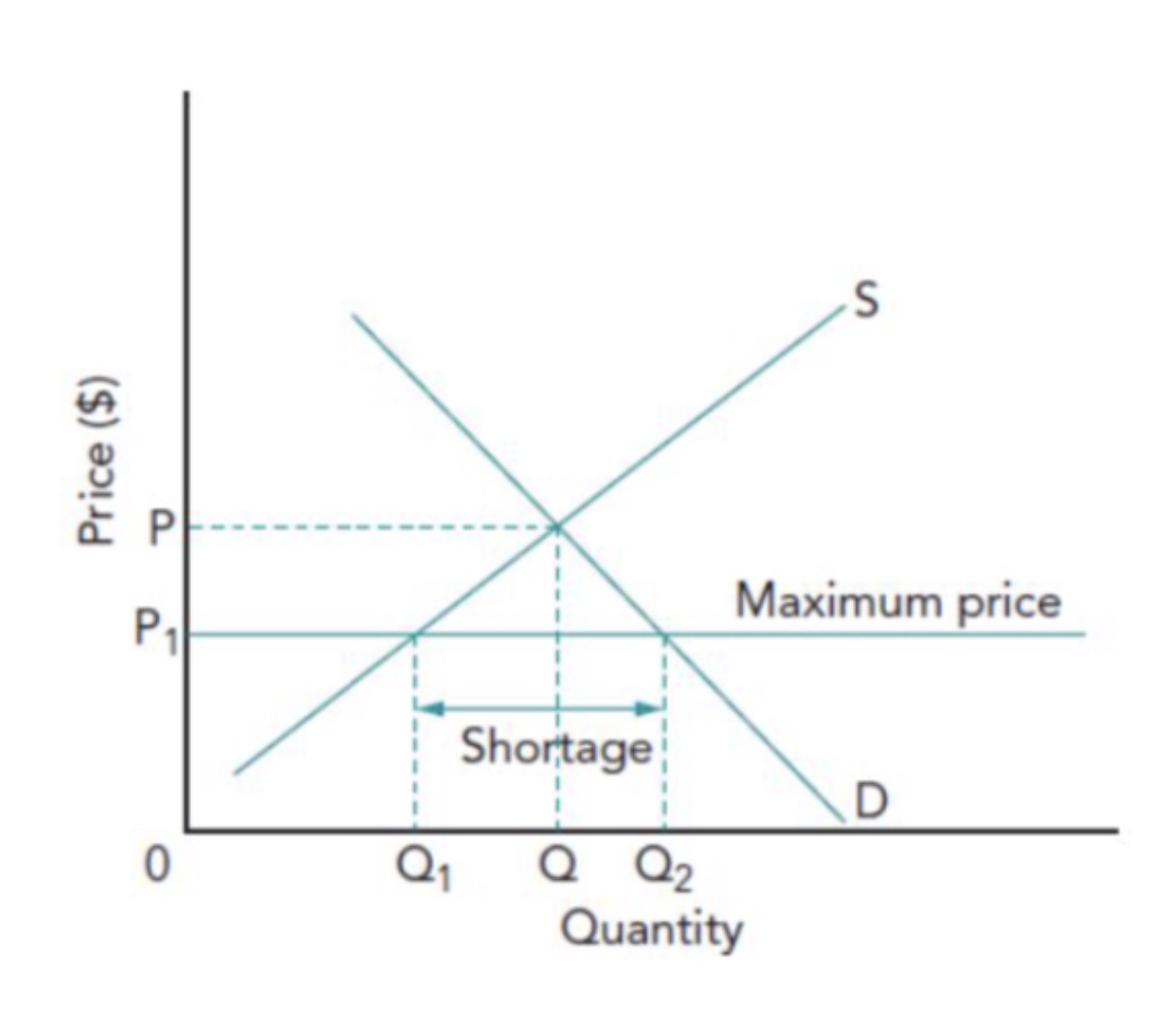
Price is forced down from P-P1
This creates a shortage (Q2-Q1) because producers are only willing to supply Q1 but consumers demand Q2
Production is not sufficient to satisfy everyone - there is an excess demand
Some consumers will benefit - those who are able to buy the product (Q1) at a lower price
Other consumers will lose out as the product is no longer available
The available supply of the product may have to be allocated by queuing or rationing
Rationing restricts demand but this may create an informal or underground market for the product - consumers will then have to pay high prices well above the maximum price
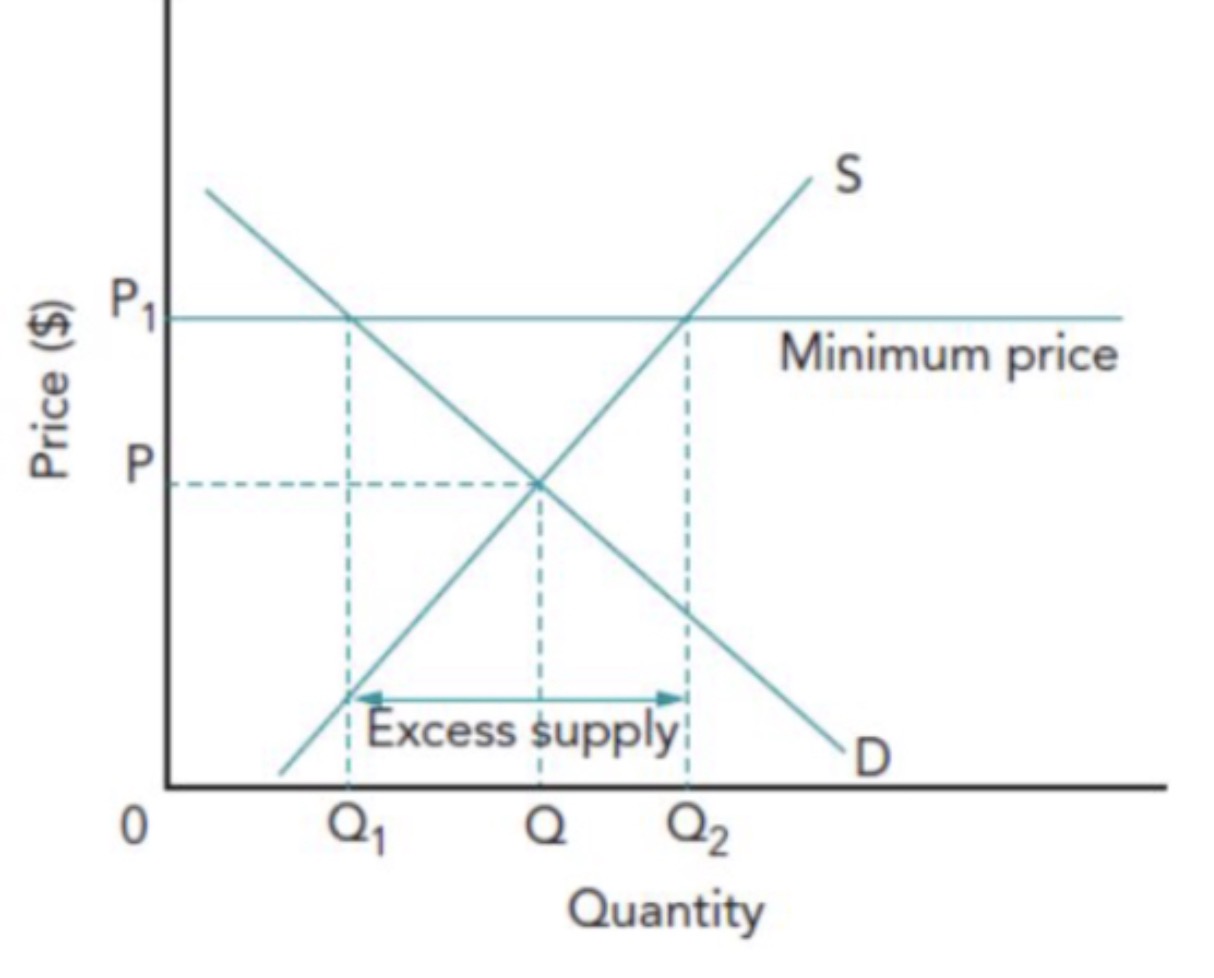
Minimum price (price floor)
a price that is fixed and the market price must not go below this price
To have any effect, the minimum price must be set above the equilibrium price of the free market
Governments use legislation to enforce minimum prices for:
Demerit goods e.g. high-sugar sports drinks
Agricultural products, particularly in middle and in high-income countries
Wages in certain occupations, usually low skilled, to avoid employers exploiting their employees
Certain types of imported goods where close substitutes produced by domestic producers are available
Example: minimum price for high-sugar sports drinks
Price is forced up from P-P1
This creates a surplus (Q2-Q1) because producers are willing to supply Q2 but consumers only demand Q1
There is an excess supply
Only those consumers who can afford the higher price will purchase the product
A lower quantity (Q1) is traded
Limitations of minimum prices
Producers are likely to be inefficient - firms with high costs have little incentive to reduce costs since they are protected by the high minimum price from lower-cost competitors
An informal market may develop e.g. cigarettes
If there is a high rate of indirect tax and a high minimum price, consumers may be happy to buy these goods from dealers offering them at a lower price than the minimum price
Agricultural markets - the minimum price tends to be set at a level that provides a living income for producers
The excess supply will usually be bought by the government at the minimum price
Buffer stock scheme
a type of commodity agreement designed to limit price fluctuations
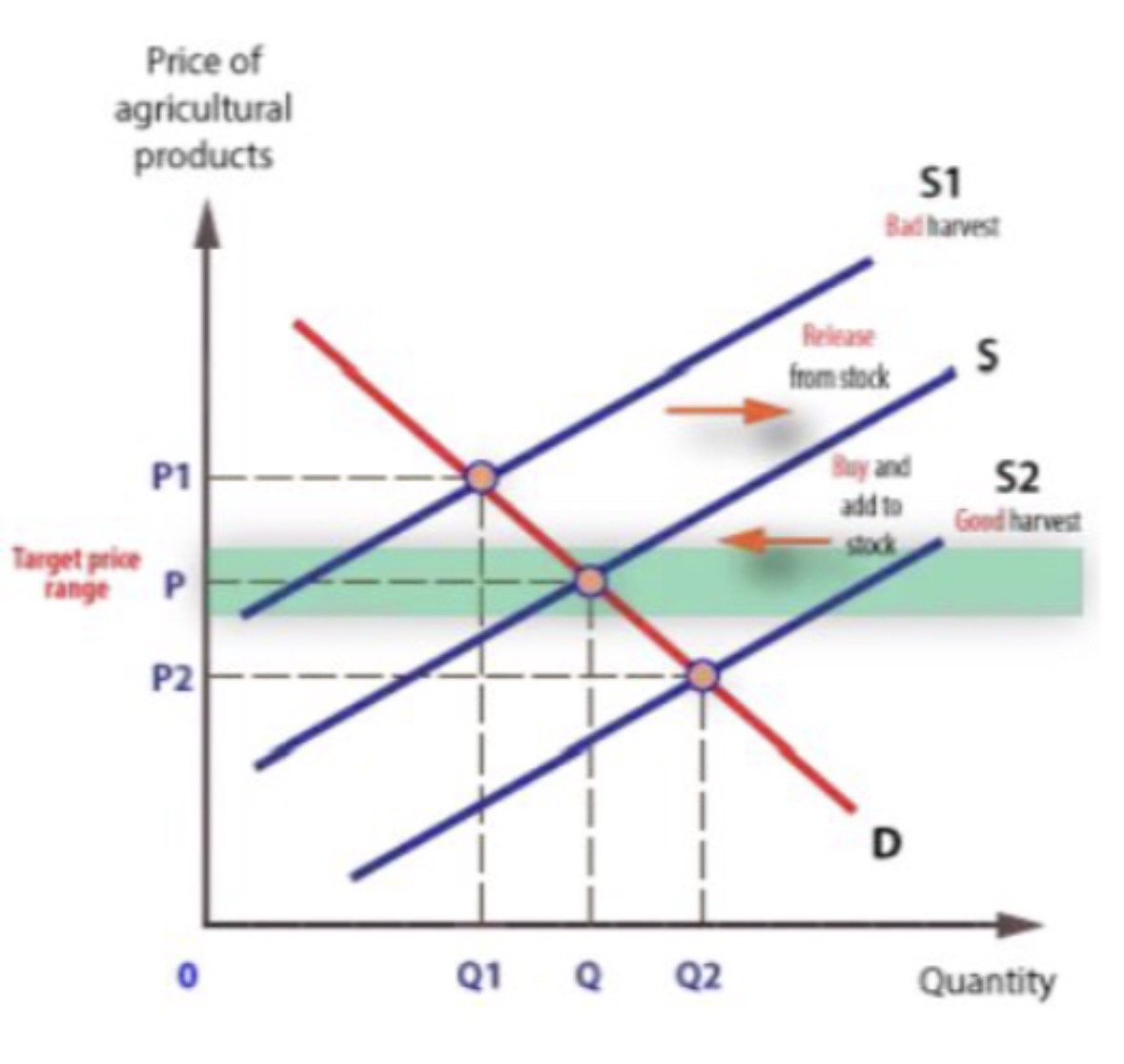
The government will hold stocks and these will be bought or sold to stabilise prices if there is a disequilibrium (shortage or surplus)
The government will buy stocks when there is a surplus so that price does not fall drastically
The government will sell stocks it has held when there is a shortage so that price does not rise drastically
It combines the principles of a minimum and maximum price control
This is especially useful in agricultural markets because prices are unpredictable due to changes in supply
Example: agricultural products
If supply decreases from S-S1, this will create a shortage at the initial price P - this will put upward pressure on the price to rise to P1
The government will then sell stocks (increasing supply on the market) so that price will fall and be stabilised in the target price range
If supply increases from S-S2, this will create a surplus at the initial price P - this will put downward pressure on the price to fall to P2
The government will then buy stocks (decreasing supply on the market) so that price will rise and be stabilised in the target price range
Provision of information
Information failure can result in under consumption of merit goods and over consumption of demerit goods
The government can therefore use information provision as a form of direct intervention:
Examples:
Compulsory information on cigarette packets warning of the dangers of smoking
Public health announcements and campaigns
Advice on non-prescription medicines
Nutrition and allergy information on food packaging