3 - Crime Scene Investigation
 Call Kai
 Learn
Learn Practice Test
 Spaced Repetition
 Match
Match Flashcards
 Knowt Play
1/47

There's no tags or description
Looks like no tags are added yet.
Name | Mastery | Learn | Test | Matching | Spaced | Call with Kai | Chat |
|---|
No analytics yet
Send a link to your students to track their progress
48 Terms
Crime Scene
Any place where the crime scene is committed
Crucial piece of evidence
Any object present in the crime scene,
which might be very ordinary before commission of crime, is a _______________
Primary
Secondary
Types of Crime Scene (2)
Primary Crime Scene
first criminal activity
Secondary Crime Scene
any subsequent crime scene
Macroscopic Crime Scene
Microscopic Crime Scene
Size (2)
Macroscopic Crime Scene
the overall or large-scale view of the crime scene.
Example: the whole room, house, or area where the crime happened.
Microscopic Crime Scene
the small-scale or detailed view of the crime scene.
It focuses on tiny or trace evidence that may not be seen easily, such as hair, fibers, fingerprints, blood droplets, gunshot residue, or glass fragments
Homicide
Robbery
Sexual Assault
etc.
Types of crime committed:
Homicide
the unlawful killing of one person by another person.
Robbery
the taking of money or property from a person
through force, violence, intimidation, or threat
Sexual Assault
any unwanted sexual contact or act done without a person’s consent.
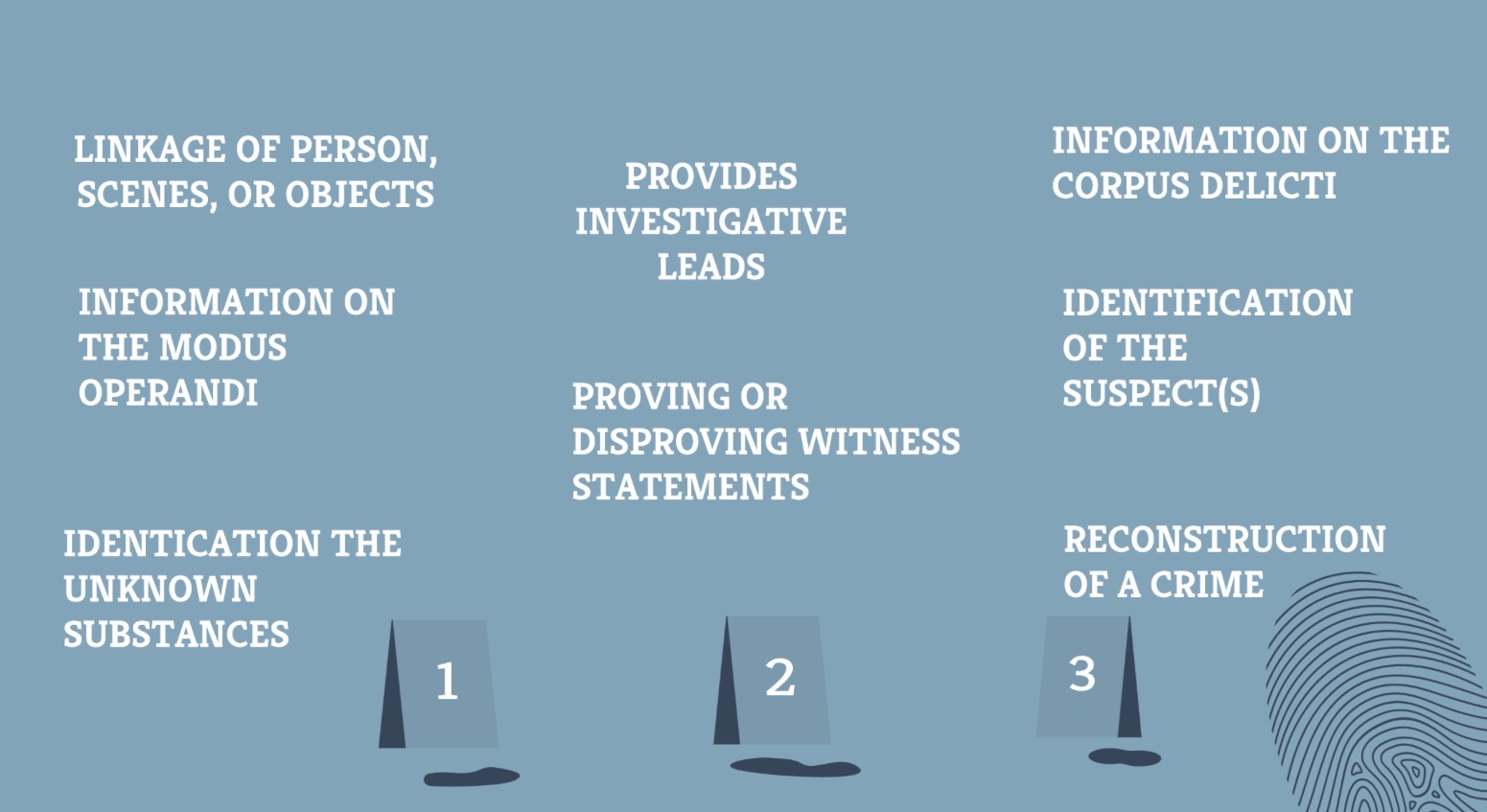
USES AND INFORMATION from physical investigations:
Recognition
Identification
Individualization
Reconstruction
4 Steps of Crime Scene Investigation (CSI)
R-I-I-R
Recognition
scene survey, documentation, collection
Identification
comparison testing
Individualization
evaluation, interpretation
Reconstruction
reporting and presentation
First Responder
The first person to arrive at the crime scene, usually a police officer.
Locard’s Exchange Principle
A forensic principle stating that every contact leaves a trace.
Scene Management
First Responding Officer
Duties of First Responder
Securing the Crime Scene
Crime Scene Survey
GENERAL CRIME SCENE Procedures:
Information
Manpower
Technology
Logistics
4 Scene MANAGEMENT:
Information Management
organizing and recording all crime scene details and evidence.
Manpower Management
assigning and supervising personnel
involved in the investigation.
Technology Management
using tools and equipment like cameras, computers, and forensic devices.
Logistics Management
providing needed materials, transport, and support for the investigation.
First Responding Officer
Police officers
Fire department personnel or
Emergency medical personnel
assist
arrest
witnesses
crime scene
noted
Duties of the First Responder:
___ the victim and prevent any changes to the victim.
Search for and ____ the suspect if that person is still" on scene.
Detain any _____.
Protect the ______.
All movements, alterations, or changes made to the crime scene should be ___ and communicated to the crime scene investigators.
Securing the Crime Scene
The first responder must establish tapes or use any physical barriers
Protecting the Crime Scene
An officer shall be designated as the scene security officer to be responsible for preventing any entrances into the crime scene by curious onlookers.
Crime Scene Survey
Preliminary scene survey or "walk through" should be done
crime scene investigator & first reponder
The _______ and the _______ will usually do the scene survey together
Crime Scene Survey
is the first examination or orientation of the crime scene
by the crime scene investigator
Taking notes
Video Recording
Photographing
Sketching
Digital Imaging
Crime Scene Documentation: (5)
Taking notes
A general guideline include the following:
• Notification information
• Arrival information
• Scene description
• Victim description
• Crime Scene team
Video Recording
The following summarizes the process that should be followed for effective video taping of crime scenes:
• Document the recording by use of a placard.
• Begin with the surroundings.
• General orientation of the scene.
• Victim's viewpoint.
• Camera techniques.
• Original videos.
Photographing
To provide a true and accurate pictorial record of the crime scene and physical evidence present
General or overall photos (with locator images)
Mid-range photos
Close-up photos
Photographing the Crime Scene, General to specific guideline: (3)
SLR 35mm
(Camera) is the most common
50-60 mm
Normal Lens
28-35mm
Wide angle lens
Sketching
The final task to be performed
in the documentation of the crime scene
Sketching
It is the assignment of units of measurement or correct perspective to the overall scene and the relevant physical evidence identified within the scene.
Rough sketch
Final sketch
Two Basic types of SKETCHING:
Title or caption
legend of abbreviations
symbols
numbers or letters used
a compass designation
case number
offense type
victim name/s
location
scene descriptor
date/time of sketch beginning
sketcher's name(s)
Documentation includes: (Sketch)
Digital Imaging
Provides the crime scene investigator with powerful new tools for capturing, analyzing, and storing the record of the crime scene and its physical evidence.
Digital Imaging
Advantage - instant access to the images, easy integration into existing electronic technologies, and no need for the often-expensive film processing equipment and darkrooms.
Digital Imaging
Disadvantage - issues of court admissibility because of easy image manipulation.