Electric Circuits Physics 11
 Call Kai
 Learn
Learn Practice Test
 Spaced Repetition
 Match
Match Flashcards
 Knowt Play
1/59

There's no tags or description
Looks like no tags are added yet.
Name | Mastery | Learn | Test | Matching | Spaced | Call with Kai |
|---|
No analytics yet
Send a link to your students to track their progress
60 Terms
A device that produces electricity by transforming chemical energy into electrical energy is called a
battery
A car battery
has an emf of 12 V consisting of six 2 V cells connected in series
The total amount of charge that passes through a wire’s full cross section at any point per unit of time is referred to as
current
The direction of conventional current is taken to be the direction that
positive charges would flow
A coulomb per second is the same as
an ampere
Car batteries are rated in “amp-hours.” This is a measure of their
charge
A current that is sinusoidal with respect to time is referred to as
a direct current
The resistance of a wire is defined as
V/I
What is 1 Ω equivalent to?
1 V/A
The resistance of a wire is
proportional to its length and inversely proportional to its cross-sectional area.
The resistivity of a wire depends on
the material out of which it is composed.
What conducting material has the lowest resistivity value?
silver
Consider two copper wires. One has twice the length of the other. How do the resistivities of these two wires compare?
Both wires have the same resistivity.
Consider two copper wires. One has twice the length of the other. How do the resistances of these two wires compare?
The longer wire has twice the resistance of the shorter wire.
Consider two copper wires. One has twice the cross-sectional area of the other. How do the resistances of these two wires compare?
The thicker wire has half the resistance of the shorter wire.
Consider two copper wires. One has twice the length and twice the cross-sectional area of the other. How do the resistances of these two wires compare?
Both wires have the same resistance.
The length of a wire is doubled and the radius is doubled. By what factor does the resistance change?
half as large
How much more resistance does a 1 18 .0 cm diameter rod have compared to a 2.0 cm diameter rod of the same length and made of the same material?
300%
The resistivity of most common metals
increases as the temperature increases.
Negative temperature coefficients of resistivity
exist in semiconductors.
Materials in which the resistivity becomes essentially zero at very low temperatures are referred to as
superconductors.
What is 1W equivalent to?
1 V·A
A kilowatt-hour is equivalent to
3 600 000 J.
If the resistance in a constant voltage circuit is doubled, the power dissipated by that circuit will
decrease to one-half its original value.
If the voltage across a circuit of constant resistance is doubled, the power dissipated by that circuit will
quadruple.
If the resistance in a circuit with constant current flowing is doubled, the power dissipated by that circuit will
double.
If the current flowing through a circuit of constant resistance is doubled, the power dissipated by that circuit will
quadruple.
During a power demand, the voltage output is reduced by 5.0%. By what percentage is the power on a resistor affected?
10% less
When two or more resistors are connected in series to a battery
all of the given answers.
When resistors are connected in series,
the current flowing in each is the same.
Three identical resistors are connected in series to a battery. If the current of 12 A flows from the battery, how much current flows through any one of the resistors?
12 A
Three identical resistors are connected in series to a 12 V battery. What is the voltage across any one of the resistors?
4 V
When two or more resistors are connected in parallel to a battery,
all of the given answers
When resistors are connected in parallel, we can be certain that
the potential difference across each is the same.
Three identical resistors are connected in parallel to a 12 V battery. What is the voltage of any one of the resistors?
12 V
Three identical resistors are connected in parallel to a battery. If the current of 12 A flows from the battery, how much current flows through any one of the resistors?
4 A
The potential difference between the terminals of a battery, when no current flows to an external circuit, is referred to as the
emf.
The potential difference between the terminals of a battery, when current flows to an external circuit, is referred to as the
terminal voltage.
You obtain a 100W light bulb and a 50W light bulb. Instead of connecting them in the normal way, you devise a circuit that places them in series across normal household voltage. Which statement is correct?
The 50W bulb glows more brightly than the 100W bulb.
As more resistors are added in series to a constant voltage source, the power supplied by the source
decreases.
As more resistors are added in parallel to a constant voltage source, the power supplied by the source
increases.
The lamps in a string of Christmas tree lights are connected in parallel. What happens if one lamp burns out? (Assume negligible resistance in the wires leading to the lamps.)
The brightness of the lamps will not change appreciably.
Consider three identical resistors, each of resistance 43 R. The maximum power each can dissipate is P. Two of
the resistors are connected in series, and a third is connected in parallel with these two. What is the maximum
power this network can dissipate?
3/2 P
State Kirchhoff’s junction rule.
Junction rule: the sum of all currents entering a junction equals the sum leaving it (conservation of charge).
State Kirchhoff’s loop rule.
Loop rule: the sum of all potential changes around any closed loop equals zero (conservation of energy).
Kirchhoff’s loop rule is an example of
conservation of energy.
Kirchhoff’s junction rule is an example of
conservation of charge.
Which of the equations here is valid for the circuit shown?
6 − I2 − 2I2 = 0
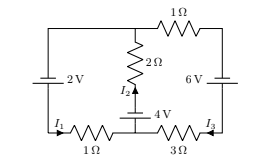
If you connect two identical storage batteries together in series (“+” to “ 49 −” to “+” to “−”), and place them in a circuit, the combination will provide
twice the voltage, and the same current will flow through each.
If you connect two identical storage batteries together in series (“+” to “ 50 −” to “−” to “+”), and place them in a circuit, the combination will provide
zero volts.
If you connect two identical storage batteries together in parallel, and place them in a circuit, the combination will provide
the same voltage and twice the total charge that one battery would.
An ideal ammeter should
introduce a very small series resistance into the circuit whose current is to be measured.
A galvanometer can be converted to an ammeter by the addition of a
small resistance in parallel.
A current reading is obtained by properly placing an ammeter in a circuit consisting of one resistor and one battery. As a result,
the current flowing in the circuit decreases.
Decreasing the resistance of an ammeter’s shunt resistance
allows it to measure a larger current at full scale deflection.
In order to construct a voltmeter from a galvanometer, one normally would
use a very large series resistor.
Increasing the resistance of a voltmeter’s series resistance
allows it to measure a larger voltage at full-scale deflection.
A voltage reading is obtained by placing a voltmeter across a resistor. What happens to the total current flowing in the circuit as a result of this action?
The current increases.
An unknown resistor is wired in series with an ammeter, and a voltmeter is placed in parallel across both the resistor and the ammeter. This network is then placed across a battery. If one computes the value of the resistance by dividing the voltmeter reading by the ammeter reading, the value obtained
is greater than the true resistance.
An unknown resistor is wired in series with an ammeter, and a voltmeter is placed in parallel across the resistor only. This network is then connected to a battery. If one computes the value of the resistance by dividing the voltmeter reading by the ammeter reading, the value obtained
is less than the true resistance.