Chemical Reaction Classification [Part-II]
 Call Kai
 Learn
Learn Practice Test
 Spaced Repetition
 Match
Match Flashcards
 Knowt Play
1/26

There's no tags or description
Looks like no tags are added yet.
Name | Mastery | Learn | Test | Matching | Spaced | Call with Kai |
|---|
No analytics yet
Send a link to your students to track their progress
27 Terms
Calcification
The process by which organisms build hard structures by depositing calcium carbonate or other calcium minerals
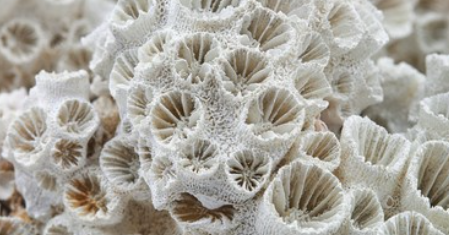
Coral skeleton
A rigid external structure made primarily of calcium carbonate that is secreted by coral polyps (marine animals in the phylum Cnidaria).
Seashell
A hard protective outer covering produced by certain marine organisms, most commonly mollusks, and composed primarily of calcium carbonate
Phylum
Term that comes below class and above kingdom
Mollusks
A diverse phylum of invertebrate animals characterized by a soft body, a muscular foot, and a mantle that often secretes a shell made of calcium carbonate
Examples: Snails, Clams, Oysters, Mussels, Scallops, Octopuses, and Squids
Calcification Equation
Ca²⁺(aq) + 2HCO₃⁻(aq) → CaCO₃(s) + CO₂(aq) + H₂O(l)
Calcium oxalate
CaC₂O₄
The most common type of kidney stone is primarily comprised of this compound
Precipitation Reaction
A chemical reaction in which dissolved ions in solution combine to form an insoluble solid (precipitate).
Crystallization
The process where the precipitate forms and those solid particles become organized into crystals and grow larger over time.
Precipitation Reaction Equation
Ca²⁺(aq) + C₂O₄²⁻(aq) → CaC₂O₄(s)
Aggregation
Process where the crystals stick together
Precipitation + Crystallization + Aggregation
Kideny Stone Formation = ?
Gravimetric Method
A laboratory method used to determine the amount of a substance by forming, collecting, drying, and weighing a solid precipitate. The mass of the precipitate is then used to calculate how much of the substance was originally present
Example: Determining the amount of chloride ions in a solution by precipitating them as silver chloride and weighting the solid.
Golden Rain Experiment
2KI(aq) + Pb(NO₃)₂(aq) → PbI₂ + 2KNO₃
When a hot solution of lead(II) iodide (PbI₂) cools, shiny yellow crystals form and settle through the liquid, creating the appearance of falling golden raindrops
Potassium nitrate
KNO₃
A soluble salt
Most commonly used as a fertilizer
Perovskite Solar Cell
A solar cell that uses a perovskite-structured material as the light-absorbing layer to convert sunlight into electrical energy.
Achieve high efficiencies while being cheaper and easier to manufacture than traditional silicon solar cells.
Lead(II)Iodide
PbI₂
Most commonly used materials in the synthesis of a perovskite structures
Methylammonium lead iodide
CH₃NH₃PbI₃
Most common perovskite solar cell material
A = CH₃NH₃⁺
B = Pb²⁺
X = I⁻
Calcium titanate
CaTiO₃
The very first discovered perovskite structure
Perovskite
When atoms arrange in the following way to form a crystal: ABX₃
A = Large positive ion
B = Smaller positive ion
X = Negative ion
Silver chloride
AgCl
Compound that forms the part of Ag/AgCl electrode
Which converts ionic currents from brain activity into electronic currents that an EEG machine can detect and record
Weak acids
The substances partly responsible for:
The tangy taste of citrus fruits
The stinging sensation of insect bites
The unpleasant smells associated with body odor.
Neutralization of stomach acid by magnesium hydroxide
Mg(OH)₂(s) + 2HCl(aq) → MgCl₂(aq) + 2H₂O
Burning sensation associated with heartburn
A result of the acid of the stomach leaking through the muscular valve at the top of the stomach into the lower reaches of the esophagus.
The lining of the esophagus is not protected from the corrosive effects of stomach acid the way the lining of the stomach is, and the results can be very painful.
Doctors recommend Calcium Carbonate to be taken
CaCO₃(s) + 2HCl(aq) ⇌ CaCl₂(aq) + H₂O(l) + CO₂(g)
Urea cycle
A metabolic pathway that helps remove excess nitrogen from the body.
Ornithine
C₅H₁₂N₂O₂
A non-protein amino acid
Combines with carbamoyl phosphate to help convert toxic ammonia into urea, which can then be excreted by the kidneys
Putrescine
C₄H₁₂N₂
Formed when bacteria break down the ornithine during the decomposition of dead organisms and other organic matter.
Compounds responsible for the characteristic odor of decaying animal tissue