phonetics final review
 Call Kai
 Learn
Learn Practice Test
 Spaced Repetition
 Match
Match Flashcards
 Knowt Play
1/99

There's no tags or description
Looks like no tags are added yet.
Name | Mastery | Learn | Test | Matching | Spaced | Call with Kai |
|---|
No analytics yet
Send a link to your students to track their progress
100 Terms
In IPA, each symbol represents a single
sound
the scientific study of “universal” language is
linguistics
phonology states how ______ ______are used in language
speech sounds
phonology is the study of ____ of speech sounds and the ____ which govern them
systems, rules
the variations in air pressure create _____ waves
longitudinal
phone is an _____ sound of speech
individual
a phoneme is the smallest sound that does what?
that distinguishes meaning
a variant of a phoneme that doesn’t change the meaning of a word
allophone (phonological rules)
glottis is the space
BETWEEN vocal folds
the moving parts in vocal cord are called
the vocal folds
if someone has a stuffy nose, their voice is
denasalized (because nose is closed)
when a vowel has no appreciable change in quality during a syllable
monopthong
A vowel has a change in quality during a single syllable
diphthong
tense vowels with partial off glide are considered full diphthongs.
FALSE
tongue height =
high, mid, low
tongue advancement =
front, central, back
during nasal sounds, the velum goes _____ (up or down) to close the _____ tract
down, oral
vowels can be described by which 4 things
tongue height, tongue advancement, lip rounding, tense/lax
the tense vowels are
i, e, o, u
lax vowels are
ɪ, ɛ, æ, ʌ, ʊ, ə
we can more precisely describe vowels by which characters?
their acoustic characters (more than their articulatory features)
which vowel replaces another vowel when vowel reduction occurs?
ə (shwa)
a feature that is either on or off is called
binary features (ex. voiced/voiceless)
which features can not be explained by clear cut binary features?
graded features (like prosody)
when a consonant sound is produced for a longer duration and it changes the meaning of that word
geminate consonant
example of geminate in Japenese
saka (hill) vs sakka (author)
when we can group segments which are phonetically similar and the sounds occur within our environment
natural classes (ex. we group p,t,k together bc they are VL stops)
we call our speech _____ speech because we do not separate each word in our daily speech
connected
when we separate words/ have single words pronounced individually
citation form
when future sounds influence a present sound
anticipatory coarticulation (ex. skrewz, your lips round at sk before you even get to u)
when previous sounds still influence a present sound
preservative coarticulation (ex. boots)
when a sound changes into another sound because of neighboring sounds
assimilation (input → imput)
when a sound is influenced by neighboring sounds but it changes to like a new segment
disassimilation (ex. sixths → goes from fric-fric-fric TO fric-stop-fric)
syllables are often used to describe patterns of _____ and timing of speech
stress
stressed sounds use extra _____ energy during speech and are usually what 3 things?
respiratory. louder, longer, higher (in pitch)
stress must always be placed in words with more than one syllable (t/f)
TRUE
the stress symbol is placed (before or after) the syllable carrying the most stress?
before!
the one syllable that carries the most stress for a phrase
tonic syllable
sentence level intonation uses ____ variations to convey syntactic info
pitch
yes/no is
rising intonation
wh- questions is
falling intonation
intonational phrase is also known as a
tone group
english and german are ____ timed languages
stress
spanish and japenese are _____ times languages
syllable
ToBI stands for
“tones and break indices”
when we transcribe and annotate speech prosody we call this
ToBI system
broad transcription captures the ____ of a language, with simple symbols
phonemes
narrow transcription captures ____, using more phonetic detail with specific symbols
allophones
aspiration is when there is a period of _____ after the release of an articulation
voicelessness
the vocal folds are the ____ in the source-filter theory?
source
the vocal tract is the ____ in the source-filter theory?
filter
the vocal folds are the ____ in the source-filter theory?
source
fundamental frequency (F0) is perceived as
pitch
fundamental frequency (F0) is the ____ harmonic of the voice
FIRST
harmonics are the ______shown in integer multiples of the F0 in voiced sounds
energy
formants are a product of vocal tract _____
resonances
we can identify vowels by which formants
the first 3 formants: F1, F2, and F3
F1 relates to tongue
hieght
as our jaw goes DOWN, F1 goes
UP
F2 relates to tongue
advancement (front and back)
as the tongue moves forward, F2
increases
as we round our lips, all formants are (increased or decreased)?
decreased/lowered
F3 lowers with _____ vowels
r-coloring
Amplitude is also known as ____ and is percieved as
intensity, loudness
on a spectrogram, what are the x-axis and y-axis? what does the darkness on the graph represent?
x= time, y=frequency. the darkness represents intensity (like loudness)
frequency is the rate of _____ of a periodic event
vibration (ex. number of cycles of vibration per second (Hz).
frequency is measured as
cycles per second is
a cycle on a graph looks like
a loop that goes up then down/down then up counts as one cycle
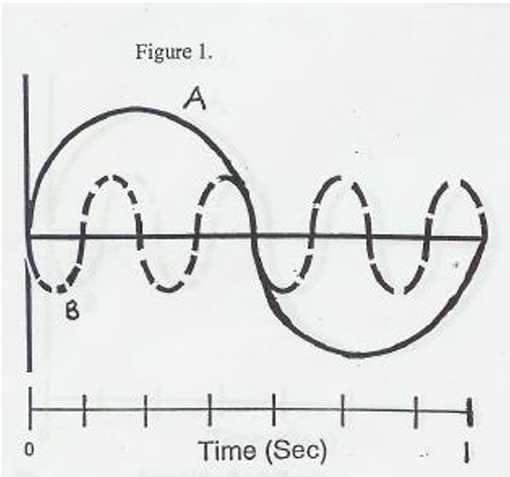
amplitude is the magnitude of _______for a sound wave
displacement
phase is the relative _____ of two or more components of a complex periodic waveform.
timing
phase is measured in
degrees (if one is positive-going and the other is negative-going, they have a relative phase of 180 degrees)
wavelength is the ______ that a periodic signal travels in __ complete cycle of vibration
distance, 1
the two types of periodic waves are
simple and complex
simple waves look simple and the types are
sine or sinusoid
complex waves are made up of many overlapping _____ waves
simple
_________ features are properties that are ____ for a single consonant or vowel
Suprasegmental, not (ex. stress, length, tone, intonation)
the quality that sounds with the same length, stress, and pitch that differ in loudness is called
sonority
the extent that a sound stands out from others because of its sonority, length, stress, and pitch
prominence
strong form is when a word that is usually _____ is ______
unstressed is stressed (like “a” or “to”)
weak form is when a word that is usually stressed is ______, typically happens in conversational speech
unstressed (like “but”)
tone languages use ____ to convey part of meaning to a word
pitch
register tone has ____ levels and is used in ____ languages
set, African
contour tone may include ______ or tone _____, used in _____ languages
rise/fall, shapes, Chinese
In Mandarin (Chinese), /ma/ pronounced with a high-level tone means “mother” and with a high falling tone means “scold.” what type of tone is this?
contour tone
in breathy voice, the vocal folds are ____ open and allows for ____ rate of airflow through the glottis?
slightly, high
murmur is known as
breathy voice
in creaky voice the arytenoid cartilages hold the _______ (post or ant?) end of the ______ ______ together so that they can vibrate only at the other end
posterior, vocal folds (ex. in Hausa)
airstream mechanism is the manner in which what is set in motion for the purposes of speech?
airstream
egressive airstream mechanism
outward airflow
ingressive airstream mechanism
inward airflow
ejectives are a stop made with an _______ glottalic airstream, such as Hausa /k’
egressive
implosives are a stop made with an ______ glottalic airstream, such as Sindhi /ɓ/
ingressive
In english consonants that are more than 25 ms are
VOICELESS stops (vL=L=Longer)
voice onset time is
The interval between the release of a stop consonant and the beginning of vocal cord vibration (voicing).
what are the steps to produce a stop?
1. closure
2. build up intra-oral pressure
3. release (burst)
4. (VOT)
5. if voiceless in syllable-initial
position → aspiration
6. voicing
____ (voiced or voicless?) fricatives turn out longer when theres a vowel before them
voiced (ex. teethe vs teeth)
prevoicing
voicing before a supraglottal articulatory event (ex. for stops, prevoicing happens after release)
sibilants are speech sounds where there is ____-pitched, turbulent noise
high (like s/, /z/, /ʃ/ , and /ʒ/ )
accents have _____ and ______ distinctions varieties between a language
phonetic and phonological
dialects are any variety in language with diff ______ and _______
word selection and phonological characters