Biol 143
 Call Kai
 Learn
Learn Practice Test
 Spaced Repetition
 Match
Match Flashcards
 Knowt Play
1/168

Earn XP
Description and Tags
This is a study guide for the microscope basic skills and parts , the cell structure and function, and diffusion & osmosis
Name | Mastery | Learn | Test | Matching | Spaced | Call with Kai |
|---|
No analytics yet
Send a link to your students to track their progress
169 Terms
100x total magnification
What is the total magnification produced by a microscope, using a 10X ocular lens and a 10X objective lens?
Be sure to carry the microscope upright, with one hand on the arm and the other under the base. Always begin focusing with the lowest power lens available. To protect the optics of the microscope, place it down gently and don't drag it across the tabletop. Only use the coarse focus knob with the scanning and low power lenses.
Which of the following describes proper microscope care and technique.
coarse focus knob
Turning which of the following knobs moves the objective lenses the greatest vertical distance?
Resolution
is the ability to see two objects as separate.
high power lens
the objective lens that lens is the longest
iris diaphragm lever
regulates the amount of light passing through the slide specimen on the microscope stage?
An increase in magnification causes
a decrease in the field of view, depth of field and working distance
Why must a small object seen through the ocular lens be centered in the field of view, before changing to a higher power objective lens?
to prevent its disappearance due to the decrease in the field of view
A parfocal microscope allows you to quickly focus using the low power or scanning lens and then, to switch to a higher power lens with only a minimal adjustment of the fine focus knob.
true
what does one meter equal to in mm , cm and km?
1000 mm, 100 cm, .001 km
depth of field example
Depth of field is best demonstrated with a slide containing overlapping threads.
letter e slide
When the letter e slide is viewed with the microscope, it appears upside down and backwards.
wet mount
a freshly prepared slide
inverted
Objects seen through a microscope are inverted which means right side up and backwards.
pseudopods
how do paramecium swim
diffusion
is the passive (does not require energy)
higher
net movement of molecules from an area of ____ concentration to an area of lower concentration.
lower
net movement of molecules from an area of higher concentration to an area of ___ concentration.
osmosis
is the diffusion of water across a differentially permeable membrane.
All molecules display random thermal motion or kinetic energy.
true
The temperature of a substance is a direct measure of the average kinetic energy of the molecules of the substance.
true
Water molecules stop moving when water freezes at 0 degrees Celsius.
true
At absolute zero (0 Kelvin or -273.25 degrees Celsius), all molecular motion stops.
true
solution
is a homogenous, liquid mixture of two or more kinds of molecules.
solvent
is a fluid that dissolves substances.
solute
is a substance dissolved in a solution.
A membrane that allows some molecules to pass while retarding others is a ________ _________
semipermeable membrane
Membrane permeability of a solute molecule depends on the molecule's ________ , charge, polarity, and lipid solubility.
size
The random movement of small particles when they collide with moving molecules is called _______ ________
brownian motion
This motion was originally described in 1827 by ____ _____ when he prepared dead pollen grains in water and viewed them under the microscope.
robert brown
the 6 kingdoms
1. eubacteria or bacteira
2. archaebacteria or archaea
3. animal
4. plant
5. protist
6. fungi
eukaryote kingdoms
animal
plant
protist
fungi
prokaryote kingdoms
bacteria and archaebacteria
what kingdom does oscillatoria belong to
bacteria
what kingdom does amoeba belong to
protist
what kingdom does paramecium belong to
protist
what kingdom does paramecium belong to
protist
what kingdom do humans belong to
animal
what kingdom do elodea belong to
plant
cells
the basic unit of life
eukaryotic cells
amoeba, paramecium, human cheek, elodea, onion, potato
prokaryotic cells
oscillatoria
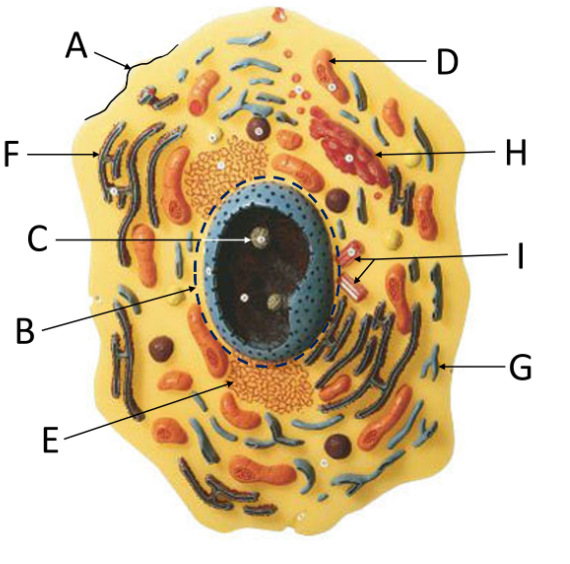
what is a
plasma membrane
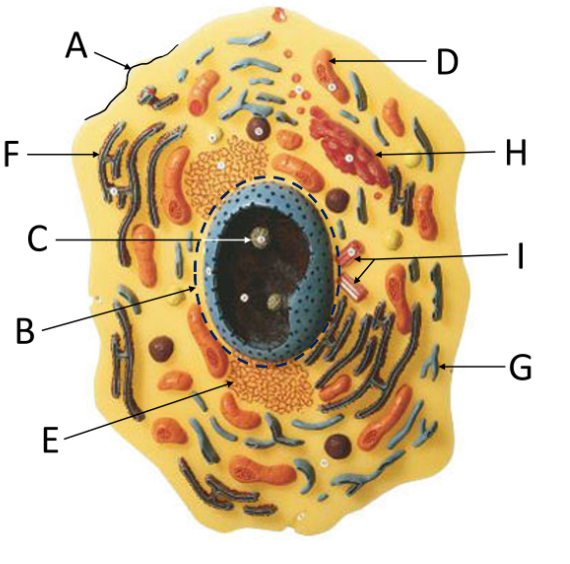
what is b
nucleus
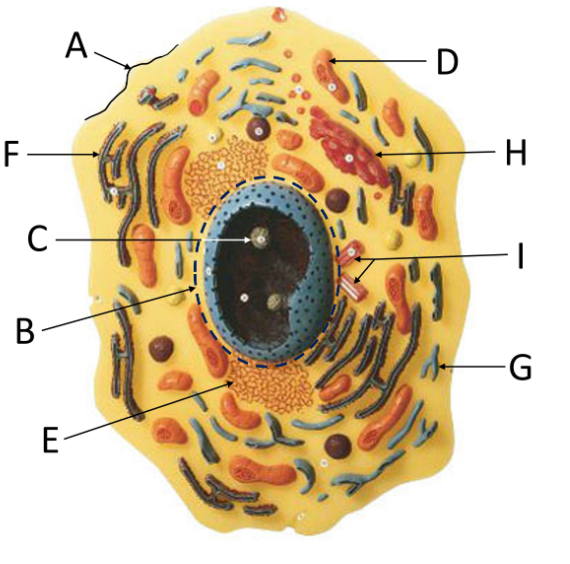
what is c
nucleolus
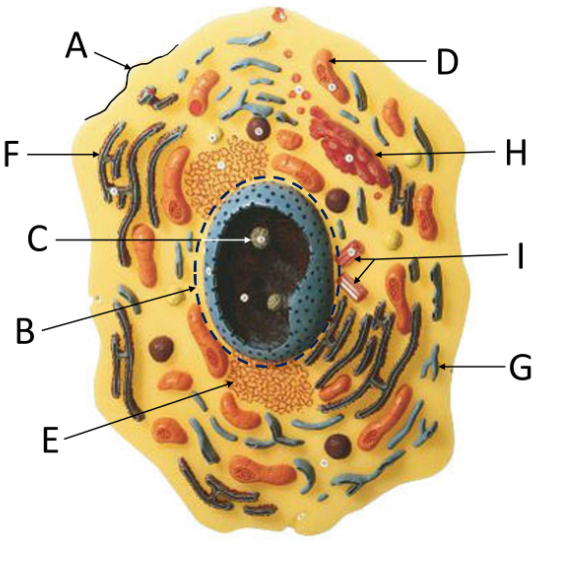
what is d
mitochondria
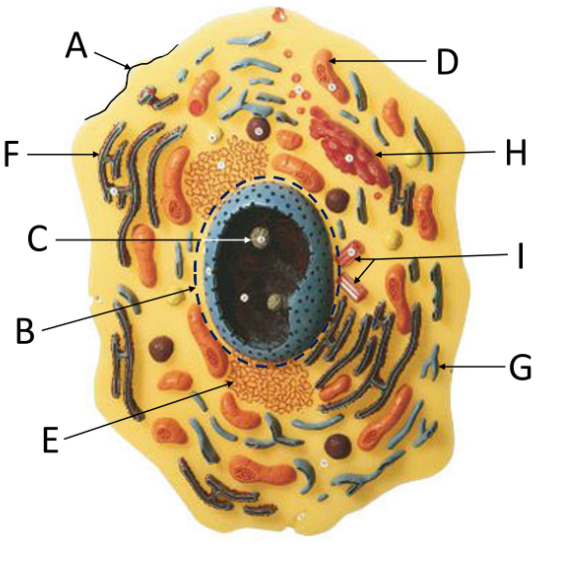
what is e
ribosomes
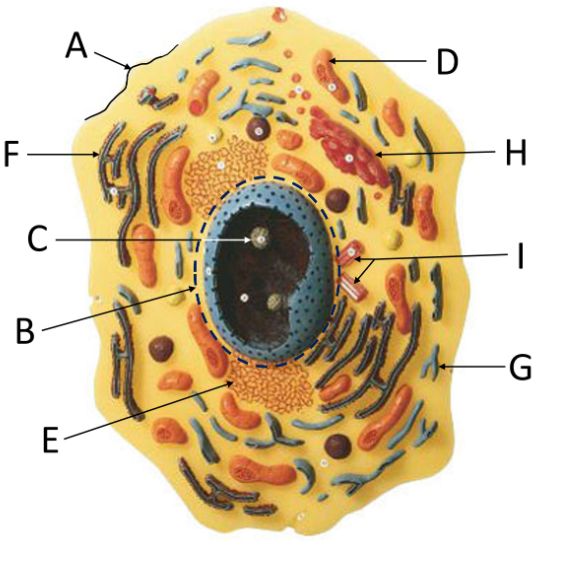
what is f
rough endoplasmic reticulum
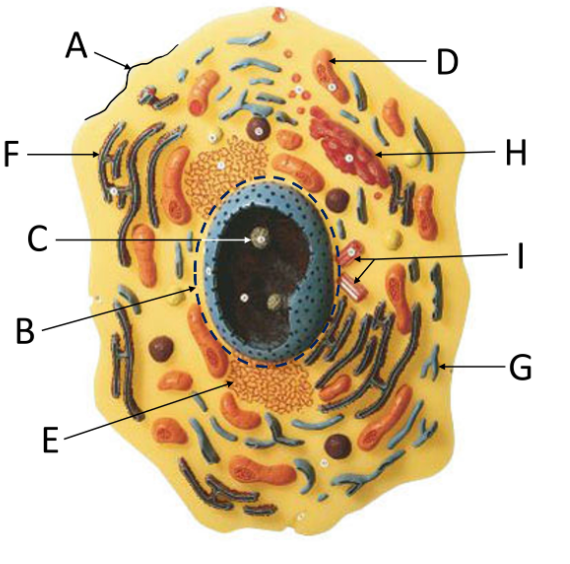
what is g
smooth endoplsmic reticulum
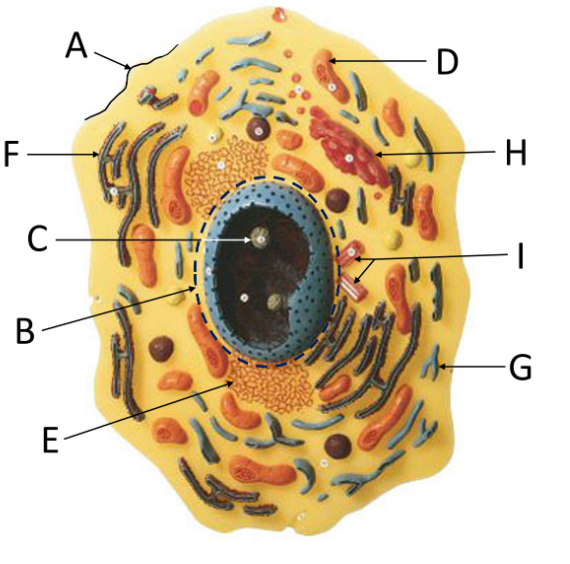
what is h
golgi apparatus
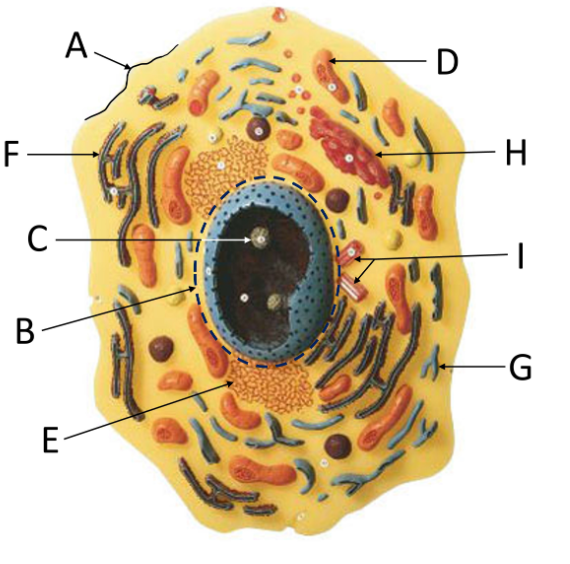
what is i
centrioles in the cenrtosome
____ cells do not contain a membrane-bound nucleus or any other membrane-bound organelles.
prokaryotic
____ cells contain membrane-bound nuclei and other organelles.
eukaryotic
mucilaginous sheath
surrounds a colony of cyanobacteria, such as Oscillatoria
nucelus
contains the genetic material of a cell
chloroplast
site of photosynthesis in plant cells
mitochondria
powerhouse of the cell; where aerobic respiration occurs
cell wall
rigid structure that surrounds a plant cell; mde primarily of cellulose
amyloplast
plastids where starch is made and stored
pseduopod
temporary protrusions of an amoeba that allow movement
cilia
short hairlike structures surrounding a paramecium that allow movement
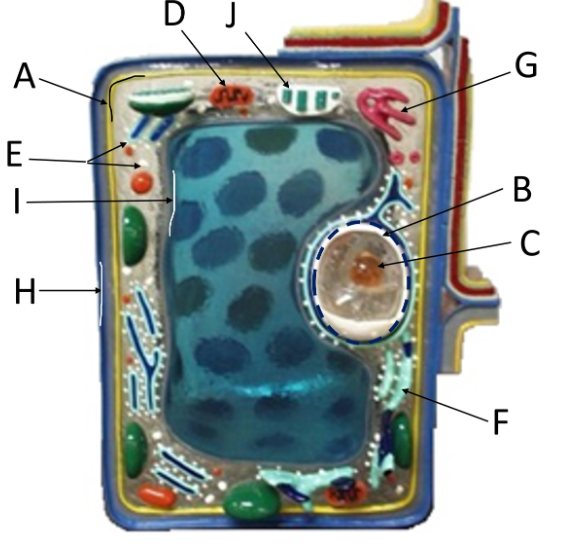
what is a
plasma membrane
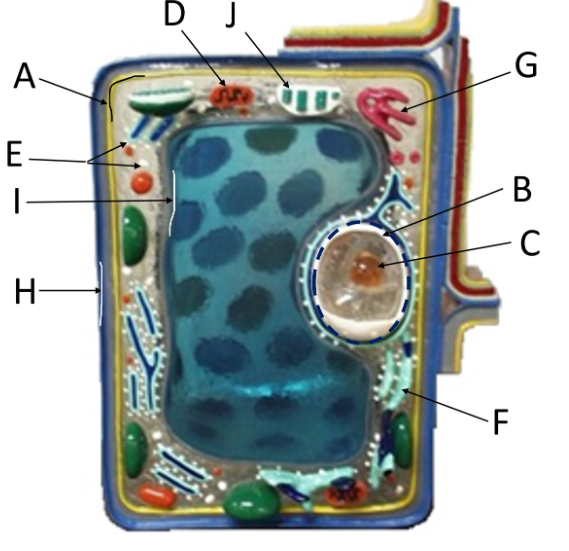
what is b
nucelus
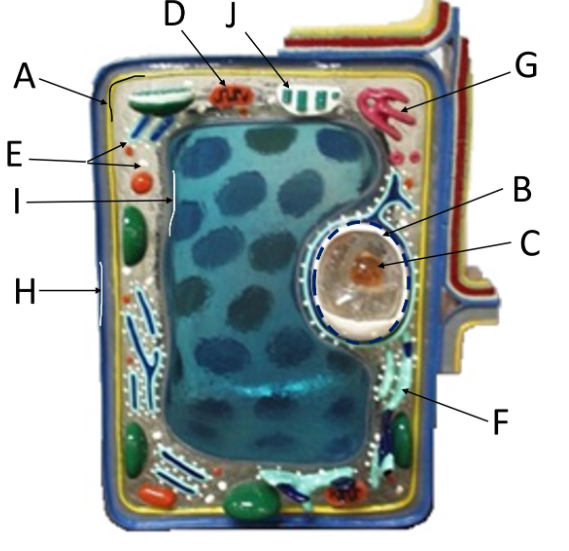
what is c
nucleolus
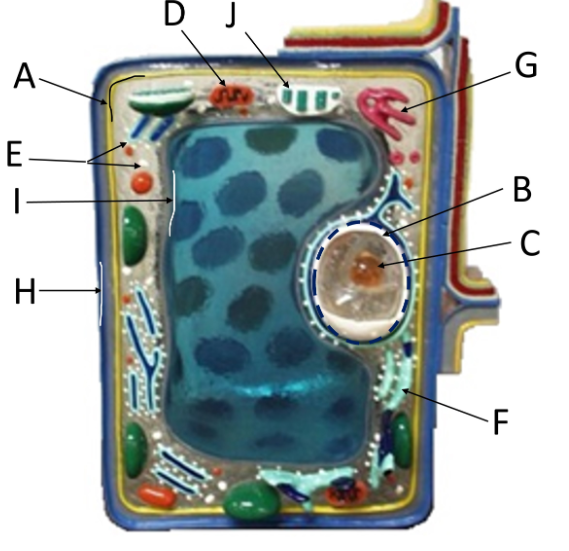
what is d
mitochondria
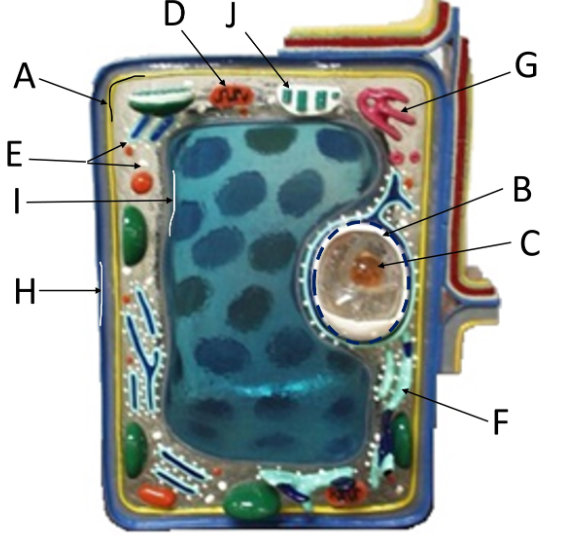
what is e
ribosomes
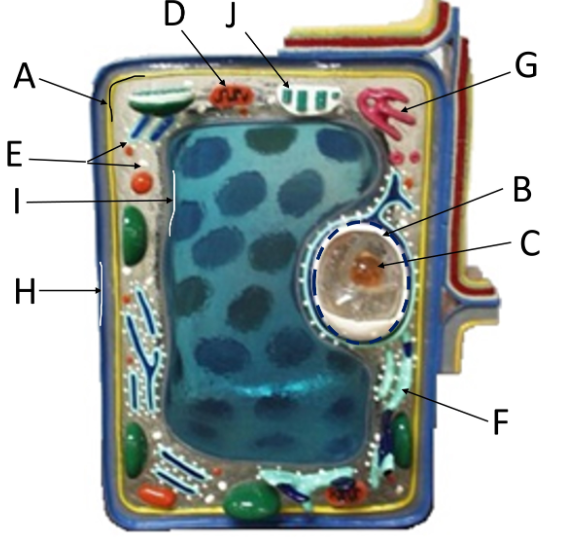
what is f
rough endoplasmic reticulum
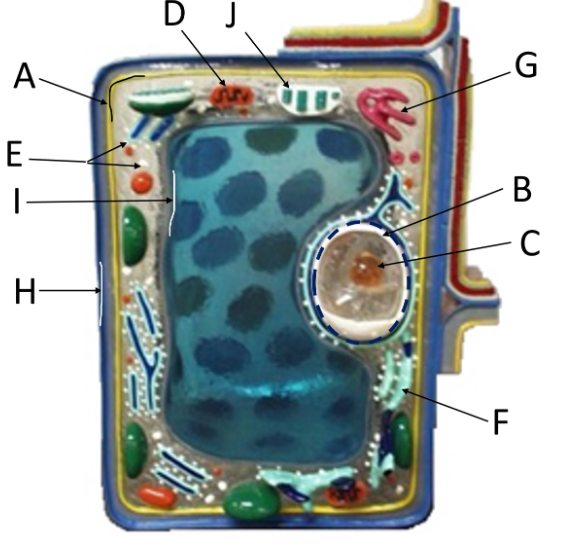
what is g
golgi apparatus
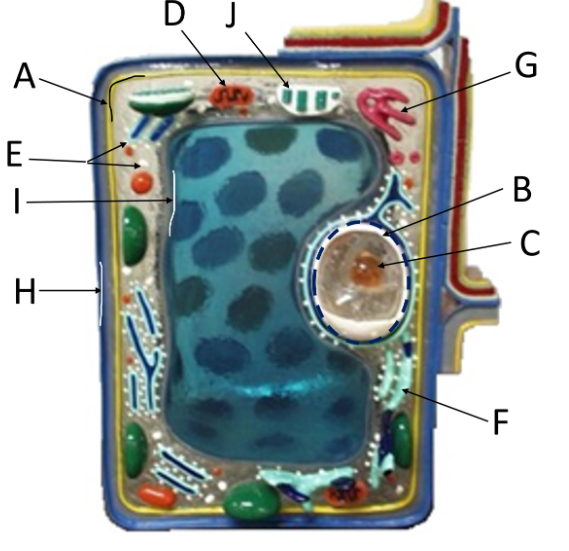
what is h
cell wall
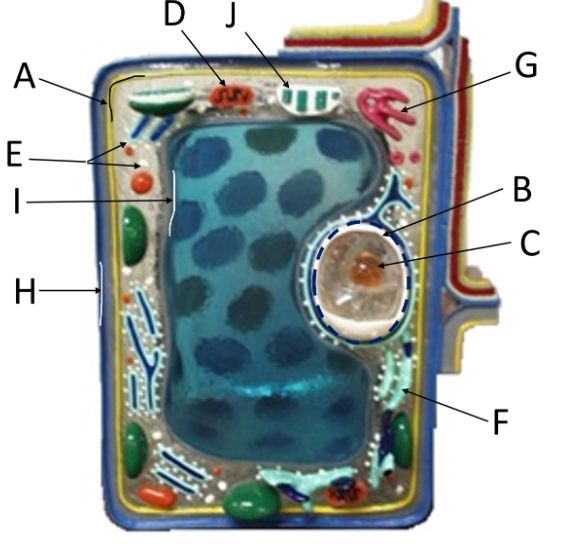
what is i
central vacuole
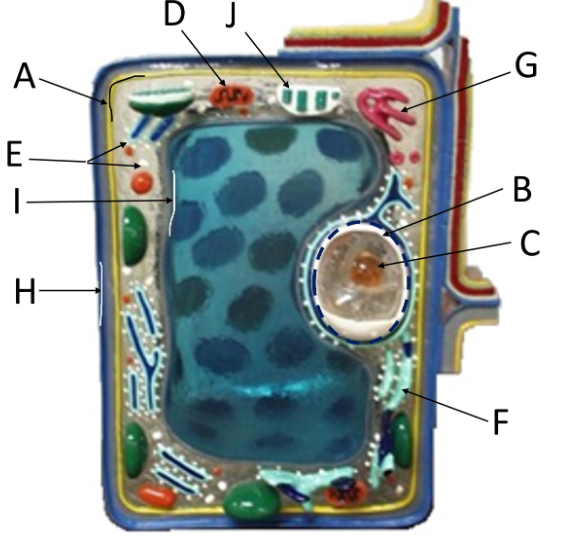
what is j
chloroplast
what kingdom does amoeba belong to
protist
are amoeba unicellular or multicellular
unicellular
are amoeba eukaryote or prokaryote
eukaryote
what helps amoeba swim
pseudopods
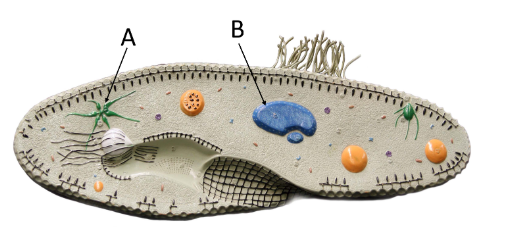
what is a
contractile vacuole
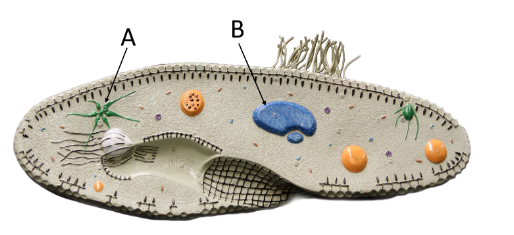
what is b
macronucleus
what kingdom does amoeba belong to
protist
are amoeba unicellular or multicellular
unicellular
are amoeba prokaryote or eukaryote
eukaryote
what kingdom do oscillatoria belong to
bacteria
are oscillatoria unicellular or multicellular
unicellular
are oscillatoria prokaryote or eukaryote
prokaryote
what kingdom do paramecium belong to
protist
are paramecium unicellular or multicellular
unicellular
are paramecium eukaryote or prokaryote
eukaryote
how do paramecium move
cilia
The protective, rigid structure that surrounds a potato cell is called ______ _______
cell wall
Plastids in potato cells that make and store starch are called _———
amyloplasts
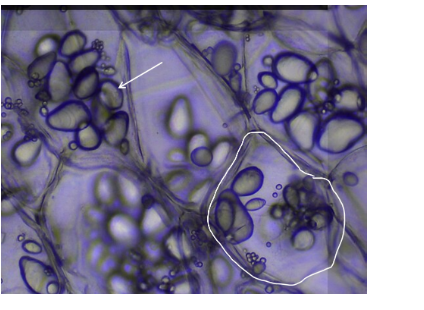
what is this
potato cell
The lipid bilayer embedded with proteins that encloses the cytoplasm of human cheek cells is called ______ _______
plasma membrane
The organelle that houses the DNA of a human cheek cell is called ____________
nucleus
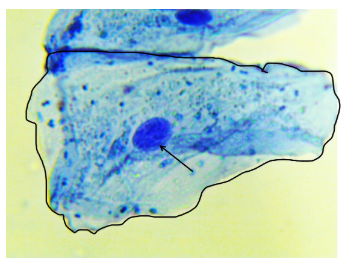
what is this
human cheek cell
The protective, rigid structure that surrounds an Elodea cell is called ____ _____
cell wall
Organelles in Elodea cells that are the site of photosynthesis are called _______—
chloroplasts
It stores molecules, ions, water, waste products and occupies a large volume of the Elodea cell. _______ ______
central vacuole
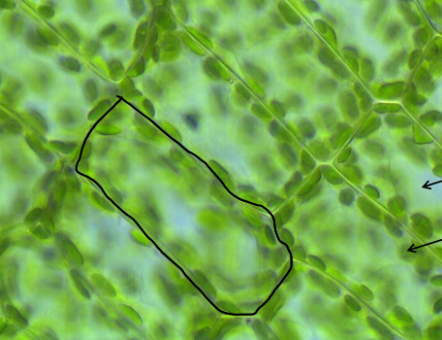
what is this
elodea cell
The protective, rigid structure that surrounds an onion cell is called _____ _______-
cell wall
Organelle that houses the DNA of an onion cell is called ________
nucleus
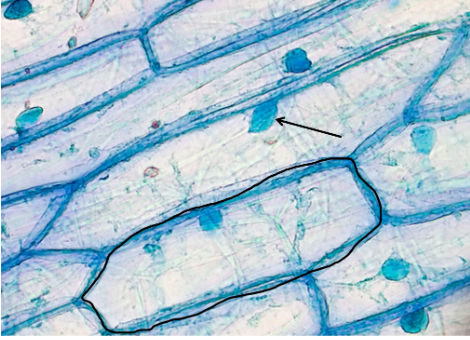
what is this
onion cell