HAN 200 CHAPTER 11
 Call Kai
 Learn
Learn Practice Test
 Spaced Repetition
 Match
Match Flashcards
 Knowt Play
1/111

There's no tags or description
Looks like no tags are added yet.
Name | Mastery | Learn | Test | Matching | Spaced | Call with Kai |
|---|
No analytics yet
Send a link to your students to track their progress
112 Terms
Muscle tissue
all contractile tissues
- Skeletal, cardiac, smooth muscle
Focus on skeletal muscle
- How muscles interact to increase movement
- Criteria for naming muscles
- Principles of leverage
Muscles can only pull never push
True
Agonist
primary mover
Antagonist
opposes or reverses particular movement
Synergist helps prime movers
- Adds extra force to same movement
- Reduces undesirable or unnecessary movement
Fixator
- Synergist that immobilizes bone or muscle's origin (rotator cuff and G-H joint)
- Gives prime mover stable base on which to act (ex scap and G-H joint)
Muscle location
bone or body region with which muscle associated
Muscle shape
e.g., deltoid muscle (deltoid = triangle)
Muscle size
e.g., maximus (largest), minimus (smallest), longus (long
Direction of muscle fibers or fascicles
e.g., rectus (fibers run straight), transversus (fibers run at right angles), and oblique (fibers run at angles to imaginary defined axis)
Number of origins
e.g., biceps (2 origins) and triceps (3 origins)
Location of attachments
named according to point of origin and insertion (origin named first)
- sternocleidomastoid
Muscle action
named for action they produce, e.g., flexor or extensor
T tubules are an extension of the _________.
- sarcomere
- sarcoplasmic reticulum
- sarcolemma
- endomysium
sarcolemma
The force exerted by a contracting muscle is _______.
- muscle summation
- muscle twitch
- muscle tension
- muscle load
Muscle tension
Additional factors contributing to muscle force and speed
- Fascicle arrangement
- Lever systems
5 patterns of fascicle arrangement
parallel, fusiform, circular, triangular, pennate
Circular
Fascicles arranged in concentric rings (e.g., orbicularis oris, orbicularis oculi)
Convergent
Broad origin; fascicles converge toward single tendon insertion (e.g., pectoralis major)
Parallel fascicles
Fascicles parallel to long axis of straplike muscle (e.g., sartorius)
Fusiform fasicles
Spindle-shaped muscles with parallel fibers (e.g., biceps brachii)
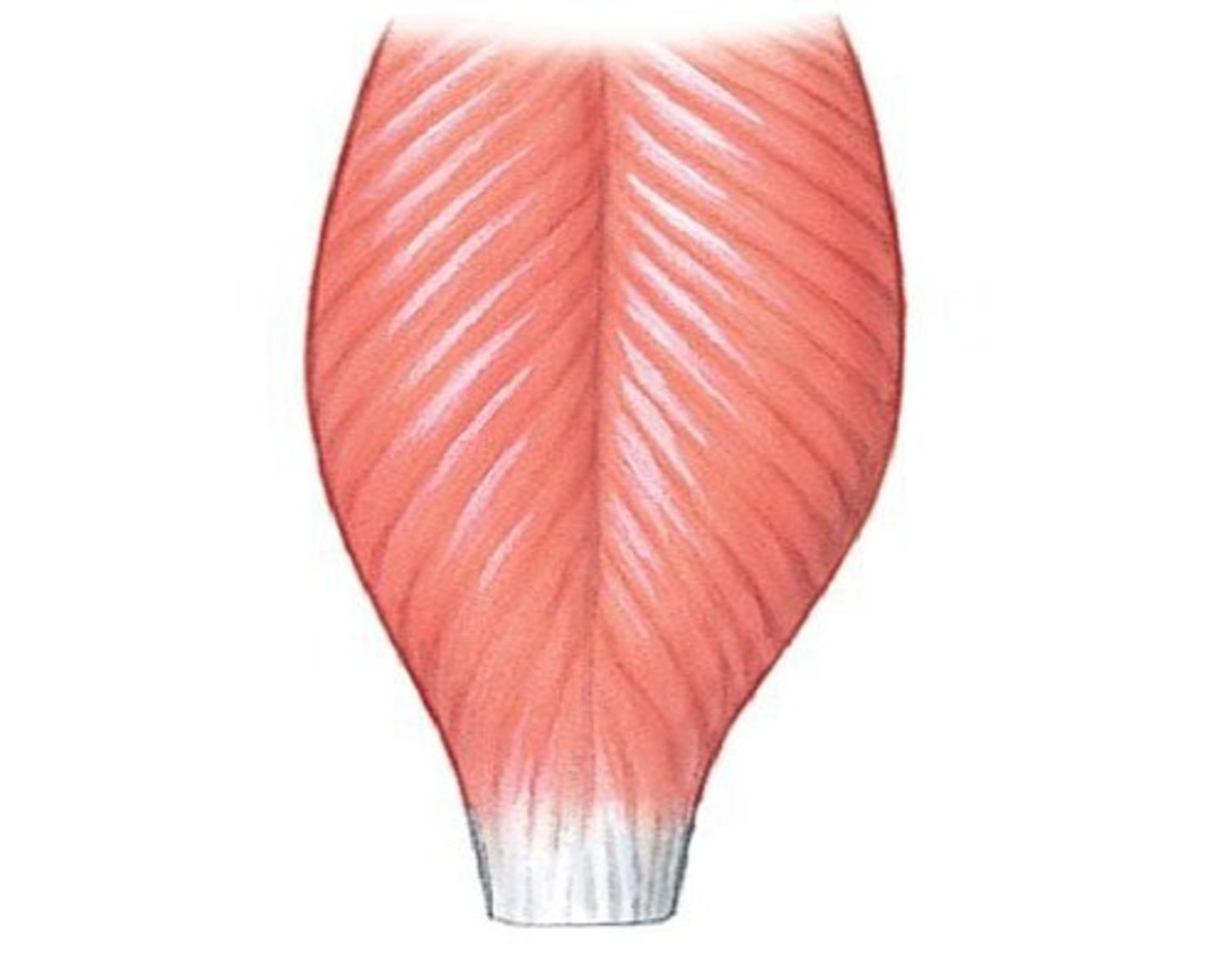
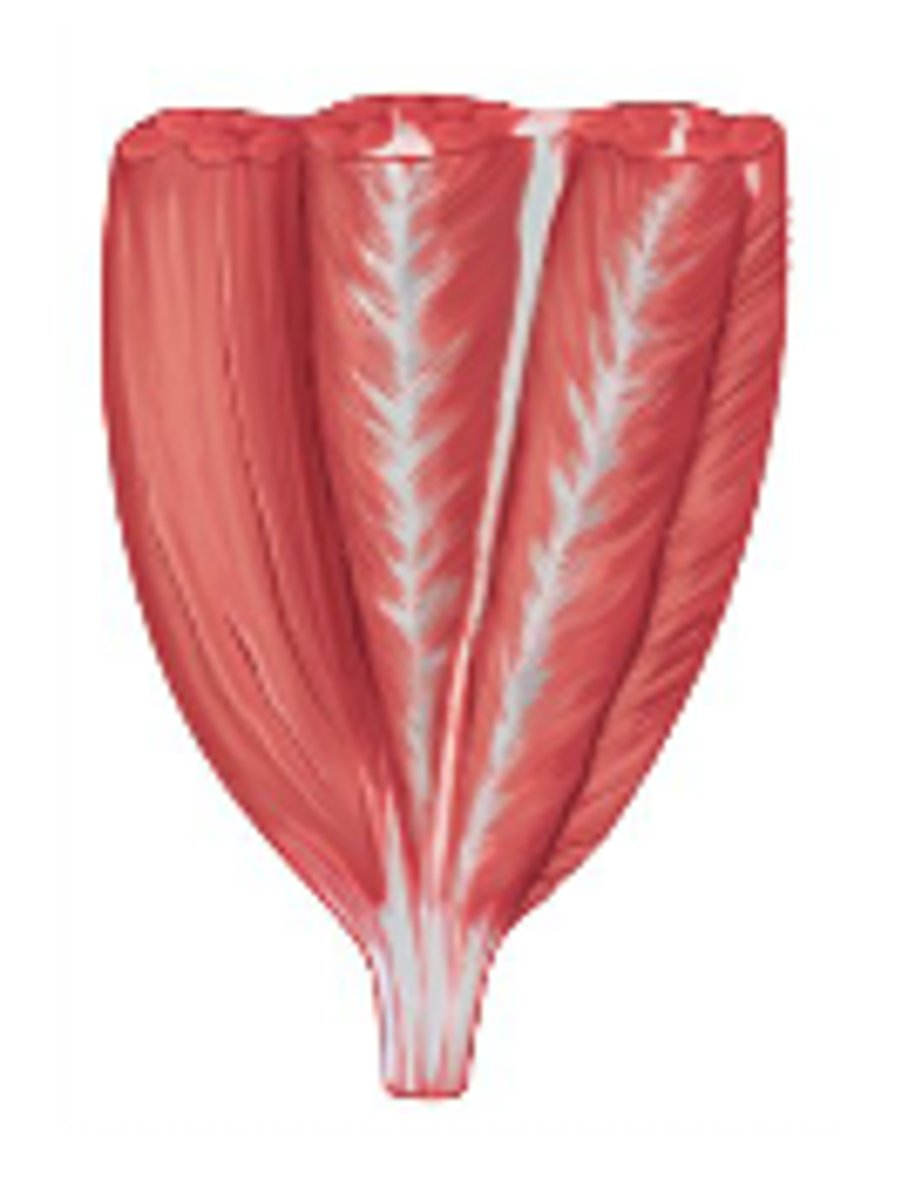
Pennate
Short fascicles attach obliquely to central tendon running length of muscle (e.g., rectus femoris)
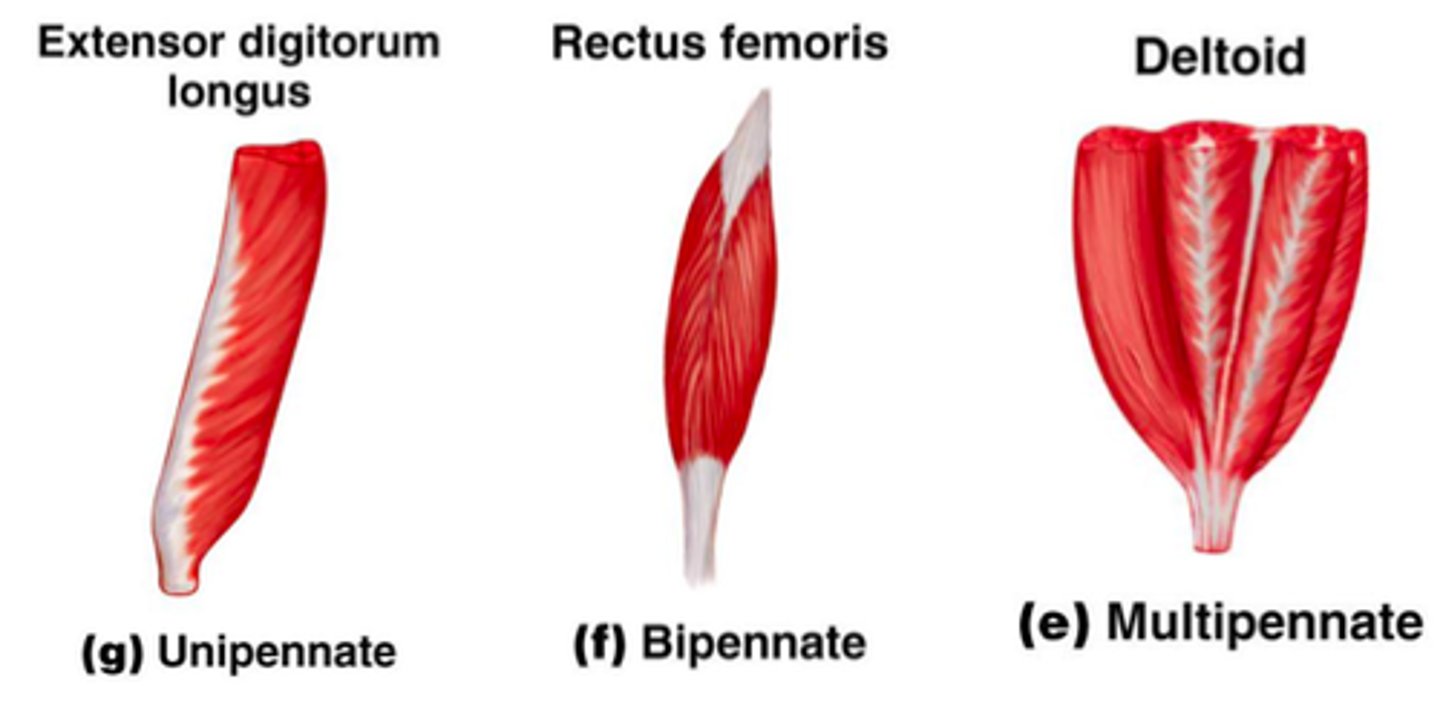
Unipennate
fascicles attach only to one side of tendon
(e.g., extensor digitorum longus)
Bipennate
fascicles insert from opposite sides of tendon (e.g., rectus femoris)
Multipennate
appears as feathers inserting into one tendon (e.g., deltoid)
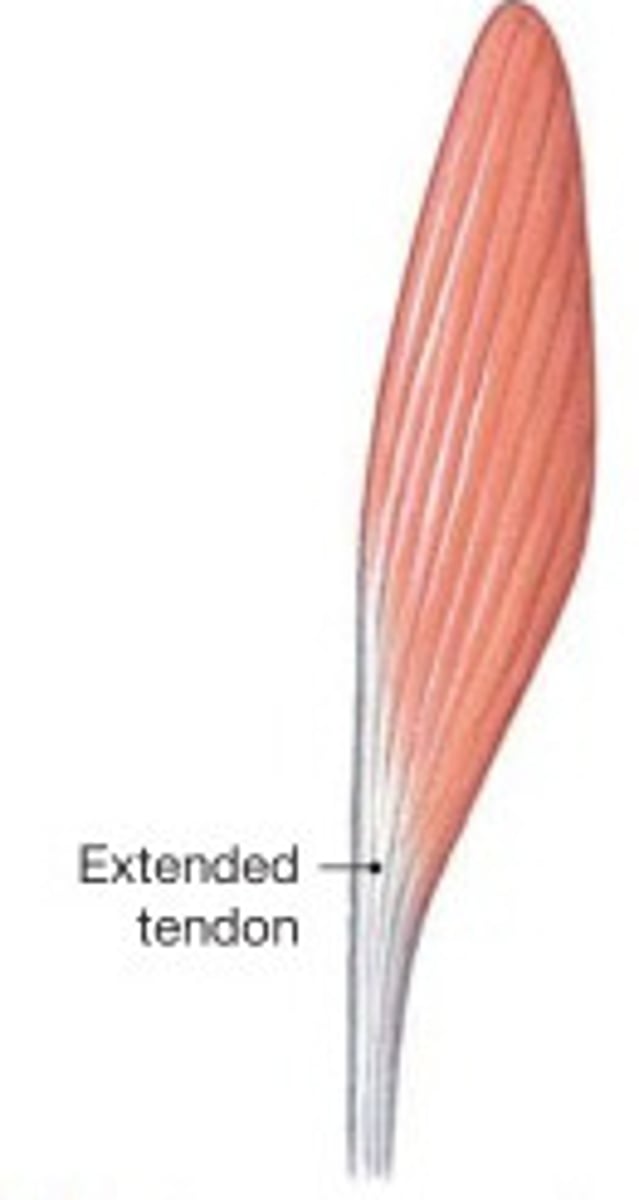
Lever systems
Levers allow given effort to move heavier load; move load farther or faster
What are the components of a lever system?
- Lever—rigid bar (bone) that moves on a fixed point called
fulcrum (joint)
- Effort—force (supplied by muscle contraction) applied to lever to move resistance (load)
- Load—resistance (bone + tissues + any added weight) moved
by the effort
Mechanical advantage (power lever)
load close to fulcrum; effort far from fulcrum
- Small effort can move large load
Mechanical disadvantage (speed lever)
load far from fulcrum; effort close to fulcrum
- Load moved rapidly over large distance; wide range of motion
First-class levers
fulcrum is between the effort and the load
- example: seesaws
Second-class lever
the load is between the fulcrum and the effort
- example: wheelbarrow
Third-class lever
The effort is between the fulcrum and the load
- example: pair of forceps
Zygomaticus
Smile muscle
Risorius
grin
Orbicular Oculi
closes eyelids
Orbicularis Oris
puckers lips
Platysma
Pulls corners of mouth down
Three muscles anchor and move tongue
- Genioglossus
- Hyoglossus
- Styloglossus
Sternocleidomastoid
major head flexor and rotator
Sternocleidomastoid and scalenes
lateral head movements
Splenius capitis and cervicis portions
head extension, rotation, and lateral bending
Semispinalis capitis
synergist with sternocleidomastoid
Erector spinae (sacrospinalis) group
prime movers of back extension and lateral bending
• Iliocostalis (most lateral)
• Longissimus
• Spinalis (most medial)
Semispinalis and quadratus lumborum
synergists in extension and rotation
External intercostals
more superficial muscles; elevate ribs for inspiration
Internal intercostals
deeper muscles; aid forced expiration
Diaphragm
- Partition between thoracic and abdominal cavities
- Most important muscle in inspiration
Four paired muscles
- Rectus abdominis
- External obliques
• Most superficial
- Internal obliques
- Transversus abdominis
• deepest
Valsalva maneuver
increased intra abdominal pressure used during coughing, vomiting, sneezing, defecation and childbirth
The coracobrachialis muscle has its origin and insertion on what two bones? (use the name to guide you!)
• vertebral column and clavicle
• femur and tibia
• scapula and humerus
• trapezium and radius
Scapula and humerus
When you bite down on an ice cube, this muscle strongly contracts.
• Lateral pterygoid
• Buccinator
• Hyoglossus
• Masseter
Masseter
Pelvic floor (pelvic diaphragm)
composed of two paired muscles
- Levator ani
- Coccygeus
Urogenital diaphragm
Contains external urethral sphincter (voluntary control of urination)
Pectoralis minor
protraction & downward rotation of scapula
Serratus anterior (saw tooth)
protraction
Subclavius
stabilizes pectoral girdle
Posterior extrinsic shoulder muscles
trapezius, levator scapulae, rhomboids
Upper trapezius
elevation of scapula (shrug)
Middle trapezius
retraction of scapula
Lower trapezius
depression of scapula
Rhomboids (major and minor)
retraction and downward rotation of scapula
Pectoralis major
adduction & flexion
Latissimus dorsi
adduction & extension
Deltoid
• anterior fibers - flexion
• middle fibers - abduction
• Posterior fibers - extension
Supraspinatus
assists deltoid in abducting arm
Infraspinatus
shoulder external rotation
Teres minor
Shoulder external rotation
Subscapularis
Shoulder internal rotation
Brachialis and biceps brachii (2 heads)
chief forearm flexors
Brachioradialis
synergist and stabilizer
Triceps brachii
(3 heads) prime mover of elbow extension
Anconeus
weak synergist
The ______ muscles are antagonistic to each other when moving the scapula
forward and backward (protraction and retraction).
• pectoralis major and subclavius
• latissimus dorsi and rhomboid
• pectoralis minor and serratus anterior
• serratus anterior and rhomboids
serratus anterior and rhomboids
The prime mover in abduction of the arm is the ______.
- triceps brachii
- deltoid
- biceps brachii
- supraspinatus
deltoid
This muscle flexes the elbow and inserts on the ulnar
• Biceps brachi
• Brachialis
• Brachioradialis
• Coracobrachialis
Brachialis
Pronator teres and pronator quadratus...
pronate forearm
Supinator
synergist with biceps brachii in forearm supination
- Flexor carpi radialis
- Palmaris longus
- Flexor carpi ulnaris
flexes wrist
Flexor digitorum superficialis and flexor digitorum profundus
flexes finger
Flexor pollicis longus
flexes thumb
The ______ is (are) the most important muscle(s) for inspiratory breathing.
• internal intercostals
• diaphragm
• scalenes
• rectus abdominis
Diaphragm
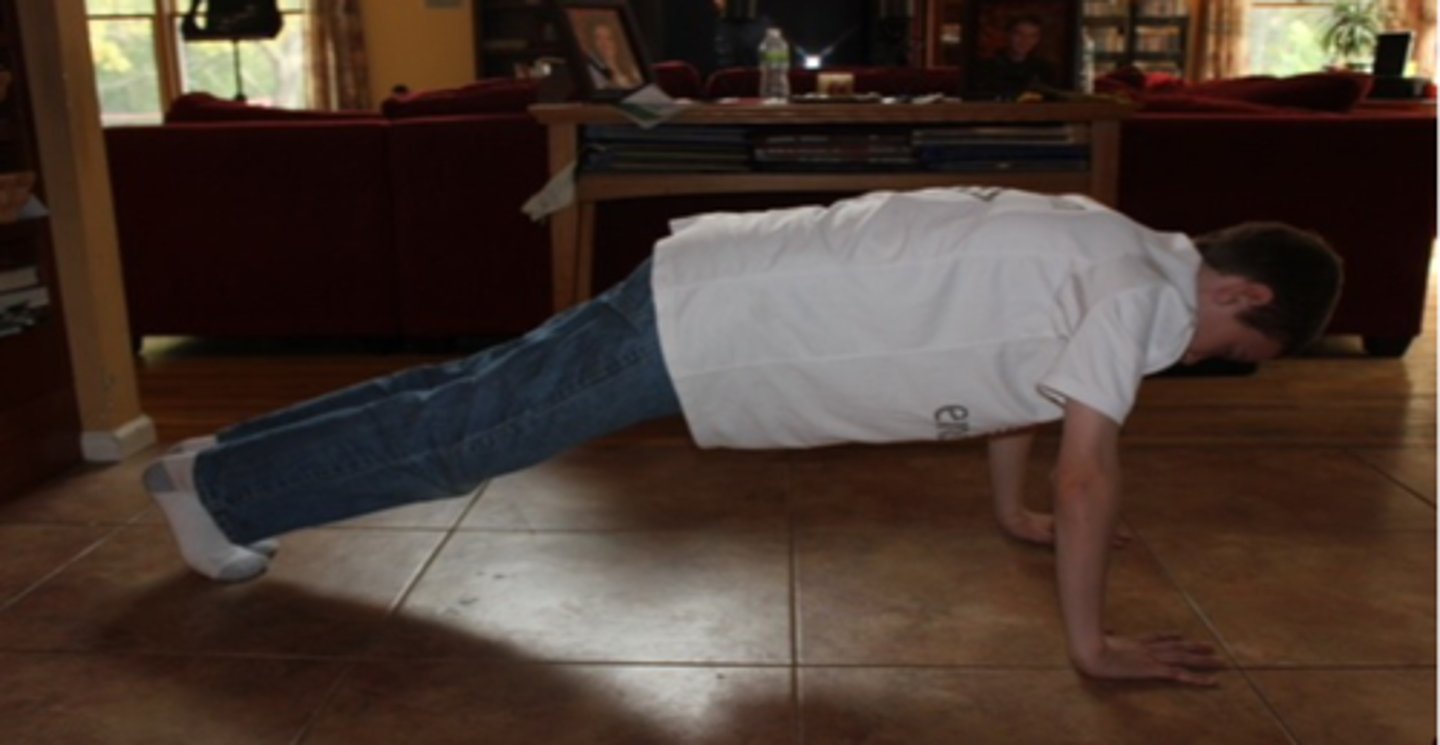
What arm muscle is prime mover for this activity?
• biceps brachii
• latissimus dorsi
• triceps brachii
• flexor carpi radialis longus
triceps brachii
The rotator cuff muscles include the supraspinatus, infraspinatus, teres minor,
and _________.
• Subscapularis
• Pectoralis major
• Teres major
• Deltoid
Subscapularis
- Extensor carpi radialis longus and brevis
- Extensor carpi ulnaris
wrist extensions
Extensor digitorum
finger extension
Extensor pollicis brevis and longus
thumb extension
Extensor indicis
index finger
Abductor pollicis longus
thumb abduction
Thenar eminence (ball of thumb)
Produce opposition—move thumb toward little finger
Hypothenar eminence (ball of the little finger)
Each of above groups has flexor, abductor, and opponens muscle
Midpalmar muscles
lumbricals and interossei
• abduct and adduct fingers
Do medial muscles all adduct or abduct thigh?
adduct thigh
Do lateral muscles adduct or abduct thigh?
abduct thigh
Iliopsoas
prime mover of flexion
Rectus femoris (hip flexion)
This muscle is the only quadricep muscle that acts on the hip
Hamstring muscles
prime movers of extension
Biceps femoris
lateral hamstring
- Semitendinosus
- Semimembranosus
medial hamstring
Gluteus maximus
assists hamstrings in forceful thigh extension