Full Model L & R
 Call Kai
 Learn
Learn Practice Test
 Spaced Repetition
 Match
Match Flashcards
 Knowt Play
1/14

There's no tags or description
Looks like no tags are added yet.
Name | Mastery | Learn | Test | Matching | Spaced | Call with Kai |
|---|
No analytics yet
Send a link to your students to track their progress
15 Terms
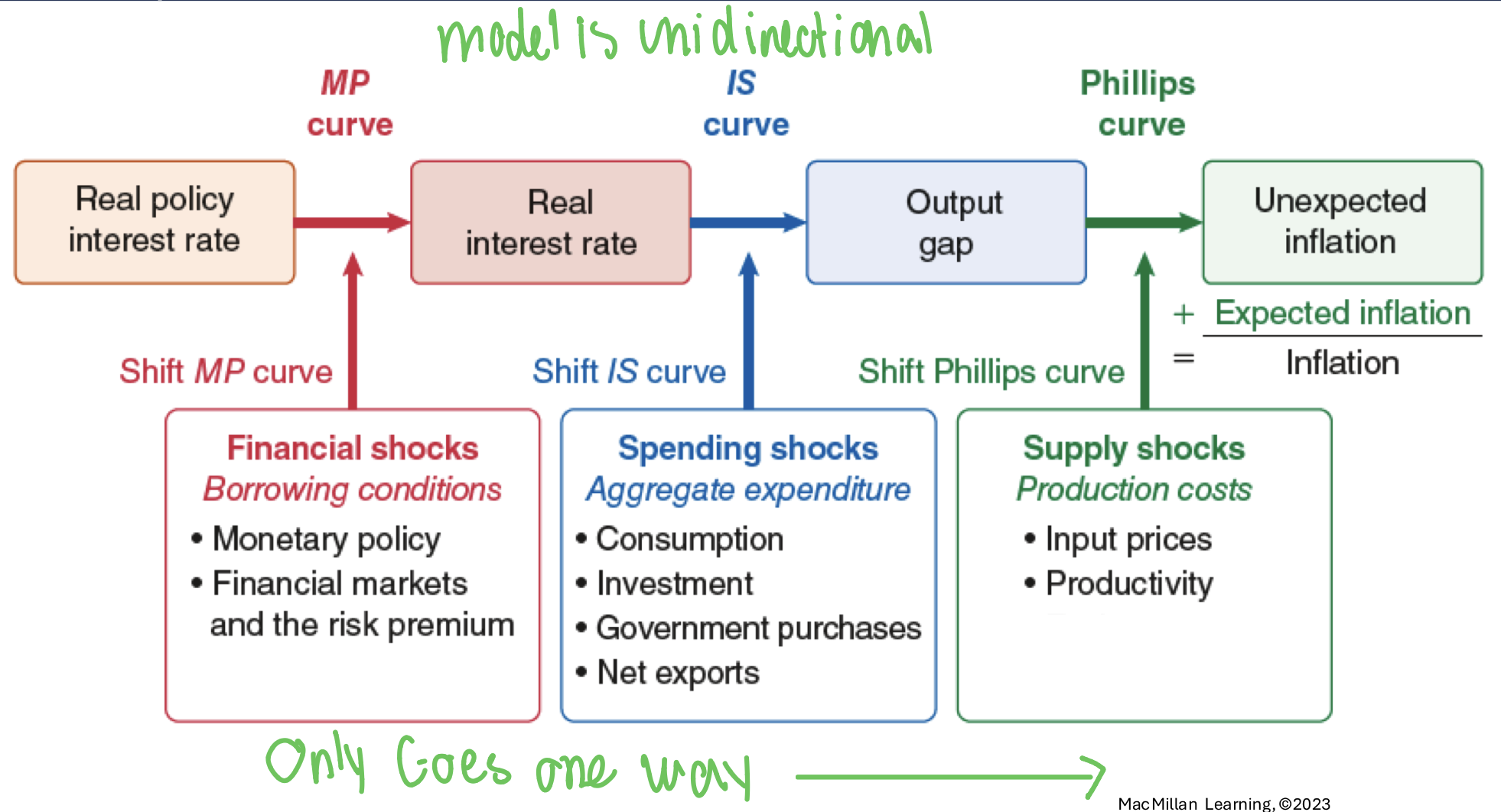
Three types of macroeconomic shocks
Financial Shocks
Spending Shocks
Supply Shocks
Financial Shocks
(shift the MP curve): changes in borrowing conditions/costs
Monetary policy, risk premium, borrowing conditions, inflation expectations, uncertainty/volatility in the economy
Spending Shocks
(shift the IS curve): changes in autonomous spending at a given real interest rate
Unrelated to changes in interest rate
Consumption: Changes in wealth, consumption confidence, taxes
Investment: Business confidence, corporate taxes, lending standards uncertainty, technological advances
Govt expenditures: Fiscal policy and automatic stabilizers
Net exports: Economic growth of trading partners, trade policy
Supply Shocks
(shift the Philips curve)
Changes in input prices: Affects production costs
Productivity: Weaker than expected productivity leads production costs to rise more quickly than expected
Changes in inflation expectations
What does it mean that the model is unidirectional
Only goes one way
R What is BOC rate
Overnight rate at 2.25
Deposit Rate: 2.2
Bank Rate: 2.5
R What is economic growth in US driven by
Consumption
AI Inflation
US inflation is strong
R How will the economy grow (C) in response to tariffs
Excepted to grow modestly as it adjust to tariffs and trade uncertainty
Employment gains in late 2025 have been reversed in 2026 unemployment growth
R Prior to war the global economy was on pace to grow at what rate
3%
R What is the focus of US Fed
Dual Mandate: Stable prices, and maximum sustainable employment
R Why did the fed decide to leave the policy rate unchanged
See current rate as appropriate to promote max sustainable employment and 2% inflation
Implications of Middle East uncertain
R Indicators Suggest
Consumer spending has been resilient
Fixed investment has continued to expand
Activity is the housing sector is weak
Real GDP will rise 2.4% this year and 2.3% next
R Why do job gains remain low
Decline in the growth of the labour force due to lower immigration and labour force participation
Labour demand has softened as well
R What is target for federal fund rates
Maintained at 3.5% - 3.75%
R What are the implications in the middle east, near term
Higher energy prices will push up overall inflation