Study Guide Week 3
 Call Kai
 Learn
Learn Practice Test
 Spaced Repetition
 Match
Match Flashcards
 Knowt Play
1/66

Earn XP
Description and Tags
chapters 1,3,4,5 and 6
Name | Mastery | Learn | Test | Matching | Spaced | Call with Kai |
|---|
No analytics yet
Send a link to your students to track their progress
67 Terms
Antoni Van Leeuwenhoek and his discoveries and his first observations, also the limitations
Used a simple microscope to be the first to see "animalcules" (microbes).
He never shared his lens-making secrets, and his tech couldn't see viruses. He observed bacteria, protozoa, and sperm cells, greatly contributing to microbiology.
Characteristics of fungi
Eukaryotic cells have cell walls (chitin) and obtain food from other organisms. They reproduce by spores and can be unicellular or multicellular. Examples: molds, yeast
Characteristics of Protozoa
Single-celled eukaryotes, similar to animals in nutritional needs and structure; most are capable of locomotion. Live in water or as parasites
What is bioremediation?
Using microbes to detoxify polluted environments. Example: bacteria breaking down oil spills
Pasteur’s experiments on Spontaneous Generation (proving/ disproving)
Used swan-necked flasks to disprove spontaneous generation; proved microbes in the air contaminate broth, but air itself doesn't "create" life.
Synthesis of insulin using E. coli (with reference to Recombinant technology)
Recombinant DNA technology inserts the human insulin gene into E. coli to mass-produce the hormone. Bacteria produce insulin → used for diabetes
Cell structures and biofilms
Biofilms = communities of microbes stuck to surfaces
Protected by slimy layer → harder to kill
What are the processes of life for free living organisms? With applications
Growth, Reproduction, Responsiveness, and Metabolism. Example: bacteria dividing in your body.
Components of flagella
Filament, Hook, and Basal Body (the motor).
Function of eukaryotic plasma membrane
Controls entry/exit (semi-permeable) and contains sterols for stability. Maintains homeostasis
Function of membranous organelles
Nucleus → DNA
Mitochondria → ATP
ER/Golgi → protein processing
Principle of Gram staining
Based on cell wall differences
Gram + = purple (thick peptidoglycan)
Gram – = pink (thin layer + outer membrane)
Significance of pili/fimbriae, how is it different from the flagella
Fimbriae: Short, hair-like; for adhesion and biofilms.
Pili: Longer than fimbriae; used for DNA transfer (conjugation).
Flagella: Long, for motility.
Prokaryotes
Bacteria and Archaea
Eukaryotes
Fungi
Protozoa
Algae
Small multicellular animals
Discoveries by Semmelweis
Handwashing (childbed fever)
Discoveries by Lister
Antiseptic surgery (phenol)
Discoveries by Nightingale
Hygiene/sanitation in nursing
Discoveries by Jenner
Smallpox vaccine (immunology)
Learn conversions from millimeter to micrometer and nanometer
1 mm = 1000 µm
1 µm = 1000 nm
Size of a virus metric equivalent
nanometers (nm)
Dyes used in acid-fast staining
Carbol fuchsin, Acid-alcohol and Methylene blue
Primary stain Carbol fuchsin
Penetrates waxy cell wall (with heat), All cells turn red
Acid-alcohol
Removes stain from non-acid-fast cells, only acid-fast stay red
Methylene blue
Stains non-acid-fast cells, non-acid-fast turn blue/green
Characteristics of classifying micro-organisms
Shape, structure, metabolism, genetics
Calculate magnification of an object
Total Magnification=Eyepiece (ocular)×Objective lens
Functions and parts of a microscope: “Magnification”
eyepiece + objectives
Functions and parts of a microscope: “Light control”
condenser + diaphragm
Functions and parts of a microscope: “Focusing”
coarse & fine knobs
Functions and parts of a microscope: “Support”
arm + base + stage
Synthesis of ATP molecules from glucose in aerobic respiration? “Prokaryotic aerobic respiration”
(oxygen is present) 36–38 ATP per glucose
Synthesis of ATP molecules from glucose in aerobic respiration? “Prokaryotic Anaerobic respiration”
(no oxygen, but still uses ETC), 2-36 ATP per glucose
Fermentation
(no oxygen), (no ETC), 2 ATP
Carbohydrate Fermentation
bacteria ferment different sugars and produce end products, these end products bring about a change in the medium
What are exergonic reactions?
releases energy
What are endergonic reactions?
equire more energy than they release
Enzymes are biological catalysts that
speed up chemical reactions
Lower activation energy
Are specific to their substrates
Are not consumed in the reaction
All the 6 categories of enzymes
Hydrolases
Isomerases
Ligases or polymerases
Lyases
Oxidoreductases
Transferases
Hydrolases Enzymes
Break bonds with water
Isomerases Enzymes
Rearrange structure
Ligases or polymerases Enzymes
Join molecules using ATP
Lyases Enzymes
Break/form double bonds
Oxidoreductases Enzymes
Redox (electron transfer)
Transferases Enzymes
Transfer functional groups
Structure and function of enzyme
Enzymes are proteins with a specific active site that bind substrates, catalyze reactions, release products, and return to their original shape so they can be reused.
Electron Transport Chain
is the final stage of cellular respiration where most ATP is produced
Alcoholic fermentation
ethanol + CO₂, microbe: (Saccharomyces)
Acidic fermentation
Lactic acid, microbes: (Lactobacillus), (Aspergillus), (Streptococcus)
Examples of anabolic reactions
Builds molecules
Examples of catabolic reactions
Breaks down molecules
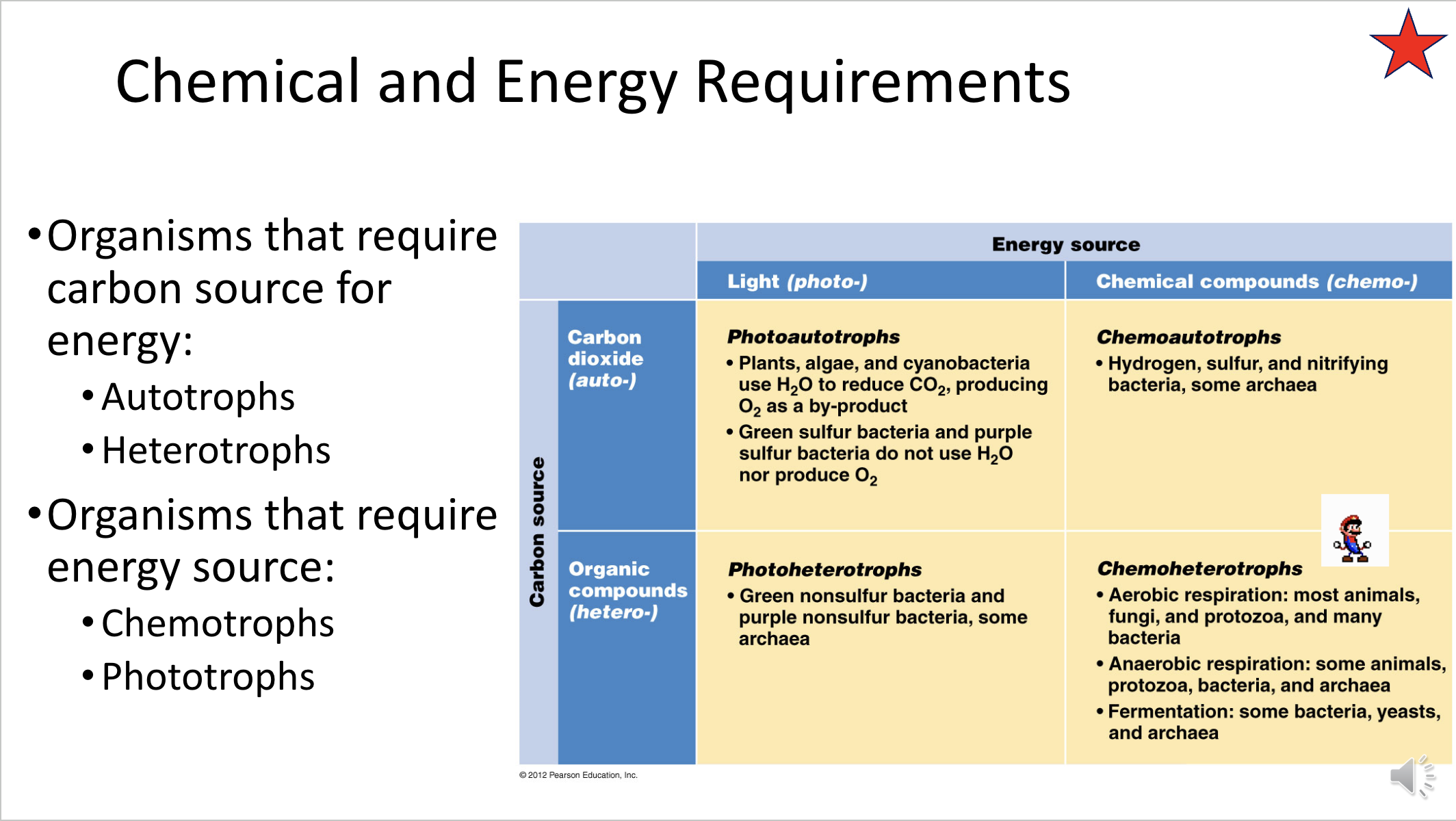
Review of chemical and energy requirements
What are microbes with different requirements of oxygen called? “Obligate aerobes”
Must have O₂
What are microbes with different requirements of oxygen called? “Obligate anaerobes”
O₂ is toxic
What are microbes with different requirements of oxygen called? “Facultative anaerobes”
With or without O₂, if oxygen is not present it can switch to fermentation
What are microbes with different requirements of oxygen called? “Aerotolerant anaerobes”
Tolerates O₂, doesn’t use
Necessary information on nitrogen requirements
Anabolism often ceases because of insufficient nitrogen
Nitrogen acquired from organic and inorganic nutrients
All cells recycle nitrogen from amino acids and nucleotides
Nitrogen fixation by certain bacteria is essential to life on Earth
Events of binary fission
DNA replicates
Cell elongates
Middle wall forms
Cell divides into two identical cells
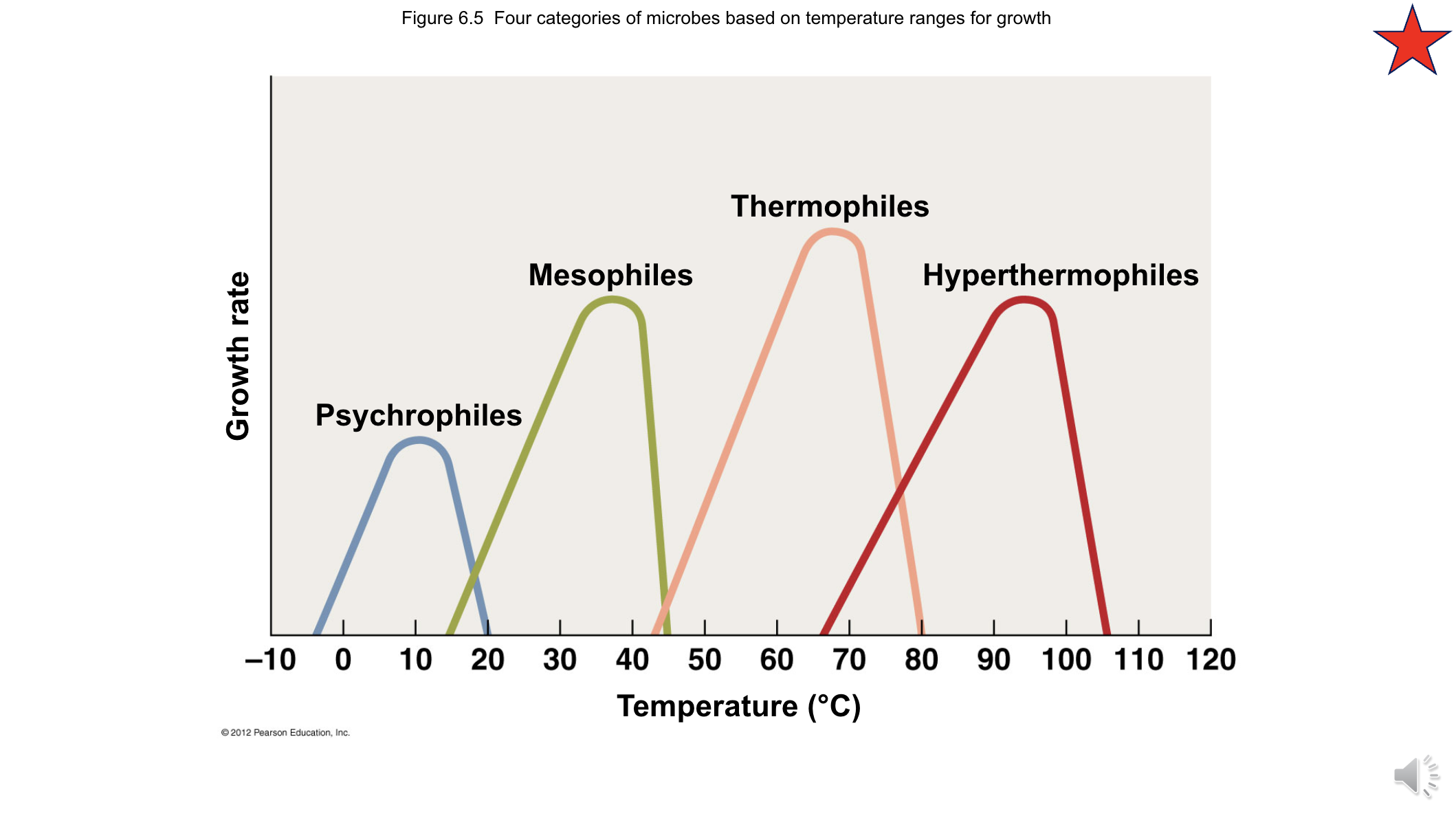
Review of physical requirements for microbial growth
Include temperature, pH, osmotic pressure, oxygen availability, and light, all of which influence enzyme activity and cellular processes
Figure 6.5 Four categories of microbes based on temperature ranges for growth
What are the different kinds of culture media “Defined media”
Exact chemical composition is known; Research where exact nutrients must be controlled
What are the different kinds of culture media “Complex Media”
Exact composition is unknown; General growth of many microorganisms
What are the different kinds of culture media “Selective Media”
Allows some microbes to grow, inhibits others; Isolate a specific group of bacteria
What are the different kinds of culture media “Differential Media”
Distinguishes between microbes based on biochemical reactions; Identify differences (e.g., sugar fermentation)
What are the different kinds of culture media “ Anaerobic Media”
Designed for microbes that cannot tolerate oxygen; Grow obligate anaerobes
What are the different kinds of culture media “Transport Media”
Maintains microbes during transport (does NOT promote growth); Carry specimens to the lab safely
Calculation of generation time (Imp)
g=t/n