Bonding, Structure & Properties of Matter
 Call Kai
 Learn
Learn Practice Test
 Spaced Repetition
 Match
Match Flashcards
 Knowt Play
1/23

There's no tags or description
Looks like no tags are added yet.
Name | Mastery | Learn | Test | Matching | Spaced | Call with Kai |
|---|
No analytics yet
Send a link to your students to track their progress
24 Terms
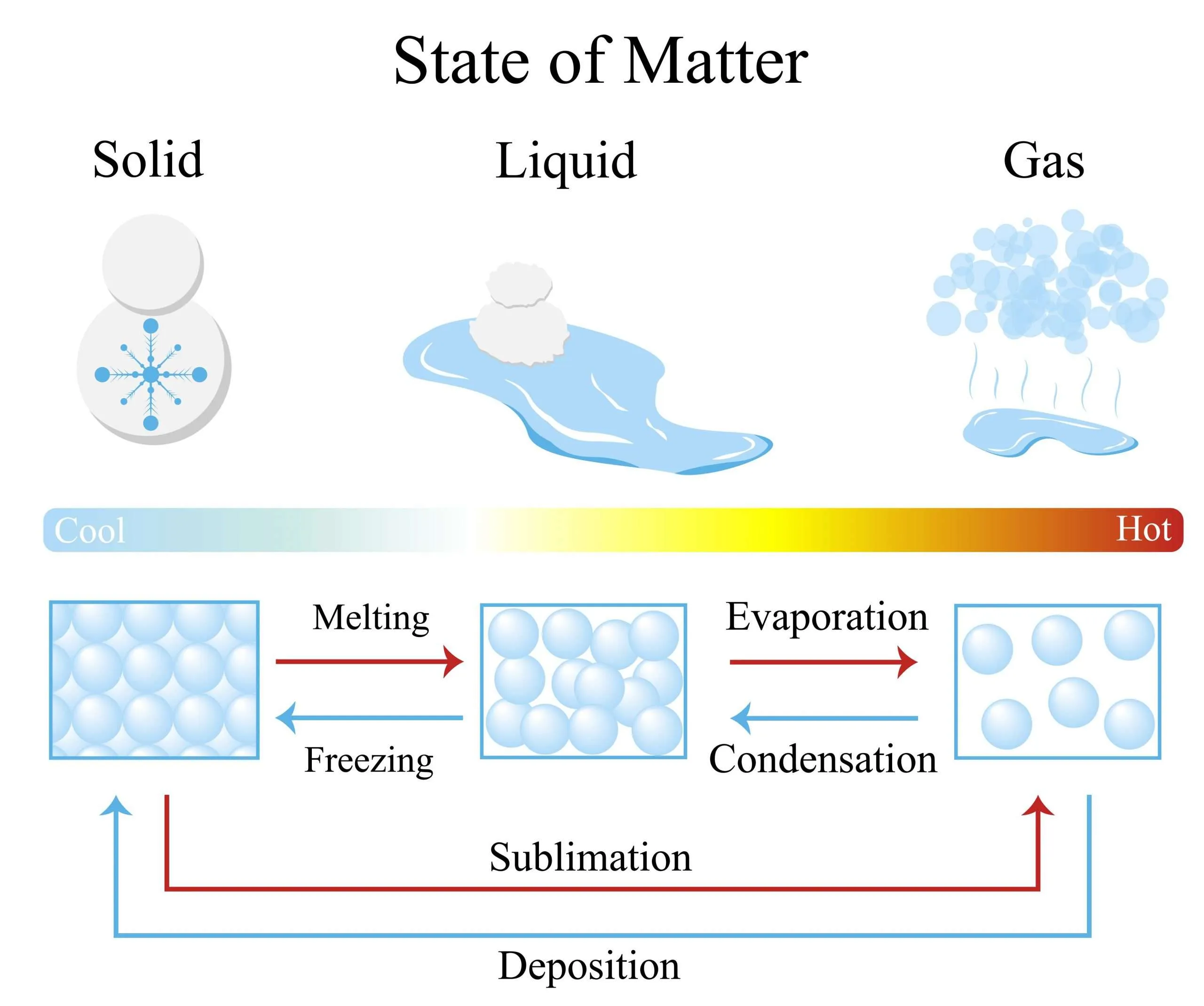
What are the changes in matter
Describe the bonding of ionic compounds (sodium chloride)
sodium loses one electron to become positively charged
The electron is transferred to chlorine
Both elements have a full outer shell
An ionic bond is formed
Explain why sodium chloride has a high melting and boiling point
bonded by strong electrostatic forces
Take a lot of energy to overcome the forces
Describe the bonding of covalent molecules (carbon dioxide)
carbon shares 4 electrons with oxygen
Oxygen shares 2 electrons each
Oxygen and carbon now have a full outer shell
Explain why CO2 has a low melting and boiling point
molecules are held together by weak intermolecular forces
Low amount of energy to break these bonds
What is the structure and bonding of ionic compounds
bonded by strong ionic bonds
Electrostatic forces
Giant lattice structure
Solid at room temp
High boiling & melting point
conducts electricity at only molten or dissolved
Explain why ionic compounds can only conduct electricity when in a molten or dissolved state
Ions can move through the structure
Carrying a charge
Due to being surrounded by a sea of electrons
Define polymer
A long chain of repeating molecules
What is polymerisation?
when molecules combine to form a polymer
What is a monomer?
A single unit of a polymer
State four different monomers and their polymer
ethene → polyethene
propene→ polypropene
Styrene → polystyrene
Chloroethene → polychloroethene
Describe the forces of attraction between polymers
relatively strong
Molecules are larger then simple molecules
Require more energy to overcome
Solids at room temp
Describe the formation of diamond
made up of carbon atoms
Each carbon atom is bonded by 4 other carbon atoms
Strong covalent bond
Lot of energy to overcome bonds
Solids at room temp
Cannot conduct electricity
tetrahedron shape
Explain why diamond has a high melting and boiling point
held together by strong covalent bonds
Takes a lot of energy to overcome these bonds
Explain why graphite is softer then diamond
hexagonal rings in layers
Layers move over each other
Explain why graphite can conduct electricity
Weak forces of attraction allows the layers to move
graphite has delocalised electrons
The layers move allowing the electrons to carry an electrical charge
Explain what graphene is
a layer of graphite
Describe a Fullerene
hallow sphered
Cage other molecules
Held together by strong covalent bonds
State some usages of fullerenes
deliver drugs into the body
Trapping medicine
Nanotubes when in a cylindrical shape
What are the properties of metals
conductor of electricity n thermal energy
Malleable (can be bent easily into shape)
Ductile
What is meant by a pure metal?
Made up of 1 type of metal atom
Explain why pure metals are soft
all the atoms are the same size
Arranged in a regular pattern
Layers of atoms can easily slide over each other
What is an alloy?
Mixture of different metal atoms
Why would adding another substance to copper (a metal) make copper harder?
Atoms will have different sizes
Distorts the regular pattern Mates
More difficult for layers to slide over each other