Sem 2, Unit 5: Plants + Photosynthesis
 Call Kai
 Learn
Learn Practice Test
 Spaced Repetition
 Match
Match Flashcards
 Knowt Play
1/107

There's no tags or description
Looks like no tags are added yet.
Name | Mastery | Learn | Test | Matching | Spaced | Call with Kai | Chat |
|---|
No analytics yet
Send a link to your students to track their progress
108 Terms
photosynthesis
how plants create carbohydrates for cellular respiration
1) endergonic
2) requires sunlight
3) occurs in the chloroplast
photosynthesis equation
6CO2 + 6H2O → C6H12O6 + 6O2
1) oxygen = a waste product because inhibits the calvin cycle
2) is the reverse of cellular respiration
plant
a multicellular organism that does photosynthesis
1) most use seeds to reproduce
plant characteristics (5)
1) are photosynthetic autotrophs
2) are non mobile
3) cell walls are made of cellulose
4) respond to their environment + grow through the use of hormones
5) need water and nutrients to survive
green algae
are the ancestors of land plants
1) are aquatic photosynthesizers
2) aren’t really plants because 1) live in water and 2) are mostly unicellular (can be multicellular though)
Plant Classification Categories
1) vascular system/tissue
2) seeds
3) flowers (enclosed seeds)
vascular tissue
for transportation
plant classification (vascular system)
plant = random plant
if( plant != vascular system)
{//bryophytes}
if (plant = vascular system)
{//tracheophytes}
bryophytes
plants without a vascular system
1) are the most primitive plants
2) live in moist/shady areas (don’t have transportation system so must get water through brute osmosis)
3) are small (b/c need to directly diffuse so can’t grow too big)
4) don’t have true roots/stems/leaves (look like them but tech. aren’t b/c no vasc. tissue)
5) are moss
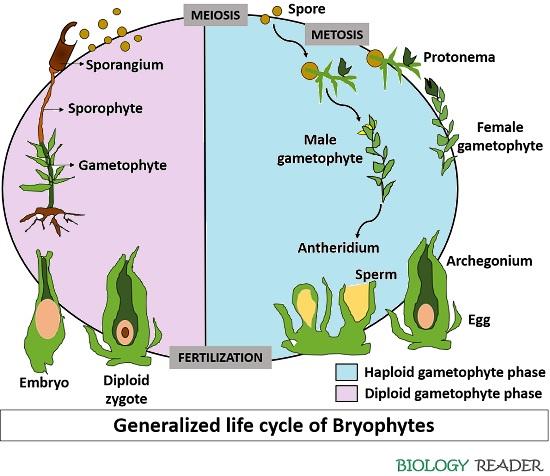
bryophyte reproduction
reproduce with spores or sperm
1) spores = waterproof cells that grow into a new organism (haploid)
2) sexual reproduction requires water b/c sperm swims to the egg (= simple)
tracheophytes
plants with vascular tissue
1) contain 2 types of specialized vascular tissue for internal transport: xylem and phloem
2) vascular system allows them to grow more than bryophytes
3) includes true specialized organs (roots, stems, and leaves)
xylem
transports water from roots
phloem
transports nutrients from photosynthesis to the rest of the plant
leaves
job is to maximize photosynthesis
1) let CO2 and O2 in/out + regulate water intake w/ guard cells
2) are covered in chloroplasts (is where photosynthesis occurs)
3) also let light reach chloroplasts
parts of a leaf
1) epidermis
2) palisade layer
3) spongy layer
4) veins
5) guard cells
epidermis
thin and clear first layer of a leaf that allows light in + reduces water loss
1) has a wax coating to protect the leaf from UV rays (cuticle)
palisade layer
densely padded layer of cells full of chloroplasts
1) maximizes the absorption of sunlight
spongy layer
cells with tons of air pockets
1) air pockets allow gases to diffuse through the leaf
DIAGRAM
CHECK
veins
contain specialized cells for support, water conduction, and food conduction
1) spec. tissue includes the xylem and phloem
guard cells
allow cells to regulate the intake of CO2 and the release of O2 (+ release of H2O)
1) close and open the stomata (the actual openings)
plant classification (seeds)
tracheophyte = a tracheophyte
if(tracheophyte != seeds)
{//fern}
if tracheophyte = seeds)
{//tracheophytes with seeds (not really a name)}
ferns
tracheophytes without seeds
1) have a vascular system (tracheophytes)
2) grow in most/shady places (b/c reproduce with spores still)
3) fronds = their underground stems, roots, and leaves
4) reproduce using spores
tracheophytes with seeds
have reproductive strategies that don’t need water like others with spores
1) use seeds
2) use pollen to spread sperm
3) use seed-bearing structures (cones + flowers)
seeds
how angiosperms and gymnosperms reproduce; contain…
1) fully developed embryo
2) food supply for the embryo
3) water-proof seed coat (keeps water from leaving/seed from drying out)
seeded tracheophytes classification
open or closed seeds
1) tracheophytes with exposed seeds = gymnosperms
2) tracheophytes with closed seeds (flowers/fruit) = angiosperms
gymnosperms
tracheophytes with open/exposed seeds
1) have three types: cycad, ginkgo, and conifer
2) use cones to reproduce
conifers
most common type of gymnosperms
1) have needles/scales for leaves
2) males produce pollen; females produce eggs + seeds
3) use cones to reproduce
conifer needles + scales
provide reduced surface area + have a waxy coat to help avoid water loss and prevent freezing
1) are perfect for plants in colder areas
pollen
collection of pollen grains
1) pollen grains = male gametophytes of a plant
1) sticks to the sticky part of stigma and grows a tube (for angiosperms)
conifer reproduction
1) male cones produce pollen (male gametophytes)
2) pollen makes its way to female cones that produce eggs
3) pollen fertilizes egg
4) egg becomes an embryo/seed
5) female scales of cone mature, dry out, and then open
6) seeds are scattered by the wind (inefficiently)
pollen transport (conifers)
pollen is transported by the wind, but the process is inefficient so produce tons of pollen (some might self pollinate, so it’s not the best process)
angiosperms
tracheophytes with enclosed seeds
1) use flowers for reproduction
2) produce fruit as a result of reproduction
fruit
the pollinated ovary in angiosperms that contains mature seeds
flowers
contain ovaries in which eggs/seeds are made in angiosperm reproduction
angiosperm reproduction (flowering)
allows for a direct + efficient pollen transfer
1) pollen is carried by a pollinator to the stigma of a flower
2) pollen sends sperm down the pollen tube + fertilizes an ovule
3) male part of flower also spermates the egg
3) seed coat grows around the seed embryo
4) multiple seeds grow within the mature ovary of the fruit
5) embryo grows into a plant after germination
plant cycle
{gametophyte plant} → mitosis (makes haploid gametes) → {fertilization} → mitosis → {sporophyte plant} → {meiosis} → {gametophyte plant}
red = haploid
blue = diploid
gametophyte stage
haploid stage of a plant’s life
1) produces gametes by mitosis (b/c start of haploid so don’t need meiosis again)
sporophyte stage
diploid stage of a plant’s life
1) produces haploid cells through meiosis
Sporophyte v Gametophyte Dominance
plants with dominant gametophyte forms:
-moss (small othr)
plants with dominant sporophyte forms:
- ferns (small othr)
- seeded tracheophytes (miscroscopic other)
pollinators
bats, flying insects, + birds that transfer pollen from flower to flower
1) = for angiosperms
complete perfect
an angiosperm with both male and female organs
types of fruit (to help with transporation)
1) winged fruit = glides to new location
2) floating fruit = floats to new location
3) fleshy fruit = brightly colored; survive in digestive system of animals
4) spiky fruit = have “velcro” that attaches to fur of animals
parts of angiosperms
1) sepals
2) petals
3) stamen
4) carpel
5) ovules
sepals
leaves of a flower
petals
modified leaves of a flower
1) usually brightly colored
stamen
the male parts of a flower
1) includes the anther, and the filament
anther
produces pollen
filament
the stick that supports the anther
carpel
the female parts of a flower
1) includes the stigma, style, and the ovary
stigma
where pollen sticks for fertilization
style
the tube that connects the stigma to the ovary
ovary
where sperm fertilizes the ovule
ovule
the egg
1) found within the ovary
seed coat
the covering around a seed
1) protects the seed from drying out (is waterproof)
micro pyle
the hole in the seed coat that allows the seed to absorb water
1) one place that’s not waterproof
hilium
attachment point on the seed for the ovary
parts of a seed
1) epicotyl
2) hypocotyl
3) radicle
epicotyl
part of the seed that grows into a leaf
hypocotyl
part of the seed that grows into a stem
radicle
part of the seed that grows into a root
cotyledon
part of the seed that does food storage
gymnosperm reproduction
use seeds for reproduction but don’t use fruits/flowers to enclose seeds
1) use cones
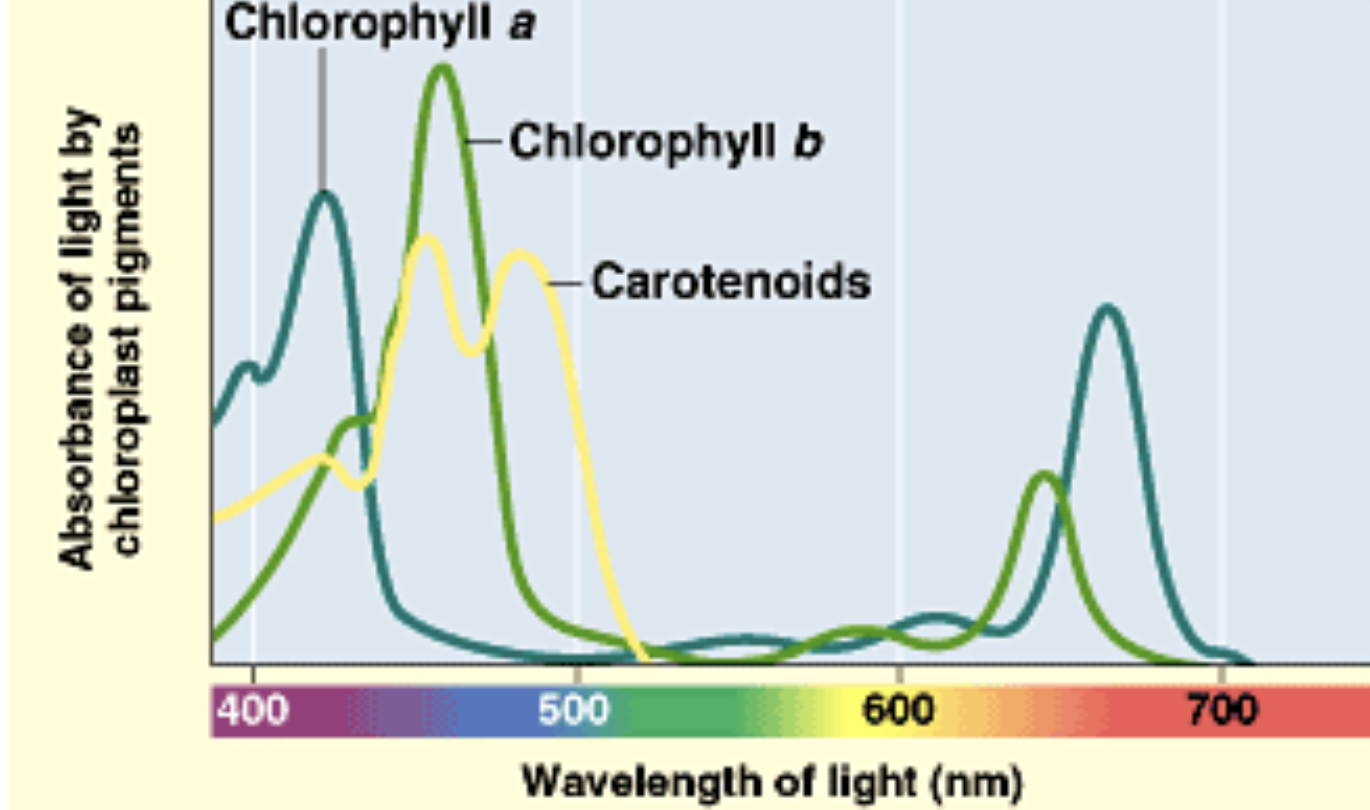
pigments
something that absorbs certain wavelengths (reflects the others)
1) are how light is absorbed for photosynthesis
higher wavelength
longer distance between points
lower wavelength
shorter distance between points
visible light range (#)
380-750nm
visible light range (explanation)
the light range humans can see
1) plants mostly use visible light range for absorption
chlorophyll (wavelengths)
absorbs all kinds of wave lengths but reflects green
absorbed vs reflected
1) absorbed wavelengths = used for photosynthesis as light energy
2) reflected wavelengths = not used for photosynthesis; are rejected/reflected and become the color that we see
absorption spectra
shows the absorption levels of a pigment for different wavelengths
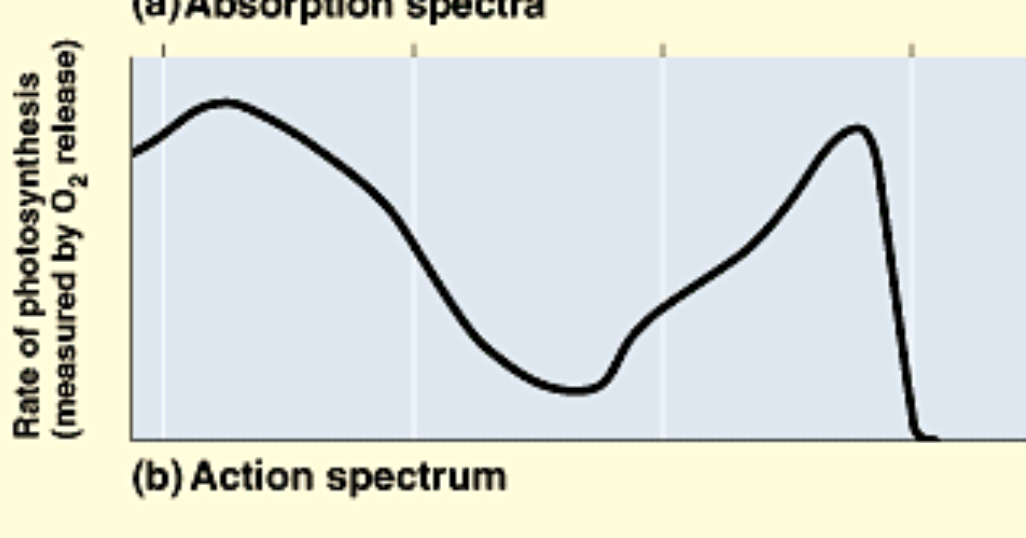
action spectrum
measures amount of released O2 by a plant for different wavelengths
1) O2 is a waste product of photosynthesis, so shows what light is being absorbed for photosynthesis
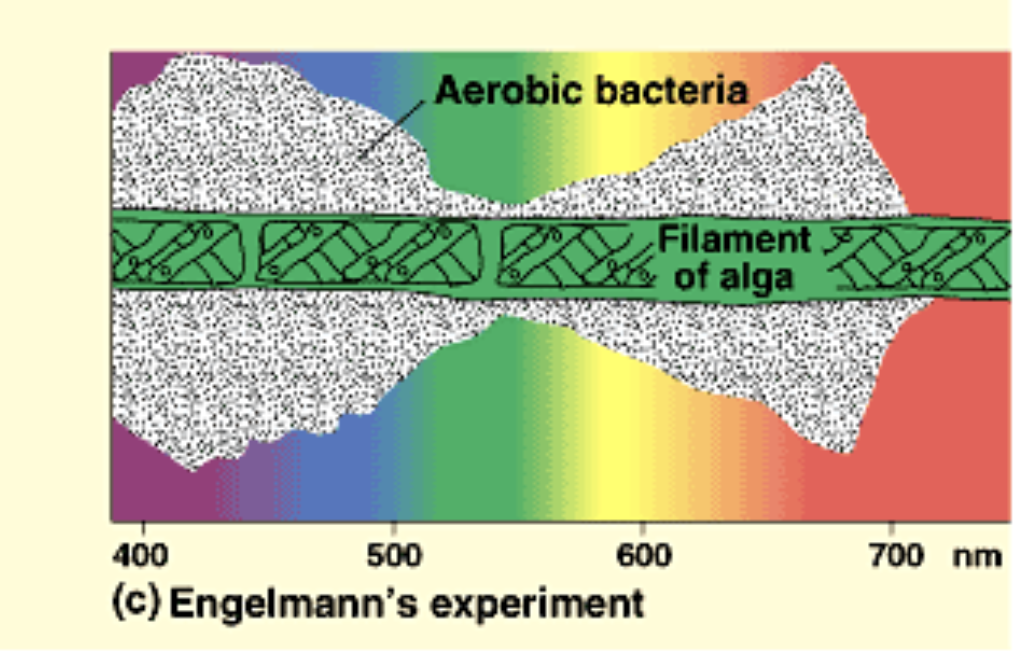
Engelmann’s Experiment
shows under which light/wavelengths aerobic bacteria gather the most with algae
1) algae produces O2 as a waste product of photosynthesis; because bacteria are aerobic and require O2 for cellular respiration, they gather wherever algae is photosynthesizing the most which is where they’re absorbing the most light
explanation for plants having multiple pigments
being able to absorb as many kinds of wavelengths as possible is good for photosynthesis; ready for anything
who can do photosynthesis (the three P’s)
1) some prokaryotes (bacteria)
2) some protists (euglena)
3) all plants (except ghost pipe plant bc bec. parasite)
plant cells (photosynthesis)
not all plant cells do photosynthesis
1) but they all do cellular respiration
chloroplast structures
1) double membrane
2) ribosomes
3) thylakoids
4) lamellae
5) chromosomes
6) proteins
7) stroma

lamellae
connect different granums
granum
stack of thylakoid discs
stroma
the space within chloroplasts
double membrane (chlorplast)
probably because were eaten by eukaryotes (endosymbiotic theory)
parts of the thylakoid
1) thylakoid membrane
2) thylakoid space (space within a thylakoid)
chlorophyll
the main pigment for photosynthesis
1) made to be embedded into the membrane bc of its long carbonate tail (nonpolar)
2) embedded in the thylakoid membrane
3) has 2 types: chlorophyll A + B
4) has porphyrin ring
porphyrin ring
light-absorbing ring in chlorophyll a and b
light reactions
the first part of photosynthesis
1) occurs in the thylakoid space and thylakoid membrane
2) functions like the ETC of cellular respiration
3) includes photosystem II, photosystem I, and the ATP synthase
what goes into light reactions
light, H2O, NADP+, ADP, and P
what comes out of light reactions
O2, ATP, and NADPH
NADP+
empty electron carrier for photosynthesis
O2 (light reactions)
= waste product of light reactions
1) needs to leave because inhibits the Calvin Cycle (rubisco)
Photosystems (II and I)
light-absorbing protein complexes within the thylakoid membrane
1) contain pigments like chlorophyll
Light Reactions Steps
1) photosystem II absorbs light which excites electrons and moves them to the ETC
2) ETC transports electrons to protein; protein uses electron energy to do active transport and move H+ ions across into the thylakoid space (making a gradient)
3) after electrons are transported, H2O atom is split to get photosystem II its electrons back and repeat the function
4) electrons are transported to photosystem I where light is absorbed again; excites the electrons, and they move to 2nd ETC (no breaking of water molecule)
5) electrons are transported and picked up on a protein by NADP+ (electron carrier) along with an H+ atom; becomes NADPH
6) H+ that’s been concentrated inside the thylakoid space moves down the ATP synthase, causing it to spin and produce ATP
7) NADPH and ATP go to the Calvin Cycle
photon
a package of light
1) used for photosystems II and I
Calvin Cycle
the second part of photosynthesis
1) occurs in the stroma (space of the chloroplast)
2) goal is to make the actual carbohydrate (G3P)
3) includes carbon fixation with rubisco
what goes into the Calvin Cycle
ATP, NADPH, and CO2
1) ATP and NADPH = from light reactions
2) CO2 = from the outside (pulled in through the stomata)
what comes out of the Calvin Cycle
G3P (sugar)
G3P
a building block for basically any carbohydrate (= ½ of glucose)
1) needs to be a building block for a lot of things b/c needs to be able to become everything plant needs
2) made by the Calvin Cycle
rubisco
key enzyme for the Calvin Cycle
1) takes CO2 from the air and attaches it to sugars (= carbon fixation)
2) is the most abundant enzyme on the plant
3) inhibited by O2 (why O2 is a waste product of light reactions)
4) has 8 active sights for CO2 but only 3 of them work b/c is extremely inefficient; plant has a ton of them to offset that
carbon fixation
the process of rubisco taking carbon dioxide from the air and attaching it to sugars (RuBP)
plant cellular respiration
plants do do cellular respiration but not as much as animals b/c aren’t very mobile
1) use a lot more CO2 than they produce because are constantly doing photosynthesis and don’t move like animals
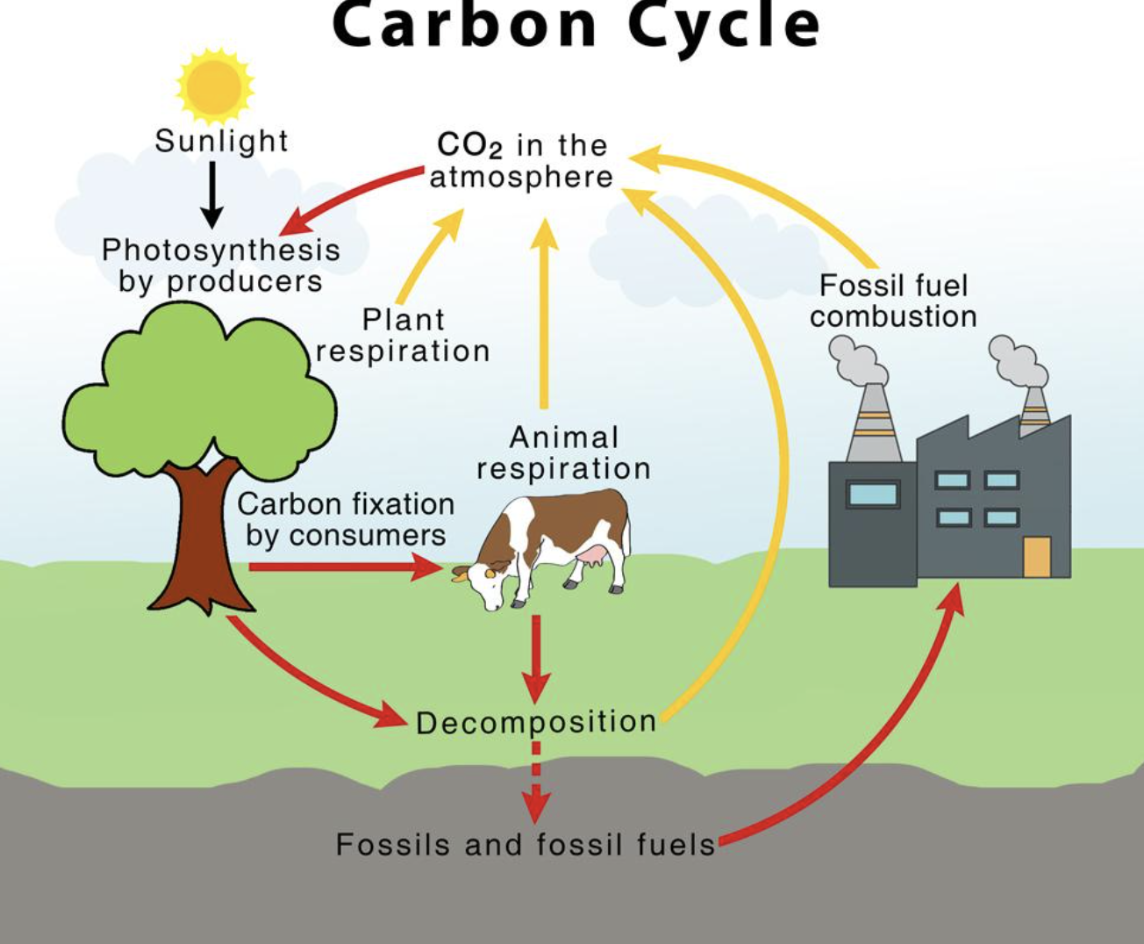
carbon cycle
1) plants take in CO2 from atmosphere →
2) plants release O2 from photosynthesis
3) animals take in O2 (respiration)
4) decomposition takes in O2
4) animals release Co2 (respiration)
5) decomposition releases CO2