MB 251 Exam 3
 Call Kai
 Learn
Learn Practice Test
 Spaced Repetition
 Match
Match Flashcards
 Knowt Play
1/98

There's no tags or description
Looks like no tags are added yet.
Name | Mastery | Learn | Test | Matching | Spaced | Call with Kai |
|---|
No analytics yet
Send a link to your students to track their progress
99 Terms
bacterial nomenclature rules
Genus is Capitalized Campybacter
species is lowercased jejuni
Gene/Protein Nomenclature
DNA/RNA: znuA; ftsz
Protein: ZnuA; FtsZ
DNA —> RNA —> Protein
Central Dogma
DNA makes RNA, RNA makes Protein
Horizontal Gene Transfer (Expression)
Recombination: Genetic info is used in a cell to make proteins needed for the cell to function. Involves Transcription and Translation leading to cell metabolizing and growing
Horizontal Gene Transfer (Recombination)
Genetic info transferred between cells in same generation
Vertical Gene Transfer
Bacteria a dividing and passing DNA to daughter cells
Chromosome
Main genetic element that main genetic element that is Essential for the cell's survival Tells cell how and when to do something
Gene
Genetic element in chromosomes that encode info to make specific RNA/Protein
1 Gene: 1000 Base Pairs
Genome
Entire complement of genes in cell including chromosomes and plasmids
Plasmids
Extrachromosomal DNA element that encodes Non-Essential genes; Expendable. Do not have to be transferred to daughter cells
Replicate separately from chromosomes, double stranded DNA, genetically mobile (can be passed from cell to cell), circular, and encode good genes like antibiotic resistance
Can be lost and still survive
Bacteria transformed with plasmids —> Conjugation/transformation
Etopic (out of place) expression of non-native genes/proteins
Ex. Lac promoter driving expression of GFP: +Lactose/-glucose (or lactose analogue) = +GFP = Green
Vertical Transfer
Homologous Recombination:
Takes plasmid and integrates into chromosomes making it Essential; Genes guaranteed to transfer in every generation (daughter cells). --> Chromosomal genes
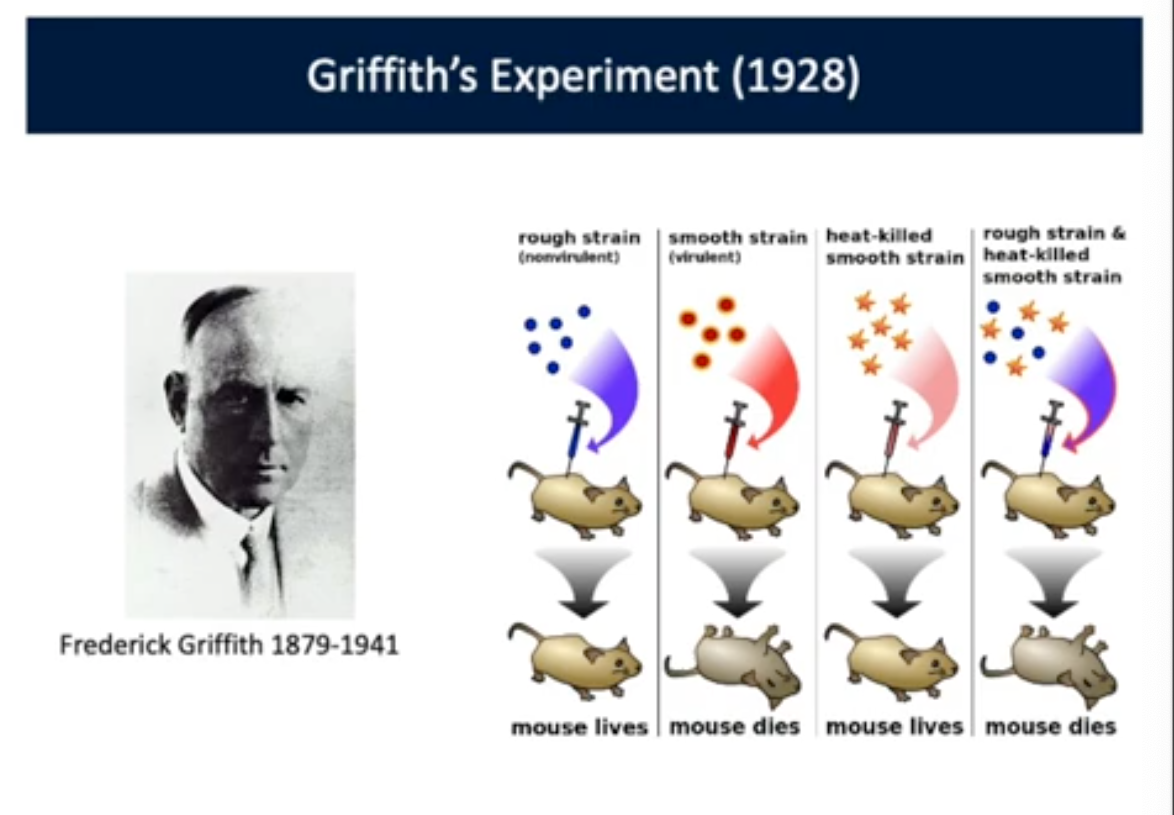
Griffith’s Experiment
Smooth Strain: Capsulated, evades immune system, Virulent = Causes Diseases/death; Mouse Dies
Rough Strain: No capsule, Non-virulent (Can’t cause diseases/death); Mouse Lives
Heat Killed Smooth Strain: Heat treated bacteria. Mouse lives because cells are dead
Rough Strain & Heat Killed Smooth Strain: Rough Strains mixed with heat killed smooth and Mouse Dies; Smooth Strains found out of mouse even though never added; Rough bacteria transformed into Smooth Bacteria
Results in death: Live smooth, Live smooth + Dead smooth & Live rough + Dead smooth
Transformation
Cells have changed by a genetic change
Avery, Macleod, McCarty
Depleted sample of ONE component of smooth killed cells and assess transformation of rough cells. T2 Bacteriophage; Escherichia coli
4 Experiments: Only RNA removed, Only Protein removed, Only Lipids removed, Only DNA removed
1-3 Experiments RNA, Protease/Protein, Lipids Removed: Live Rough Bacteria —> Transformation into Smooth
4th Experiment DNA Removed: Rough cells stay Rough; Absence of DNA = Loss of Transformation
Does NOT DIRECTLY show that DNA is transformer of rough into smooth
Hershey Chase Experiment (Alfred and Martha)
Directly showed DNA = molecule transferred into cells allowing transformation.
Labeled Phage Proteins with Radioactive Sulfur → Incubation → Separation of phage and bacterial cells → Did not Observe Radioactive Sulfur/Proteins. Radioactive Sulfur = Proteins
Labeled Phage DNA with Radioactive Phosphorus → Incubation → Separation of phage and bacterial cells → Observed Radioactive Phosphorous/DNA. Radioactive Phosphorous = DNA
Bacteriophage (Hershey Chase)
Viruses that specifically infect bacteria
Protein coat and DNA gene
Bind to surface of bacterial cell and inject genetic material into it
Injected DNA incorporated into chromosomes —> more genes that have competitive advantage ex. Capsule
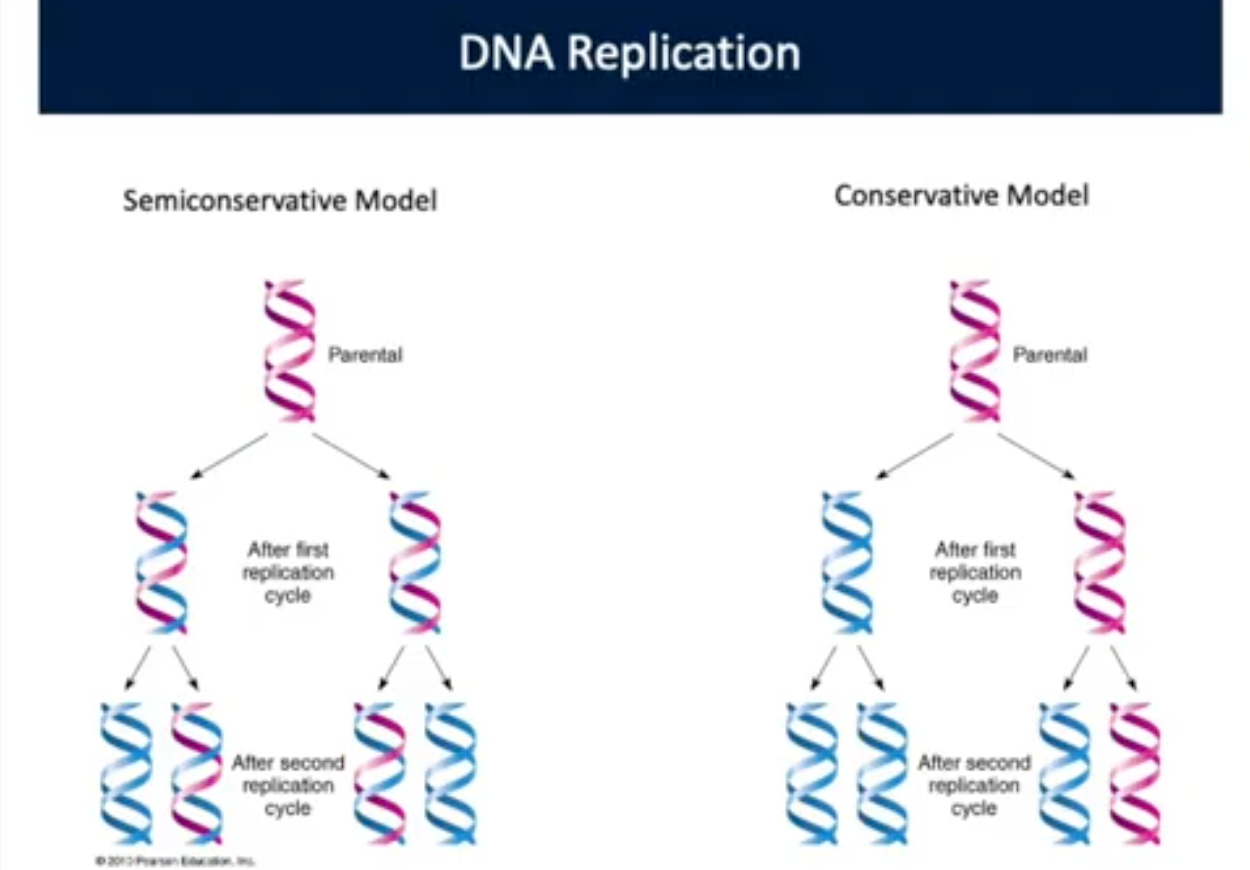
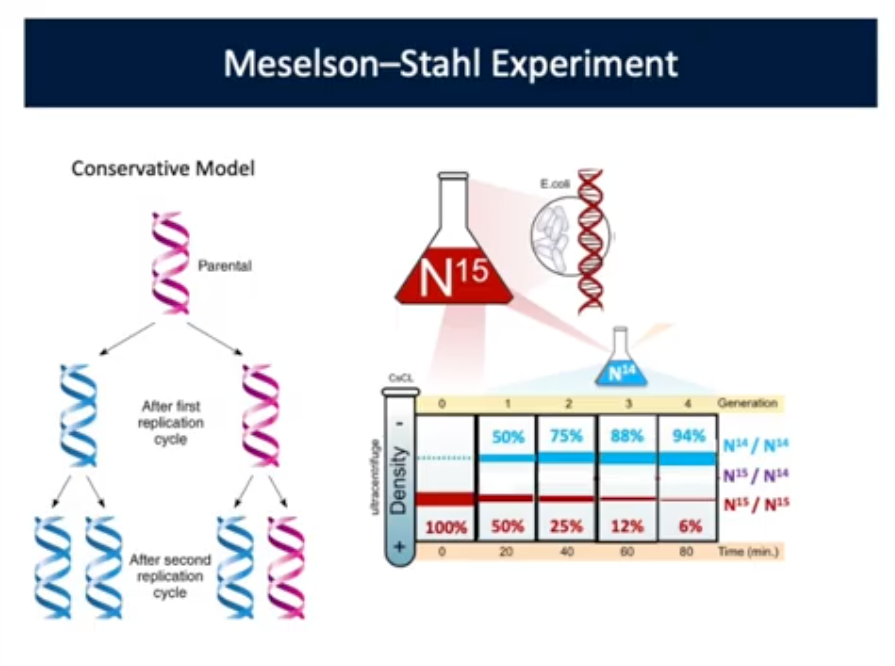
DNA Replication (Semi-Conservative) Meselson-Stahl Experiment
Replicated in a Semiconservative Model; The Parental DNA both serves as templates for a copy to be made so any new DNA made is a hybrid
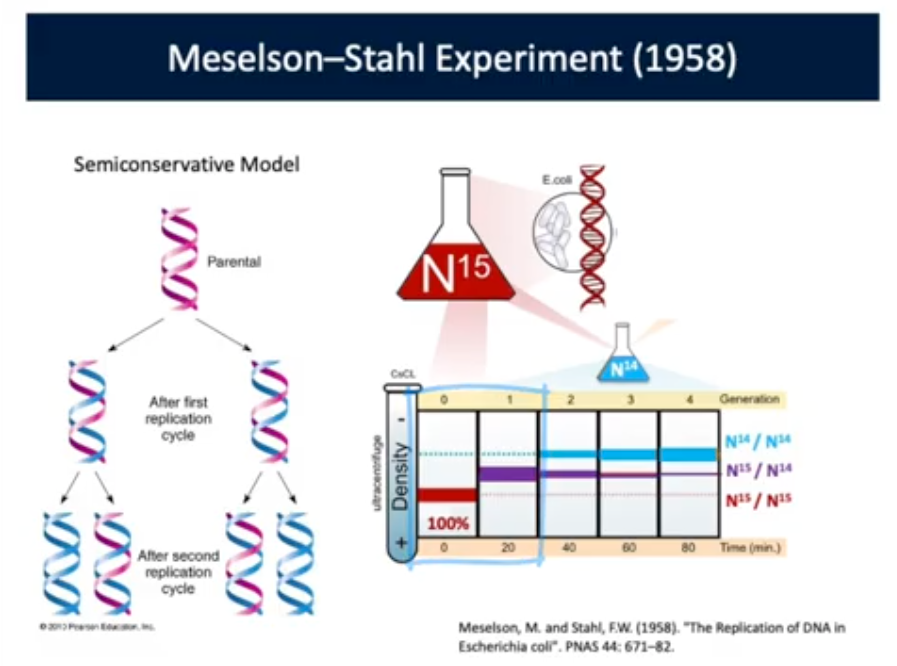
Semiconservative Model (N15 Experiment): All Nitrogen in the cell’s DNA is N15. Next you switch to N14 and allow for Cell Division and all new Daughter cells will be a new N15/14 species. Eventually it will divide until you have almost all N14
After 20 minutes: Will be hybrids of the N15/14 and concentration goes down as time goes on
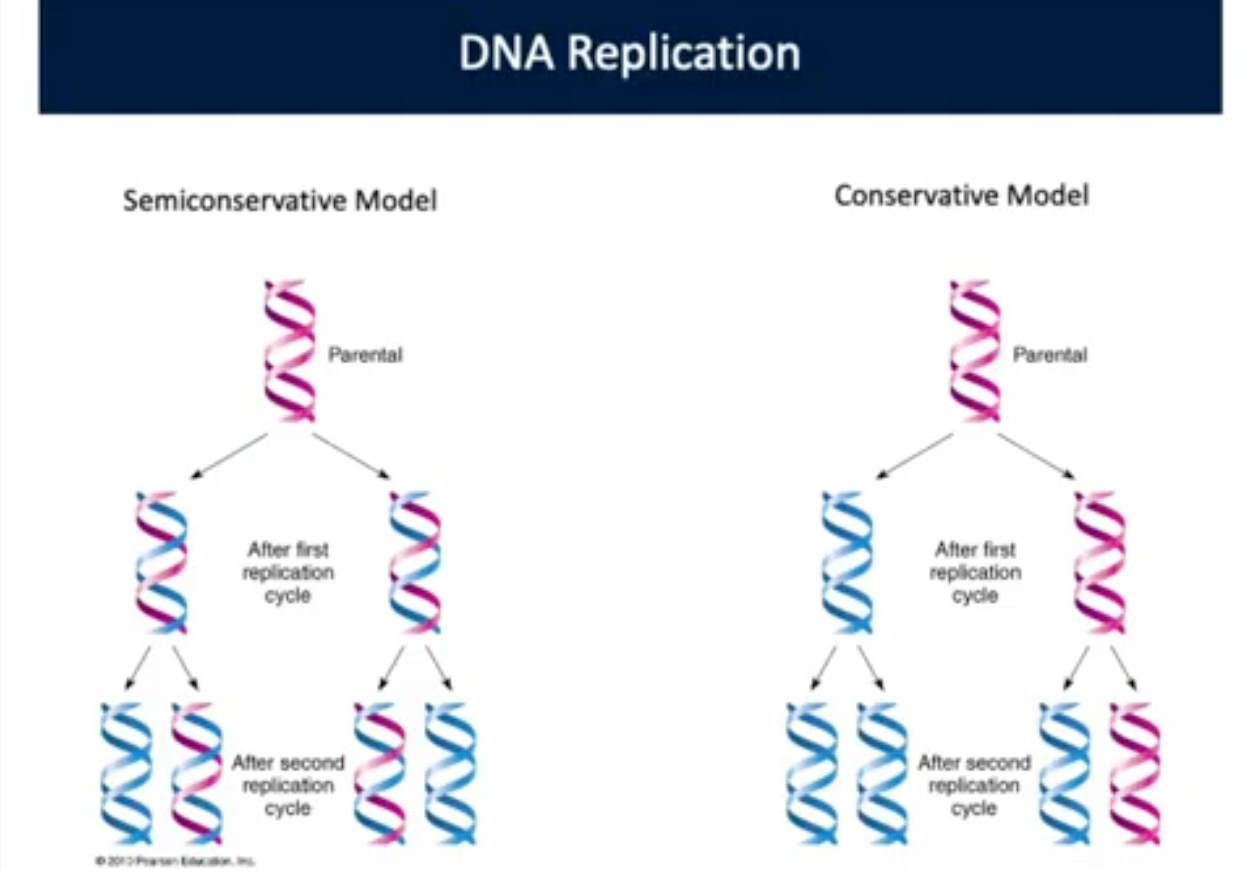
DNA Replication (Conservative) Meselson-Stahl Experiment
Parental DNA was a template but the same 2 strands from the OG parent were always passed down to a daughter cell and any copy of DNA would be completely new
Conservative Model (N15 Experiment): Does not happen naturally; Double stranded DNA from parent is copied but never splits and forms a hybrid to turn into a new species
After 20 minutes: 50% will be Blue; 50% Red
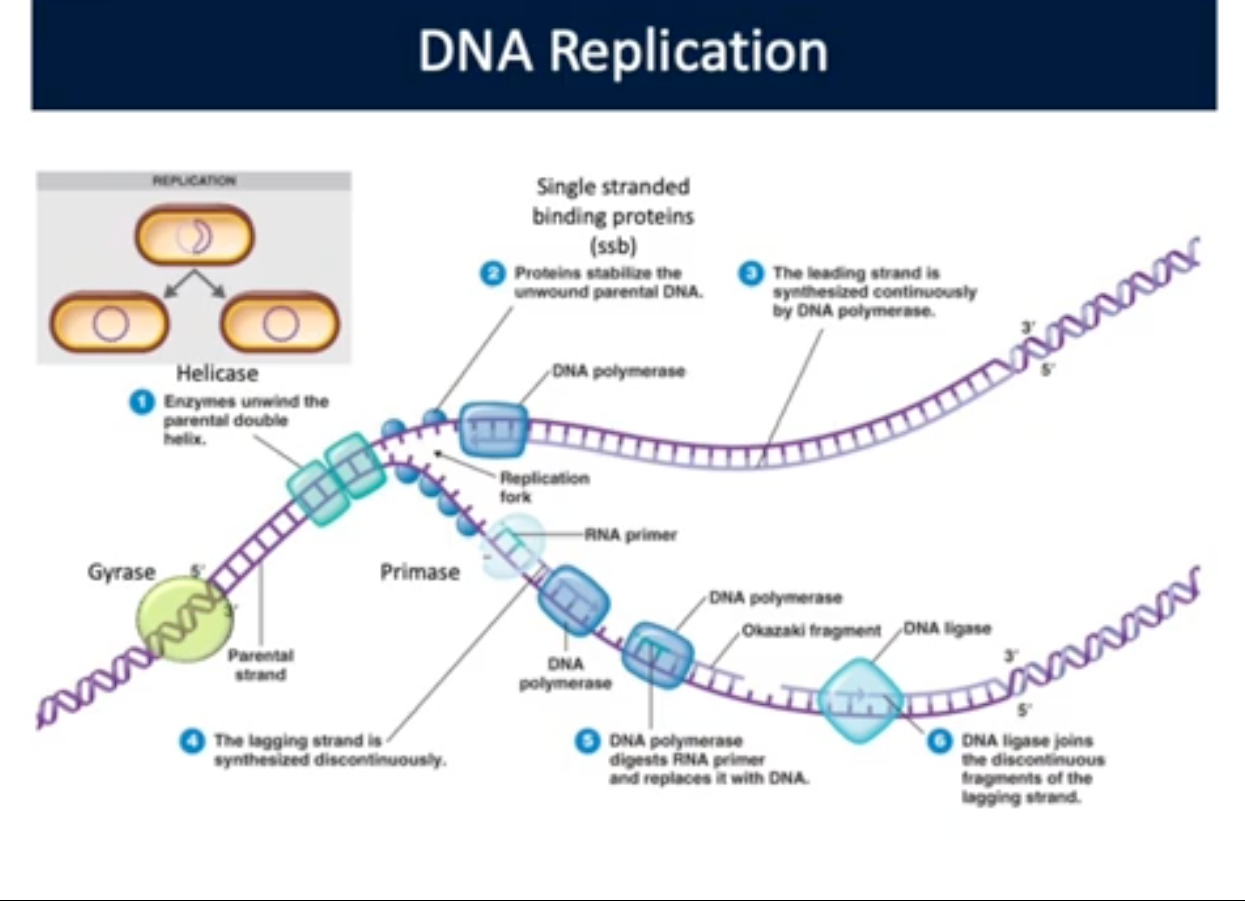
Replication
DNA makes DNA; DNA is copied; Make sure cell has all of the functions needed to survive
Starts at Origin of Replication (Ori)
Proceeds in both directions around chromosomes
1000 bp/second
New round starts before whole chromosome replicated
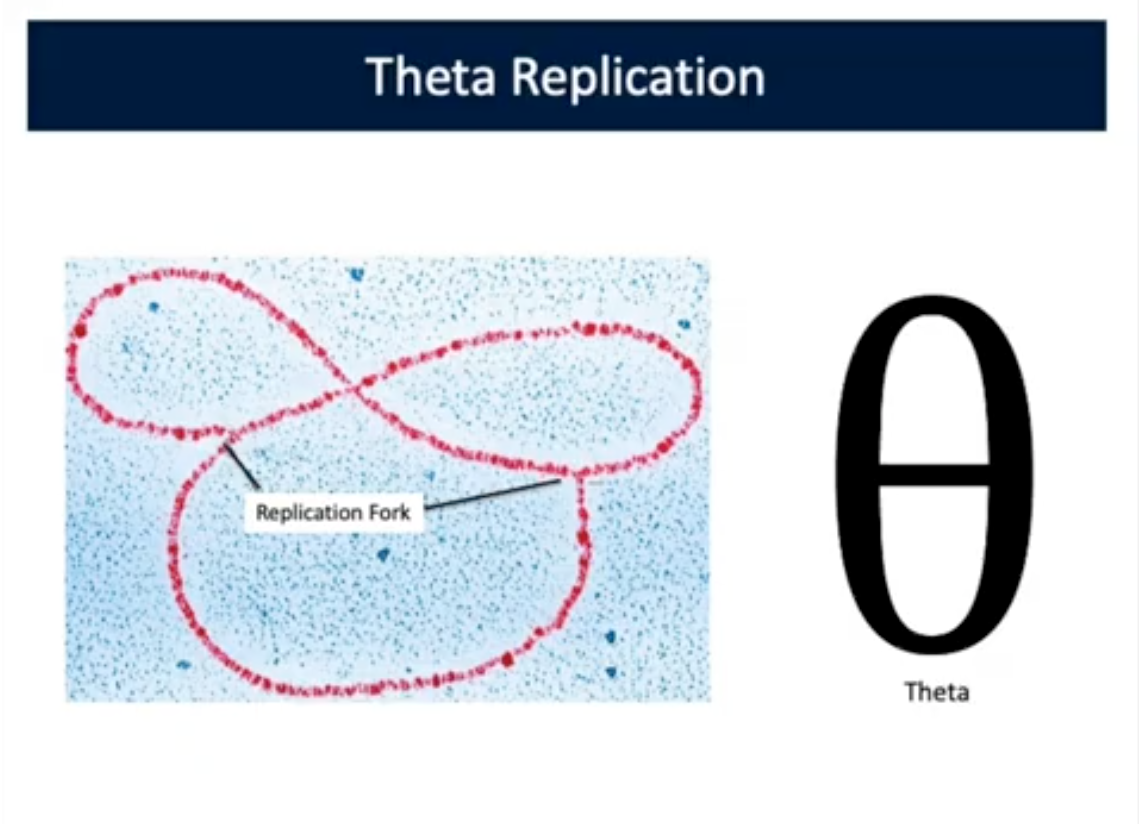
Theta Replication
Takes place in Cytoplasm (Nucleoid Region)
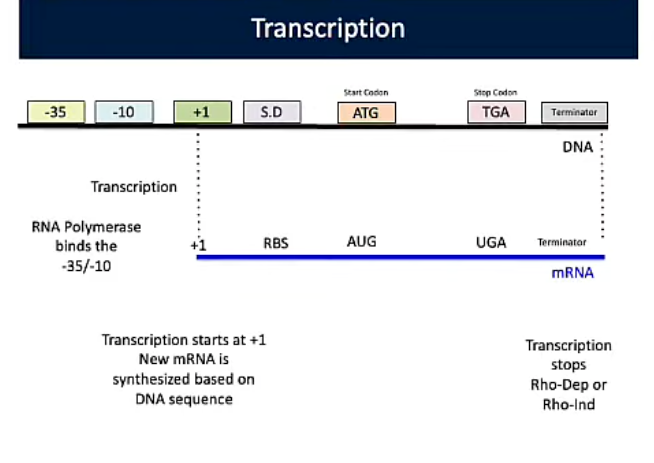
Transcription
DNA makes RNA; DNA is converted to RNA
RNA Polymerase carries this out
Controlled/regulated process
Not all genes (DNA) are Always transcribed
Starts at +1 → Termination Sequence
Genes transcribed/translated into proteins when needed
Ex. Genes that code for proteins to metabolize lactose in DNA but lactose is NOT available, it is waste of time/energy
o (sigma) recognizes promoter region and STARTS Transcription
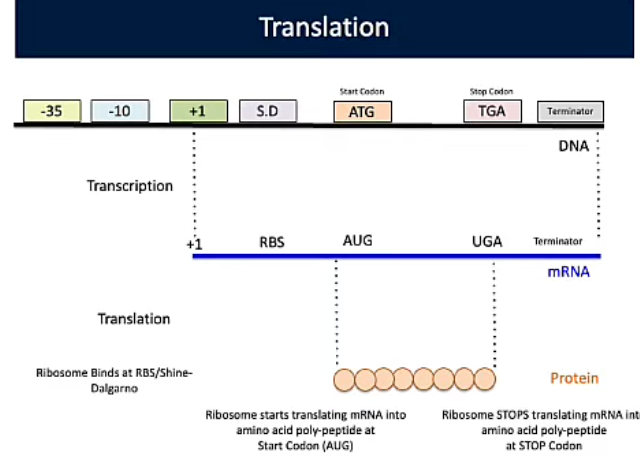
Translation
RNA makes Protein; RNA converted to Protein
Synthesis of proteins from mRNA
Not all RNA on transcript is translated
Translation is from Start Codon (AUG) to Stop Codon (UGA/UAA/UAG)
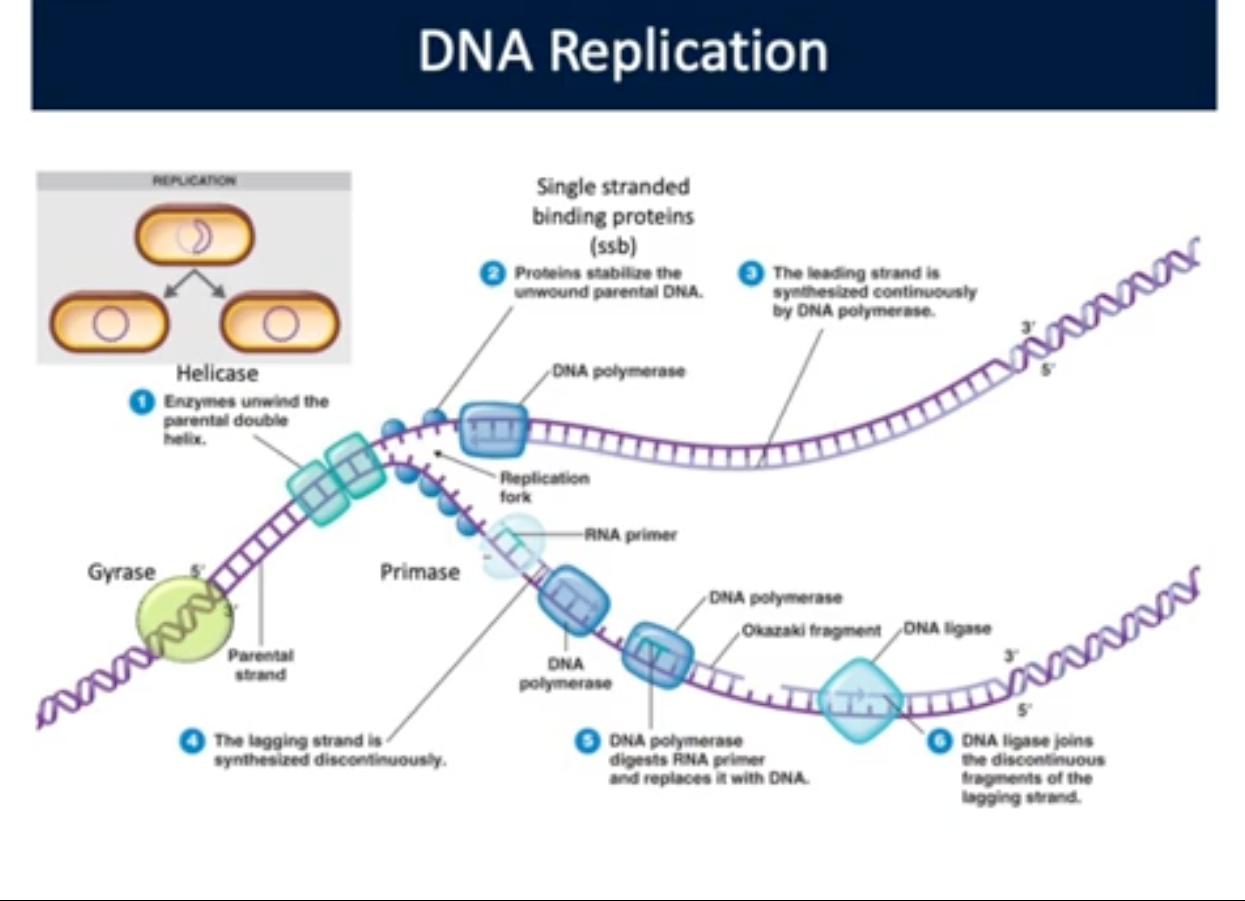
DNA Replication (Starts with?)
Starts at Ori and goes in both directions around chromosome; Termination site is where two chromosomes separate
Central Dogma
Replication, Transcription, Translation
What unwinds DNA?
Gyrase and Helicase
Polymerase
Enzyme that makes nucleic acid strands from nucleic acid template
DNA Polymerase
Makes new DNA from a DNA template during REPLICATION
RNA Polymerase
Makes new RNA from DNA template
o (sigma) recognizes promoter region and starts Transcription
During Transcription: Reads DNA Template strand 3’ - 5’. When MAKING RNA = 5’ - 3’ adding complement base
EX. Reads 3’ - G - C - T - A 5’
Adds COMPLEMENT 5’ - C - G - A - U 3’
Recognizes and binds to -35/-10
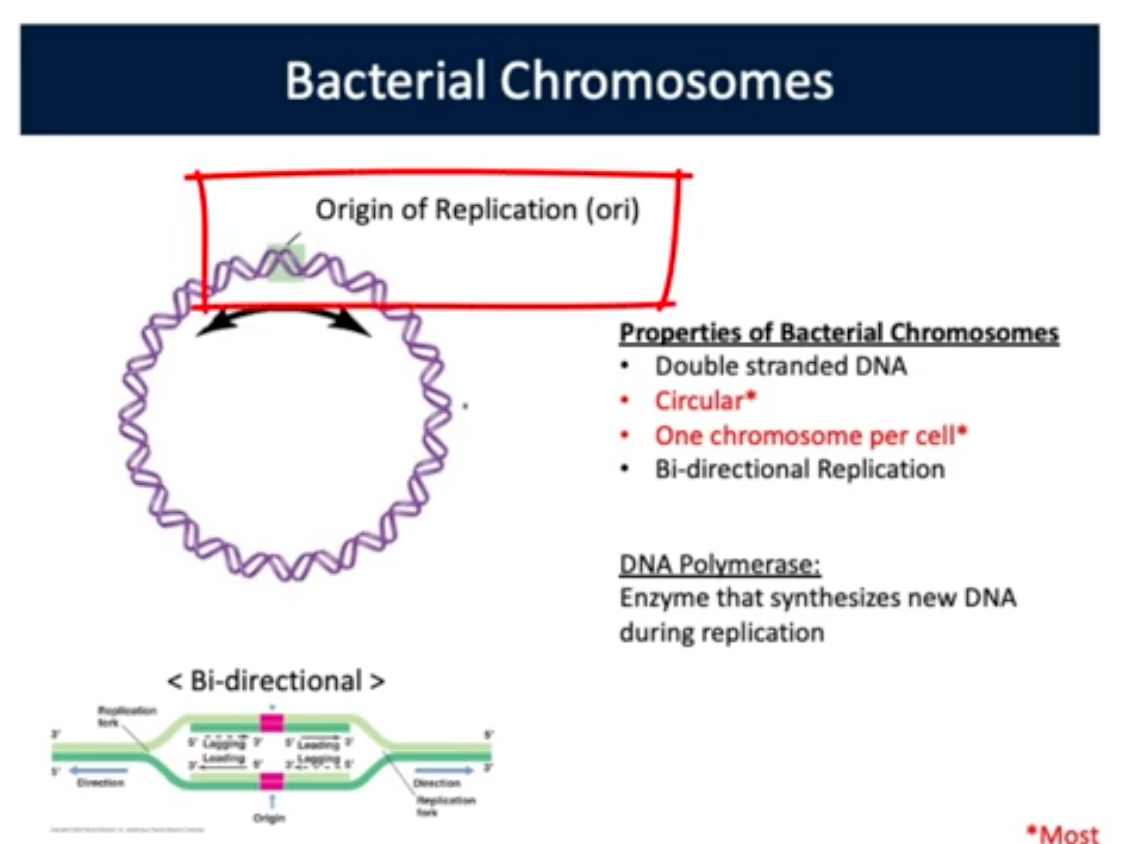
Ori (Origin)
Start of Replication; Origin of Replication; 5 Prime and 3 Prime ends
Bacterial Chromosome Properties
Double stranded DNA, Circular, One chromosome per cell, Bi-directional Replication.
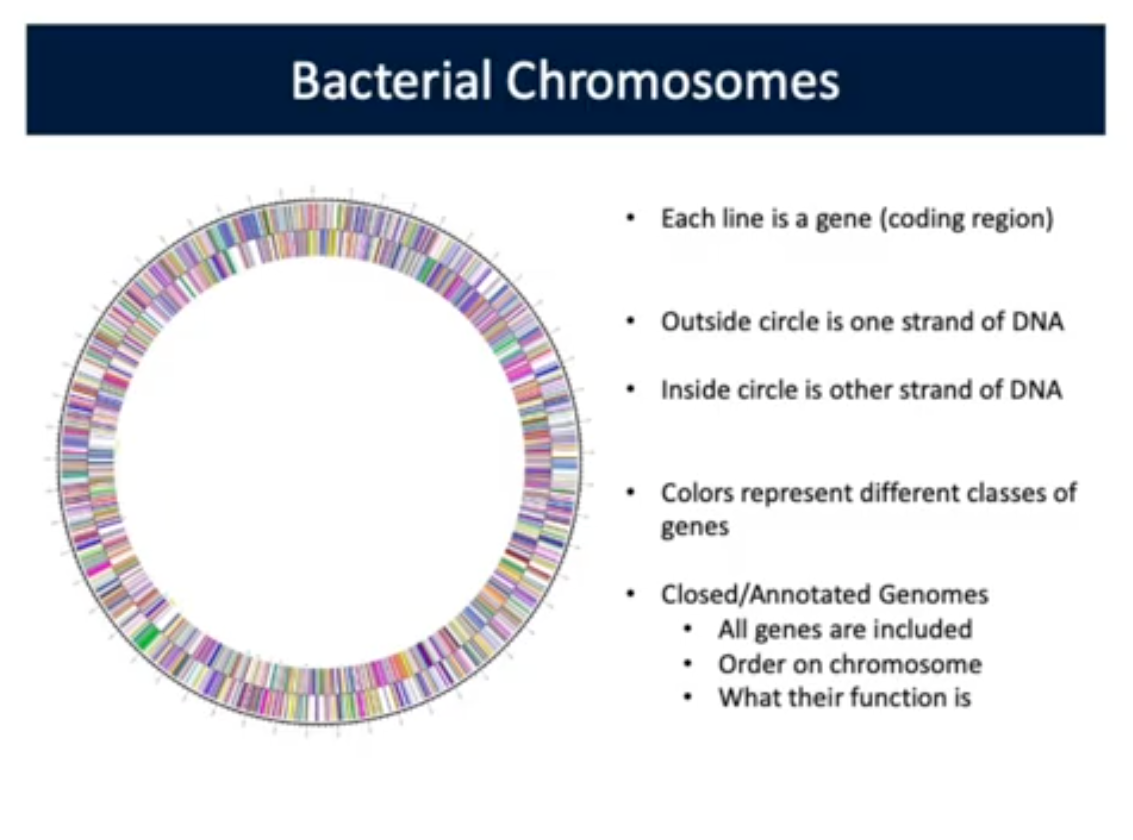
Bacterial Chromosomes
Each line is a gene; coding region,
Outside circle is one Strand of DNA, Colors show different classes of genes
Closed/Annotated Genomes: All genes included, Order on chromosomes, What their function is
Supercoiling
DNA supercoiled to fit into compact space of the cell
Sometimes hides DNA binding sites
Proteins required to locate specific locations on DNA
Allows for regulating transcription/replication
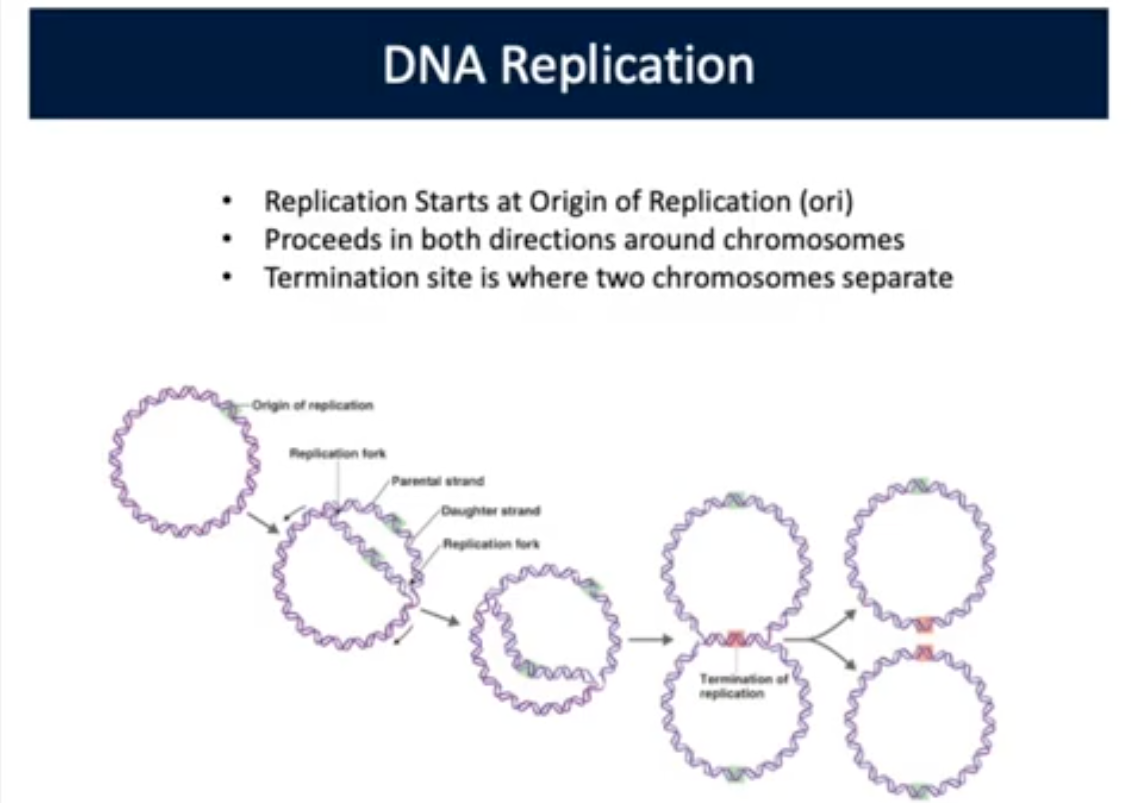
Termination Site
Where two chromosomes separate
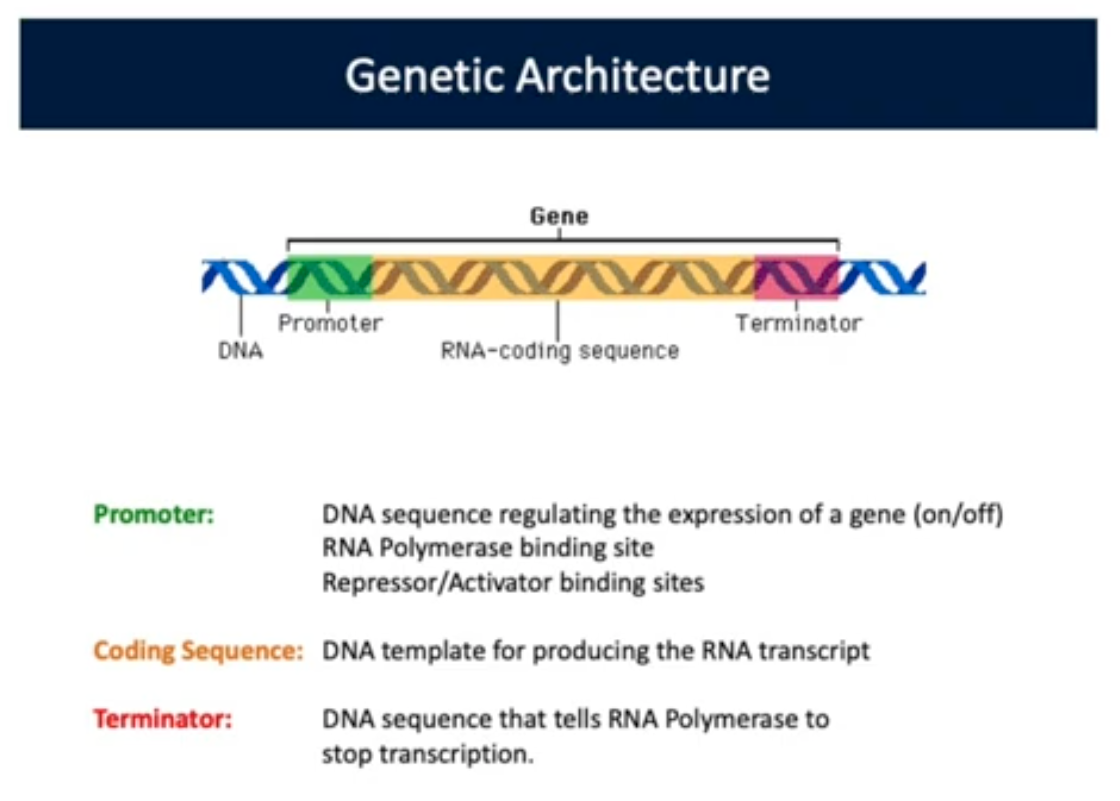
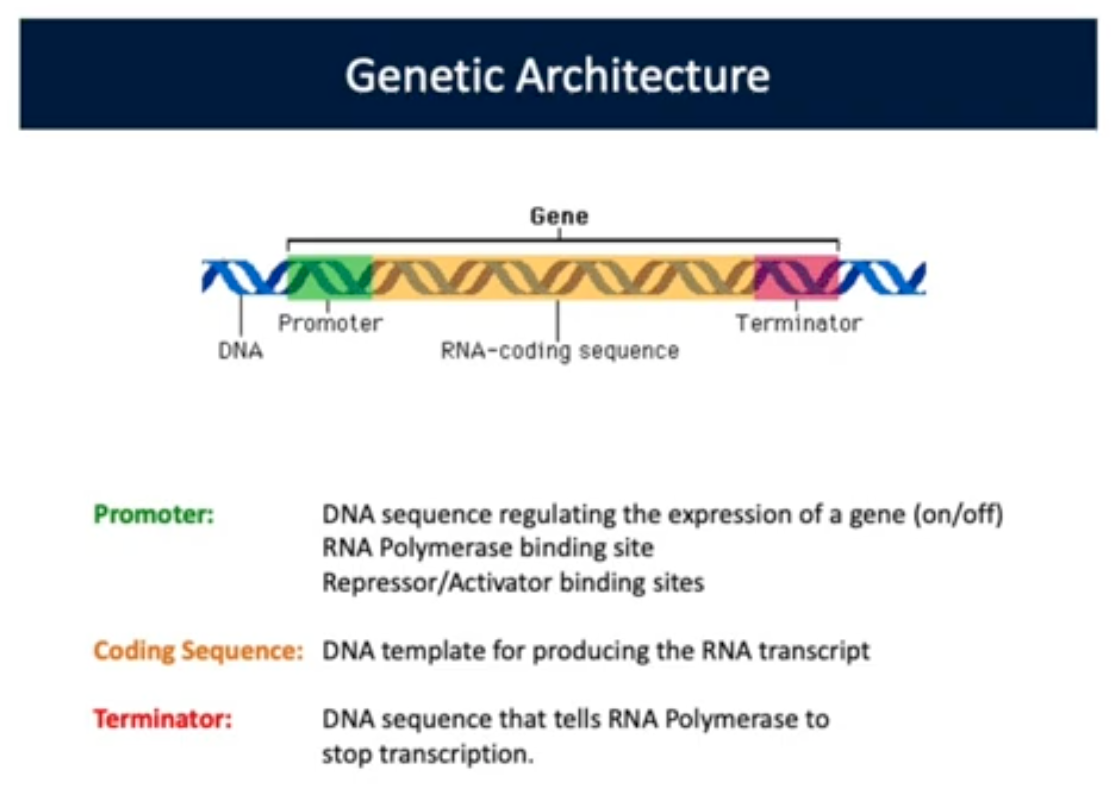
Promoter (Transcription PT. 1)
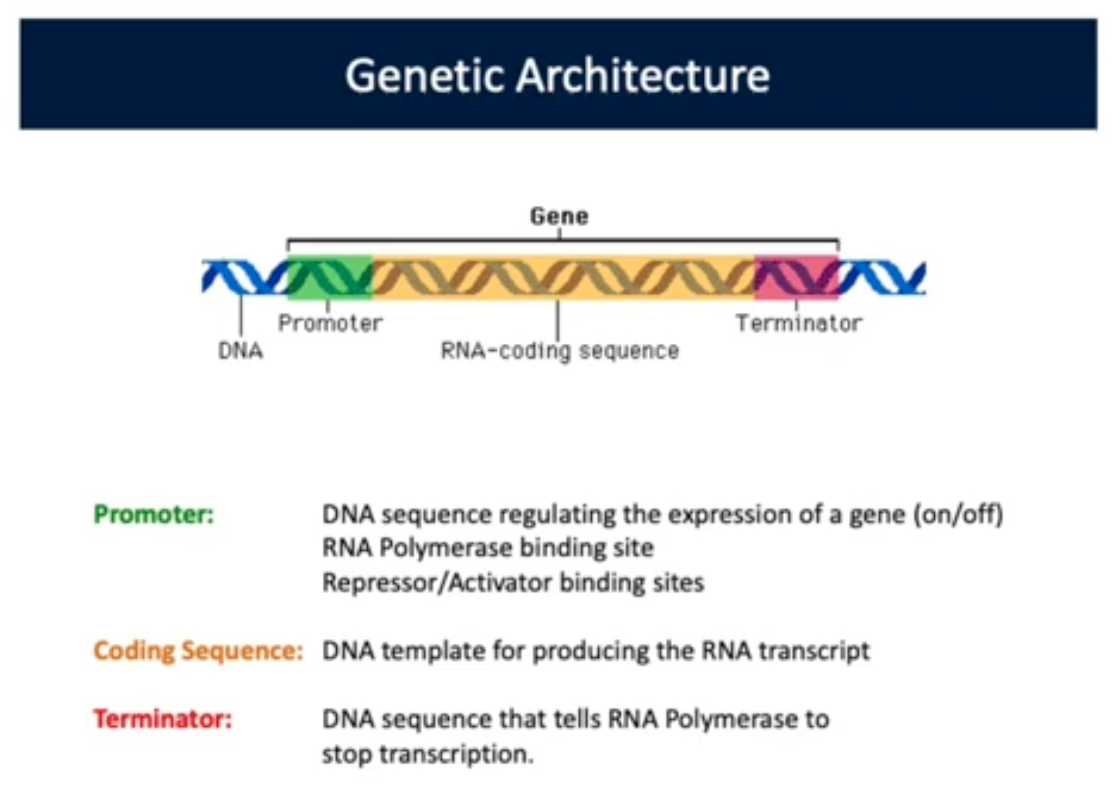
Far left region (upstream); DNA regulating expression (on/off) of a gene. RNA Polymerase = bonding site. Repressor/Activator binding sites
Downstream = right; Upstream = left
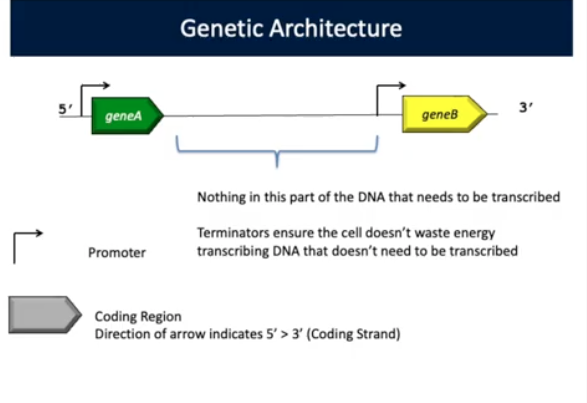
Coding Sequence (Transcription PT. 2)
Middle; DNA template for producing RNA transcript
Coding Regions: Coding Strand: 5’ - 3’
Non-Coding Strand: 3’ - 5’
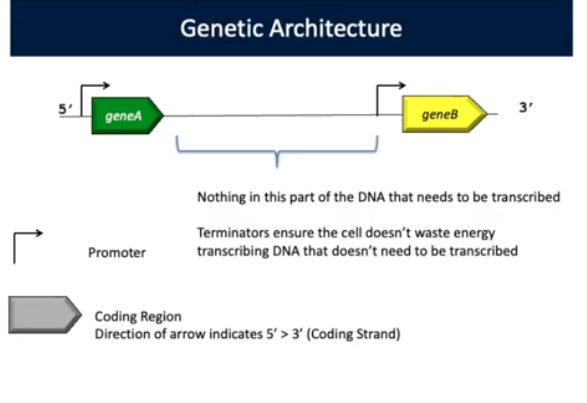
Nothing between geneA and geneB is transcribed
Terminator (Transcription PT 3.)
Far right region (Downstream);DNA sequence that tells RNA polymerase to stop transcription. Make sure cell does not waste energy transcribing DNA it does not need
Coding Strand (DNA Sequence)
5’ - 3’; DNA sequence is identical to transcribed RNA.
T in DNA is replaced by U in RNA
RNA Polymerase DOES NOT READ this strand
Non-Coding/Template Strand (RNA Sequence)
3’ - 5’; reverse complement of coding strand
Strand that RNA Polymerase READS when making RNA
Chargaff’s Rules (Transcription)
A = T
G = C
+1 Strand (Promoter Region)
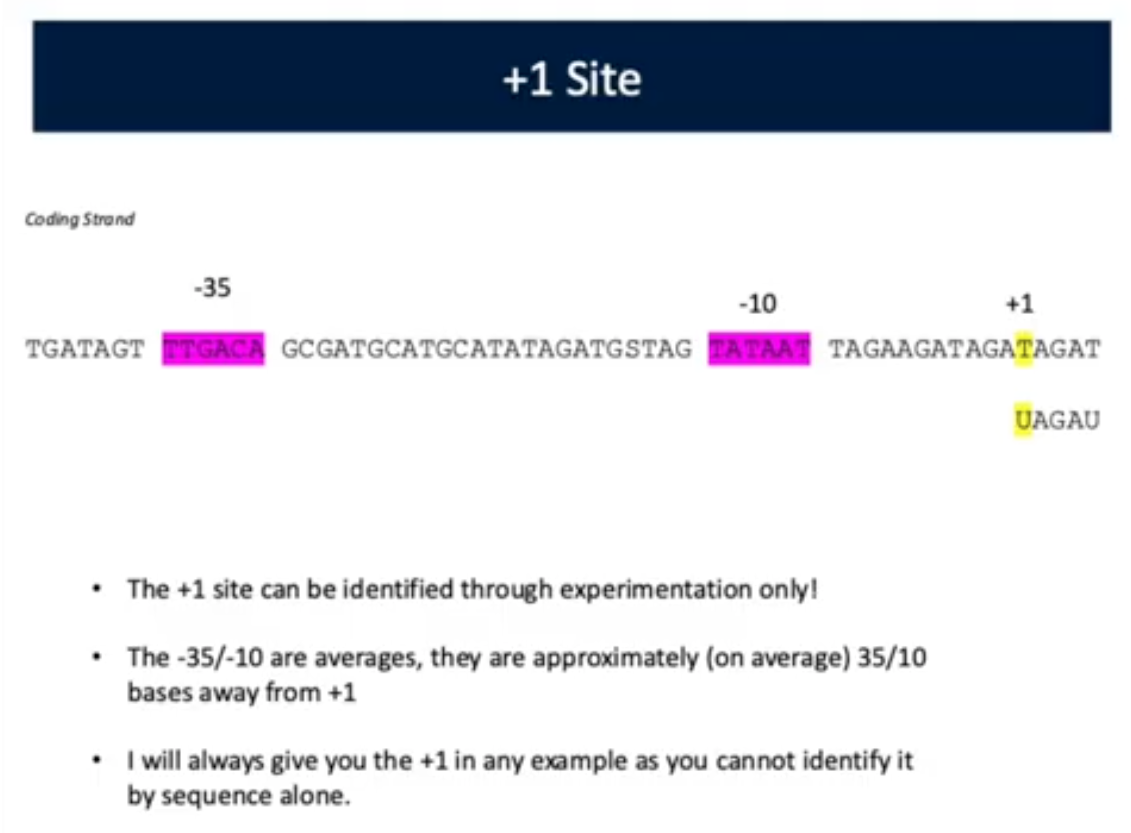
Found through experiments only; START site of transcription. 1st nucleotide that RNA Polymerase Reads and Synthesizes.
1st base of NEW RNA
-35/-10 are averages, 35/10 bases away from +1
RNA Polymerase (Subunits)
Holoenzyme: Core Enzyme: a2, B, B’ —> Synthesize RNA
o (sigma) Recognizes promoter region and STARTS Transcription
Transcription Initiation:
RNA Polymerase binds to -10/-35 region of the promoter. Sigma is the subunit that recognizes the sequence
RNA Polymerase moves down the DNA 5’ → 3’
RNA Polymerase synthesizes new mRNA at +1 site. +1 is the start of Transcription; 1st nucleotide transcribed into RNA
LoGo
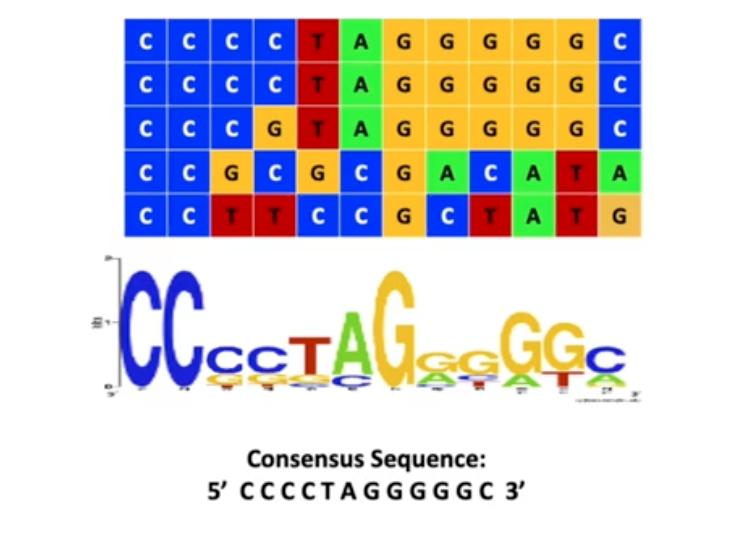
Representation of Consensus sequence where more info is presented than traditional consensus sequence
Size of the letter shows frequency among many sequences; Larger the letter more represented that nucleotide is at that position.
Allows for all nucleotides to be viewed
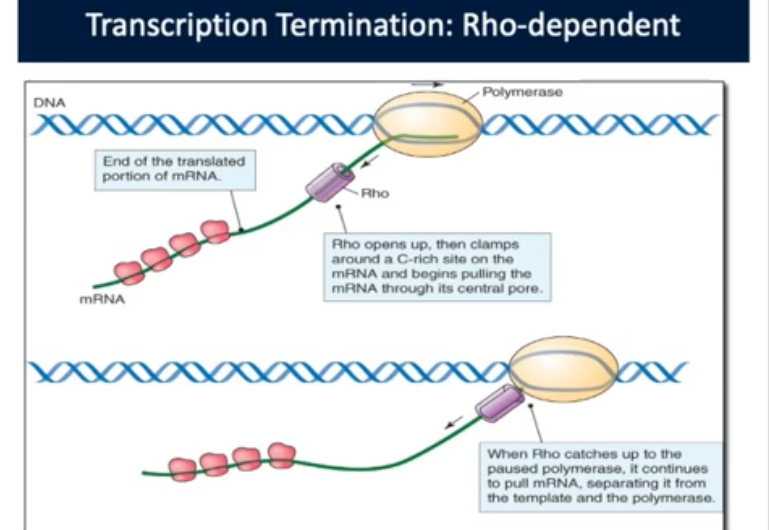
Transcription Termination PT 1. (Rho-Independent)
Rho opens up, clamps to a C-rich site on mRNA and pulls mRNA through its central pore. When Rho catches paused polymerase, it keeps pulling mRNA separating it from the template and polymerase
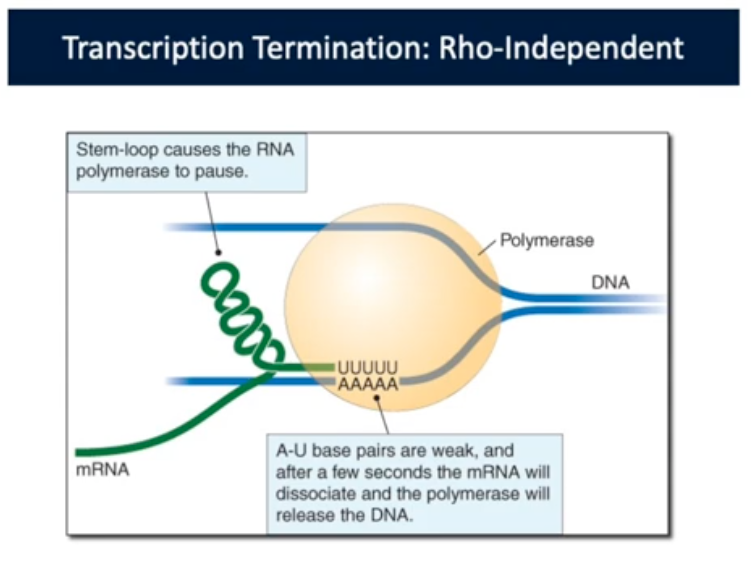
Transcription Termination PT 1. (Rho-Dependent)
Stem-loop causes RNA polymerase to pause. A-U bps are weak, mRNA dissociates, and polymerase releases DNA
mRNA transcript is single stranded, allowing nucleotides to bp with complementary ones (A-U, G-C) on same strand of RNA
A series of T’s is the genetic motif that provides evidence of Rho-Independent termination
Ribosome (Translation)
Protein: RNA complex where amino acid subunits are linked together to form a protein. Site of protein synthesis
Thousands per cell
2 Subunits: 30S and 50S in prokaryotes = 70S Complex (S=Svedberg units)
Combination of rRNA and Protein
Needed to transfer mRNA in Protein
Binds at Shine-Dalgarno Site on mRNA Transcript
Genetic Code (Codon) (Translation)
Triple of nucleic acid bases (codon) that encodes a single amino acid
Specific codons for Start/Stop
Anticodon (Translation)
on tRNA recognizes codon on mRNA
tRNA is amino acid carrying RNA
16S rRNA (Translation: Initiation)
Recognizes and binds Shine-Dalgarno sequence on mRNA, helping the ribosome start codon. Also good for structural stability
Initiation (Translation)
AUG = Codon. Incorporates amino acids; Arrival of new tRNA
P = Protein chain held here
Elongation (Translation)
Elongation = Exit of empty tRNA
3 stop codons: UAA, UAG, UGA
Termination (Translation)
Stop Codon = Uncharged tRNA will enter at A-Site
Ribosome will Dissociate and mRNA and polypeptide will be released
Coupled Transcription & Translation
Translation can begin before transcription stops.
Bacteria don't have organelles which allows transcription and translation to happen in the cytoplasm
mRNA transcripts do not need to be transported before translation starts
Coupled transcription and translation is another mechanism by which bacteria can divide quickly
Most bacteria have how many chromosomes?
1 Chromosome and this DNA is CIRCULAR
Where does replication start and how does it move?
Bacteria initiate the process of replication at the origin (ori) and move in a bi-directional manner resemble the greek letter THETA
DNA Polymerase (High Fidelity Enzyme)
It doesn't make a lot of mistakes (less likley to result in mutations)

‘5 in-between 3’
-35, -10, +1, ATG, TGA, Terminator
Operon
A set of genes transcribed of the same promoter
Only in Bacteria; One promoter driving transcription of many genes
All genes in operon transcribed at same time
RNA Polymerase only binds once
1 Operon transcribed:1 mRNA produced
Frame Shift
Ribosome reads the incorrect 3 nucleotide code, incorporating the wrong amino acid in the polypeptide
Correct: THE CAT ATE THE RAT
Incorrect: ATH ECA TAT ETH ERA
Why Regulate Transcription and Translation?
It is expensive to make proteins
Protein synthesis: 2 million ATP/Second
Transcriptional Regulation
Regulating how much transcript mRNA is produced
Can be turned on/off/dimmed/high
When it can be turned on
DNA = Promoter region
DNA Binding Proteins: Regulators of Transcription; Activators/Repressors. Bind to DNA at Promoter regions
RNA Polymerase: Enzyme transcribes DNA into mRNA
DNA Binding Proteins
Regulators of Transcription; Activators/Repressors. Bind to DNA at Promoter regions
RNA Polymerase
Enzyme transcribes DNA into mRNA
Translational Regulation
Regulating the translation of mRNA into protein; mRNA is made but not translated into protein
Post Translation Regulation
Regulating activity of synthesized protein; Protein is made but may/may not be active
Constitutive (Type of Transcriptional Regulation)
No regulation, gene is continuously transcribed, always on
Ex. rpoD
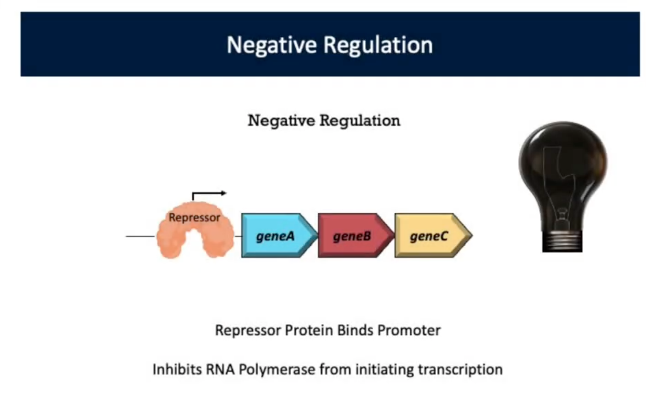
Repression/Negative Regulation (Type of Transcriptional Regulation)
STOP RNA Polymerase, Transcription Off
Ex. znuABC
Repressor Protein binds Promoter. Stops RNA Polymerase from starting transcription
NO RNA Polymerase binding, No Transcription = No mRNA = No Proteins
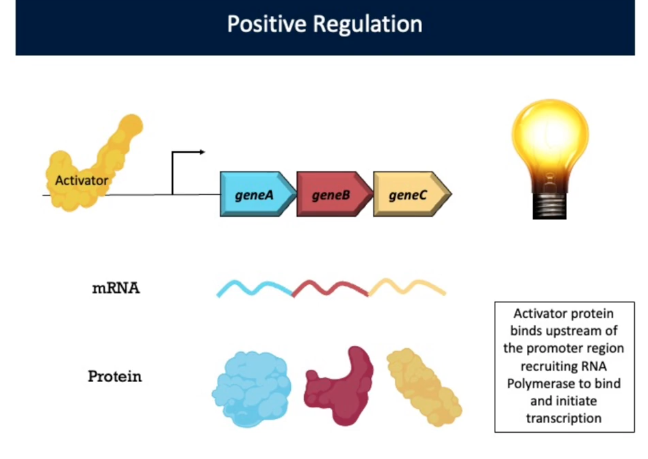
Activation/Positive Regulation (Type of Transcriptional Regulation)
Recruit RNA Polymerase, Transcription ON/Activated
Ex. luxCDABE
Activator protein binds upstream of promoter region
Recruits RNA Polymerase to bind/start Transcription
When would transcription of znuABC be on?
Low levels of zinc in the cell
When would transcription of znuABC be off?
High levels of zinc in the cell. Transcription off
Allosteric Regulation
Molecule binds to protein at a site other than active site causing the protein to change shape and activity
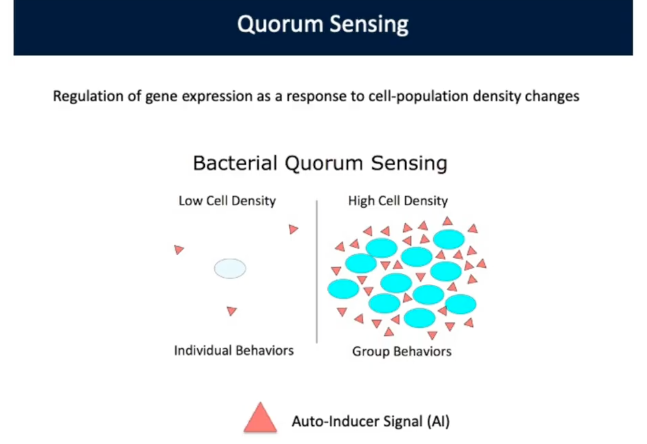
Quorum Sensing
Regulation of gene expression as a response to cell population density changes
Low cell Density: Individual
High cell Density: Group
Bioluminescence
Light production, luxCDABE operon. Makes all required enzymes/substrates to produce light. Ex. Firefly light
Low Cell Density, Low AI Signals = No Bioluminescence
High Cell Density, High AI Signals = Bioluminescence. LuxR sense increase in AI signal and activates luxCDABE → Bioluminescence
Vibrio fischeri
Gram negative Bacteria, Naturally Bioluminescent, forms a symbiotic relationship with Hawaiian Bobtail Squid
Bioluminescence and Quorum Sensing
LuxR = Activator
Light: Only binds DNA and activates when bound to AI signal molecule
AI signal High = Binds to LuxR → Activation of Transcription → Bioluminescence
No Light: Low AI signal will not bind with LuxR
LuxR does not bind to promoter → No Transcription = No light
Hawaiian Bobtail Squid
Morning: Low V. fisheri = No light Production. Bacteria grows → Produce low AI signals → No light
Night: Population reached → AI levels High → Activate luxCDABE → Light Produced
Morning Again: Vibrios expelled from light organ → Low level bacteria → No light
Under which condition does the activator LuxR bind to the promoter of luxCDABE activating transcription?
High Cell Density/High AI molecules
LuxR protein is bound to promoter region of IuxCDABE operon when
High Cell Density
The Zur protein recognizes specific sequences in the promoter region of the znuABC operon and will only bind at this location, it will not bind the promoter region of the luxCDABE operon.
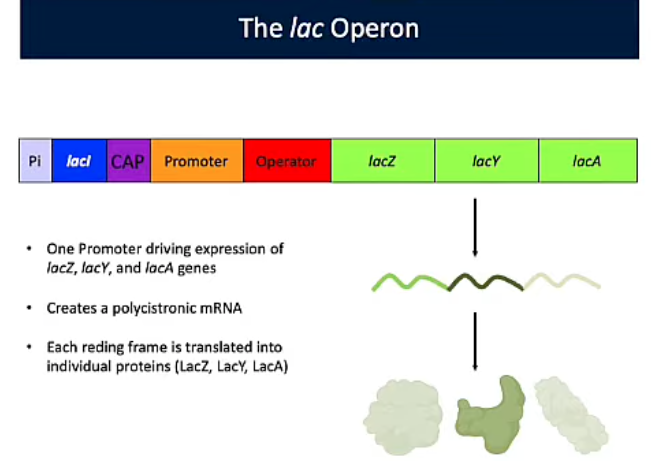
lac Operon
One Promoter driving expression of lacZ, lacY, and lacA genes
Creates Polycitronic genes
Each frame translated into individual proteins: LacZ, LacY, LacA
Codes for proteins that USE lactose
LacI
Used in: Repression & De-Repression, Constitutive Expression, Allosteric/Post-Translational Regulation.
DNA binding protein that senses lactose (Allolactase).Transcription is constituitive = always on.
When not bound, binds to promoter region of lacZYA operon called the Operator (O)
Repression when lactose is not present
Depression when lactose is present
Lactose is present: Not able to bind DNA and does not bound operator region (Depression)
CAP-cAMP
Used in Activation
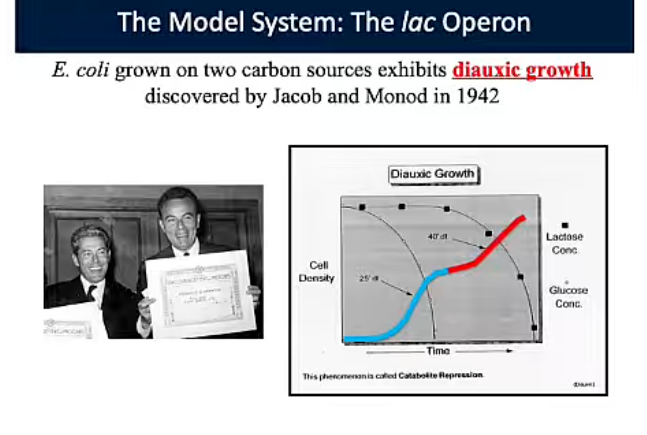
(Jacob and Monod)
E. coli grown on two carbon sources show diauxic growth; Multiple growth phases in 1 growth experiment
lacZ: Lactose Hydrolysis
Cleaves Lactose into D-galactose and D-glucose
lacY: Lactose Transport
Driven by energy in the proton motive force. Transporter that brings sugar into the cell
lacZYA operon
Should be transcribed when Lactose is present
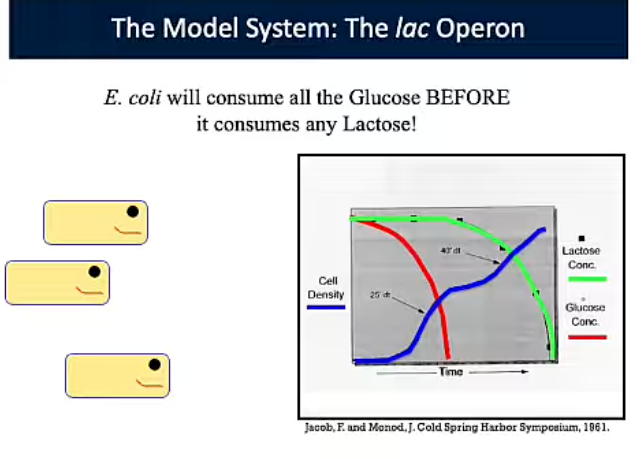
Model System Lag Phase
ALL GLUCOSE BEFORE LACTOSE! Then short period of stopping before Lactose consumed and growth starts again
Glucose
Monosaccharides. After transport used for Glycolysis
Lactose
Disaccharide. After transport enzyme breaks apart 2 sugars which requires input of energy
Promoter
-10/-35 RNA Polymerase bonding site
Operator
Binding site for lactose sensor/repressor (LacI)
CAP
Binding site for Catabolic Active Protein
Activator of lac operon
Only Activates when there is NOOO Glucose
Knows glucose is present through cAMP
Pi
Promoter for lacI gene
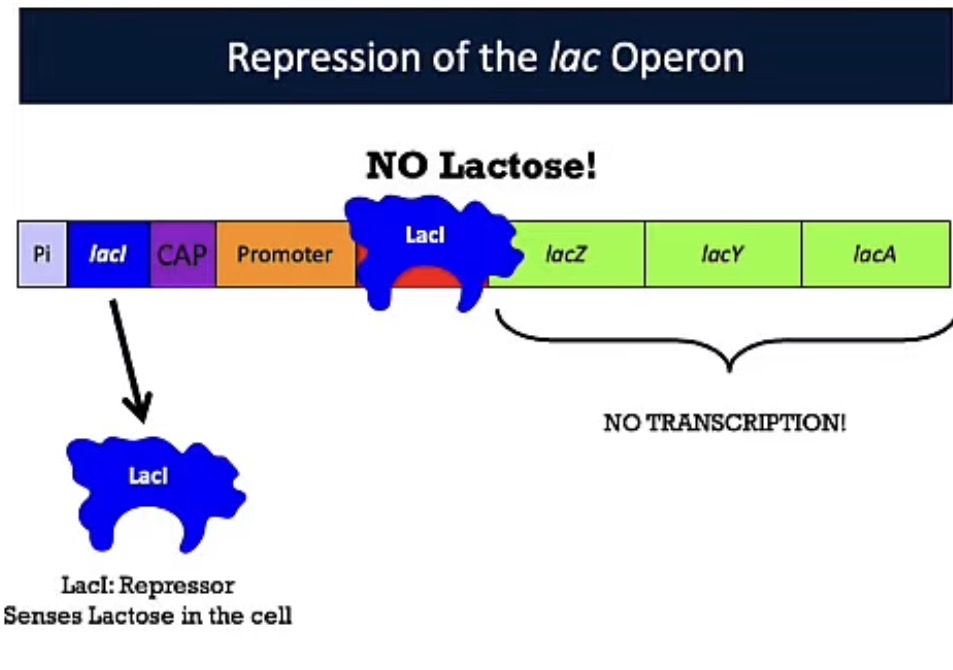
LacI repression
No Lactose, No transcription, LacI bonds to operator, Represson
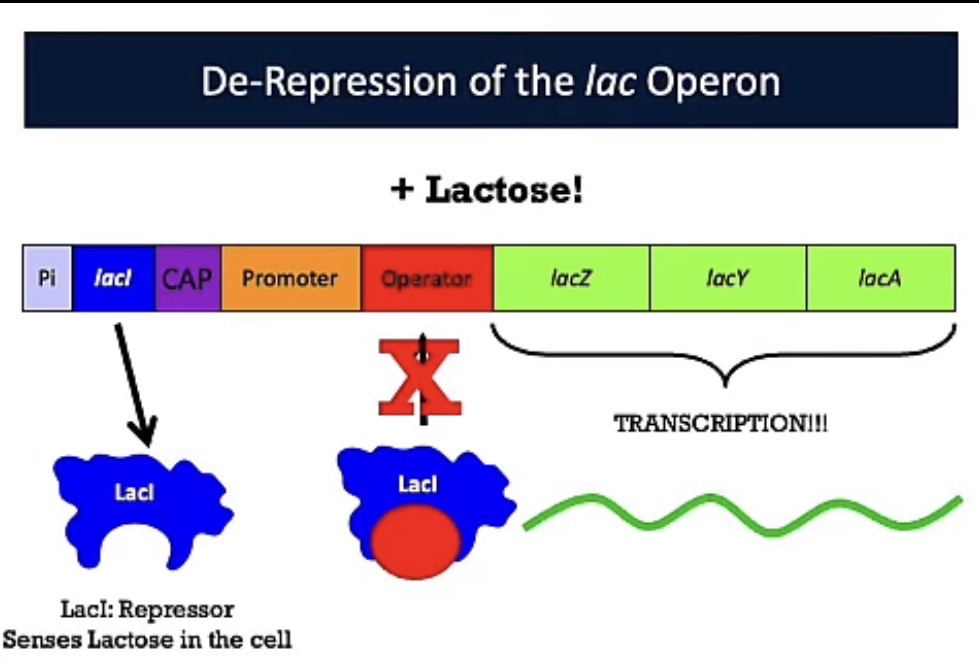
LacI derepression
LacI does not bind to Operator, Transcription
cAMP
Only produced by E.Coli
Activated when No Glucose; tells cell about energy source
cAMP absent = glucose
cAMP present = no glucose
CAP-cAMP
Bonds to promoter region = CAP
recruits RNA polymerase to transcribe operon
Only binds to lac promoter when bound by cAMP
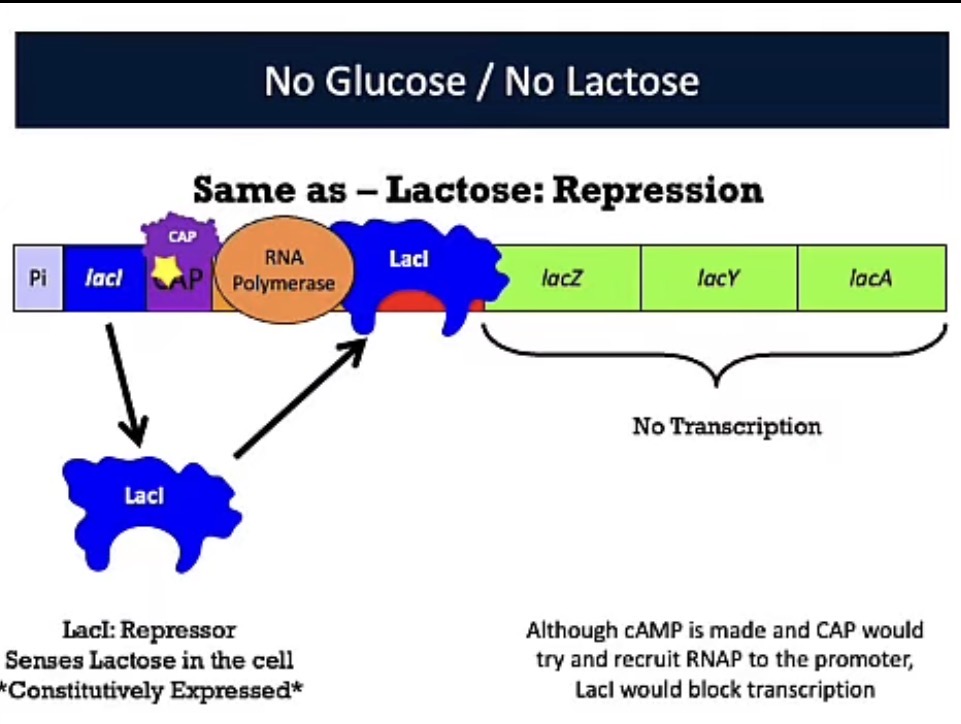
No Lactose/No Glucose
Transcription is off
LacI cAMP present/bound
Repression
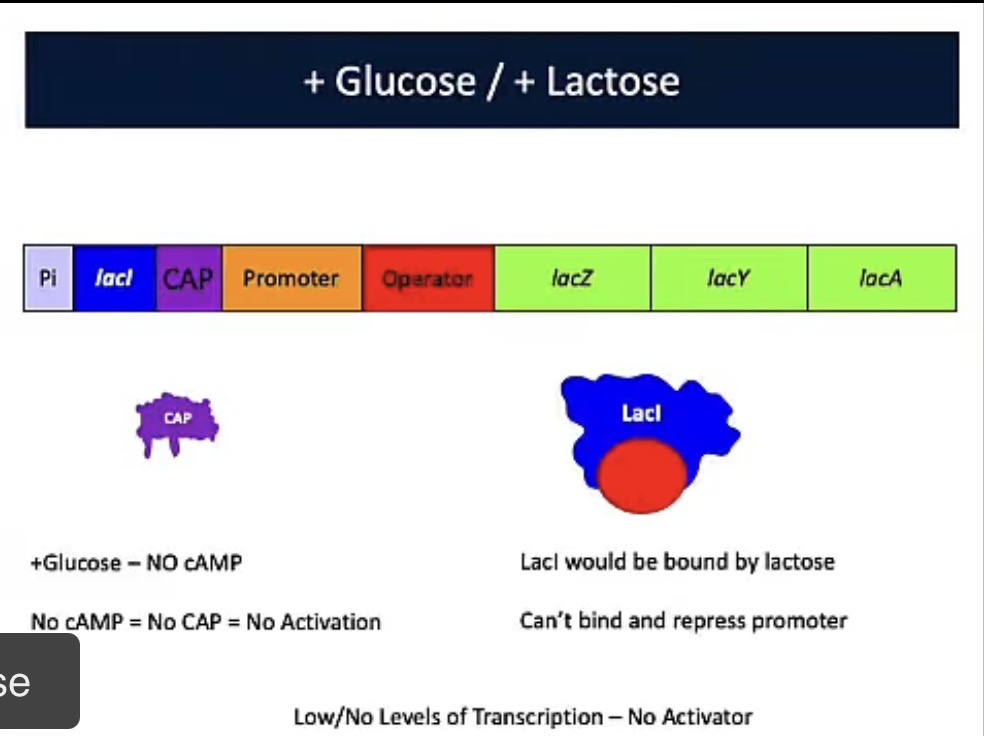
No Lactose/ + Glucose
Transcription off
Repression
No cAMP/No LacI
No Activstor
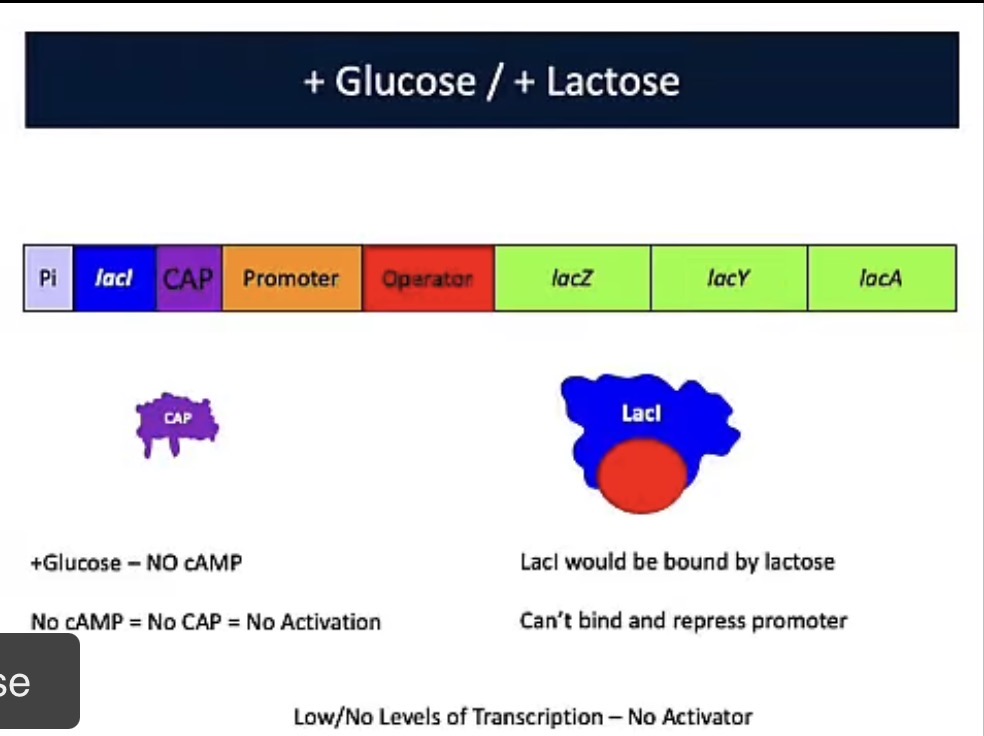
Lactose/Glucose
Transcription is on, but the levels are LOW as glucose is present and there is no cAMP being made to bind CAP and activate transcription of the operon.
Derepression
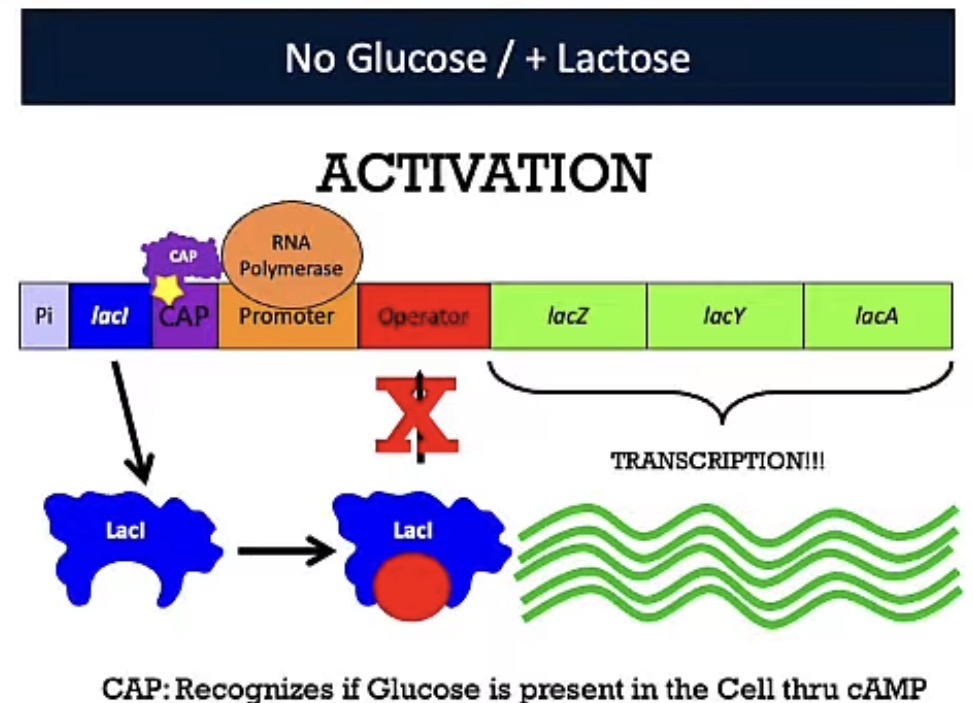
Lactose/No Glucose
Transcription is on, and transcription is HIGH/ACTIVATED as glucose is gone, resulting in cAMP being produced, binding to CAP, activating transcription.
Derepression