Waves - Physics
 Call Kai
 Learn
Learn Practice Test
 Spaced Repetition
 Match
Match Flashcards
 Knowt Play
1/50

There's no tags or description
Looks like no tags are added yet.
Name | Mastery | Learn | Test | Matching | Spaced | Call with Kai |
|---|
No analytics yet
Send a link to your students to track their progress
51 Terms
Transverse waves
Oscillations are perpendicular to the direction of energy transfer
Examples of transverse waves
Electromagnetic and water
Longtitudinal waves
Oscillations parallel to the direction of energy transfer
Example of a longitudinal wave
Sound
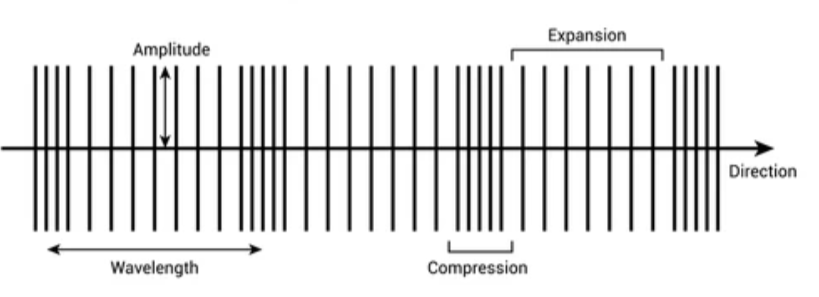
Longtitudinal waves
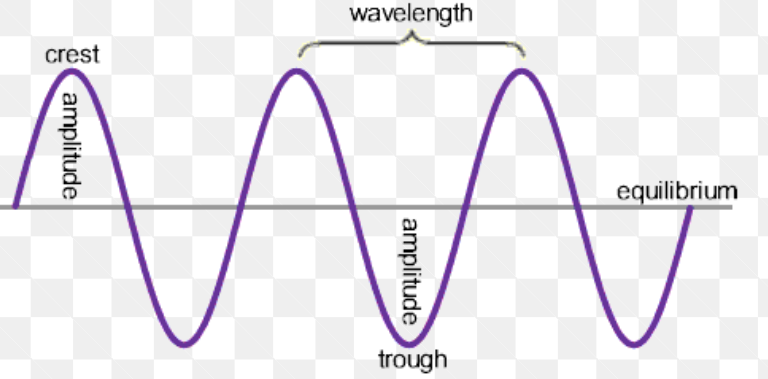
Transverse waves
Wavelength
The distance between 2 identical successive points on a wave such as a peak to the next peak, or a trough to the next trough
Amplitude
The maximum displacement or distance moved by a point on a wave from its undisturbed rest position
Frequency
The number of complete waves passing a fixed point per second, measured in Hz
Mechanical waves
Vibrations that transfer energy through a material medium (solid, liquid or gas) by making particles oscillate
Waves that transfer energy
All transverse and longtitudinal waves
Waves that travel at the speed of light
Specific types of transverse waves like electromagnetic waves
Waves that can be heard
Longtitudinal waves are always heard (unless in a vaccum), but transverse waves are only heard when travelling through a solid
Waves that can travel through a vaccum
Electromagnetic transverse waves can travel through a vaccum, whereas mechanical waves cannot, and longtitudinal waves cannot
Period of a wave
How long it takes for one wave to pass a point
Equation for wavelength
wavelength = wave speed / frequency
Speed of sound in air
343m/s
Speed of light in a vaccum
3×10^8m/s
Echo-ranging
A process used to detect how far beneath the surface the sea bed is from a ship, using the reflection of a sound wave (echo) to determine the distance (range) to an object, such as the seabed.
Why can the equation used to find the distance of the sea bed beneath the surface be written as d = ½ (v x t)?
Because the time (t) measured is the total time for the signal to travel to the seabed and back again, so since the wave travels the distance twice, the desired answer for distance is only ½ of the total distance.
Translucent
A material that allows objects to be seen through them but not as clearly or sharply as a transparent material. eg. tracing material, frosted glass
Transparent
A material that allows objects behind it to be seen as if nothing is in the way, eg. glass, perspex
Opaque
A material that may or may not allow light through to the object behind it, and so it would be hard to determine what object was behind it, eg. wood, paper
Law of reflection
The angle of incidence is equal to the angle of reflection
Specular reflection
Reflection from a smooth surface in a single direction so give a shiny, reflective appearance, eg. from a mirror
Diffuse reflection
Reflection from a rough surface causes scattering which gives the surface a dull or matte appearance.
What type of wave are light waves?
Electromagnetic transverse waves
Virtual image
An image where light rays appear to diverge from, but do not actually pass through
Refraction
The change in direction of a wave, typically light, as it passes from one medium to another
Absorption
The process by which a material takes in energy from a wave, such as radiation, light or sound, causing the energy to be transferred to the material’s internal energy store
Transmission
The process where a wave, such as light, sound, or electromagnetic, passes through a material or medium
What happens when light enters a glass block? Mention density
It refracts because glass is more dense than air
What type of wave is sound?
Longtitudinal
How do we hear things?
Sound waves are funnelled by the pinna down the ear canal down to the ear drum, which cause the ear drum to vibrate, and these are passed via the ossicles (anvil, hammer and stirrup) to the cochlea. Here the vibrations are converted to electrical signals, which pass down the auditory nerve to the brain.
Range of human hearing
20Hz to 20 KHz
Why is the speed of sound faster in solid compared to in air?
In air, the particles are spread out more, and the vibrations are passed on more slowly
Features of ultrasound waves
They have a higher frequency than the upper limit of human hearing, and they are partially reflected when they meet a boundary between 2 different media. The time taken for the reflections to reach a detector, and the speed of the waves, can be used to determine how far away such a boundary is. This allows for ultrasound waves to be used for both medical and industrial imaging.
How are ultrasound waves used in pre natal scans?
If the amplitude is converted into the brightness of an image, we obtain a 2 dimensional image known as a brightness scan. (B scan)
What are seismic waves produced by?
Earthquakes
P-waves
Longtitudinal seismic waves that travel at different speeds through solids and liquids
S-waves
Transverse seismic waves that cannot pass through liquid
Seisometer
Tool used for the detection of P and S waves
State of the inner core
Solid
State of the outer core
Liquid
State of the mantle
Mostly solid, but it can flow
State of the crust
Solid
Why are P waves called primary waves and S waves called secondary waves?
P waves move faster, while S waves move slower
What does a frequency of 440 Hz mean for a note?
The sound oscillates 440 times per minute.
RP method for activity 1: determining the wave speed through a liquid
Set up a ripple tank with an oscillating wooden rod connected to a motor in a shallow tank of water with a light above it to illuminate the waves
Count the number of waves to pass a given point every 10 seconds
Measure the length of 10 waves
Change the frequency and retake the measurements
Repeat until you have at least 6 sets of results, finding the frequency and wavelength for each
Calculate the speed for each result set using the equation: speed = frequency x wavelength
RP method for activity 2: determining the wave speed through a solid
Set up a vibration generator connected to a power supply, where a stretched string/elastic cord hangs over a wooden bridge and off the end is connected to a weight.
Put on eye protection and turn on the vibration generator
Adjust the length of the spring which vibrates by moving the wooden bridge if you are unable to see a stable wave pattern produced by the string
Measure the length of 1 wavelength
Record the frequency of the vibration generator
Calculate the speed, using the equation: speed = frequency x wavelength
Change the frequency and repeat twice more
Why, in RP activity 1, do we measure the length of 10 waves to calculate the wavelength, instead of just measuring 1?
It is easier to measure a larger distance more accurately