5.4 NITROGEN AND PHOSPHATE CYCLE, MYCORRHIZAE, CROP ROTATION, AND FERTILISERS:
 Call Kai
 Learn
Learn Practice Test
 Spaced Repetition
 Match
Match Flashcards
 Knowt Play
1/7

There's no tags or description
Looks like no tags are added yet.
Name | Mastery | Learn | Test | Matching | Spaced | Call with Kai |
|---|
No analytics yet
Send a link to your students to track their progress
8 Terms
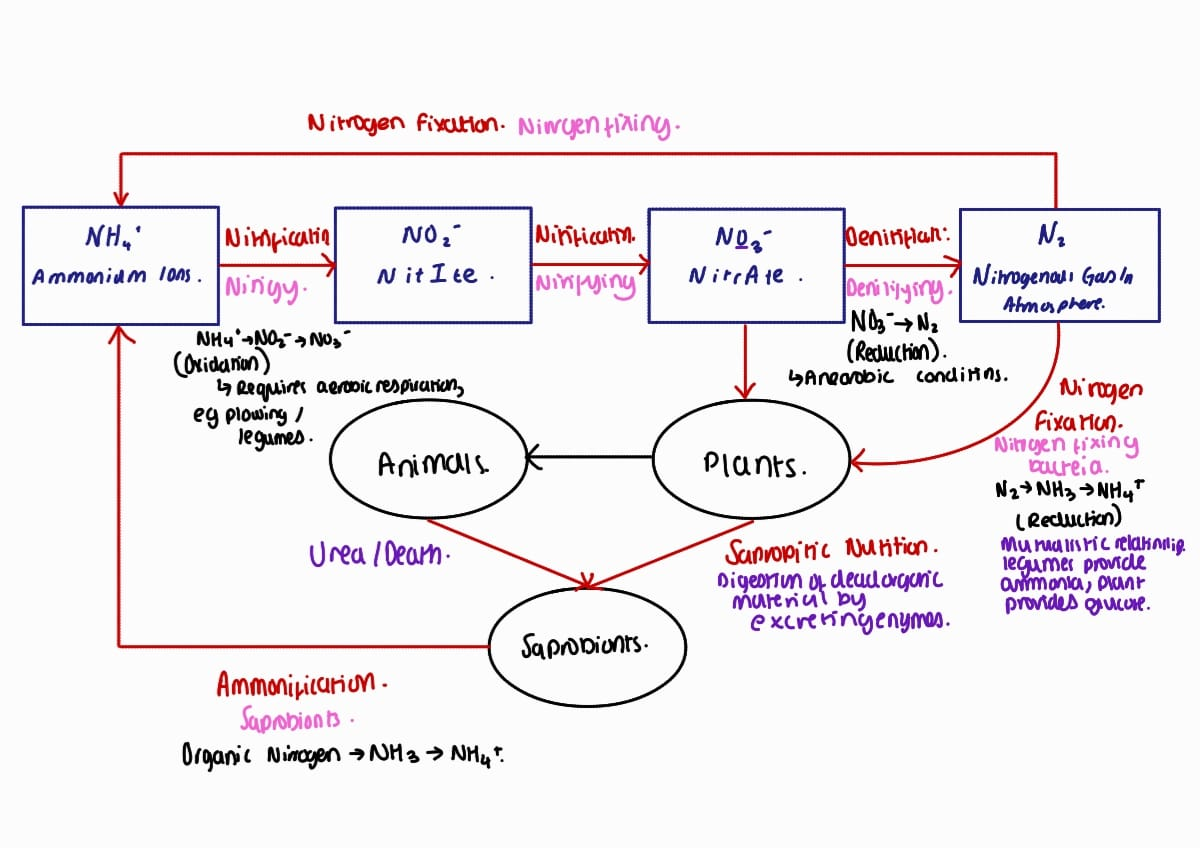
NITROGEN CYCLE:
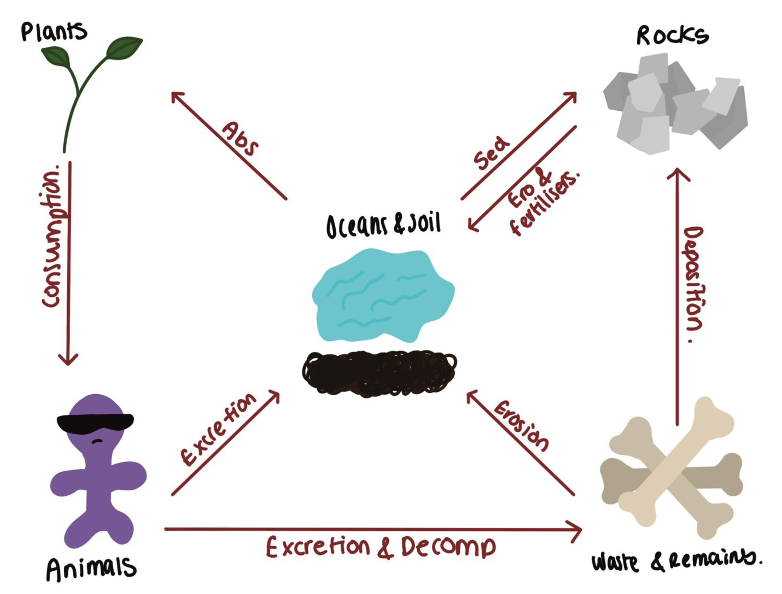
PHOSPHATE CYCLE:
MYCORRHIZAE:
Mutualistic relationship, both sides benefit nutritionally.
Fungus gains carbohydrates.
Plant gains hyphae.
SA ::: faster diffusion.
Better at absorbing mineral ions eg phosphates.
Protection from drought.
CROP ROTATION:
Different crops at different times of the year.
Plowed into the soil and left to decay.
Legumes used a lot for this part.
ORGANIC VS ARTIFICIAL FERTILISER:
Cheap.
Releases slowly, may be too slow.
Humus, contributes to structure.
Hard to distribute, requires machinery.
Unknown concentrations.
Artificial = opposite.
ENVIRONMENTAL CONSEQUENCES OF ARTIFICIAL FERTILISERS:
Reduced species diversity (those with artifertiliser grow rapidly and outcome many other speices, killing them).
Leaching (very soluble in water).
LEACHING:
Process by which nutrients are removed from the soil.
Rainwater dissolves any soluble nutrients and washes them out of the soil.
These leached nutrients find their way into watercourses.
Can then cause EUTROPHICATION.
EUTROPHOCATION:
Minerals are often limiting factors, but after leaching into watercourses they are no longer one and cause exponential growth.
Algal bloom.
Dense layer of algae absorbs sunlight and blocks lower layers.
Plants below cannot photo and die.
Decomp of plants and bacteria population increases.
Increase of aerobic resp by bacteria.
Fish die.