BIOL172 Exam 1 Guide 3: Naked-Seed Plants and Angiosperms
 Call Kai
 Learn
Learn Practice Test
 Spaced Repetition
 Match
Match Flashcards
 Knowt Play
1/33

There's no tags or description
Looks like no tags are added yet.
Name | Mastery | Learn | Test | Matching | Spaced | Call with Kai | Chat |
|---|
No analytics yet
Send a link to your students to track their progress
34 Terms
Which group produces seeds that are "naked," not enclosed in fruit?
Gymnosperms
- seeds not enclosed inside an ovary or fruit
- seeds found on the scales of cones (conifers, cycads, ginkgo, gnetophytes)
Which group produces seeds enclosed within a fruit?
Angiosperms
Which group has flowers as their reproductive structures?
Angiosperms
Which groups bears cones (strobili) instead of flowers?
Gymnosperms (conifers, cycads, ginkgo)
Strobili: cone like, reproductive structures that bear seeds
What is the main difference between gymnosperm and angiosperm ovules?
Gymnosperm:
not enclosed in ovary
exposed on cone scales "naked"
Angiosperm:
enclosed in ovary
Which group has double fertilization, forming both a zygote and endosperm?
Angiosperm
Endosperm: triploid, sperm cell fuses with two polar nuclei, used as energy reserve to nourish the embryo
Which group has more diverse pollination strategies (insects, animals, wind)?
Angiosperms
Which group relies mostly on wind pollination?
Gymnosperm
Which gymnosperm division has only a single living species?
Ginkgophyta (ginkgo)
Which gymnosperm division has large, palm like leaves, but is not related to palms?
Cycadophyta (cycads)
Which gymnosperm division is the most diverse and includes pines, firs, and spruces?
Coniferophyta (conifers)
Which gymnosperm division produces motile sperm cells (that swim to the egg)?
Cycads and ginkgo
Which gymnosperm division includes trees that are mostly evergreen with needle-like or scale-like leaves adapted to cold and dry habitats?
Coniferophyta (conifers)
Define complete, incomplete, staminate, carpellate, and pistillate flower
Complete: has all main parts --> sepals, petals, stamens, pistil
Incomplete: lacks one or more main parts
Staminate: only has stamen no pistil/carpel (male)
Carpellate: only has pistil no stamen (female)
Pistillate: only pistil (same thing just different name)
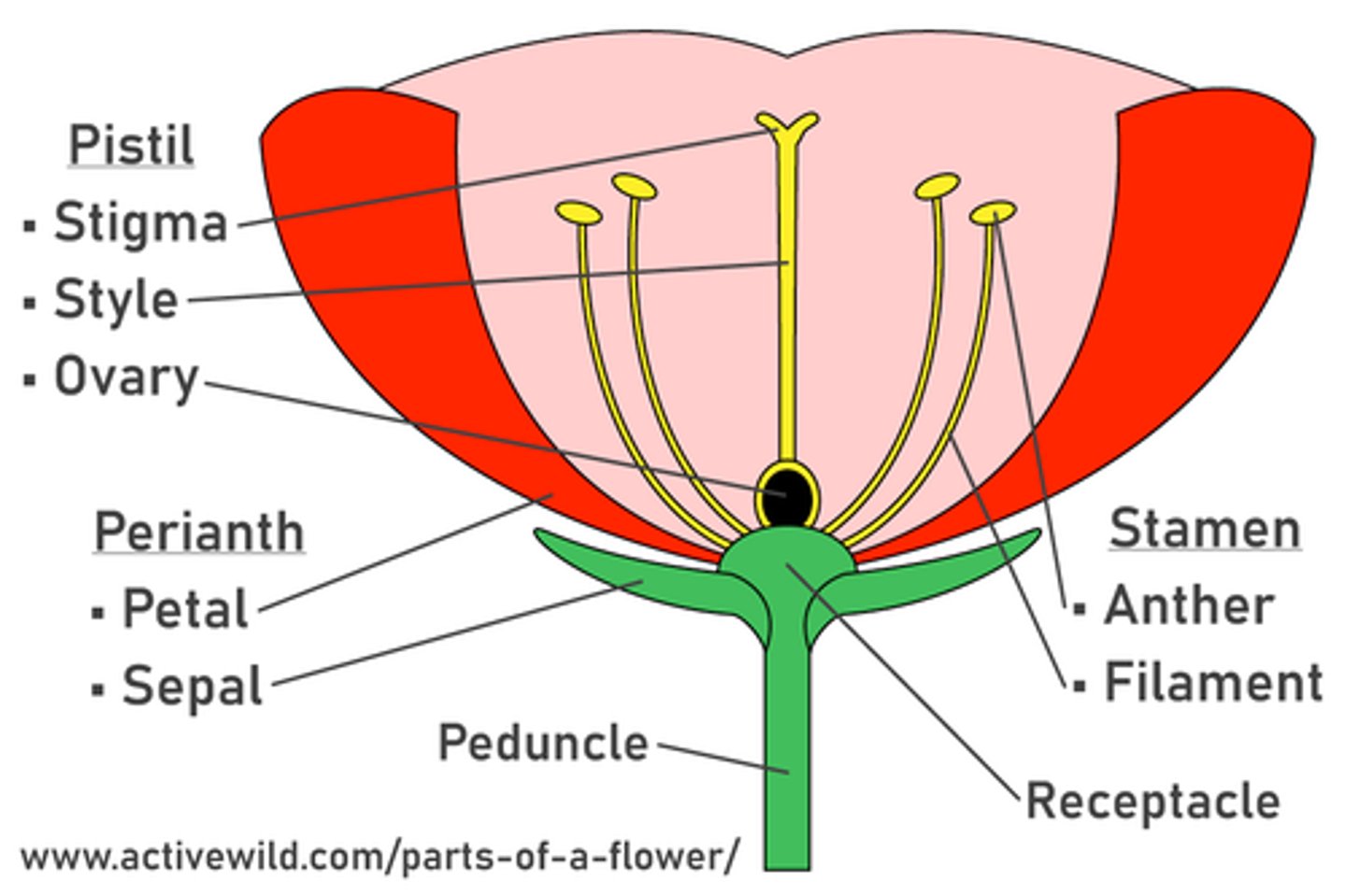
Define calyx
All sepals of a flower
Define corolla
All petals of a flower
Define perianth
Calyx and corolla
Define anemophily, hydrophily, and zoophily
Anemophily: pollen transported by wind (gymno and angiosperms)
Hydrophily: pollen transported by water (angiosperms)
Zoophily: pollen transported by animals (angiosperms
Define the gynoecium and the androecium of a flowering plant, and state which organs form each.
Gynoecium: female
- pistil (ovary, style, stigma)
Androecium: male
- stamen (filament, anther)
What is called the microgametophyte of Angiosperms? Where is it formed?
Pollen grain, housed in pollen sacs (split open when ready to germinate, group = pollen)
Formed on anther that has four pollen sacs (the microsporangia)
How are the zygote and endosperm formed after pollination?
Pollen tube grows into ovule releasing two sperm
1 sperm fertilizes egg to form zygote
other sperm fuses with 2 polar nuclei to form triploid endosperm
AKA double fertilization
Define fruit, list and describe its parts:
Fertilized, developed, and matured ovary
Pericarp + seed (+ pedicel)
Pericarp: originates from the wall of the ovary
- epicarp: external epidermis of ovary
- mesocarp: ovarian mesophyll
- endocarp: internal epidermis of ovary
Seed: originates from seminal rudiment (egg)
Pedicel: stalk that attaches fruit to the plant
Define fleshy, dry, simple, and multiple fruit
Fleshy: attract dispersal agents (animals) more easily (offer rewards)
Dry: have modified structures for adhesion to the dispersal agent (biotic) or for floating and gliding (abiotic dispersal agents)
Simple: resulting from a single flower (single carpel or several distinct carpels forming 1 gynoecium --> aggregate) (grape or raspberry)
Multiple: gynoecium of several closely clustered flowers (pineapple)
Why are plant species included in the ANA grade and Magnoliids clade (basal angiosperms) not considered Eudicots (true dicots)?
Diverged before the split before monocots and true eudicots
Eudicots are monophyletic
Lack shared traits:
- eudicots have triaperturate pollen (3 pores or furrows) --> not found
- magnoliids have 2 cotyledons but this is convergent not shared recent ancestor
What are the main synapomorphies that make monocots a monophyletic group?
Synapomorphies: shared characteristics
1 cotyledon
Parallel venation
Scattered vascular bundles in stem
Vascular bundles in ring in root
Flower parts in 3
Fibrous roots
What are the main synapomorphies of eudicot species?
Tricolpate pollen (3 aperatures)
2 cotyledons
Flower parts 3,4
Taproot
Net live leaf venation
Stem vascular bundles in ring
Root vascular bundles in X
What is the difference between an aposepalous and a synsepalous flower
Apo = separate
Separate sepals vs sepals fused (calyx)
What is the difference between an apopetalous and a sympetalous flower
Separate petals vs fused petals (corolla tube and corolla lobes)
What is the difference between an apocarpous and a syncarpous fruit
Developed from flowers with free carpels (aggregrate) vs fused carpels into one compound ovary (simple)
What is the difference between connation and adnation
Fusion of similar parts in a whorl vs unlike parts from different whorls (stamens to petals)
What is the difference between zygomoporhic, actinomorphic, and asymmetric flowers
Zygo = bilaterial
Actino = radial
Asymmetric = every flower part different size
What is the difference between trimerous, tetramerous, and pentamerous flowers
Tri = flower parts in 3, tetra = 4, penta = 5
Labeled flower
Flower Formulas
