lesson 4: psychology and art - close encounters of a strange kind or a match made in heaven?
 Call Kai
 Learn
Learn Practice Test
 Spaced Repetition
 Match
Match Flashcards
 Knowt Play
1/58

There's no tags or description
Looks like no tags are added yet.
Name | Mastery | Learn | Test | Matching | Spaced | Call with Kai |
|---|
No analytics yet
Send a link to your students to track their progress
59 Terms
wilhelm diltey
natural sciences
humanities
natural sciences
explaining general laws of nature (erklären)
o External forces, invariant principles, repeatable
humanities
understanding humankind and complex phenomena resulting from interactions between humans such as history, culture and religion (verstehen)
o Total experience, not to be reduced to a small number of factors isolated in the lab, essentially non-repeatable
Snow
the 2 cultures”
- Humanities <> sciences and engineering
- Arts <> sciences
- Arts engagement and aesthetic experience <> experimental aesthetics, computational aesthetics, neuro-aesthetics
Arts engagement and aesthetics experience
- Full-blown, rich experience
- First-person perspective
- Unique, subjective
- Influenced by personality, history, context, culture
- Case studies with qualitative methods
Exp aesthetics, computational aesthetics, neuro-aesthetics
- Focused on small number of factors, isolated for max experimental control
- Averaged overlarge samples for max generalizability
- Reduced experience, operationalization, rating scales
ideal scenario
- Full-blown, rich experiences
- From a large number of diverse pp
- Investigated in-depth in all their aspects
- With a large number of diverse art encounters
- In their proper context
- Using a large combination of methods
symmetry project
900 pp were asked to indicate image regions containing symmetry for 200 images if artworks and 200 images of natural scenes, with 50 raters per image
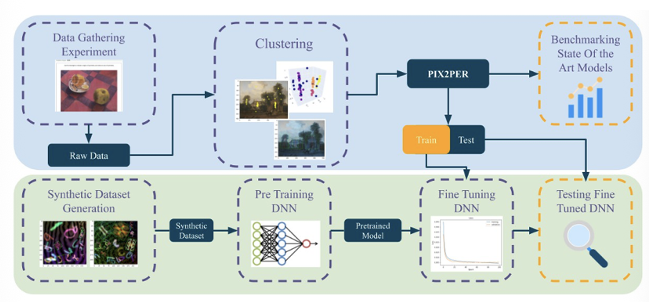
clustering (symmetry project)
- Regions of symmetry
- what most people do when asked to point out the symmetry
charm project
Image aesthetic assessment (IAA)
- Rate the aesthetic value → tend to give numbers in the middle of the scale
CHARM
a novel tokenization approach that simultaneously preserves Composition, High-resolution, Aspect Ratio and Multi-scale information
conclusion CHARM
balances computational cost with the preservation of crucial aesthetic information for achieving optimal performance in image aesthetic assessment
LAPIS
Leuven Artworks Personalized Image Set
- = dataset of art images with art and image attributes + aesthetic score
results LAPIS
- Range around the mean
- Some more liked styles (baroque, impressionism, rococo …)
- Some less liked styles (abstract impressionism, color field painting, minimalism)
FIAT
Flexible Image Annotation Toolbox
- Different types of visual elements that people can use to annotate the image
- Specific thing in specific images
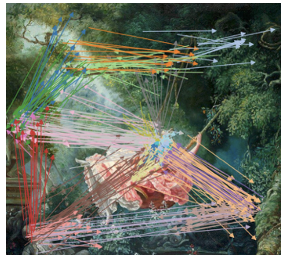
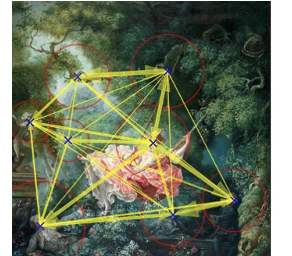
eye-movement
tracked in the lab when looking at an image
heatmap
scan map
network map
heatmap
red if there’s a lot of fixations, blue if not
scan map
how the eyes move when they explore the image
o The more the it follows the composition of the image (here it follows the swing), the higher the appreciation for the image will be
network map
o Circles: hotspots → the bigger the more views
o Lines: thickness = how often you get transitions between the hotspots
3 case studies (Palettes)
1. A time and a place to perceive art
2. Immersion and aesthetics in Ganzfeld experiences
3. Complexity, order and aesthetics of dance
typical museum visit
- Viewing time: reported averages of 25-30 seconds/artwork
- Explorative approach to viewing
- Motivation: interest in exhibition, love of art, social expectations, tourism, boredom …
- “Nobody goes to an art museum to participate in a research study”
explorative approach to viewing
wide range of behaviors possible (approaching, retreating, viewing on angles, returning to re-view certain works)
expirimental aesthetics research
- Viewing time: sometimes free viewing, sometimes restricted at moderate to extremely short timescales
- Restricted viewing approach to viewing
- Motivation: receiving course credit/other monetary reward, contributing to scientific knowledge
- “Nobody goes to a psychology lab to have an aesthetic experience”
restricted approach to viewing
often artworks presented on computer screen, without ability to zoom in, re-view or change angle
experimental tradeoffs
o Stimuli control vs exhibition cohesion
o Freedom of movement vs restriction
free viewing
no viewing constraints applied (unlimited time, zoom in/out, revisit)
rigid viewing
pp could only view each artwork for 10 sec, from set angles
museum free viewing
instructed to visit exhibition as they naturally would
lab free viewing
o Gallery overview screen presented
o Click on artwork to view, use across keys to change angle, press space to return to overview
museum rigid viewing
o Guided from artwork to artwork in pseudo-random order
o Instructed to keep eyes on the floor, expect for the 10 sec viewing period for each artwork
lab rigid viewing
artworks presented on screen for 10 sec, in random order
museum matters
for more in-depth, rather than simple, assessments of art experience → questions that invite pp to reflect on their experience more result in higher ratings in the museum space
ganzfeld (GF)
- Unstructured, homogeneous visual field (Schmidt et al, 2020)
- You take all the details away, but still have your eyes open
- Here: designed a Ganzfeld lab → pp sits down and is emerged in a color field (20 mins)
experiences in ganzfeld
hallucinations, blackouts, complete loss of depth, alterations in consciousness
blackouts
Decreased eye-movement
Increased alpha or alpha rebound
hallucinations
predicted by alpha accelerations
conclusions ganzfeld study
- The Ganzfeld effect induced altered states of consciousness
- Higher liking and beauty in dynamic GF compared to static
- Art perception was a predictor of liking and beauty of the light installation
- Blackouts were characterized by a decrease in eye movements
- Alpa power was lower during decay and higher during hallucination than baseline
low-level explanations
the dynamic in the movement of the dancer, the difficulty …
high-level explanations
the kind of story, the music, the dance as a whole art piece …
choreography
organization of dance material
complexity
quantity and variety of information → variability
dance moves that people wouldn’t be able to do themselves
variability
amount and variety of information presented simultaneously (or over short time spans)
order
the way in which this information is organized → predictability
predictability
the presence/absence of a principle for the organization of movement that predict changes
confusion
complexity without order
boredom
order without complexity
de Keersmaeker
a formal approach to choreography
1. Spatial organization based on geometrical patterns (circles, squares, diagonals)
2. Drawing inspiration from sacred geometry (golden ratio, Fibonacci sequence)
3. Structural relation to music
fase
2 dancers
Simple movements
Repetition
Low overall complexity
rain
10 dancers (7 women, 3 men)
Complex, rich movements
Counterpoint
High overall complexity
complexity in fase
phase shifting
suspension and attack
phase shifting
changing the spatial relationship between dancers
suspension and attack
changing the dynamics of the movement
complexity in rain
spatial patterns
gender-based grouping
counterpoint
spatial patterns
diagonal and Tadin line
counterpoint
video-scratching (Tadin line)
viewing behavior
o More variability in movement = more switching
o Trajectories from the dancers
o Influence from different choreographic levels (ex shadow in Fase)
o Ind differences
playground
• Where psychology-researchers can enjoy themselves
• Everything comes together here
podium
• Where psychology-researchers can show what’s possible
• Progress by combining lab-experiments, online studies, museum studies …
Psychoesthetics as psychology
What comes together here
Aesthetics and experiences as subjective, private events (how to make them measurable?)
Interplay between perception, cognition, emotion (determined by multiple, interacting factors)
Some general principles, but also large individual differences (interest, familiarity, expertise, personality, culture…)
Difficult research