PAT 401-011 WEEK TWELVE (12): SHOCK AND MULTIPLE ORGAN DYSFUNCTION SYNDROME (MODS)
 Call Kai
 Learn
Learn Practice Test
 Spaced Repetition
 Match
Match Flashcards
 Knowt Play
1/341

There's no tags or description
Looks like no tags are added yet.
Name | Mastery | Learn | Test | Matching | Spaced | Call with Kai |
|---|
No analytics yet
Send a link to your students to track their progress
342 Terms
PAT 401-011 WK 12: Shock + Multiple Organ Dysfunction Mods (MODS)
(Overview) of Shock:
Cardiac Output is low meaning
tissues are not being perfused properly and getting the oxygen they need
PAT 401-011 WK 12: Shock + Multiple Organ Dysfunction Mods (MODS)
(Overview) of Shock:
BP formula
CO X SVR
PAT 401-011 WK 12: Shock + Multiple Organ Dysfunction Mods (MODS)
(Overview) of Shock:
CO formula
CO = HR X SV (stroke volume)
Cardiac output formula
heart rate x stroke volume
stroke volume
The amount of blood ejected from the heart in one contraction.
PAT 401-011 WK 12: Shock + Multiple Organ Dysfunction Mods (MODS)
(Overview) of Shock: SVR causes vessels to be
smaller
low svr
vasodilation
PAT 401-011 WK 12: Shock + Multiple Organ Dysfunction Mods (MODS)
(Overview) of Shock:
impaired cell metabolism due to
due to a lack of oxygen to tissues
PAT 401-011 WK 12: Shock + Multiple Organ Dysfunction Mods (MODS)
(Overview) of Shock:
low blood perfusion = low 02 = low atp meaning what metabolic processes must occur now
anaerobic processes = uptake of gluconeogenesis, lipolysis, and glyconeogenssi, protein breakdown, and lactic acidosis
PAT 401-011 WK 12: Shock + Multiple Organ Dysfunction Mods (MODS)
(Overview) of Shock:
protein metabolism is impaired why?
glucongoegenesis occurs to feed the tissue in response to no atp for glucose = bad bc protein buildup like ammonia and urea is toxic in the body!
PAT 401-011 WK 12: Shock + Multiple Organ Dysfunction Mods (MODS)
(Overview) of Shock:
protein metabolism is bad for the body because
it affects cell functioning = builds ammonia and urea
PAT 401-011 WK 12: Shock + Multiple Organ Dysfunction Mods (MODS)
(Overview) of Shock:
the go to protein the body breaks down first is?
albumin
PAT 401-011 WK 12: Shock + Multiple Organ Dysfunction Mods (MODS)
(Overview) of Shock:
protein content in the ______ is broken down before the ______
blood before the muscles
PAT 401-011 WK 12: Shock + Multiple Organ Dysfunction Mods (MODS)
(Overview) of Shock:
the body turns to albumin in the blood for energy which in turn causes what
albumin is a huge protein = breakdown reduces circulatory volume - increases shock more
PAT 401-011 WK 12: Shock + Multiple Organ Dysfunction Mods (MODS)
(Overview) of Shock:
breakdown of muscle causes?
muscle wasting
PAT 401-011 WK 12: Shock + Multiple Organ Dysfunction Mods (MODS)
(Overview) of Shock:
anerobic metabolism causes what acid base imbalance
metabolic acidosis = disrupts electrolyte imbalances
PAT 401-011 WK 12: Shock + Multiple Organ Dysfunction Mods (MODS)
(Overview) of Shock:
impaired na-k pump d/t no atp causes what cellular ionic change for these ions
na increase inside the cell
k loss
water goes into the cell = further causes shock
PAT 401-011 WK 12: Shock + Multiple Organ Dysfunction Mods (MODS)
(Overview) of Shock:
does the blood become thinner or thicker
thicker bc losing more water so it acc becomes thicker with plasms and lots of rbc
PAT 401-011 WK 12: Shock + Multiple Organ Dysfunction Mods (MODS)
(Overview) of Shock:
compensatory mechansisms the body relies on what two cardiovascular techniques
1. tries to increase blod volume
2. increases blood pressure
PAT 401-011 WK 12: Shock + Multiple Organ Dysfunction Mods (MODS)
(Overview) of Shock: shock involves a deep working with the SNS system = the go-to catecholamines are?
NE and EPI and Dopamine
PAT 401-011 WK 12: Shock + Multiple Organ Dysfunction Mods (MODS)
(Overview) of Shock: SNS catecholamines will do what?
increase in growth hormones just like in burns = massive increase in constriction increasing SVR and HR
PAT 401-011 WK 12: Shock + Multiple Organ Dysfunction Mods (MODS)
(Overview) of Shock:
dopamine and NE acts on what receptors?
alpha and beta receptors
PAT 401-011 WK 12: Shock + Multiple Organ Dysfunction Mods (MODS)
(Overview) of Shock:
what renal chemical is released
renin
PAT 401-011 WK 12: Shock + Multiple Organ Dysfunction Mods (MODS)
(Overview) of Shock:
renin does what (1 + 2) linear things
increased aldosterone release --> increases svr and increases na retention
PAT 401-011 WK 12: Shock + Multiple Organ Dysfunction Mods (MODS)
(Overview) of Shock:
besides ne/epi/da and renin what else contributes to increase in SVR and BP
vasopressin
PAT 401-011 WK 12: Shock + Multiple Organ Dysfunction Mods (MODS)
(Overview) of Shock:
chemicals such as NE that cause vasconstriction can cause clots. why?
vasoconstriction = turbulent flow = favor clot formation
PAT 401-011 WK 12: Shock + Multiple Organ Dysfunction Mods (MODS)
(Overview) of Shock:
NE drug does acts on what 2 cdv processes
increasing BP
increasing CO via increasing contractility
PAT 401-011 WK 12: Shock + Multiple Organ Dysfunction Mods (MODS)
(Overview) of Shock:
how does NE increase CO
increases contracility
positive inotrope
a drug that increases the FORCE of heart contractions
PAT 401-011 WK 12: Shock + Multiple Organ Dysfunction Mods (MODS)
(Overview) of Shock:
shock is classified as a shift in?
shift in volume
PAT 401-011 WK 12: Shock + Multiple Organ Dysfunction Mods (MODS)
(Overview) of Shock:
shift in volume is aka
distributive shock = in which shift in volume causes low perfusion d/t vessels dilation
PAT 401-011 WK 12: Shock + Multiple Organ Dysfunction Mods (MODS)
(Overview) of Shock:
septic shock think ifx will present with
capillary permeability/leakage
PAT 401-011 WK 12: Shock + Multiple Organ Dysfunction Mods (MODS)
(Overview) of Shock:
anaphylactic shock leads to massive....
vasodilation
PAT 401-011 WK 12: Shock + Multiple Organ Dysfunction Mods (MODS)
(Overview) of Shock:
neurogenic shock is an issue of ____ and _____ of the CNS
neurogenic shock = issue of tone and dysregulation of the CNS
PAT 401-011 WK 12: Shock + Multiple Organ Dysfunction Mods (MODS)
(Overview) of Shock:
for septic shock = 3 main tx
abx for ifx
vasopressor for fluid
fluids for fluids
PAT 401-011 WK 12: Shock + Multiple Organ Dysfunction Mods (MODS)
(Overview) of Shock:
anaphylactic shock = 5 main tx
remove antigen
EPI pen
fluids
antihistamine
steroids
PAT 401-011 WK 12: Shock + Multiple Organ Dysfunction Mods (MODS)
(Overview) of Shock:
neurogenic shock: 4 main tx
position upright for venous return,
fluids
vasopressor
temp regulation
PAT 401-011 WK 12: Shock + Multiple Organ Dysfunction Mods (MODS)
(Overview) of Shock:
hypovolemic shock - losing...
losing volume
PAT 401-011 WK 12: Shock + Multiple Organ Dysfunction Mods (MODS)
(Overview) of Shock:
hemorrhgaic shock -losing
losing blood
PAT 401-011 WK 12: Shock + Multiple Organ Dysfunction Mods (MODS)
(Overview) of Shock:
nonhemmorhagic shock -
losing fluids and plasma
PAT 401-011 WK 12: Shock + Multiple Organ Dysfunction Mods (MODS)
(Overview) of Shock:
main 3 symptoms
cool extremitiries
oliguria
decrease in turgor
PAT 401-011 WK 12: Shock + Multiple Organ Dysfunction Mods (MODS)
(Overview) of Shock:
shock can also be r/t output
cardiogenic shock - r/t to what 3 issues
myocardial MI
arrhytmias
valves
PAT 401-011 WK 12: Shock + Multiple Organ Dysfunction Mods (MODS)
(Overview) of Shock:
obstructive output shocks = is d/t what 2 main things
poor outflor
poor inflow
PAT 401-011 WK 12: Shock + Multiple Organ Dysfunction Mods (MODS)
(Overview) of Shock:
obstructive outflow shock example
cardiac tamponade = cardiac effusion = lots of fluid closing on heart causing heart to not move this impedes diastolic filling
PAT 401-011 WK 12: Shock + Multiple Organ Dysfunction Mods (MODS)
(Overview) of Shock:
what is reperfusion injury?
poor perfusion, give fluids, causes injury, xanthine oxidase combines combines with oxygen to become free 02 radicals leading to destruction of tissue and can also lead to MODS
PAT 401-011 WK 12: Shock + Multiple Organ Dysfunction Mods (MODS)
(Overview) of Shock: Primary MODS caused by?
lack of perfusion causes an increase in catecholamines - neutrophils and macrophages are primed
PAT 401-011 WK 12: Shock + Multiple Organ Dysfunction Mods (MODS)
(Overview) of Shock:
primary mods what wbc are primed (2)
neutrophils
macrophages
PAT 401-011 WK 12: Shock + Multiple Organ Dysfunction Mods (MODS)
(Overview) of Shock:
primary MODS is not clinically testable but?
WBC are primed
PAT 401-011 WK 12: Shock + Multiple Organ Dysfunction Mods (MODS)
(Overview) of Shock:
secondary mods = d/t
casacde of issues stemming from inflammation
PAT 401-011 WK 12: Shock + Multiple Organ Dysfunction Mods (MODS)
(Overview) of Shock:
secondary mods = what 2 wbc components are involved
neutrophils and platelets
PAT 401-011 WK 12: Shock + Multiple Organ Dysfunction Mods (MODS)
(Overview) of Shock:
Secondary MODS neutrophils and plts are injuring what?
injuring the endothelium leading to MODS
PAT 401-011 WK 12: Shock + Multiple Organ Dysfunction Mods (MODS)
(Overview) of Shock:
secondary MODS activation of what 2 processes
endothelial activation and neuroendocrine activation
PAT 401-011 WK 12: Shock + Multiple Organ Dysfunction Mods (MODS)
(Overview) of Shock:
what causes endothelial activation in secondary MODS
arachinodic acid metabolism and ros = increase during endothelial activation
PAT 401-011 WK 12: Shock + Multiple Organ Dysfunction Mods (MODS)
(Overview) of Shock:
neuroendocrine activation = causes what 2 things
hypermetabolic state
catabolism
r/t catecholamine release
PAT 401-011 WK 12: Shock + Multiple Organ Dysfunction Mods (MODS)
(Overview) of Shock:
secondary shock = flow phase is hypermtabolic which leads to an increase in what 4 things
increase in 02 consumption
increase in glucagon
increase in cortisol
increase in growth hormone
PAT 401-011 WK 12: Shock + Multiple Organ Dysfunction Mods (MODS)
(Overview) of Shock:
tx for shock centered (6)
mechanical ventilation
enternal feeding for calories, nutrients, glucose control
dialysis
inotropic drugs
vasopressors
dvt prophylaxis
PAT 401-011 WK 12: Shock + Multiple Organ Dysfunction Mods (MODS)
(Overview) of Shock:
shock in children assessment -->
head to toe
check cap refill
peripheral pulse
breathing - accessory muscles retraction
skin mottled cool cold clammy
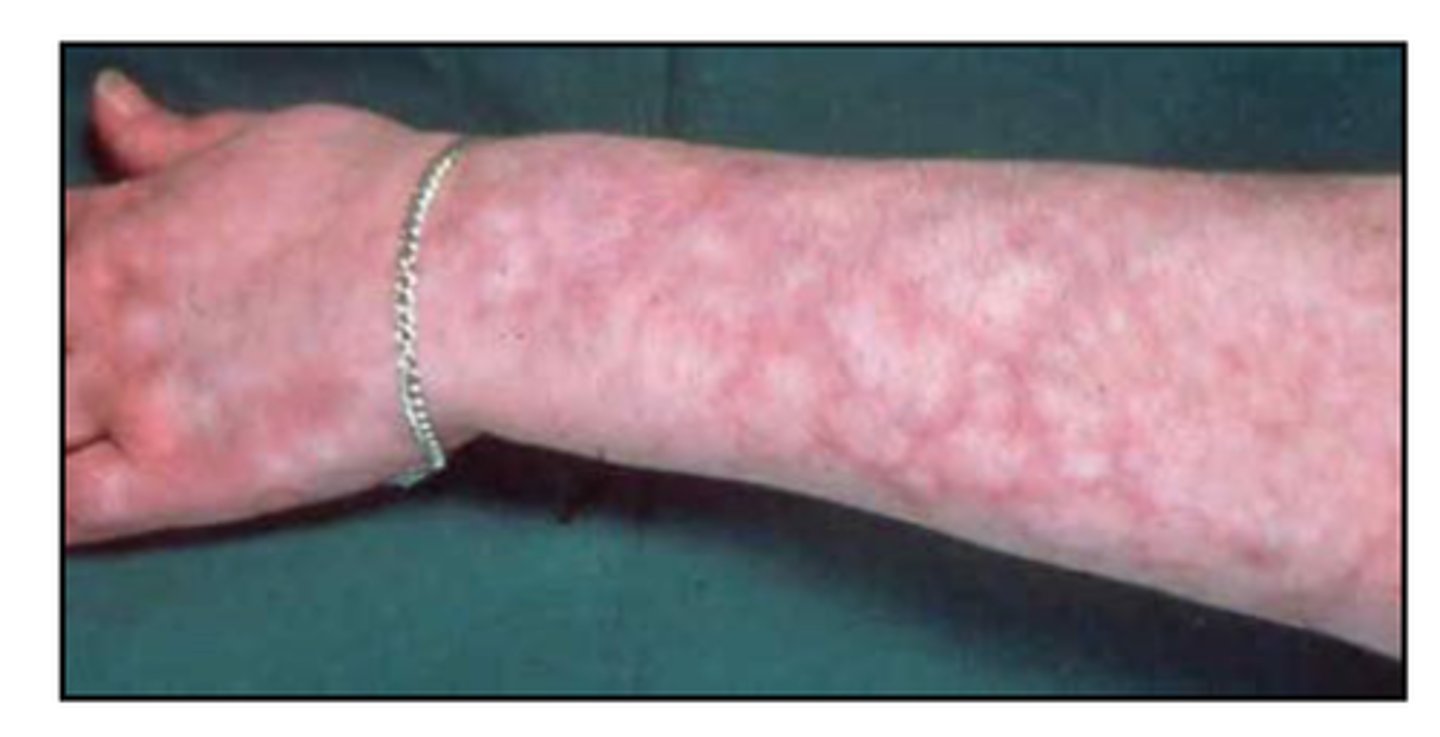
mottled skin
is patchy discoloration indicating primary or secondary changes of the deep, middle, or superficial dermal blood vessels
PAT 401-011 WK 12: Shock + Multiple Organ Dysfunction Mods (MODS)
(Overview) of Shock:
what shock pts are flushed and pink d/t vasodilation (4)
septic shock
anaphylactic shock
neurogenic shock
disruptive shock
PAT 401-011 WK 12: Shock + Multiple Organ Dysfunction Mods (MODS)
(Overview) of Shock:
for children we use what lab value
lactate = indicative of acidosis
PAT 401-011 WK 12: Shock + Multiple Organ Dysfunction Mods (MODS)
(Overview) of Shock:
fluid replacement via what 2 medications usually
colloids or crystalloids
PAT 401-011 WK 12: Shock + Multiple Organ Dysfunction Mods (MODS)
(Overview) of Shock:
anaphylactic shock = given them
h1 receptor anagonist diphenhydramine
PAT 401-011 WK 12: Shock + Multiple Organ Dysfunction Mods (MODS)
Introduction to Shock:
Shock is characterized
circulatory dysfunctioning that is both _____ and ______
acute and progressive
PAT 401-011 WK 12: Shock + Multiple Organ Dysfunction Mods (MODS)
Introduction to Shock
shock is not only poor 02 to tissues but also
poor 02 + nutrients to tissues
PAT 401-011 WK 12: Shock + Multiple Organ Dysfunction Mods (MODS)
Introduction to Shock
Normally the cdv system is able to maintain blood flow, in shock the CV system fails to maintain and thus there is general and widespread impairment of?
cellular metabolism
PAT 401-011 WK 12: Shock + Multiple Organ Dysfunction Mods (MODS)
Introduction to Shock: 3 main common pathways in all types of shock are
1. no 02/nutrients = cellular metabolism impairment
2. cells demanding and consuming more 02 and nutrients from other places
3. decreased removal of cellular wastes (normal part of metabolism)
PAT 401-011 WK 12: Shock + Multiple Organ Dysfunction Mods (MODS)
Introduction to Shock: Understanding Shock
3 main linear arrow pathways briefly explain
failure of normal regulatory mechansism can lead to rapid and profound shock
--> decreased tissue perfusion
--> impaired cellular metabolism
PAT 401-011 WK 12: Shock + Multiple Organ Dysfunction Mods (MODS)
Impairment of Cellular Metabolism: Impaired Oxygen Delivery & Use
the body will shift from aerobic metabolism to?
anaerobic metabolism
PAT 401-011 WK 12: Shock + Multiple Organ Dysfunction Mods (MODS)
Impairment of Cellular Metabolism: Impaired Oxygen Delivery & Use
Lack of 02 disrupts ATP na/k synthase pump creating a loss of ability to maintain what inside the cell
loss of ability to maintain an electrochemical gradient
PAT 401-011 WK 12: Shock + Multiple Organ Dysfunction Mods (MODS)
Impairment of Cellular Metabolism: Impaired Oxygen Delivery & Use
poor 02 = no atp = poor na/k pump
meaning what is high inside the cell and what is low inside the cell
na, cl, and water high in cell (reducing ecf volume)
k leaves the cell
PAT 401-011 WK 12: Shock + Multiple Organ Dysfunction Mods (MODS)
Impairment of Cellular Metabolism: Impaired Oxygen Delivery & Use
activation of which pathway and release of which enzymes
activation of coagulation pathway and release of lysososomal enzymes
PAT 401-011 WK 12: Shock + Multiple Organ Dysfunction Mods (MODS)
Impairment of Cellular Metabolism: Impaired Oxygen Delivery & Use
lysosomal enzymes are enzymes which break down material = contribute to
damage of the cell tissues organs
PAT 401-011 WK 12: Shock + Multiple Organ Dysfunction Mods (MODS)
Impairment of Cellular Metabolism: Impaired Oxygen Delivery & Use
Glycogenolysis
breakdown of glycogen to glucose
lipolysis
the breakdown of fats and other lipids by hydrolysis to release fatty acids
gluconeogenesis
formation of glucose from noncarbohydrate sources
PAT 401-011 WK 12: Shock + Multiple Organ Dysfunction Mods (MODS)
Impairment of Cellular Metabolism: Impaired Nutrient Delivery (Glucose):
Impaired nutrient delivery of glucose leads the cells to shift into what 3 metabolic processes to
glycogenolysis
gluconeogeneosis
lipolysis
PAT 401-011 WK 12: Shock + Multiple Organ Dysfunction Mods (MODS)
Impairment of Cellular Metabolism: Impaired Nutrient Delivery (Glucose):
Glucongeogenesis uses what for fuel?
uses proteins for fuel
PAT 401-011 WK 12: Shock + Multiple Organ Dysfunction Mods (MODS)
Impairment of Cellular Metabolism: Impaired Nutrient Delivery (Glucose)
Why is metabolic acidosis compensatory mechanism inititiated
allows cardiac and skeletal muscle to use lactic acid as a fuel source but only for a limited time
PAT 401-011 WK 12: Shock + Multiple Organ Dysfunction Mods (MODS)
Impairment of Cellular Metabolism: Impaired Nutrient Delivery (Glucose)
What 2 compensatory metabolic processes contribute to cellular failure when *sustained*
glycogenolysis
lipolysis
PAT 401-011 WK 12: Shock + Multiple Organ Dysfunction Mods (MODS)
Impairment of Cellular Metabolism: Impaired Nutrient Delivery (Protein):
What metabolic pathway causes proteins to be used for fuel
gluconeogenesis
PAT 401-011 WK 12: Shock + Multiple Organ Dysfunction Mods (MODS)
Impairment of Cellular Metabolism: Impaired Nutrient Delivery (Protein)
Why is sustained gluconeogenesis problematic from a protein structural pov
protein breakdown for energy means those proteins are no longer available to maintain normal functionings: cellular structure, function, repair, replication --> causes cellular/tissue/organ failure
PAT 401-011 WK 12: Shock + Multiple Organ Dysfunction Mods (MODS)
Impairment of Cellular Metabolism: Impaired Nutrient Delivery (Protein)
Why is sustained gluconeogenesis problematic from a protein byproduct pov?
ammonia and urea produced
PAT 401-011 WK 12: Shock + Multiple Organ Dysfunction Mods (MODS)
Impairment of Cellular Metabolism: Impaired Nutrient Delivery (Protein)
Protein breakdown for secondary metabolism is preferential; what does this mean?
serum albumin and other plasma proteins are consumed for fuel first
PAT 401-011 WK 12: Shock + Multiple Organ Dysfunction Mods (MODS)
Impairment of Cellular Metabolism: Impaired Nutrient Delivery (Protein)
Serum protein consumption during protein breakdown = contributes what intravascular change
loss of serum protein = decreases capillary osmotic pressure = leading to edema
albumin draws water inside the BV = loss of it means less water entering BV = edema development! -> contributes to a decrease in circulatory volume
capillary osmotic pressure
inward pulling force of particles in vascular fluid
PAT 401-011 WK 12: Shock + Multiple Organ Dysfunction Mods (MODS)
Impairment of Cellular Metabolism: Impaired Nutrient Delivery (Protein)
Muscle wasting by protein breakdown affects what 2 tissue types
skeletal muscle
cardiac muscle
PAT 401-011 WK 12: Shock + Multiple Organ Dysfunction Mods (MODS)
Impairment of Cellular Metabolism: Impaired Nutrient Delivery (Protein)
protein breakdown = metabolic wastes accumulate in cell and interstitial spaces and contribute to?
toxic to cells and further disrupt cellular function and membrane integrity
PAT 401-011 WK 12: Shock + Multiple Organ Dysfunction Mods (MODS)
Impairment of Cellular Metabolism: Impaired Nutrient Delivery (Protein)
T or F Decrease of circulatory volume when albumin is consumed
True
PAT 401-011 WK 12: Shock + Multiple Organ Dysfunction Mods (MODS)
Clinical Manifestations of Shock:
Each type of shock involves numerous clinical manifestations & s/s.
if there are overlapping shock states that occur simultaneously then it becomes difficult to?
determine the cause based only on CM
PAT 401-011 WK 12: Shock + Multiple Organ Dysfunction Mods (MODS)
Clinical Manifestations of Shock
what can help determine etiology of shock
clients history risk and situation are correlated with suspected or anticipated shock state
PAT 401-011 WK 12: Shock + Multiple Organ Dysfunction Mods (MODS)
Bodily Compensation for Shock:
3 main aspects
1. SNS alpha and beta receptors adrenergic receptors to increase bp and bv
2. renin
3. other clotting factors
PAT 401-011 WK 12: Shock + Multiple Organ Dysfunction Mods (MODS)
Bodily Compensation for Shock
Compensatory mechanisms try to maintain SATA
a. bp
b. cxn
c. co
d. HR
blood pressure and cardiac output
A AND C
PAT 401-011 WK 12: Shock + Multiple Organ Dysfunction Mods (MODS)
Bodily Compensation for Shock
condition not tx promptly then compensatory mechansims will....
decompensate into various shock states = decompensated
PAT 401-011 WK 12: Shock + Multiple Organ Dysfunction Mods (MODS)
Bodily Compensation for Shock
compensatory mechansism are not effective over long term --> they become
uncompensated and detrimental
PAT 401-011 WK 12: Shock + Multiple Organ Dysfunction Mods (MODS)
Shock #1: Neurogenic/Vasogenic Shock: Compensatory Mechanisms:
What is it caused by?
loss of sympathetic tone prevents compensatory tachycardia
meaning the person is no longer able to compensate via higher hr --> there is a disconnect with the SNS no increase in BP or CO because no increase in HR (which is in both of these formulas)
PAT 401-011 WK 12: Shock + Multiple Organ Dysfunction Mods (MODS)
Shock #2: Cardiogenic Shock: Compensatory Mechanisms
Main compensatory method here is?
renin-angiotension compensatory method
PAT 401-011 WK 12: Shock + Multiple Organ Dysfunction Mods (MODS)
Shock #2: Cardiogenic Shock
Compensatory responses: renin-angiotension, neurohormonal, and SNS cause what 4 cdv changes
1) fluid retention via aldosterone
2) vasoconstriction via ace enzyme
3) tachycardia
4) catechoalmines increase contractility and heart rate
PAT 401-011 WK 12: Shock + Multiple Organ Dysfunction Mods (MODS)
Shock #2: Cardiogenic Shock
what is wrong with cardiogenic shock compensatory mechansims?
tachycardia and systemic arterial constriction actually increase o2 consumption in a time where 02 consumption is already strained = so dysfunctioning can lead to CO and BP falling again
PAT 401-011 WK 12: Shock + Multiple Organ Dysfunction Mods (MODS)
Shock #2: Cardiogenic Shock
what may result from persistant and severe organ failure
MODS