Philosophy Exam 1

0.0(0)
Studied by 0 people
call kaiCall Kai
learnLearn
examPractice Test
spaced repetitionSpaced Repetition
heart puzzleMatch
flashcardsFlashcards
GameKnowt Play
Card Sorting

1/78

flashcard set

Earn XP

Description and Tags

augh

Last updated 12:56 PM on 4/22/26
Name
Mastery
Learn
Test
Matching
Spaced
Call with Kai

No analytics yet

Send a link to your students to track their progress

79 Terms

1
New cards
A posteriori
Something known as a result of an experience
2
New cards
A priori
Something that is known prior to or without necessary experience
3
New cards
Abduction
An argument that makes an appeal by inference to the best explanation
4
New cards
Aesthetics
what is beauty?
5
New cards
Analytic Truth
Demonstrably true by virtue of the logical form or the meanings of the component truths
6
New cards
Apology
to speak before, in time and space
7
New cards
Coherence test for truth
interconnectedness of a proposition with a specified system of propositions
8
New cards
Contingent truth
a belief that is true but might not have been, is based on experiences
9
New cards
Correspondence test for truth
agreement between a proposition and an actual state-of-affairs
10
New cards
Deduction
a process of reasoning from one principle to another by means of accepted rules of inference.
11
New cards
Epistemology
what is reasonable?
12
New cards
Ethics
what is good?
13
New cards
Fallacy
an error of reasoning
14
New cards
Induction
an argument where the premises point out several cases of some pattern, and the conclusion states that this pattern will hold in general
15
New cards
Logic
the study of the rule of valid inference and “rational argument”. In general, a sense of order
16
New cards
Materialist
a person who considers material possessions and physical comfort as more important than spiritual values.
17
New cards
Metaphysics
what is real?
18
New cards
Necessary truth
lies beyond the range of all possible doubt and refutation, are a priori
19
New cards
Philosophy
The love of wisdom
20
New cards
Pragmatic test for truth
usefulness of a proposition in achieving certain intellectual goals
21
New cards
Premise
assertion assumed to be true, made to support/further an argument
22
New cards
Rhetoric
the persuasive use of language to convince other people to accept their beliefs
23
New cards
Reductio ad Absurdum
Reduce to absurdity
24
New cards
Sophist
a paid teacher of philosophy and rhetoric in ancient Greece, associated in popular thought with moral skepticism and specious reasoning.
25
New cards
Sound argument
a deductive argument that is valid and has only true premises
26
New cards
Synthetic truth
a non-contradictory proposition in which the predicate is not entailed by the subject (it adds an idea to the subject which is not already contained within it)
27
New cards
Valid argument
an argument that follows established truth preserving rules
28
New cards
Wisdom
knowledge rightly applied
29
New cards
Class definition of Philosophy?
Love of knowledge
30
New cards
Class definition of Wisdom?
Knowledge rightly applied
31
New cards
LIst and define the 4 topical divisions of philosophy:

Metaphysics: What is Real?

Epistemology: What is Reasonable?

Ethics: What is Good?

Aesthetics: What is Beauty?

32
New cards
List the 4 chronological periods of philosophy in order and their area of interest:

Ancients: Ontology

Medievals: Theology

Moderns: Epistemology

Post-Moderns: Language

33
New cards
What are the 3 skills needed for philosophy?
Analysis, Assessment, Argument
34
New cards
List and define the 3 tests for truth and know in which order they are used:

Correspondence Test for Truth: an agreement between a proposition and an actual state-of-affairs

Coherence Test for Truth: interconnectedness of a proposition with a specified system of propositions

Pragmatic Test for Truth: usefulness of a proposition in achieving certain intellectual goals

35
New cards
What is an argument?
A sequence of assertions or statements to back up a viewpoint
36
New cards
What are the components of an argument?
The premises and the conclusion
37
New cards
Explain the pattern of history presented in lecture:
The teacher teaches the student, the student may disagree with the teacher if disagreement is objective, the student teaches the grand-student, the grand-student may disagree with the student if objective, the grand-student may borrow some ideas from the teacher.
38
New cards
What is the Socratic Method as it was presented in class and how does it work?
Begin with the pretense of knowledge, find errors in your knowledge through constant questions and answers, continue the questions and answers until truth is found, come to agreement (but not necessarily a full one)
39
New cards
What is the test for invalidity and how does it work?
The test for invalidity is a method of testing deductive arguments to see if they hold true. It works by assuming the premises are true but the conclusion is false, and then attempting to make a coherent story that leaves the premises as true and the conclusion as false
40
New cards
What are the three major types of logic discussed in class and how do they function?
Deductive, inductive, and abductive; detective works by a process of reasoning from one principle to another by means of accepted rules of inference, inductive works by an argument where the premises point out several cases of some pattern, and the conclusion states that this pattern will hold in general, and abductive works by An argument that makes an appeal by inference to the best explanation
41
New cards
Mere Assertion
Repeating a claim as if it were true without providing evidence or justification
42
New cards
Begging the Question
Assuming the truth of what one is trying to prove within the argument itself
43
New cards
Vicious Circle
A form of circular reasoning where the conclusion is used as a premise to support itself
44
New cards
Irrelevancies
Introducing information unrelated to the argument in order to distract from the issue
45
New cards
Ad Hominem
Attacking the person making the argument rather than addressing the argument itself
46
New cards
Unclear / Shifting Conclusions
Changing the conclusion of an argument during discussion to avoid criticism or refutation
47
New cards
Changing Meanings
Altering the meaning of important terms in an argument so that the conclusion appears valid
48
New cards
Distraction
Shifting attention away from the main issue to avoid addressing the argument
49
New cards
Pseudo-Questions
Questions that appear meaningful but are actually misleading or impossible to answer logically
50
New cards
Dubious Authority
Appealing to an authority who is not a reliable expert on the subject
51
New cards
The Texas Sharpshooter
Selecting only evidence that supports a conclusion while ignoring conflicting evidence
52
New cards
Slippery Slope
Arguing that one action will inevitably lead to extreme consequences without sufficient evidence
53
New cards
Attacking a Straw Man
Misrepresenting someone’s argument to make it easier to attack
54
New cards
Appeal to Pity
Attempting to persuade by generating sympathy instead of using logical reasons
55
New cards
Appeal to Force
Using threats or intimidation to make someone accept a conclusion
56
New cards
Inappropriate Arguments
Using arguments that are logically irrelevant or unsuitable for the issue being discussed
57
New cards
What is the process of Reductio ad Absurdum?
assuming an argument's conclusion is true, then tracing it to an illogical result to prove the premise is false.
58
New cards
What is an argument from analogy?
The strength of the argument rests in the genuine similarity between components of the argument. No two (different) objects are completely alike, otherwise they would be identical objects.
59
New cards
Aristophanes, The clouds
Philosophers like Socrates teach clever arguments that allow people to avoid responsibility and manipulate truth.
60
New cards
Plato, the Crito
A person must obey the laws of their state, even when those laws harm them, because justice and social order depend on respect for the law.
61
New cards
Plato, the Phaedo
The soul is immortal, and true philosophers prepare for death because death frees the soul from the body.
62
New cards
Plato, the Republic
Justice exists when everyone performs the role they are best suited for, and the ideal society should be ruled by philosopher-kings.
63
New cards
According to the lecture, what are 2 charges against Socrates in the apology?
Corrupting the youth and Impiety
64
New cards
According to Socrates, what are the 5 “Moral Prerequisites” for doing philosophy discussed in the Apology?
Humility – Recognizing one’s ignorance, Love of truth, Intellectual honesty, Moral courage – Willingness to question authority, Commitment to reason and dialogue
65
New cards
What accusations do Socrates' “first” accusers make against him?
Investigates things in the heavens and under the earth, Makes weak arguments appear strong, Teaches others to do the same
66
New cards
According to Socrates, what did he do to bring on such accusations?
He questioned people who claimed to be wise and exposed their ignorance, which embarrassed them and made them angry.
67
New cards
After questioning politicians, poets, and craftsmen, why does Socrates believe he is wiser than some people who are renowned for their wisdom?
They believed they were wise but were not. Socrates knew that he did not know. Therefore, he says he is wiser because he recognizes his ignorance.
68
New cards
In response to a question from Socrates’ student Chaerephon, what did the oracle of Apollo at Delphi declare about Socrates?
“No one is wiser than Socrates”
69
New cards
According to Socrates, how did he get a reputation for corrupting the young?
Several of his students, including well-known young men, would go on to defect from athens and join sparta
70
New cards
What accusations do Socrates’ “later” accusers make against him?
Led by Meletus, Anytus, and Lycon, they accuse him of Corrupting the youth, Not believing in the gods of Athens, Introducing new spiritual beings
71
New cards
How does Socrates try to defend himself against the charge that he corrupts the young?
He argues no one intentionally corrupts those around them, because corrupted people would harm him. If he corrupted anyone unintentionally, he should be taught, not punished.
72
New cards
How does Socrates try to defend himself against the charge that he does not believe in the gods?
Socrates points out a contradiction: His accusers say he believes in spiritual beings (daimons), but spiritual beings are children or servants of gods. So believing in them means he must believe in gods.
73
New cards
If the jury had been willing to acquit Socrates on the condition that he stop practicing philosophy Socrates says that he would not have agreed to this condition. Why?
He believes that obeying God is more important than obeying the court. His mission is to examine life and pursue truth. He says: “The unexamined life is not worth living.”
74
New cards
What does Socrates mean by saying that he is like a gadfly to the city of Athens?
Socrates says he is like a gadfly (a biting fly) that keeps a lazy horse awake. Meaning that Athens is the slow horse & Socrates annoys people with questions so they think about truth and virtue.
75
New cards
What punishment does Socrates at first suggest for himself? Why?
Free meals at the Prytaneum (a public honor for heroes). Because he believes he benefited the city by encouraging wisdom.
76
New cards
Why does Socrates not suggest that he be exiled?
Socrates says exile would not work because Other cities would also become angry when he questions them & He cannot stop practicing philosophy. So exile would simply delay the same problem elsewhere.
77
New cards
Socratic Argument – Method

Method 1. Begin with the pretense of knowledge

2. By question & answer “error” is discovered (demonstrated?)

3. Continue question & answer in search of “truth”

4. Agreement (not necessarily full realized).

78
New cards
Stages of Wisdom

– I assume that I rightly know X

– 1st stage of wisdom: realizing our own failure

– 2nd stage of wisdom: motivated searching for truth

– 3rd stage of wisdom: knowledge

– 4th stage of wisdom: applying that knowledge to the stages of wisdom again

79
New cards

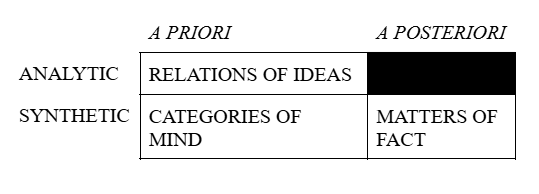
Hume’s Fork

knowt flashcard image