ROCK EXAM
 Call Kai
 Learn
Learn Practice Test
 Spaced Repetition
 Match
Match Flashcards
 Knowt Play
1/151

There's no tags or description
Looks like no tags are added yet.
Name | Mastery | Learn | Test | Matching | Spaced | Call with Kai |
|---|
No analytics yet
Send a link to your students to track their progress
152 Terms
Sedimentary rocks can be formed from smaller bits of:
a. Igneous rocks
b. Metamorphic rocks
c. Sedimentary rocks
d. All of the above
e. None of the above
All of the above
True or False: Rocks are always made up of more than one type of mineral
False
Igneous rocks are formed from:
a. Molten rock
b. Sediments
c. Chemical precipitation from water
d. Metamorphism from existing rock
Molten rock
Rhyolite, a light-colored rock with small minerals, is an:
a. Intrusive felsic igneous rock
b. Extrusive felsic igneous rock
c. Intrusive mafic igneous rock
d. Extrusive mafic igneous rock
Extrusive felsic igneous rock
How quickly molten rock cools controls what about the igneous rock that forms from it?
a. The chemical composition of the minerals
b. The color of the minerals
c. The size of the minerals
d. All of these
The size of the minerals
Solid sediment clasts are formed from what process?
a. Physical erosion/weathering
b. Chemical erosion/weathering
c. Both
Physical erosion/weathering
The process of chemical precipitation from aqueous solution of minerals creates what kind of rock?
a. Clastic sedimentary rock
b. Chemical sedimentary rock
c. Igneous rock
d. Metamorphic rock
Chemical sedimentary rock
True or False: Metamorphic rocks are rocks that have been melted and reformed.
a. True
b. False
False
Rocks can be metamorphosed by:
a. Heat
b. Pressure
c. Both
d. Neither
Both
Common transporting agents of sediments are:
a. Wind
b. Water
c. Gravity
d. Ice
e. All of these
All of these
True or False: High energy water flow can transport large sediment clasts.
a. True
b. False
True
True or False: Well-sorted sediments means those sediments were transported far.
a. True
b. False
True
True or False: Rounded sediment clasts means those sediments were transported far.
a. True
b. False
True
Sediments that are transport by glaciers are:
a. Poorly sorted
b. Angular
c. Both of these
d. Neither of these
Both of these
In desert depositional environments, the main transporting agent of sediments is:
a. Water
b. Ice
c. Gravity
d. Wind
e. None of these
Wind
River transported sediments are usually:
a. Well-sorted
b. Rounded clasts
c. All of these
d. None of these
All of these
Cross-bedding texture is only found in river environments.
a. True
b. False
False
Asymmetric ripples can be found in river environments.
a. True
b. False
True
Symmetric ripples can be found in environments with oscillating ocean waves.
a. True
b. False
True
The largest clastic sediments in the oceans are found furthest from shore.
a. True
b. False
False
True or False: Sedimentary strata are assumed to have been originally deposited
horizontally.
a. True
b. False
True
What stratigraphic principle allows us to determine that strata on either side of the Grand Canyon are the same units?
a. Law of original horizontality
b. Law of superposition
c. Law of cross-cutting relationships
d. Law of lateral continuity
Law of lateral continuity
True or False: Fossils are most commonly found in igneous rocks.
a. True
b. False
False
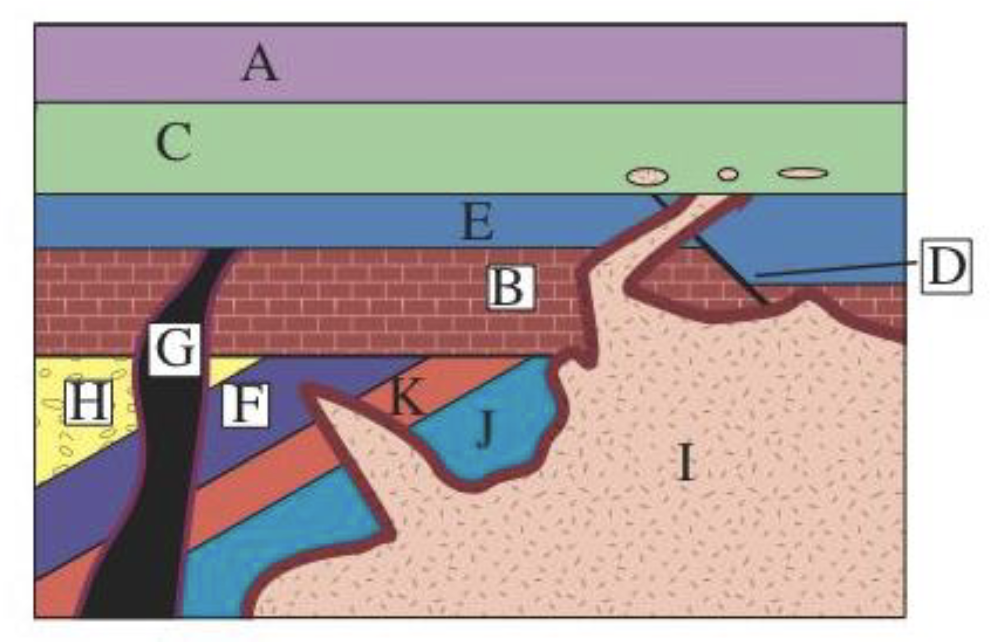
True or False: Stratum A is the youngest unit in the diagram.
a. True
b. False
True
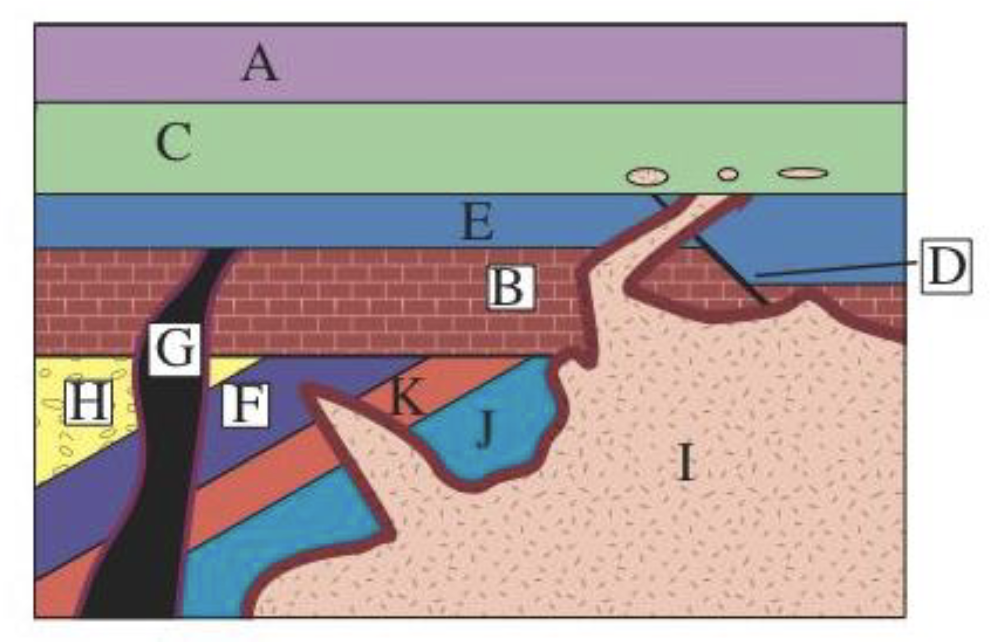
True or False: Igneous intrusion G is younger than stratum B.
a. True
b. False
True
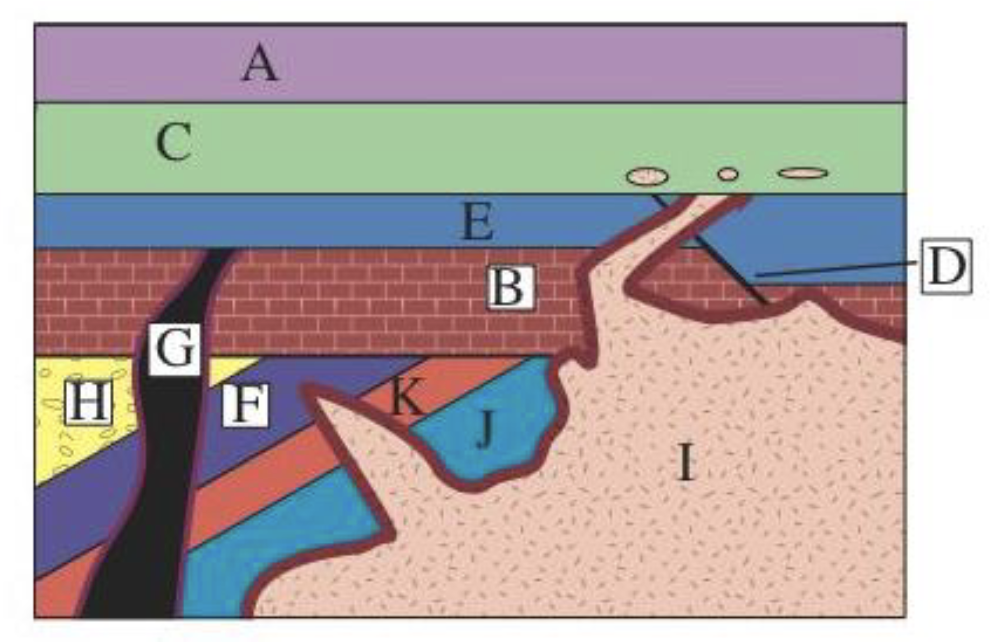
True or False: Stratum J is younger than igneous intrusion I.
a. True
b. False
False
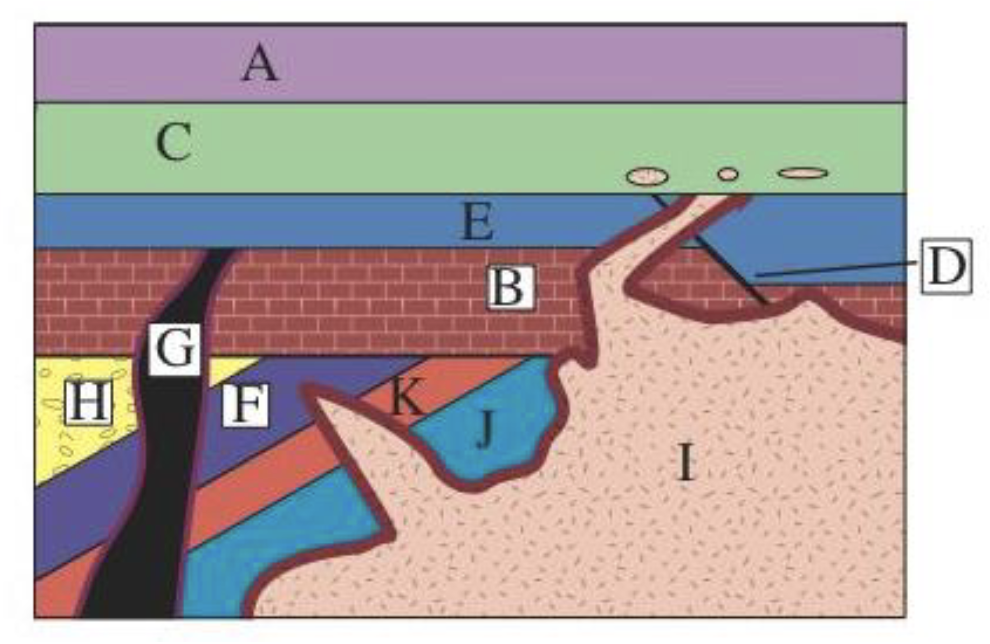
True or False: Fault D is younger than igneous intrusion I.
a. True
b. False
False
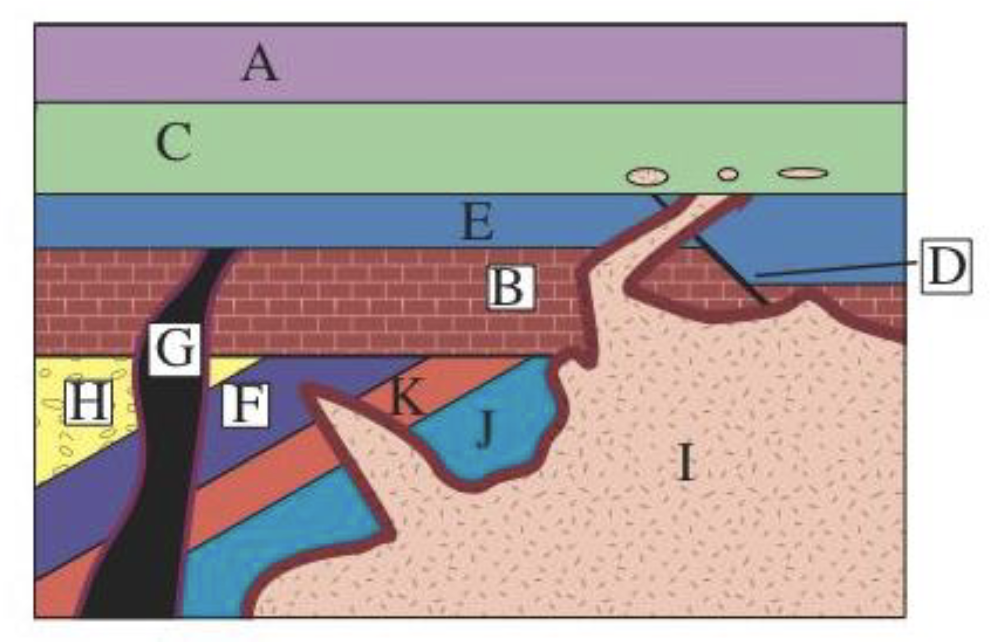
What stratigraphic principle allows us to determine that A is younger than C?
a. Law of original horizontality
b. Law of superposition
c. Law of cross-cutting relationships
d. Law of lateral continuity
Law of superposition
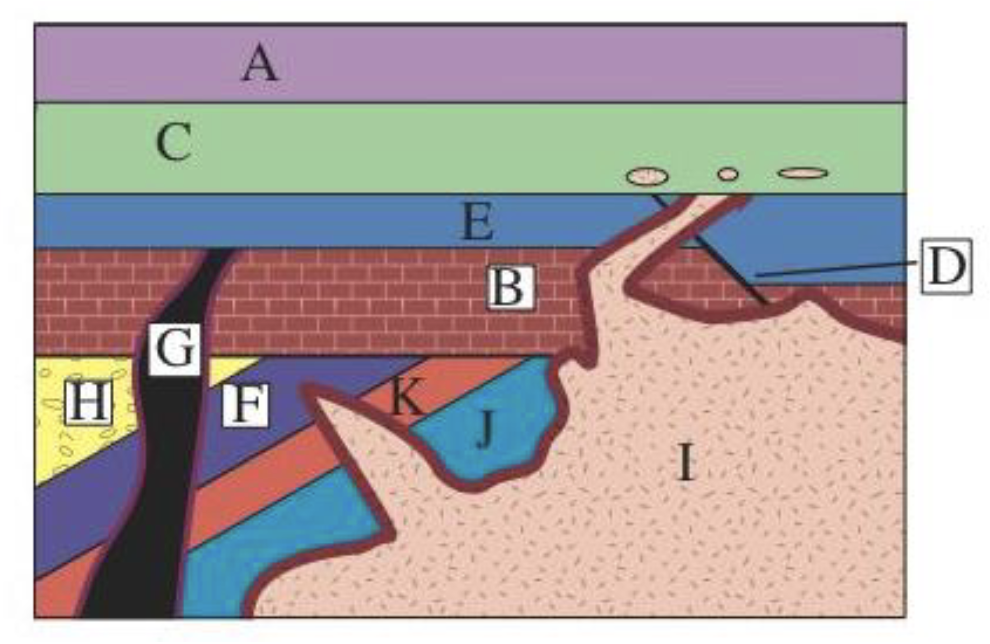
What stratigraphic principle allows us to determine that G is younger than H,F,K, and J?
a. Law of original horizontality
b. Law of superposition
c. Law of cross-cutting relationships
d. Law of lateral continuity
Law of cross-cutting relationships
What type of fossil preserves evidence of an organism's behavior?
a. Body fossil
b. Trace fossil
c. Molecular fossil
d. None of these
Trace Fossil
The type of fossil that preserves evidence of an organism's body.
a. Body fossil
b. Trace fossil
c. Molecular fossil
d. None of these
Body fossil
What kind of fossil preserves chemical evidence of life?
a. Body fossil
b. Trace fossil
c. Molecular fossil
d. None of these
Molecular fossil
True or False: The chances of being preserved as a fossil are higher for biomineralizing
organisms.
a. True
b. False
True
True or False: Fossils can be used to determine the relative age of the rock they are
found in.
a. True
b. False
True
The deepest layer of the Earth.
a. Mantle
b. Crust
c. Core
Core
True or False: Plates sink into the mantle at subduction zones.
a. True
b. False
True
Type of crust that land is made of:
a. Felsic continental crust
b. Mafic oceanic crust
c. Sedimentary crust
d. Metamorphic crust
Felsic continental crust
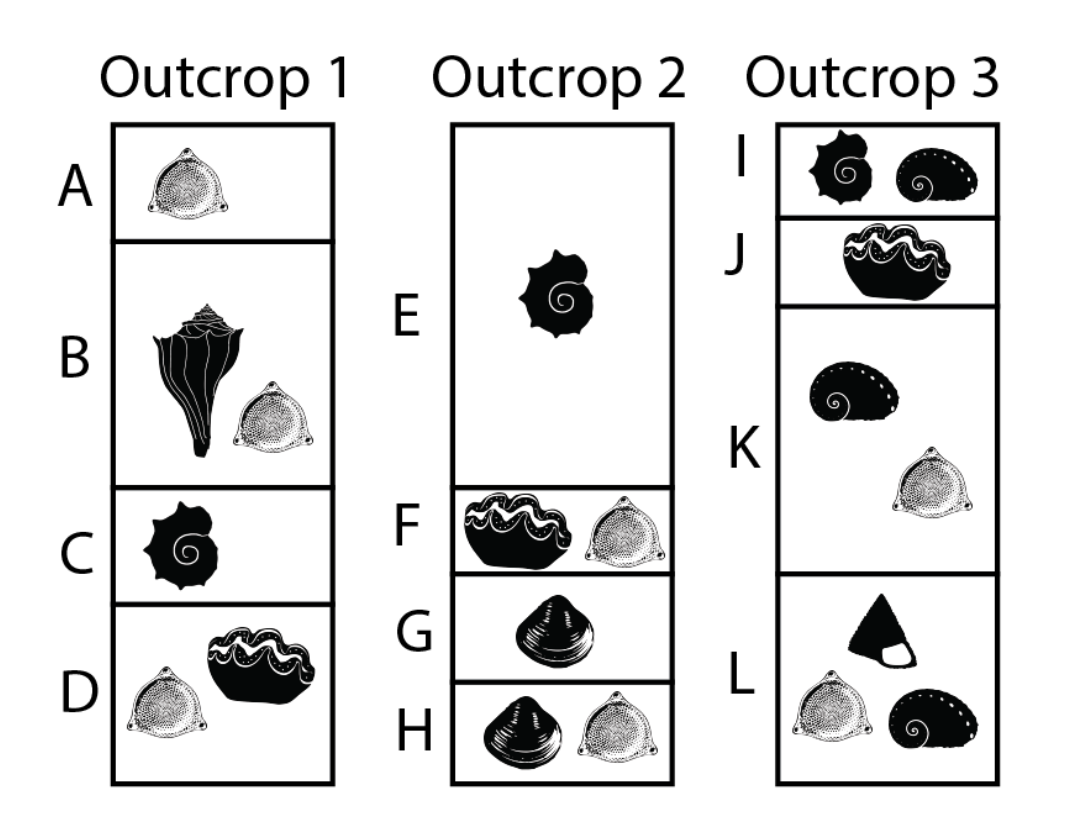
Stratum C in Outcrop 1 is the same age as:
a. Stratum L in Outcrop 3
b. Stratum F in Outcrop 2
c. Stratum E in Outcrop 2
d. None of these
Stratum E in Outcrop 2
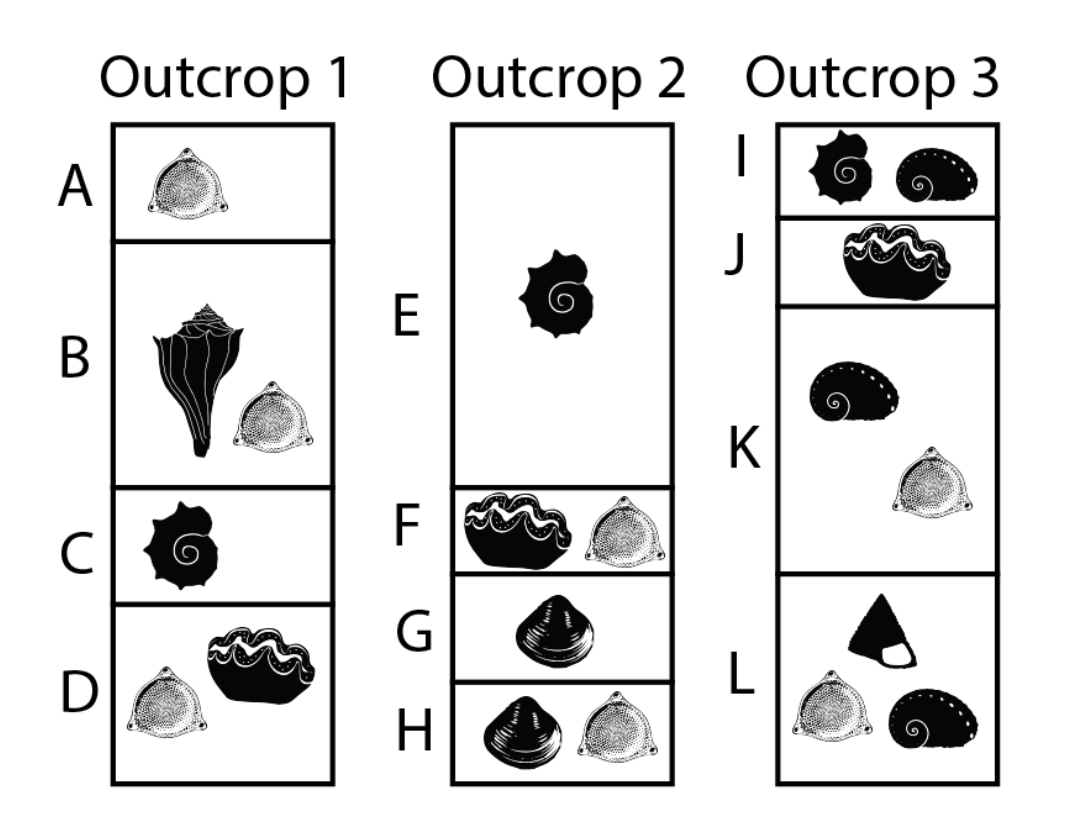
Stratum D in Outcrop 1 is the same age as:
a. Stratum K in Outcrop 3
b. Stratum J in Outcrop 3
c. Stratum E in Outcrop 2
d. None of these
Stratum J in Outcrop 3

Is the diatom a good index fossil?
No

Is the whelk a good index fossil?
No

Is the ammonite a good index fossil?
Yes
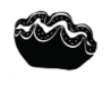
Is the giant clam a good index fossil?
Yes
What type of crust forms at mid-ocean ridges?
a. Metamorphic crust
b. Felsic continental crust
c. Sedimentary crust
d. Mafic oceanic crust
Mafic oceanic crust
Which kind of crust is the most dense?
a. Continental crust
b. Oceanic crust
Oceanic crust
Features of convergent plate boundaries.
a. Deep ocean trenches
b. Mountain ranges
c. Volcanic arcs
d. All of these
All of these
Type of plate boundary where two plates pass each other.
a. Convergent plate boundaries
b. Transform plate boundaries
c. Divergent plate boundaries
Transform plate boundaries
Type of plate boundary where two plates move towards each other.
a. Convergent plate boundaries
b. Transform plate boundaries
c. Divergent plate boundaries
Convergent plate boundaries
Deep earthquakes occur at:
a. Convergent plate boundaries
b. Transform plate boundaries
c. Divergent plate boundaries
Convergent plate boundaries
Slow (gradual) processes can lead to change on Earth.
a. True
b. False
True
Fast (catastrophic) processes can lead to change on Earth.
a. True
b. False
True
The principle of uniformitarianism states that:
a. Natural processes operate the same in the past and present.
b. Natural processes operate differently in the past than in the present.
Natural processes operate the same in the past and present.
Processes that lead to the deposition and formation of sedimentary rock layers can be
described as:
a. Catastrophic geologic process.
b. Gradual geologic process.
c. Neither of these.
Gradual geologic process.
Half-life refers to the time it takes for:
a. A half of the parent atoms to decay.
b. A half of the daughter atoms to decay.
c. All parent atoms to decay.
d. All daughter atoms to decay.
A half of the parent atoms to decay.
The length of time represented by the half-life is the same for all elements.
a. True
b. False
False
Radiometric dating can only be used to date igneous rocks.
a. True
b. False
True
As a radioactive minerals decay, the amount of daughter atoms increases, and the
amount of parent atoms decreases.
a. True
b. False
True
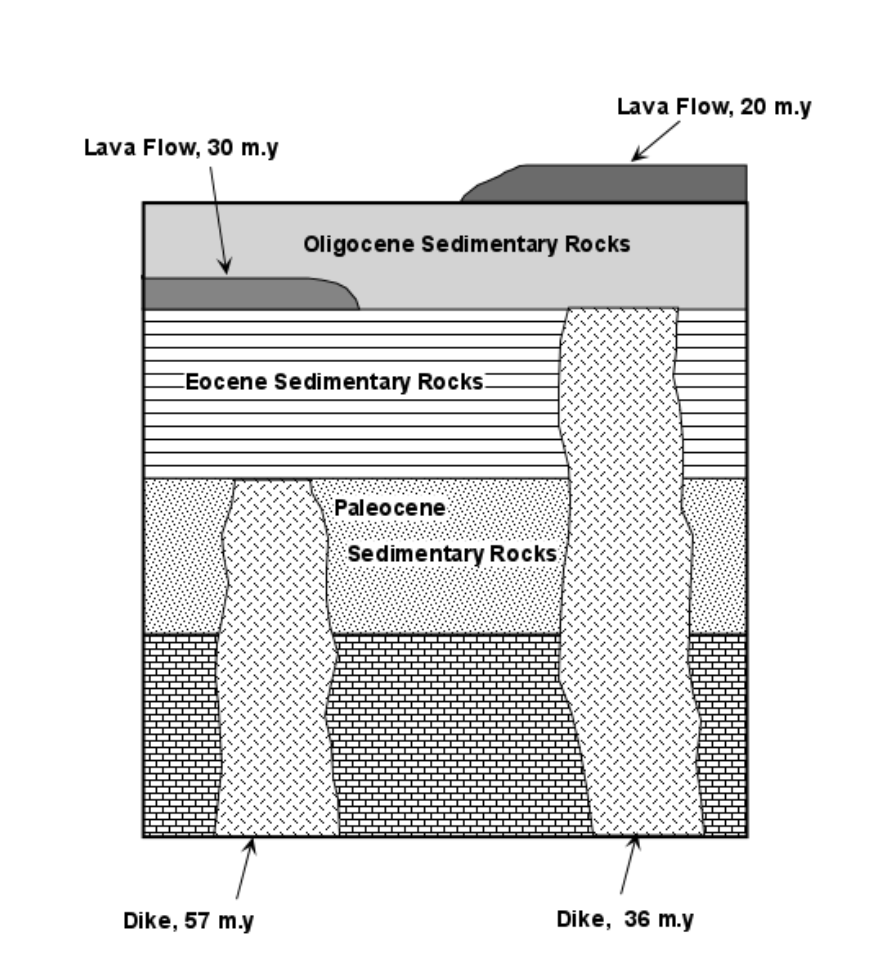
A fossil found in ‘Eocene Sedimentary Rocks’ in the image
above is likely:
a. Between 30 and 20 million years (m.y.) old
b. Between 36 and 57 million years (m.y.) old
c. 36 million years (m.y.) old exactly
d. 57 million years (m.y.) old exactly
e. None of the above
Between 36 and 57 million years (m.y.) old
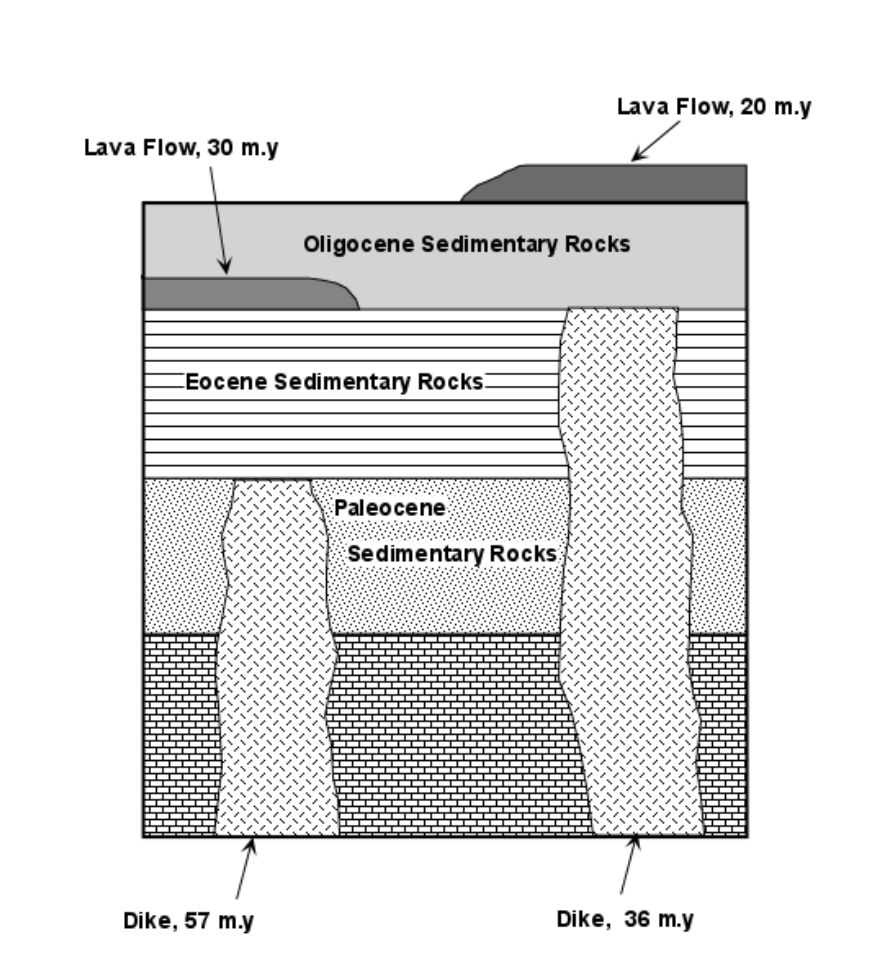
A fossil found in ‘Paleocene Sedimentary Rocks’ in the image
above is likely:
a. Between 30 and 20 million years (m.y.) old
b. Between 36 and 57 million years (m.y.) old
c. Younger than 57 million years (m.y.) old
d. Older than 57 million years (m.y.) old
e. None of the above
Older than 57 million years (m.y.) old
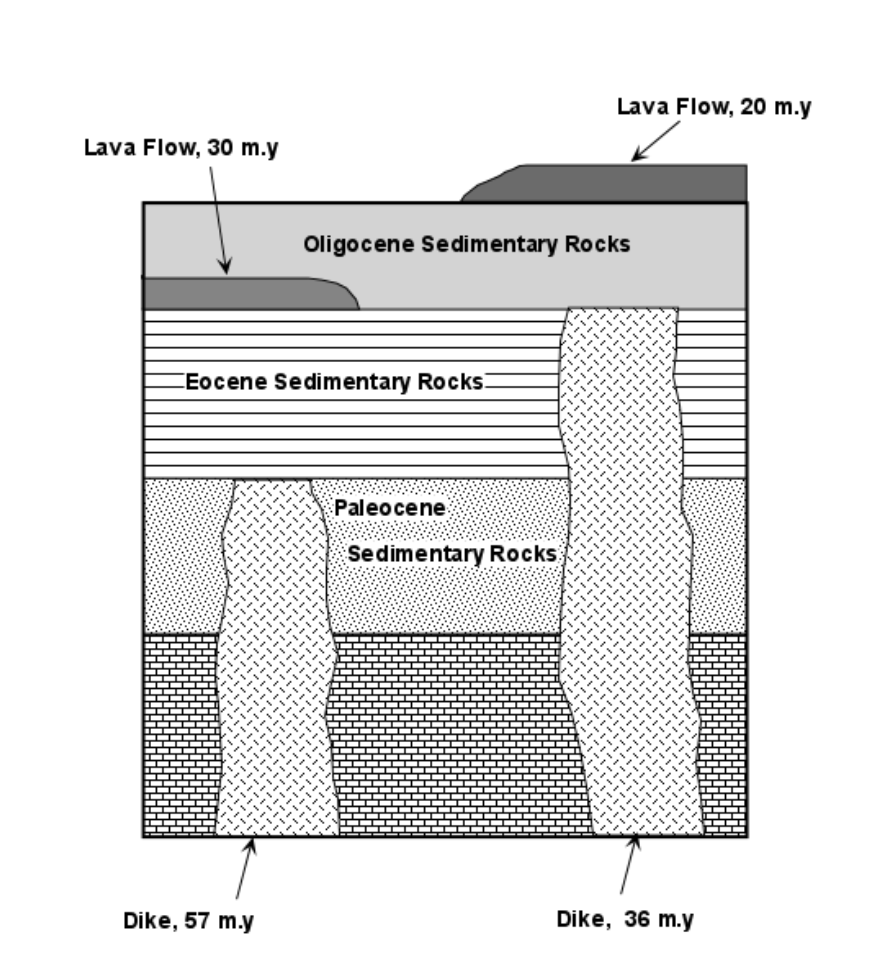
A fossil found in ‘Oligocene Sedimentary Rocks’ in the image
above is likely:
a. Between 30 and 20 million years (m.y.) old
b. Between 36 and 57 million years (m.y.) old
c. Younger than 57 million years (m.y.) old
d. Older than 57 million years (m.y.) old
e. None of the above
Between 30 and 20 million years (m.y.) old
The Hadean is the oldest geologic Eon.
a. True
b. False
True
The Phanerozoic is the youngest Eon.
a. True
b. False
True
The "Precambrian" refers to:
a. The time before the Cambrian Period.
b. The time before the Phanerozoic Eon.
c. The time before the Paleozoic Era.
d. All of these.
All of these
Events during the Hadean Eon include:
a. The end of planetary formation.
b. The differentiation of Earth’s layers
c. The formation of the Moon.
d. All of these.
All of these
The Moon’s composition most closely resembles:
a. The minerals of Earth’s core.
b. The minerals of Earth’s mantle.
c. The minerals of Earth’s crust.
d. All of these.
The minerals of Earth’s crust.
Earth's planetary magnetic field forms from:
a. Radioactivity in the Earth’s mantle
b. Spinning of the Earth’s core
c. Heavy Bombardment of Earth’s surface
d. All of these
Spinning of the Earth’s core
Rocky meteorites dated to ~4.5 billion years old are thought to be:
a. Some of the oldest rocks on Earth.
b. Some of the oldest rocks in the Solar System.
c. Leftovers from planetary formation.
d. All of these
All of these
The oldest crust on Earth can be found where?
a. In oceanic crust.
b. In continental crust.
c. Both.
d. Neither
In continental crust.
Old continental crust gets destroyed by subduction during plate tectonics.
a. True
b. False
False
The oldest rocks found on Earth are from which Eon?
a. The Hadean
b. The Archean
c. The Proterozoic
d. The Phanerozoic
The Archean
Continental cratons are made of:
a. Felsic continental crust.
b. Old igneous rocks.
c. Both of these
Both of these
Evidence of liquid water in the Archean comes from:
a. The presence of old clastic sedimentary rocks.
b. The presence of old “pillow” basalts.
c. Both of these.
d. Neither of these.
Both of these
Dissolved minerals in the oceans today are mainly sourced from:
a. Marine life.
b. The atmosphere.
c. Continental weathering.
d. All of these.
Continental weathering
Important ions dissolved in the ocean today include:
a. Sodium
b. Chloride
c. Calcium
d. All of these
All of these
The oldest evidence for liquid water on Earth is from which Eon?
a. The Hadean
b. The Archean
c. The Proterozoic
d. The Phanerozoic
The Archean
Some terrestrial sources of early water on Earth are thought to be from:
a. Early organisms.
b. Volcanic gasses.
c. Chemical weathering.
d. None of these.
Volcanic gasses
Some extraterrestrial sources of early water are thought to be from:
a. Mars
b. The Moon
c. Icy comets/meteors.
d. None of these.
Icy comets/meteors
The Goldilocks Zone refers to the fact that Earth’s distance from the sun results in:
a. The right temperature for photosynthesis.
b. The right temperature for liquid water.
c. The right temperature for fractionation.
d. All of these.
The right temperature for liquid water.
The largest component of our modern atmosphere is:
a. Oxygen
b. Carbon dioxide
c. Nitrogen
d. Helium
Nitrogen
What biological process produced CO2 and consumes O2?
a. Photosynthesis
b. Aerobic respiration
c. Hydrolysis
d. None of these
Photosynthesis
What biological process consumes CO2 and produces O2?
a. Photosynthesis
b. Aerobic respiration
c. Hydrolysis
d. None of these
Photosynthesis
Solar luminosity is thought to have been higher/brighter when the sun was younger.
a. True
b. False
False
Banded Iron Formations (BIFs) can only form by reacting with oxygen.
a. True
b. False
True
The source of O2 in the modern atmosphere is:
a. Volcanic gas
b. Meteorites
c. Photosynthesis
d. All of these
Photosynthesis
The source of nitrogen gas (N2) in the modern atmosphere is thought to be:
a. Volcanic gas
b. Meteorites
c. Photosynthesis
d. All of these
Volcanic gas
The amount of energy than enters our climate system depends on:
a. Solar luminosity
b. Solar insolation
c. The Greenhouse Effect
d. All of these
All of these
Gasses that trap energy in Earth's atmosphere.
a. Carbon dioxide
b. Water vapor
c. Methane
d. All of these
All of these
The radiative energy that enters Earth's system is the same wavelength as the energy that exits.
a. True
b. False
False
Earth is currently in an icehouse state.
a. True
b. False
True
Energy coming to the Earth from the sun is in the visible light and UV light spectrum.
a. True
b. False
True
Energy leaving the Earth into space is in the infrared spectrum.
a. True
b. False
True
An isotope is a version of an element that has a different number of:
a. Protons
b. Neutrons
c. Both
d. Neither
Neutrons
Evaporation leads to fractionation because the heavier isotope of oxygen is preferentially evaporated.
a. True
b. False
False
The oxygen isotopic ratio of seawater can be measured indirectly from:
a. Calcium carbonate (CaCO3)
b. Shells of marine fossils
c. Chemically precipitated marine sediment
d. All of these
All of these
The significance of the Banded Iron Formations at Isua, Greenland is:
a. Evidence of gaseous oxygen
b. Evidence of liquid water
c. Evidence of iron oxide formation
d. All of these
All of these
Snowball Earth was a global glaciation event that occurred during what Eon?
a. The Hadean
b. The Archean
c. The Proterozoic
d. The Phanerozoic
The Proterozoic
During Snowball Earth, we find evidence of:
a. Glacial deposits in low latitudes
b. S18O indicating cold temperatures
c. Limited oxygen gas in the oceans
d. All of these
All of these
Changes in the 18O ratio of water molecules are indicative of changes in:
a. Volcanic activity
b. Plate tectonics
c. Photosynthesis
d. Temperature
Temperature
What are stromatolites?
a. Made of sedimentary layers
b. Some of the oldest known fossils
c. Fossils of microbial mats
d. All of the above
All of the above
Which of the following have a simpler cell structure lacking many organelles?
a. Prokaryote
b. Eukaryote
Prokaryote