physical processes - MCAT
 Call Kai
 Learn
Learn Practice Test
 Spaced Repetition
 Match
Match Flashcards
 Knowt Play
1/28

Earn XP
Description and Tags
Vectors and scalars, Translational motion, Force and Newton’s laws of motions, Vector analysis and forces acting on an object, Work and energy, Fluids at rest, Fluids in motion, Gas phase, Kinetic molecular theory of gases, Electrostatics, Current and resistance, Capacitors, Magnetism, Electrochemistry, Sound, Light and electromagnetic radiation, IR and UV/Vis Spectroscopy, 1H-NMR, Thin lenses, Spherical mirrors, Reflection and refraction, Atomic nucleus, Electronic structure, Periodic table, Stoichiometry, Balancing chemical equations, Redox reactions
29 Terms
Newton’s laws of motion
First law: Inertia - Resting objects remain at rest & moving objects remain moving at constant speed in straight line, unless acted upon by an unbalanced force
Second law: F = ma
Third law: Every action (force) has equal & opposite reaction
SI units
provide for: length, mass, time, electric current, temperature, amount of substance, luminous intensity
length — meter (m)
mass — kilogram (kg)
time — second (s)
electric current — ampere (A)
temperature — kelvin (K)
amount of substance — mole (mol)
luminous intensity — candela (cd)
Work
Transfer of energy, force over a distance
W = Fd cos θ
Centripetal force
force required to keep object in circular motion, Fc = mv2 / r
not a “new force”; is produced by existing force (eg. weight, friction, tension, etc.)
Pressure
Force (applied perpendicularly) over an area
P = F/A
SI unit: Pascal, Pa = N/m2
Atmospheric pressure
1 atm
or
101.325 kPa
Density
Definition
symbol and formula
Density of water
How tightly mass is packed into a given space
ρ = m / V
(ρ = rho)
Density of water = 1000 kg/m3
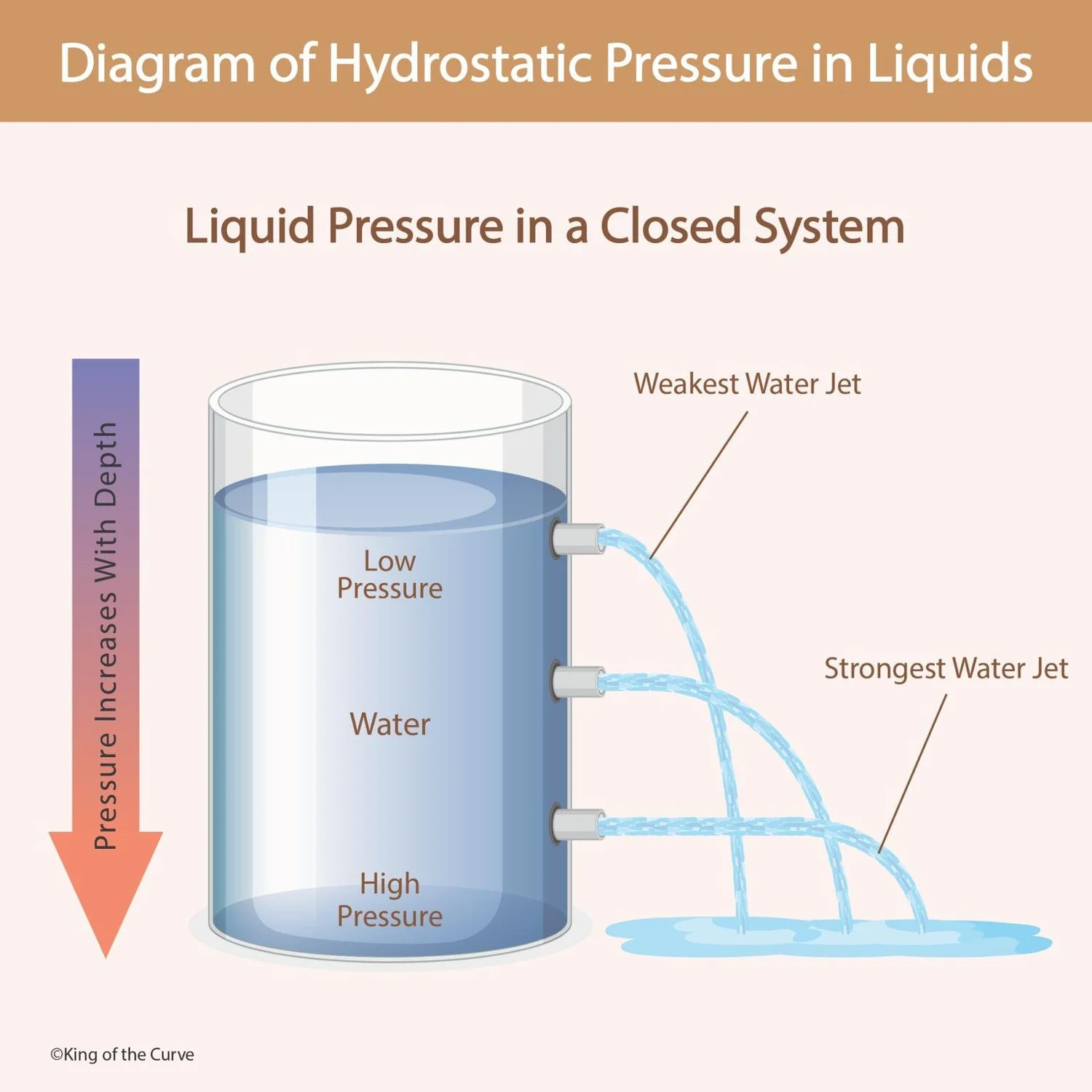
Hydrostatic pressure
definition
formula
Pressure exerted by a fluid at rest due to gravity
P = P0 + ρgh
P0 = surface/external pressure
ρ = density of fluid
g gravity
h = height of fluid column above measurement point
Continuity equation
Conservation of mass applied to fluids
ρ1A1v1 = ρ2A2v2 // if density doesn’t change you can ignore ρ
A = Area of pipe cross section
v = velocity of fluid
Bernoulli’s equation
Conservation of energy for fluids
P1 + ρgh1 + ½ρv12 = P2 + ρgh2 + ½ρv22
Derivation:
W1 + PE1 + KE1 = W2 + PE2 + KE2
W = Fd = Fvt = F/A * Avt = PV = Pm/ρ
P1m/ρ + mgh1 + ½mv12 = P2m/ρ + mgh2 + ½mv22
P1 + ρgh1 + ½ρv12 = P2 + ρgh2 + ½ρv22
Poiseuille’s Law / Hagan-Poiseuille equation
purpose
equation & variables
models volumetric flow rate of a viscous liquid through a pipe
V/t = ΔPπR4 / 8ηL
V/t = Volume / time = Q = volumetric flow rate
ΔP = change in pressure
R = radius of pipe
η = viscosity
L = length of pipe
Venturi effect
define
explain why it happens
If u got a liquid flowing through a pipe, if pipe is constricted then fluid moves faster and pressure (on pipe walls) decreases
true because conservation of mass / energy — same amount of fluid must pass through a smaller space at the same rate, so must move faster
Ideal Gas Law
equation
5 assumptions
PV = nRT
P = Pressure, V = Volume, n = number of moles, R = Ideal gas constant (8.314 J/Kmol or 0.08206 Latm/Kmol), T = Temperature (K)
Assumptions:
Negligible volume of particles
Negligible intermolecular forces
Constant, random, linear motion until collision
Collisions are perfectly elastic
Average Kinetic energy of gas molecules is proportional to absolute temperature only (so all molecular motion ceases if temperature drops to absolute zero, 0 K)
Gases behave more ideally at ____ temperature and ____ pressure (low or high)
high temperature and low pressure
Boyle’s Law, Charles’ Law, Avogadro’s Law
P1V1 = P2V2
V1/T1 = V2/T2
V1/n1 = V2/n2
Standard Temperature and Pressure (STP)
temperature, pressure, how much volume occupied by 1 mol of gas
Temperature = 0oC = 273.15 K
Pressure = 1 atm = 101.325 kPa
At STP, 1 mol of gas occupies volume of 22.4 L
Van Der Waals equation
purpose
modifications/variables
A modification of the ideal gas law that accounts for non-negligible particle volume and intermolecular forces:
(P + a(n/V)2)(V - bn) = nRT
a(n/V)2 = intermolecular forces decrease pressure
bn = volume occupied by gas particles (so V - bn = free volume for particles to move in)
a (molecular attraction) and b (molecular volume) are constants with different values for different gases
Boltzmann’s Constant, kB
formula/value
usage
Boltzmann’s Constant is equal to the ideal gas constant / avogadro’s number
kB = R / NA = 1.38 * 10-23
Relates temperature and energy: 3/2 kBT = KEavg for 1 particle, 3/2 RT = KEavg for 1 mol
Heat capacity, C
definition
formula
formulas for heat capacity at constant pressure and constant volume
Amount of heat required to change temperature of substance by 1oC:
C = Q/ΔT heat capacity = heat added / change in temperature
molar heat capacity: C = Q/nΔT
Heat capacity at constant Pressure CP = 5/2 NkB = 5/2 nR (molar heat capacity = 5/2 R) for a monoatomic ideal gas
Heat capacity at constant Volume CV = 3/2 NkB = 3/2 nR (molar heat capacity = 3/2 R) for a monoatomic ideal gas (N = number of atoms or molecules of gas, equal to n * NA)
Provide definitions and formulae for:
Electric force
Electric field
Electric potential energy
Electric potential, aka Voltage
Force that 2 charges exert on one another, FE = kq1q2/r2
Measure of force that would be exerted per unit of charge at a certain point, E = kq/r2
Energy associated with separating 2 charges a distance apart, U = kq1q2/r
Measure of potential energy per unit charge, V = U/q = kq/r
k = coulomb’s constant, a proportionality factor (turns result into standard force units)
Relate Current, Resistance and Voltage in a circuit
V = IR
V = Voltage, I = Current, R = Resistance
Equivalent resistance in series vs. in parallel
provide formulas and briefly justify
Resistors in series: Req = R1 + R2 + R3 + …
Overall voltage must equal sum of voltage drops across each resistor: VT = V1 + V2 + V3
Current must be same for all resistors in series, so V/I = V1/I + V2/I + V3/I, therefore Req = R1 + R2 + R3
Resistors in parallel: 1/Req = 1/R1 + 1/R2 + 1/R3 + …
Voltage must be same across all resistors in parallel (because they share the same 2 points in the circuit or smth)
Overall current must equal sum of currents through each resistor
this means overall conductance equals sum of conductances: Geq = G1 + G2 + G3
Conductance is inverse of resistance, so 1/Req = 1/R1 + 1/R2 + 1/R3
Resistivity and Conductivity
formula for resistance & relationship between the two
R = ρL/A
ρ = “rho”sistivity, L = Length, A = Area (of cross section)
Conductivity = inverse of resistivity (σ = 1/ρ)
How to determine electrolytic conductivity
Electrolytic conductivity is solution’s ability to conduct current
R = ρL/A
Measure Resistance of circuit in solution of known resistivity so you can determine value of L/A, which will be constant independent of solution
Then when you measure Resistance of unknown solution you have L/A value and can calculate ρ
Voltmeters and Ammeters
Hook up to circuit in series or parallel?
Should have low or high resistance?
Voltmeters should have high resistance (ideally infinite) and be hooked up in parallel
Ammeters should have low resistance (ideally 0) and be hooked up in series
Relate capacitance, charge and voltage
Q = CV
Equation for energy provided by fully charged capacitor
E = CV2/2 or Q2/2C
Parallel plate capacitance
formula
C = εA/d
Capacitance = permittivity of free space * plate Area / distance bt plates
Dielectric
definition and what it does
modified parallel plate capacitance formula
when placed between parallel plates, dielectrics are polarized and generate opposing electric field which weakens overall field strength
decrease electric field → decrease V → increase C; capacitor can accept more charge
C = kεA/d
k = dielectric constant, higher = more easily polarized
given constant Q (i.e. battery is disconnected), adding dielectric increases C while decreasing V and stored E
Q = CV, so if C increases with constant Q, V will decrease
E = CV2/2 so if C increases and V decreases by the same factor, E decreases overall
given constant V (eg. battery stays attached), adding dielectric increases C as well as Q and E
can be reasoned out using same formulas above
all dielectrics are insulators but not all insulators are dielectrics