module 3: fermentation, gluconeogenesis, pyruvate oxidation, krebs cycle
 Call Kai
 Learn
Learn Practice Test
 Spaced Repetition
 Match
Match Flashcards
 Knowt Play
1/43

There's no tags or description
Looks like no tags are added yet.
Name | Mastery | Learn | Test | Matching | Spaced | Call with Kai |
|---|
No analytics yet
Send a link to your students to track their progress
44 Terms
After glycolysis what happens if O2 is present
cellular respiration
link rxn: 2 pyruvate → 2 acetyl CoA +2CO2
Krebs
ETC
Ox phos
(slow, generate 30 additional ATP)
After glycolysis what happens if O2 is not present
fermentation
allows for regeneration of NAD+
2 lactate or 2 ethanol/2CO2
0 ATP
who does lactic acid fermentation
very active muscles and some bacteria do this in absence of O2 to regenerate NAD+
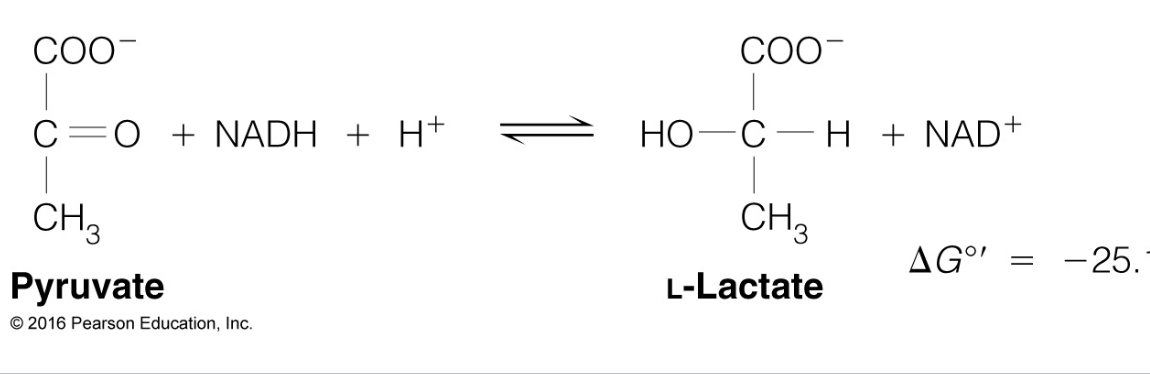
lactate dehydrogenase (LDH) rxn
pyruvate +NADH + H+ ←→ L-Lactate + NAD+
who does ethanol fermentation
some microbes (NOT MUSCLE)
ethanol fermentation rxn
pyruvate → acetaldehyde → ethanol
1st enzyme: pyruvate carboxylase
2nd enzyme: alcohol DH
2 CO2 made
2 NAD+ made
acetaldehyde is poison
warburg effect
cancer cells turn off respiration and do aerobic lactate production (fermentation)
why do cancer cells favor lactate production over cellular respiration
glycolysis is 100x times faster method of ATP production
glycolysis produces a lot of pyruvate (hub molecule)
gluconeogenesis net rxn
2 pyruvate → glucose
4 ATP → 4 ADP +4 Pi
2 GTP → 2 GDP + 2Pi
2 NADH +2 H+ → 2NAD+
which organ/tissue does a lot of gluconeogenesis
liver
what are the irreversible steps of gluconeogenesis
steps 1,2,9,11
what are steps 1&2 of gluconeogenesis
bypass steps of pyruvate kinase
step 1:
pyruvate +ATP → oxaloacetate
enzyme: pyruvate carboxylase (also uses biotin as a cofactor)
occurs in the mitochondrion
step 2:
GTP + OAA → GDP + PEP + CO2
enzyme: phosphoenolpyruvate carboxykinase (PEPCK) (also uses Mg2+)
occurs in the cytosol
step 9 of gluconeogenesis
fructose 1-6 BP → fructose 6P (enzyme: glucose-1,6-bisphosphatase)
enzyme is a hydrolase
step 11 of gluconeogenesis
glucose 6 P → glucose (enzyme: glucose 6 phosphatase)
enzyme is a hydrolase
to regenerate NAD+, the muscles use ________, instead of cellular respiration because oxygen might be limiting (called ____) and cellular respiration is slow. This causes a build up of ______.
lactate fermentation
hypoxia
lactate
where does the build up of lactate go?
the cori cycle
cori cycle
how the liver uses the lactate from muscle exercise to make glucose during recovery from exercise
can cells make glucose from things other than lactate or pyruvate?
yes; glycerol, amino acids, lactate and pyruvate can all be converted into glucose
regulation of gluconeogenesis
much of regulation of gluconeogenesis is reciprocally regulated w glycolysis
hormones
insulin= high glucose _> turn off gluconeogenesis
glucagon= low glucose → turn on gluconeogenesis
[S] + [P]
what are the 3 stages of respiration
pyruvate oxidation (link rxn) (occurs in mito matrix)
Kreb’s (occurs in mito matrix)
ETC/Ox Phos (occurs in inner membrane and IMS)
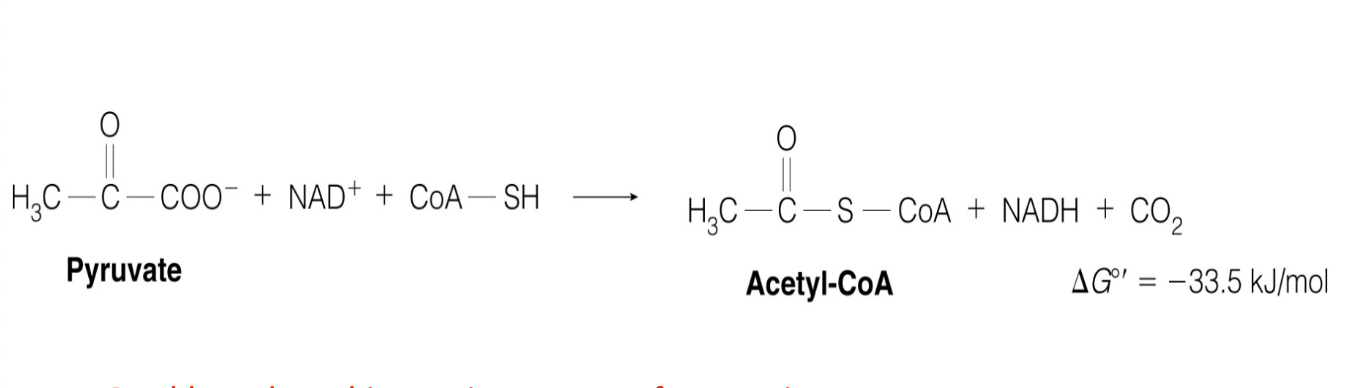
pyruvate oxidation rxn
pyruvate + NAD+ + CoA-SH → Acetyl-CoA +NADH +CO2
irreversible
major point for regulation
where does pyruvate oxidation occur?
PDH complex (metabolon)
contains 3 enzymes required for pyruvate oxid
what are the advantages of PDH forming a metabolon?
allows for “substrate channeling” to..
ensure fast/efficient catalysis
prevents unwanted side rxns
keeps local [S] high
catalytic coenzymes
regenerated by the end of the reaction so it does not appear in the net final reaction
stoichiometric coenzymes
function much like substrates, and appear in net final reaction
5 coenzymes needed for pyruvate oxidation what are they, what vitamin are they derived from and what is the coenzyme type.
NAD+ , derived from Niacin (B3), stiochiometric
CoA-SH, derived from pantothenate (B5), stoichiometric
TPP, derived from thiamin (B1), catalytic
lipoamide, catalytic
FAD, derived from riboflavin (B2), catalytic
PDH step 1
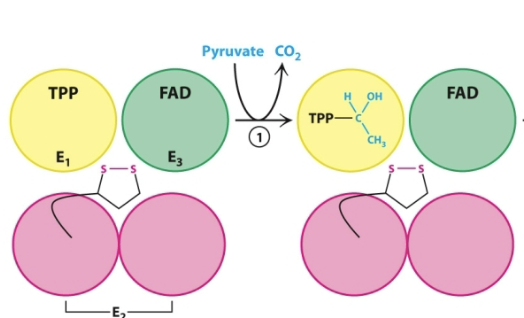
pyruvate combines with the ionized form of TPP, releasing CO2
PDH step 2
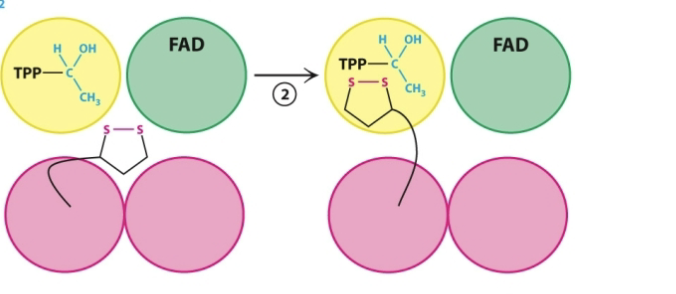
lipoamide swings from E2 to E1
PDH step 3
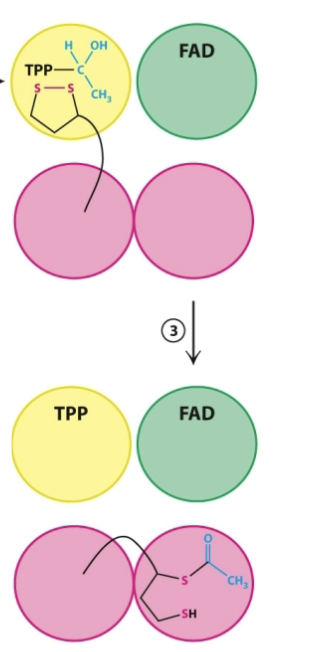
lipoamide steals the acetyl from TPP and swings back to E2
the lipoamide S is now reduced to form -SH
PDH step 4
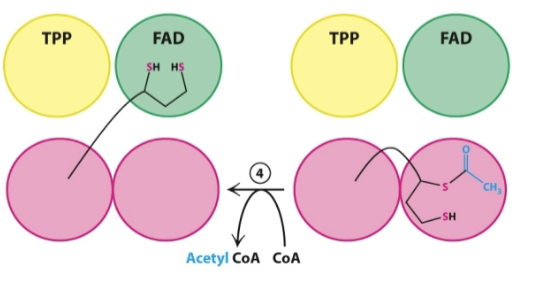
formation of acetyl-CoA
dihydrolipoamide swings to E3
PDH step 5
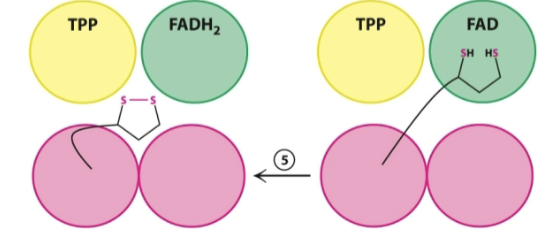
dihrdolipoamide donates 2e-/2H to FAD to regenerate lipoamide
FAD becomes FADH2
lipoamide returns to E2
PDH step 6
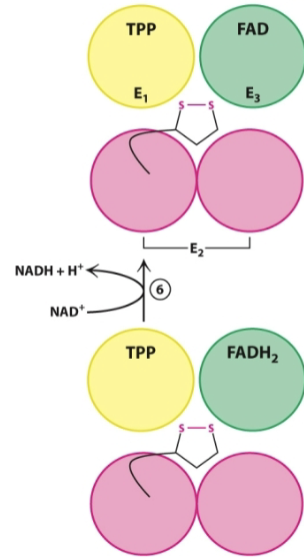
FADH2 donates 2e- to NAD+ to make NADH and regenerate FAD
how many electrons are extracted from pyruvate by PDH complex
2 (NAD+ accepts 2 electrons to become NADH)
what are the prosthetic groups in PDH complex
FAD, TPP, and lipomaide
positive regulators of pyruvate oxidation
insulin
ADP
pyruvate
Ca2+
negative regulators of pyruvate oxidation
acetyl-coA
NADH
ATP
pyruvate oxidation is primarily regulated by reversible covalent modification of the PDH complex. what is the most common form of reversible covalent modification?
phosphorylation
kinase
enzyme that adds a phosphate group to a substrate using ATP as the donor of the phosphate (aka trasnferase)
phosphatase
enzyme that removes a phosphate group from a substrate using hydolysis (aka hydrolase)
inactive PDH complex
phosphorylated by PDH kinase
active PDH complex
de-phosphorylated by PDH phosphatase
active form of PDH favored by
high Ca2+
high insulin
high pyruvate and ADP
inactive form of PDH favored by
high product (ATP, NADH, Acetyl-CoA)
8 enzymes of Kreb’s
Citrate Synthase
Aconitase
Isocitrate DH
Alpha-Ketoglutarate DH
Succinyl CoA Synthetase
Succinate DH
Fumarase
Malate DH