Plate Tectonics
 Call Kai
 Learn
Learn Practice Test
 Spaced Repetition
 Match
Match Flashcards
 Knowt Play
1/97

Earn XP
Description and Tags
Name | Mastery | Learn | Test | Matching | Spaced | Call with Kai |
|---|
No analytics yet
Send a link to your students to track their progress
98 Terms
Who created the first modern atlas?
Abraham Ortelius

Which meteorologist proposed the theory of continental drift?
Alfred Wegener
In what year was the theory of continental drift proposed?
1912
What evidence is there to support the theory of continental drift?
the theory of plate tectonics
Mesosaurus fossils
geological columns
plant fossils
animal fossils
complimentary continent shapes
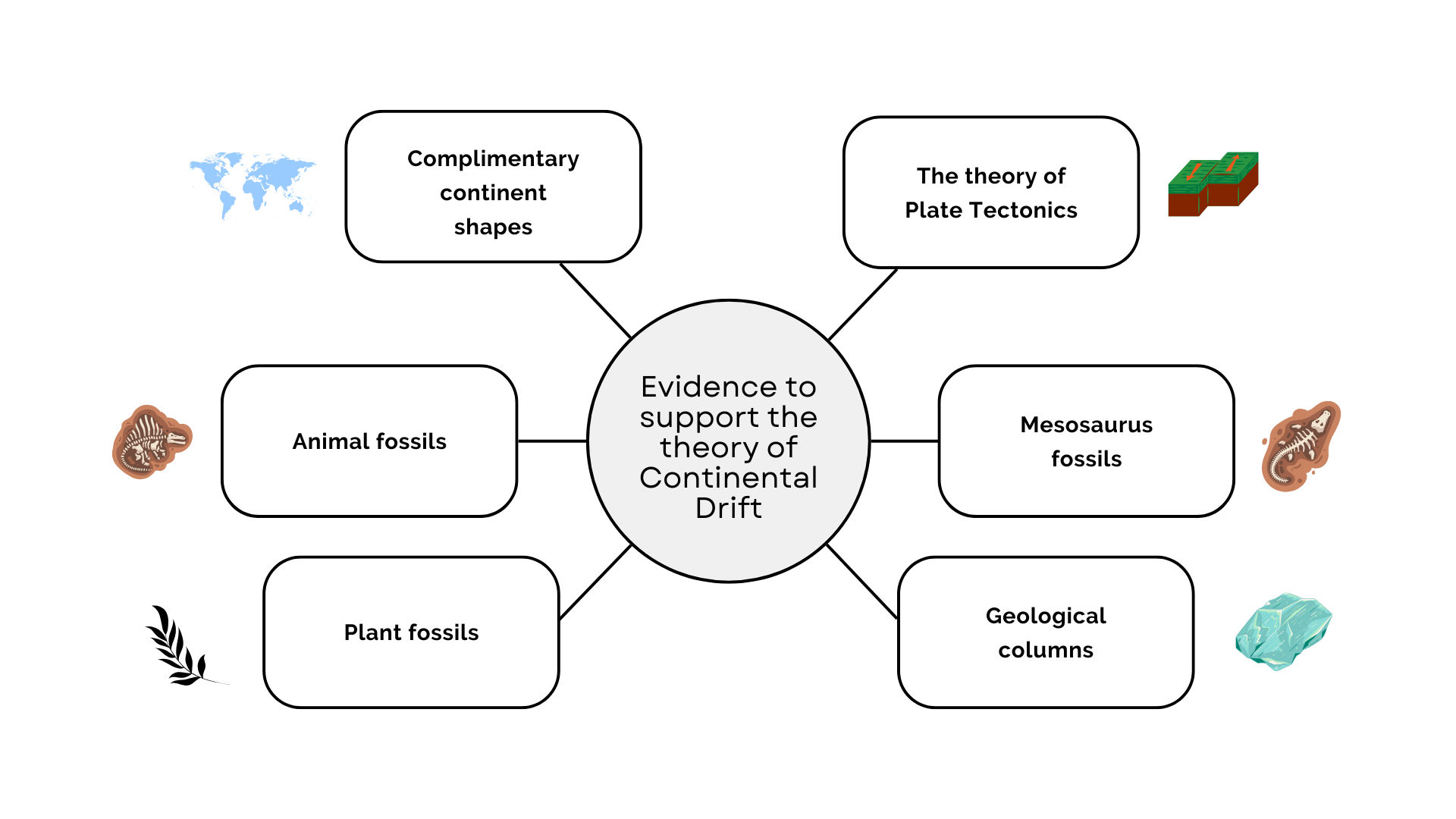
plate tectonics
the process whereby heated rock is moved within the Earth in vast convection currents, which drag along the underside of the Earth’s plates, forcing them to slowly drift across the planet
What is the thickness of conintental crust?
30-70km
What is the age of continental crust?
over 1,500 million years old
What is the density of continental crust?
2.6g/cm3
What is the composition of continental crust?
mainly granite
What is the thickness of oceanic crust?
6-10km
What is the age of oceanic crust?
less than 200 million years old
What is the density of oceanic crust?
3.0g/cm3
What is the composition of oceanic crust?
mainly basalt
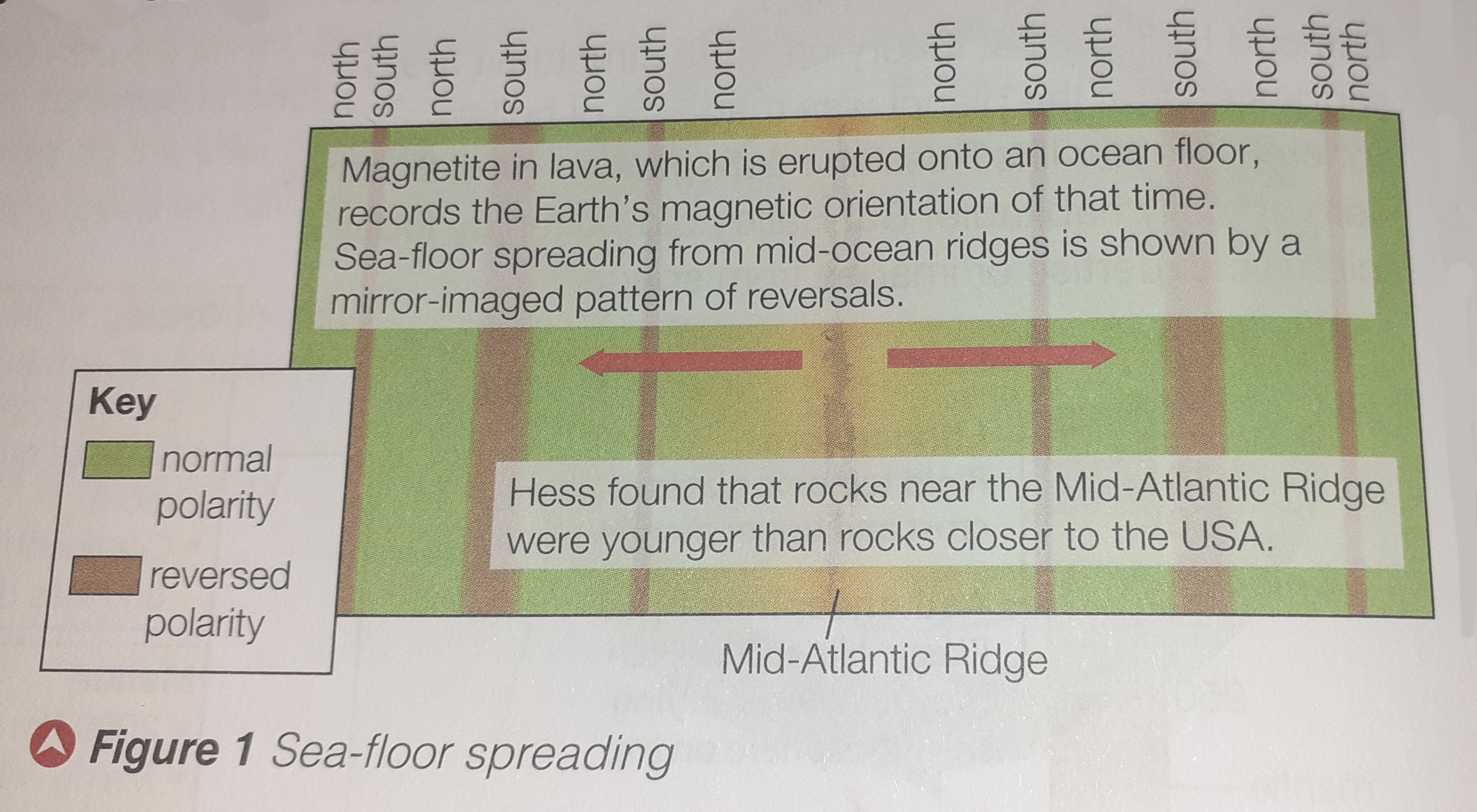
What was discovered by Dietz?
an alternating North/South magnetic striping pattern
each rock stripe is 400,000 years old
the oldest rocks are the furthest away from the Mid-Atlantic Ridge
the ocean crust is slowly spreading away from the boundary
sea floor spreading
How did Harry Hess support Dietz’s theory of sea floor spreading?
explained that the convection currents were the driving force behind sea floor spreading
found evidence of sea floor spreading, confirmed by palaeomagnetism
palaeomagnetism
the swapping of magnetic north and south poles every 400,000 years or so
convection currents
Heat from the core (hot spots) warms the mantle, causing it to rise up
This movement within the mantle moves the plates above it
The mantle nearer the surface cools and creates new crust
The mantle moves back down towards the core
ridge push
At a constructive plate boundary, plates are pulling apart
Magma rises to the surface and forms new crust
This heats the surrounding rocks, which expand and rise above the surface, creating a slope
New crust cools and becomes denser, sliding downslope away from the late margin
This puts pressure on the plates, causing them to pull apart
slab pull
At destructive plate margins, denser crust is forced under less dense crust
The sinking of the plate edge pulls the rest of the plate towards the boundary
What are the 6 different layers of the Earth?
lithosphere
asthenosphere
mesosphere
outer core
inner core
inner-inner core
What are the characteristics of the inner core?
consists of solid iron & nickel alloy
4x more dense than the crust
What is the thickness of the inner core?
1200km
What is the temperature of the inner core?
6000°C
What does the outer core consist of?
semi-liquid iron & nickel
What is the thickness of the outer core?
2250km (~2000km)
What is the temperature of the outer core?
5000°C
What are the characteristics of the mesosphere?
consists of the lower mantle
dense
more rigid
What is the thickness of the mesosphere?
2600km
What is the temperature of the mesosphere?
3700°C
What are the characteristics of the asthenosphere?
consists of the upper mantle
consists of hotter & semi-molten rock
more fluid
What is the thickness of the asthenosphere?
200km
What is the temperature of the asthenosphere?
1700°C
What does the lithosphere consist of?
the crust
the rigid upper mantle
What is the thickness of the lithosphere?
50 - 100km
What is the temperature of the lithosphere?
14 - 1500°C
What is the thickness of conintental crust?
30-70km
What is the age of continental crust?
over 1.5 billion years old
What is the density of continental crust?
2.6g/cm3
What is the composition of continental crust?
mainly granite
What is the thickness of oceanic crust?
6-10km
What is the age of oceanic crust?
less than 200 million years old
What is the density of oceanic crust?
3.0g/cm3
What is the composition of oceanic crust?
mainly basalt
What is a hot spot/magma plume?
a rising column of particularly hot magma which rises through the mantle towards the crust, eventually “burning through” and penetrating the crust
How many hot spots/magma plumes are there across the globe?
125
Where are most hot spots/magma plumes not located?
on plate boundaries
Where is there a well-known hot spot/magma plume located at a plate boundary?
Iceland
Why is there much debate & uncertainty created around the hot spot theory?
the number of modifications and elaborations necessary to make the hot spot theory apply in all cases
How does the hot spot theory work?
Radioactive decay in the Earth's core generates very hot temperatures
When the radioactive decay is concentrated, magma plumes form
The magma plumes rise vertically
Eventually, the magma plumes “burn” through the lithosphere
Volcanic activity on the surface is induced
Which scientist came up with the hot spot theory?
J. Tuzo Wilson
What alternative theory to the hot spot theory does scientist G. Foulger (2003) offer/propose instead?
the weaknesses that exist in tectonic plates themselves should be looked at instead
How many islands make up the Hawaiian state?
19
Which Hawaiian Island is the largest?
Hawaii/the Big Island
What do all the Hawaiian Islands have in common?
they are all volcanic in origin
What are the three types of destructive plate boundary?
oceanic vs. continental
oceanic vs. oceanic
continental vs. continental
What motion occurs at destructive oceanic vs. continental plate boundaries?
one plate is forced under another
oceanic and continental plates move towards each other
the denser oceanic plate subducts
as the oceanic plate subducts, increased temperature and friction cause it to melt, creating a subduction zone
What hazards occur at destructive oceanic vs. continental plate boundaries?
volcanoes
earthquakes
tsunamis
What is an example location of a destructive oceanic vs. continental plate boundary?
Nazca & South American plates
What motion occurs at destructive oceanic vs. oceanic plate boundaries?
one plate is forced under another
oceanic and oceanic plates move towards each other, both of the same density
the faster moving plate is the one that subducts
the features are the same as the continental-oceanic subduction zone
an ocean trench marks the location where the plate is pushed down into the mantle
What hazards occur at destructive oceanic vs. oceanic plate boundaries?
volcanoes
earthquakes
tsunamis
What is an example location of a destructive oceanic vs. oceanic plate boundary?
South American & Caribbean plates
What motion occurs at destructive continental vs. continental plate boundaries?
one plate is forced under another
two continental plates move towards each other
as both plates are of the same density, there is no subduction
as the plates meet, sediment and the plate edges are forced to fold upwards
What hazard occurs at destructive continental vs. continental plate boundaries?
earthquakes
What is an example location of a destructive continental vs. continental plate boundary?
Indo-Australian & Eurasian plates
What motion occurs at constructive plate boundaries?
plates pulling apart, moving away from each other
a gap is created between the plates
magma (molten rock) rises from the mantle and fills the gap between the plates, forming a mid-ocean ridge
What hazards occur at constructive plate boundaries?
volcanoes
earthquakes
What is an example location of a constructive plate boundary?
North American & Eurasian plates
What motion occurs at conservative plate boundaries?
two plates grind past each other
the plates often get stuck due to friction
friction builds up over time until the plates finally jolt past each other
What hazard occurs at conservative plate boundaries?
earthquakes
What is an example location of a conservative plate boundary?
Pacific & North American plates
continental drift
the theory suggesting that the Earth’s crust is split up into large slabs called plates that slowly move along the Earth’s surface
plate tectonics
the theory suggesting that the Earth’s crust is split up into large slabs of solid rock called tectonic plates
Gondwanaland
the ancient supercontinent of the southern hemisphere
Pangaea
the supercontinent from around 300 million years ago
Mesosaurus
an extinct freshwater reptile
Glossopteris
a seed fern
magnetic anomalies
a stripy pattern in plates because of a variation in the Earth’s magnetic field/the reversal of the Earth’s poles
Benioff zone
a zone of earthquakes close to ocean trenches
outer core
a fluid layer of the Earth composed of mostly iron and nickel
inner core
the innermost layer of the Earth that is ~2400km thick
mantle
the mostly solid layer of the Earth between the core and the crust that is about 2900km thick
asthenosphere
the zone of the Earth’s mantle between the lithosphere that is hot and fluid
lithosphere
the rigid layer of the Earth made up of the crust and the solid outermost layer of the upper mantle
Moho (Mohorovicic discontinuity)
the boundary between the crust and the mantle of the Earth
crust
the outermost shell/layer of the planet
mid-ocean ridges
seafloor mountain systems
subduction zone
where oceanic crust sinks back into the mantle
viscosity
the resistance of a fluid to change shape/the thickness of a fluid
slab pull
the force that is generated from denser oceanic plates subducting beneath less dense continental plates at subduction zones
mantle plumes
a mechanism of convection within the Earth’s mantle
How are ocean ridges formed?
Two oceanic plates move apart in oceanic areas
The space between is filled with basaltic lava, forming a ridge
Which types of crust are ocean ridges formed between?
oceanic & oceanic
How are ocean trenches formed?
An oceanic plate sinks below a continental plate OR an oceanic plate sinks below an oceanic plate
A deep section of the ocean, a deep ocean trench, is formed
Which types of crust are ocean trenches formed between?
oceanic & oceanic
oceanic & continental
How are rift valleys formed?
Plates move apart on the surface of the Earth
Areas of crust drop to create parallel faults to form the valley
How are fold mountains formed?
Rock layers are compressed as they have been forced together
The rock layers crumple, buckle, and fold
Which types of crust are fold mountains formed between?
oceanic & continental
continental & continental
How are island arcs formed?
During subduction at a destructive plate boundary, the descending plate melts
The melted material is also lighter and more gassy than the material already in the mantle, so it rises towards the surface through the crust as plutons (blobs of magma)
These eventually reach the surface as explosive volcanoes
This may form island arcs