receptors
 Call Kai
 Learn
Learn Practice Test
 Spaced Repetition
 Match
Match Flashcards
 Knowt Play
1/15

There's no tags or description
Looks like no tags are added yet.
Name | Mastery | Learn | Test | Matching | Spaced | Call with Kai |
|---|
No analytics yet
Send a link to your students to track their progress
16 Terms
Where are receptors located
deep in the skin (dermis)
In joints so organisms know which joint is changing direction
What do receptors do
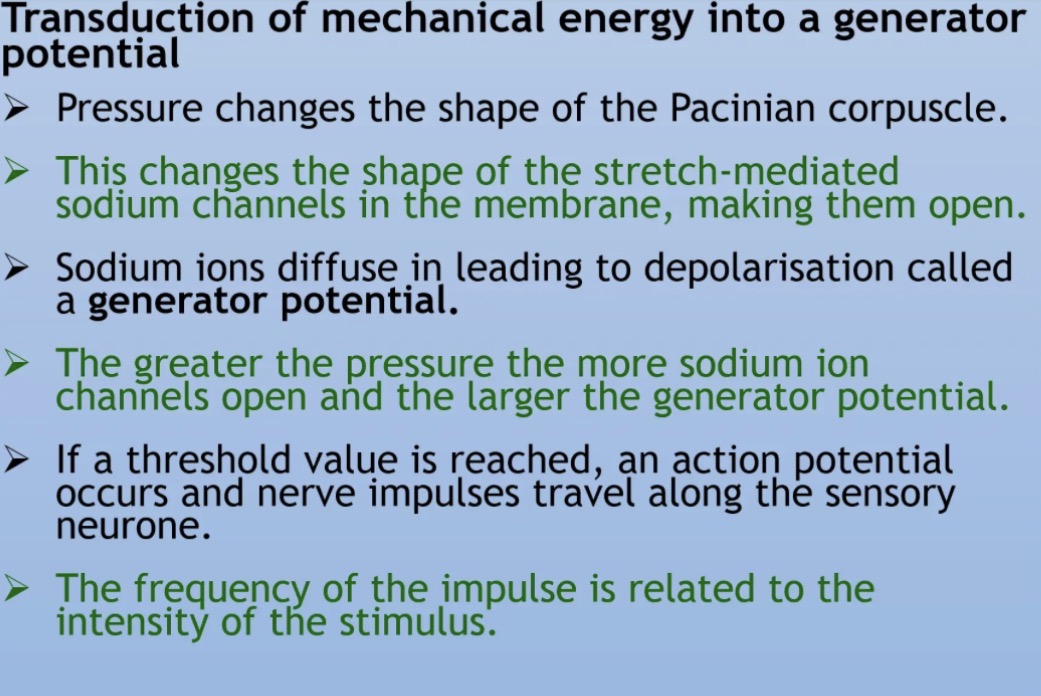
Each receptors convert one form of energy into another like mechanical into generator potential (which may result in a nervous impulse)
What is generator potential
Depolarisation of a membrane produced by a receptor cell as a result of stimulus
Pacinian corpuscle structure
Sensory neurone ending containing stretch mediated sodium ion channels surrounded by layers of connective tissue called lamellae with viscous gel between layers
How is an action potential stimulated in parcinian corpuscle
Explain why a parcinian corpuscle being stimulated may not result in an action potential being generated



What are photoreceptors
Receptors found on the retina that convert light energy into generator potential in bipolar cell where photoreceptors are connected via the breakdown of pigment in response to light. A certain threshold value has to be exceeded before a generator potential is created in bipolar cell where photoreceptors are connected
What is visual acuity
Ability to distinguish between 2 objects that are close together
What is the fovea
The point on the retina directly opposite the pupil where the light is focused and receives the highest intensity of light
Rod cells
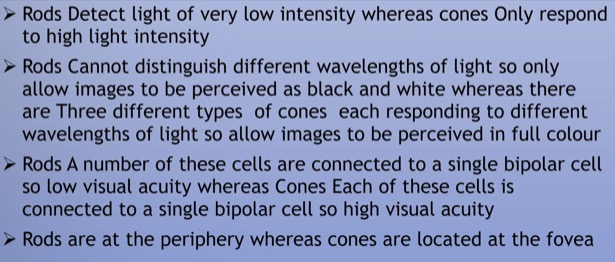
Rod cells detect light of very low intensity and cannot distinguish wavelengths of light so images are in black and white. Many rod cells connected to a single bipolar cell so low visual acuity. More rod cells at periphery absent at fovea
Cones cells
Only respond to high light intensity. Three different types each responding to different wavelengths of light so allow images to be perceived in full colour. Each of these cells is connected to a single bipolar cell so high visual acuity. Concentrated at fovea and very few at the periphery.
Compare rod and cone cells
Why do rods give low visual acuity
They detect light at low intensity so cannot distinguish different wavelengths so images are in black and white. Because a large number of rod cells are connected to a single bipolar neurone, light received by rod cells sharing the same neurone will only generate a single impulse travelling to the brain regardless of which of the rods are stimulated So brain cannot distinguish between the separate sources of light that stimulated
them.
Why do cones give high visual acuity
Because each cone is connected to its own bipolar neurone, so if 2 adjacent cone cells are stimulated, the brain receives 2 separate impulses from 2 separate
neurones The brain can therefore distinguish between the two separate sources of light that stimulated the two cone cells
Why do rods allow us to see in low light intensity
Because a number of rod cells are connected to a single bipolar neurone, (retinal convergence) generator potentials from several rod cells add together (summation), sufficient neurotransmitter released from rods collectively →much greater chance that the threshold value for action potential will be exceeded in bipolar neurone (individually rod cells would not be able to exceed threshold)