intro to animal behaviour
 Call Kai
 Learn
Learn Practice Test
 Spaced Repetition
 Match
Match Flashcards
 Knowt Play
1/41

Earn XP
Description and Tags
• Describe the main factors which shape species and individual behaviour • Discuss the pros and cons of living in groups and strategies for resolving conflict • Identify sensory adaptations and modes of communication. • Discuss relevance of factors shaping species and individual behaviour to captive living and Animal Behaviour identifying normal behaviour; adaptation or constraint?
Name | Mastery | Learn | Test | Matching | Spaced | Call with Kai |
|---|
No analytics yet
Send a link to your students to track their progress
42 Terms
what is animal behaviour
physiological and neurologucal signals
usually adaptive
features of innate species behaviour
highly conserved from distant ancestral species
feeding and foraging
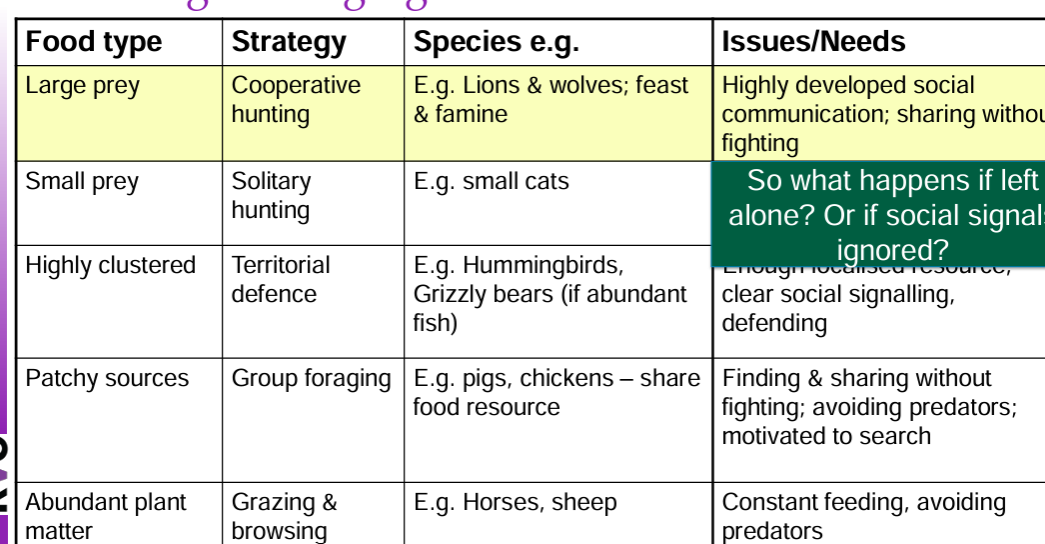
benefits of group living
food detection/ capture
anti predator-detection, dilution and defence
kin selection
comfort
social learning
disadvantages of group living
detection by predators
competition
disease risk
costly signals
where possible animals adapt to resolve conlict without violence
males competing for mates may develop energy costly signals- demonstrating virility to potential mates and also competitiveness to rivals- only fight when unclear who would win
dominance hierarchies
series paired relationships in group: one individual has priority of resource access over the other
dominance conferred by subordinate
stable hierarchy- low aggression maintianed by clear but often sublet signals
familiarity and individual recognition
frequent enoug interactions to preduct fight outcomes
usually small familiar group
relies on memories
status badges
infrequent interactions/impractical to remember indiviudals
so usually large and/ or unfamiliar groups such as seasonal breeders
relies on signals of stats eg male house sparrow black bib which is related to testosterone level
too much competition
increasing group size or reducing food
subordinates leave
too small
less dilution effect
dominants grant subordinates access to resources/breeders
sensory
color
brightness
temporal movement
spacial
signals
field of view eg predators binocular for depth and prey monocular so wide
olfactory sensitivity
olfactory range
signals
volume
requency range
expression of gentically determined traits
can be switched on and off by environmental conditions
prenatally
during early development
sensitive periods
periods during life when sensitive to specific learning
filial imprining
follow the first salient thing that moves
sexual imprinting
usually court individuals similar but not too simlar to those you first imprinited on
relatvely permanent and inflexible
abnormalities eg hand rearing
other critical period
socialisation
recognition of young
domestificaition
behavioural repertoire remains but expressed with differing frequency, duration and intensity and social tolderance increased
deliberate trait selecction
eg temperament
labradors demonstrate low aggression across studie
inadverten trait selecion
eg morphology
short snouted puppies sniffed more and elicited moreplay from other puppies vs longer snout
eye cover elicited more bites to body
selection for infantile behaviour and sociability towards humans predisposesseparation anxiety
why cant highly motivated behavour sometimes not be expressed
environmental deficits
what is behavour influenced by
species level
evolutionary adaptation to a biological niche
individual
genetic tendencies
dev environment
learning and experience
current situation including presence of learnt cues and senosry environment
modal action pattern
a sequence of movements shown by an individual that is repeated in largely invariate form. triggered by a ‘releaser stimulus’
more recently considered ore flexible complex sequences
high probability of speciifc non random movements
individuals can show variation in expression
action sequences
usually innate but can include learned components often highly motivated
usually components all relate to a single goal
what does learning allow
modification of innae genetically encoded behaviour
habituation
Habituation: response to a stimulus decreases with repeated exposure • Acts on innate unlearned responses to specific stimuli • Spontaneous recovery if stimulation withheld • Can be used to reduce fear
sensitisation
Sensitisation: response to a stimulus increases with repeated exposure • Short term effects • Indiscriminate • Likely to increase fear
classical conditioning
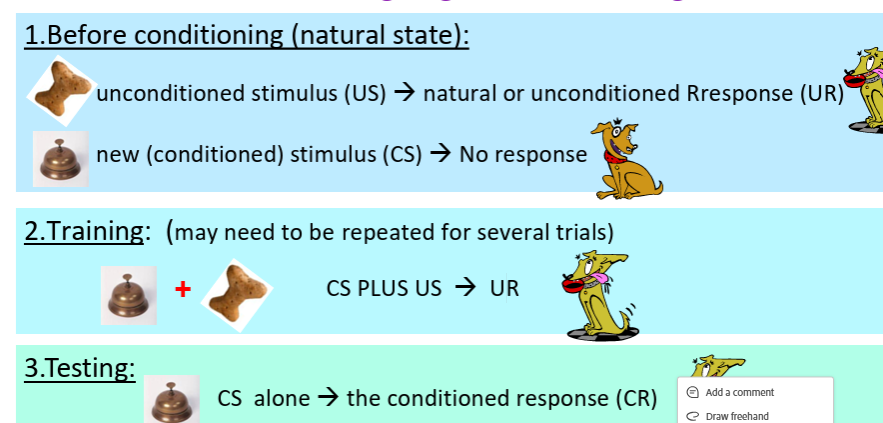
1. Classical conditioning (e.g. Pavlov’s dogs) Association formed between an event (good or bad) & a neutral but predictive cue → response to cue as if it were event
learning curve
Typically shows s-shape with slow start, fast learning with rapid increase in learned or conditioned response over a few sessions, followed by a more gradual increase until it reaches a plateau
associative
Association formed between an event (good or bad) & a neutral but predictive cue → response to cue as if it were event Animal’s behaviour has no effect on what happens (no control) Response can be emotion
operant or instrumental conditioning
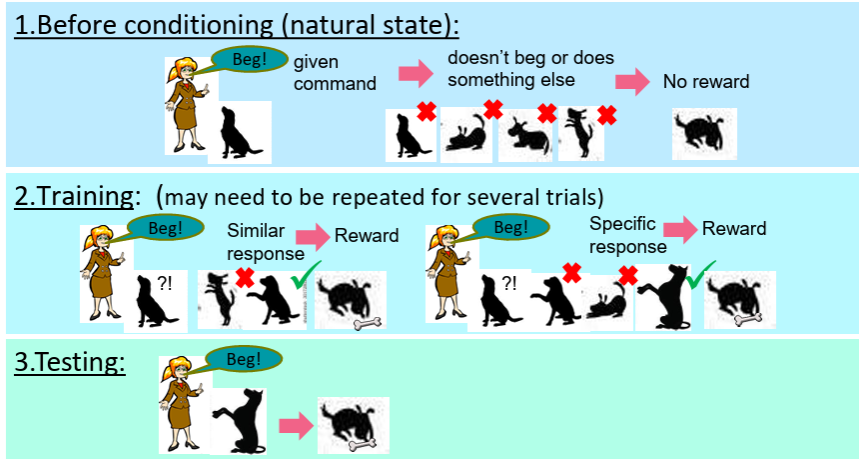
Association formed between an event (discriminative stimulus / cue), a behavioural response (operant) and the outcome (reinforcer / punisher) Behaviour dictates outcome
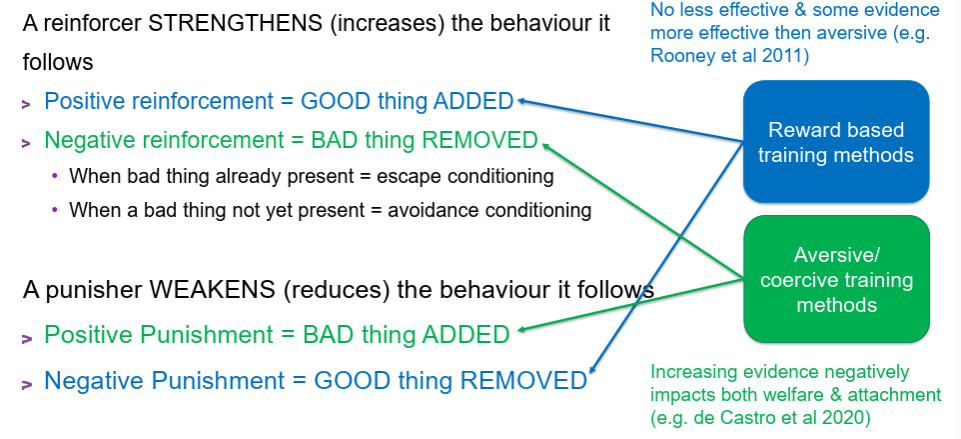
strengthening or weakening the response
caution
Highly motivated behaviour can be resilient to some types of punishment Must be an alternative behavioural route to the animal’s “goal” Timing & intensity are critical – must be applied very quickly at sufficient strength to stop behaviour. BUT severe positive punishment can induce aggression and/or emotional conflict Learned helplessness – if required response unknown/punishment inconsistent/too severe/ inescapable
timeout
Time out Must be consistently and rapidly applied – a signal for undesirable behaviour can be used Repetition is important & time out must be short - <3 min Time out should be in an undesirable location (e.g. bathroom) NO reinforcement to be received during time out Correct behaviour requires reinforcement
what other factors affect learning
Motivation: • Learning occurs if animal is highly motivated for the reinforcer / to avoid the punisher • Related to the perceived reinforce/punisher value/impact ▪ This could be a feature of quantity or quality (type) • This may change with exposure ▪ For reinforcers the animal may become satiated ▪ For punishers, the animal may become habituated
what factors affectiveassociative learning
Timing is crucial (Contiguity):
• Requires a close temporal association between events (e.g. CS and US [classical] or behavioural response & reward [operant]) for learning to occur
Reliability of pairing/outcome is important in initial acquisition (contingency):
• Learn whichever CS has the highest probability of predicting the US (classical)
• Learn whichever response has the highest probability of achieving the desired outcome (operant) Intensity of conditioning or discriminative stimulus – (salience)
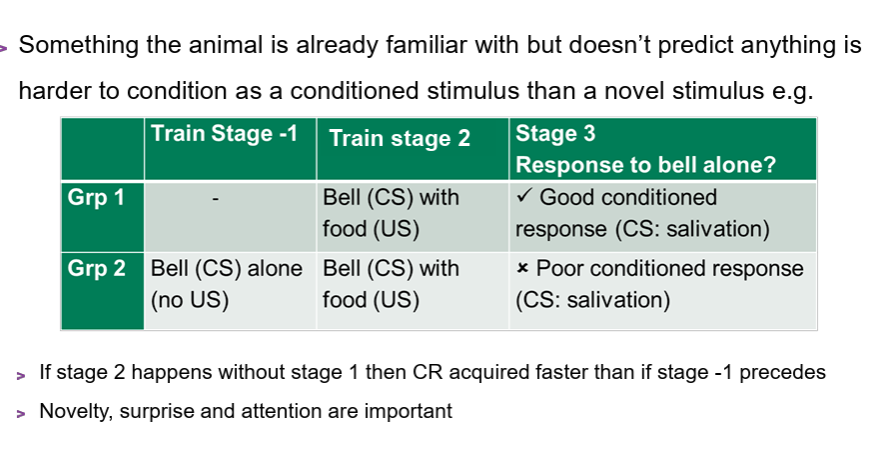
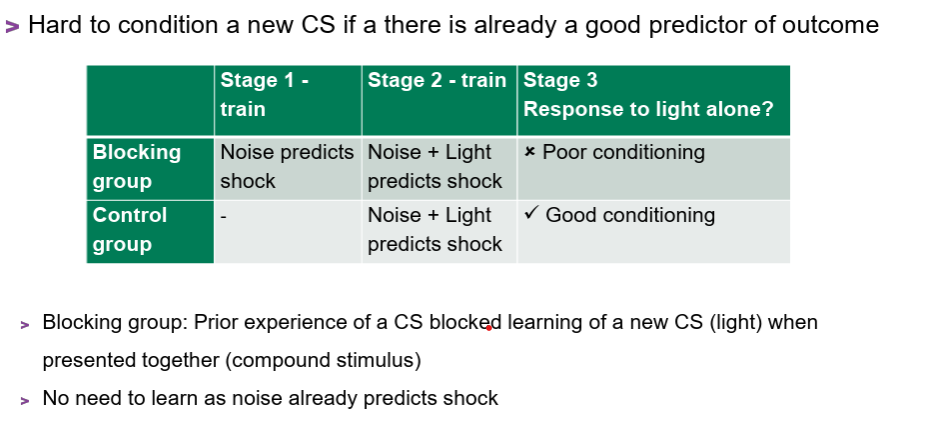
• Affected by familiarity of stimulus, what they have already learned and sensory predispositions
latent inhibition
blocking
competing motivations
Competing motivations • Learning about a new environment or novel stimuli may take precedence / distract from training • Frightened animals may be distracted & stress may interfere with memory formation (Mendl et al 1997) • Social environment may also distract animals • Sensory cues in the environment
species predispositions
Easier to condition certain, ‘more natural’ associations than others (e.g. food aversion with sickness – evolutionary advantage) Tendency to perform species-specific food acquiring behaviour in response to an opportunity to get food (e.g. Breland & Breland 1961) Species-specific responses to fear-eliciting stimulus may constrain training a new response e.g. freezing vs avoidance
associative learning processes
Generalisation • Transfer of learning from one context to another • Learned response to similar but different eliciting cue / event Discrimination • Selectively responding only to a specific cue when other similar cues are present
Extinction • Gradual weakening and ceasing of conditioned response when ▪ Conditioned stimulus no longer paired with the unconditioned (classical conditioning) ▪ Reinforcement of a behaviour stops (operant conditioning) • NOT forgetting as information is retained and can spontaneously reoccur • Behaviour may be resistant to extinction if original conditioning very strong (e.g. long period of conditioning, intense CS, highly motivated salient reinforcer etc)