Part 8- FUNGAL / ANIMAL TOXINS and AIR POLLUTANTS
 Call Kai
 Learn
Learn Practice Test
 Spaced Repetition
 Match
Match Flashcards
 Knowt Play
1/37

There's no tags or description
Looks like no tags are added yet.
Name | Mastery | Learn | Test | Matching | Spaced | Call with Kai |
|---|
No analytics yet
Send a link to your students to track their progress
38 Terms
Aflatoxin is produced by:
a. Clostridium botulinum
b. Penicillium notatum
c. Claviceps purpurea
d. Aspergillus flavus
d. Aspergillus flavus
Aflatoxin contamination is commonly associated with:
a. Fresh fruits
b. Dairy products
c. Improperly dried peanuts and grains
d. Seafood
c. Improperly dried peanuts and grains
Compared with children, adults exposed to aflatoxin are more likely to be:
a. Immediately symptomatic
b. More severely affected
c. Relatively tolerant and asymptomatic
d. Unable to metabolize the toxin
c. Relatively tolerant and asymptomatic
↑ Tolerance – asymptomatic
A child exposed to significant amounts of aflatoxin is at greatest risk of developing:
a. Acute hepatic necrosis
b. Pulmonary fibrosis
c. Renal stones
d. Myocardial infarction
a. Acute hepatic necrosis
Acute hepatic necrosis → liver cirrhosis → liver cancer
The treatment of aflatoxin poisoning is primarily:
a. Chelation therapy
b. Naloxone
c. Supportive care
d. Hemodialysis
c. Supportive care (IV fluids and electrolyte replacement)
Saxitoxin is produced by:
a. Aspergillus flavus
b. Dinoflagellates
c. Claviceps purpurea
d. Clostridium botulinum
b. Dinoflagellates
Saxitoxin is responsible for:
a. Minamata disease
b. Red tide poisoning
c. Itai-itai disease
d. Mad Hatter disease
b. Red tide poisoning
Another name for saxitoxin poisoning is:
a. Ciguatera poisoning
b. PSP
c. Ergotism
d. Scombroid poisoning
b. Paralytic shellfish poisoning (PSP)
The mechanism of action of saxitoxin is:
a. Acetylcholinesterase inhibition
b. Na⁺ channel blockade
c. K⁺ channel blockade
d. Calcium channel activation
b. Na⁺ channel blockade
Na+ channel blocker (important for muscle depolarization → contraction) → flaccid paralysis
The characteristic type of paralysis seen in saxitoxin poisoning is:
a. Spastic paralysis
b. Flaccid paralysis
c. Rigid paralysis
d. Hemiplegia
b. Flaccid paralysis
Na+ channel blocker (important for muscle depolarization → contraction) → flaccid paralysis
The most serious complication of saxitoxin poisoning is:
a. Liver failure
b. Renal failure
c. Respiratory depression
d. GI hemorrhage
c. Respiratory depression
Amatoxin is found in which mushroom?
a. Psilocybe cubensis
b. Amanita muscaria
c. Amanita phalloides
d. Agaricus bisporus
c. Amanita phalloides
Amanita phalloides is commonly known as:
a. Angel Dust
b. Destroying Angel
c. Death Cap
d. Mad Hatter
b. Destroying Angel
The primary mechanism of amatoxin toxicity is:
a. Inhibition of acetylcholinesterase
b. Blockade of Na⁺ channels
c. Inhibition of RNA polymerase II
d. Activation of opioid receptors
c. Inhibition of RNA polymerase II
inhibits RNA polymerase II in the liver → ↓ protein synthesis → hepatotoxicity
The hepatotoxicity of amatoxin is primarily due to:
a. Free radical formation only
b. Decreased protein synthesis in hepatocytes
c. Vasoconstriction
d. Hemolysis
b. Decreased protein synthesis in hepatocytes
inhibits RNA polymerase II in the liver → ↓ protein synthesis → hepatotoxicity
A patient develops severe liver injury after ingesting wild mushrooms. The most likely toxin is:
a. Saxitoxin
b. Aflatoxin
c. Amatoxin
d. Ergotamine
c. Amatoxin
The cornerstone of treatment for amatoxin poisoning is:
a. Naloxone
b. Supportive care
c. Flumazenil
d. Vitamin K
b. Supportive care (IV fluids, electrolytes)
Which drug has been proposed to competitively inhibit amatoxin at hepatic receptors?
a. Penicillin G
b. Pyridoxine
c. Atropine
d. Benzylpenicillin
a. Penicillin G &
d. Benzylpenicillin
Pen G is aka Benzylpenicillin
Benzylpenicillin is used in amatoxin poisoning because it:
a. Enhances RNA synthesis
b. Stimulates RNA polymerase II in the liver
c. Competitively inhibits amatoxin uptake in the liver (theoretical)
d. Neutralizes mushroom toxins directly
c. Competitively inhibits amatoxin uptake in the liver (theoretical)
Latrotoxin is the venom of:
a. Brown recluse spider
b. Black widow spider
c. Scorpion
d. Cobra
b. Black widow spider
Latrotoxin is produced by:
a. Loxosceles reclusa
b. Latrodectus mactans
c. Amanita phalloides
d. Claviceps purpurea
b. Latrodectus mactans
The mechanism of action of latrotoxin is:
a. Inhibits acetylcholinesterase
b. Blocks Na⁺ channels
c. Causes presynaptic release of acetylcholine
d. Inhibits RNA polymerase II
c. Causes presynaptic release of acetylcholine
LATROTOXIN Clinical Presentation:
Parasympathomimetic or Sympathetic?
Xanthopsia or Conjunctivitis?
Restlessness or Coma?
Hypertension or Hypotension?
Parasympathomimetic
Conjunctivitis
Restlessness
Hypertension
The specific treatment for severe latrotoxin poisoning is:
a. Naloxone
b. Flumazenil
c. Antivenom
d. Deferoxamine
c. Antivenom
Tetrodotoxin is commonly associated with:
a. Black widow spider
b. Pufferfish
c. Amanita mushroom
d. Dinoflagellates
b. Pufferfish
Tetrodotoxin may be found in all EXCEPT:
a. Amphibians
b. Mollusks (snails, octopus)
c. Shellfish
d. Pufferfish
c. Shellfish
Which country is classically associated with pufferfish poisoning?
a. China
b. India
c. Japan
d. Brazil
c. Japan
The mechanism of action of tetrodotoxin is:
a. Acetylcholinesterase inhibition
b. Presynaptic ACh release
c. Na⁺ channel blockade
d. RNA polymerase II inhibition
c. Na⁺ channel blockade
same with saxitoxin
The earliest symptom of tetrodotoxin poisoning is often:
a. Jaundice
b. Perioral numbness
c. Hematuria
d. Blindness
b. Perioral numbness
The characteristic type of paralysis in tetrodotoxin poisoning is:
a. Spastic paralysis
b. Flaccid paralysis
c. Hemiplegia
d. Rigidity
b. Flaccid paralysis
same with saxitoxin
The most important treatment for severe tetrodotoxin poisoning is:
a. Naloxone
b. Flumazenil
c. Airway support and intubation
d. IV fluids and supplements
c. Airway support and intubation
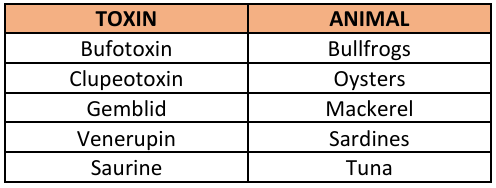
TETRODOTOXIN Toxicity:
Bufotoxin
Clupeotoxin
Gemblid
Venerupin
Saurine
Choices:
a. Mackerel
b. Bullfrogs
c. Oysters
d. Tuna
e. Sardines
Which of the following is a common air pollutant?
a. Lead
b. Carbon Monoxide (CO)
c. Mercury
d. Arsenic
b. Carbon Monoxide (CO)
Which gas is NOT typically included among the major air pollutants?
a. Nitric Oxide (NO)
b. Sulfur Dioxide (SO₂)
c. Ozone (O₃)
d. Nitrous Oxide (N₂O)
d. Nitrous Oxide (N₂O)
Which of the following is a common acute effect of air pollutant exposure?
a. Airway irritation
b. Hepatic necrosis
c. Renal failure
d. Bone fractures
a. Airway irritation
Severe exposure to air pollutants may result in:
a. Pulmonary edema
b. Hemophilia
c. Osteomalacia
d. Hyperthyroidism
a. Pulmonary edema
Chronic exposure to air pollutants primarily causes:
a. Acute liver failure
b. Chronic cardiopulmonary disease
c. Bone marrow suppression
d. Peripheral neuropathy
b. Chronic cardiopulmonary disease
Which statement regarding air pollutant toxicity is TRUE?
a. Effects always immediately damage the lungs
b. Chronic exposure may gradually damage the lungs
c. Air pollutants only affect the skin
d. Pulmonary edema never occurs
b. Chronic exposure may gradually damage the lungs