5. Seismic Hazards
 Call Kai
 Learn
Learn Practice Test
 Spaced Repetition
 Match
Match Flashcards
 Knowt Play
1/10

There's no tags or description
Looks like no tags are added yet.
Name | Mastery | Learn | Test | Matching | Spaced | Call with Kai |
|---|
No analytics yet
Send a link to your students to track their progress
11 Terms
Describe the nature and distribution of earthquakes? Giving an example how do intra-plate earthquakes occur?
Most earthquakes (95%) occur along plate margins mostly conservative eg: San Andreas fault line (fault line slip rate 2-3cm per year) and destructive (most powerful at destructive plate margins)
Many earthquakes occur along the Pacific Ring of Fire
Intra-plate earthquakes can occur due to the reactivation of old fault lines or hotspots eg: South Wales earthquake 2018 which occurred due to activity along a pre-existing fault line
How may humans be responsible for earthquakes?
Human induced earthquakes may be caused by:
Building large reservoirs which puts pressure on underlying rocks
Fracking (hydraulic fracturing of rock to release gas). Eg: Permian Basin of West Texas 2025
Describe what an earthquake is and how they happen using key words?
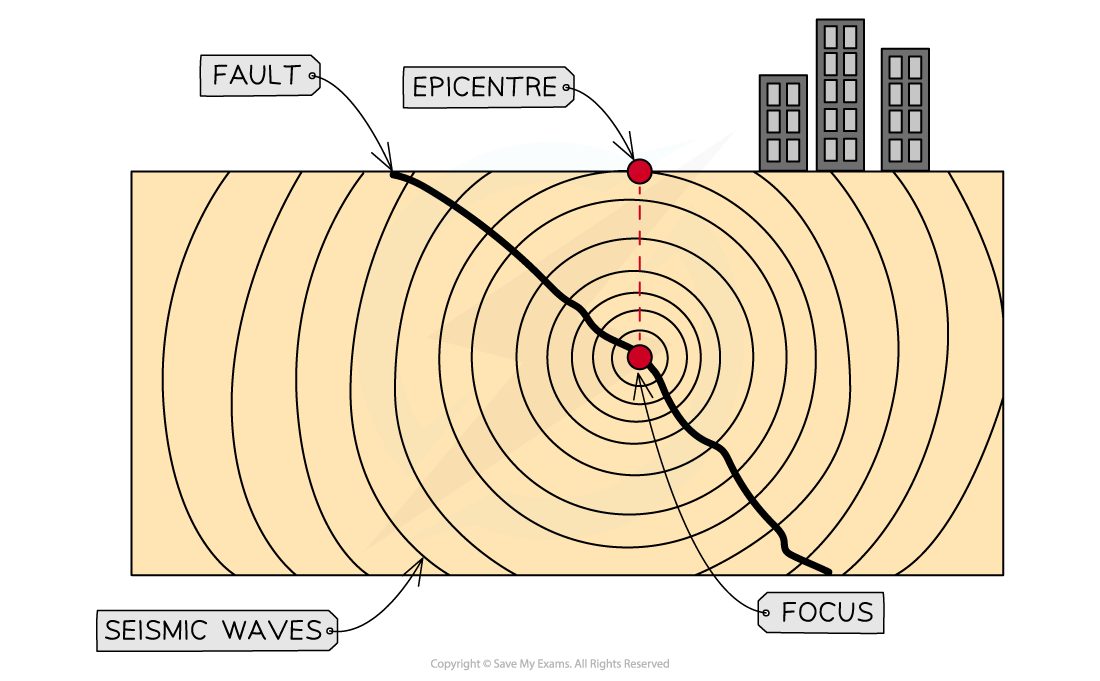
Earthquakes occur due to movements in the Earth’s crust causing stress to build up and rocks deform.
Stored energy builds up until it eventually exceeds the strength of the rock and releases known as elastic rebound → rock fractures along the fault
Intense vibrations/seismic waves spread out from the initial point of fracture (the focus) causing the ground to shake
The point directly above the focus is the epicentre (largest seismic waves)
Describe how the depth of focus impacts seismic events?
Shallow focus (0-70km deep), intermediate focus (70-300km), deep focus (300-700km)
The shallower the earthquake = more destructive
Shallow = all plate boundaries, intermediate = mainly at subduction zones under the trench but can be continental collision zones, deep = always at subduction zones
Describe how the different plate boundaries impact seismic events?
Conservative margins (e.g. San Andreas Fault): plates lock due to friction, stress builds up and is released suddenly → powerful shallow earthquakes and high surface damage.
Destructive margins: subduction of dense oceanic crust creates large megathrust earthquakes, sometimes triggering tsunamis.
Constructive margins (e.g. Mid-Atlantic Ridge): plates pull apart, tension is released more gradually → frequent but generally low-magnitude earthquakes.
Continental collision zones (e.g. Himalayas): strong compression creates shallow crustal earthquakes, often causing landslides and rockfalls in mountainous terrain.
How does the rate of movement impact seismic hazards?
Faster plate movement → stress accumulates more quickly, increasing the likelihood of frequent earthquakes.
Slower plate movement → stress builds over longer periods, potentially producing very large but less frequent earthquakes when released.
What are the 3 scales to measure earthquakes and describe them?
Richter Scale - measured magnitude but was replaced with the moment magnitude scale as it underestimates the magnitude of large-scale events
Moment Magnitude Scale - measures magnitude (energy released at the focus) using using seismographs. Logarithmic scale from 1-10+
Modified Mercalli Intensity Scale - measures intensity (impact on people) from I to XII
Describe the frequency of seismic hazards and the seismic gap theory?
Low magnitude earthquakes occur much more frequently than high magnitude earthquakes → there are around 20,000 earthquakes around the world every year many are low magnitude so not felt by humans
According to records from 1900, we expect around 16 major earthquakes (magnitude 7.0 or greater) every year however, in 1989 there were only 6
Seismic gap theory suggests that if there has been little or no earthquake activity at a plate margin for a long period of time, it is more likely to experience a large earthquake in future
This is because stress will have built up for a longer period of time, so more energy will be released - helps identify area at higher risk of large earthquakes however, it is not precise and not all seismic gaps result in large earthquakes
Describe earthquakes as a primary hazard form of seismic hazard?
This is the ground shaking. Mainly occurs on plate margins (check flashards further up). Magnitude is impacted by: type of plate margin, rate of movement, depth. Eg: 2011 Tohoku earthquake in Japan which occurred on a destructive margin had a magnitude of 9.0-9.1
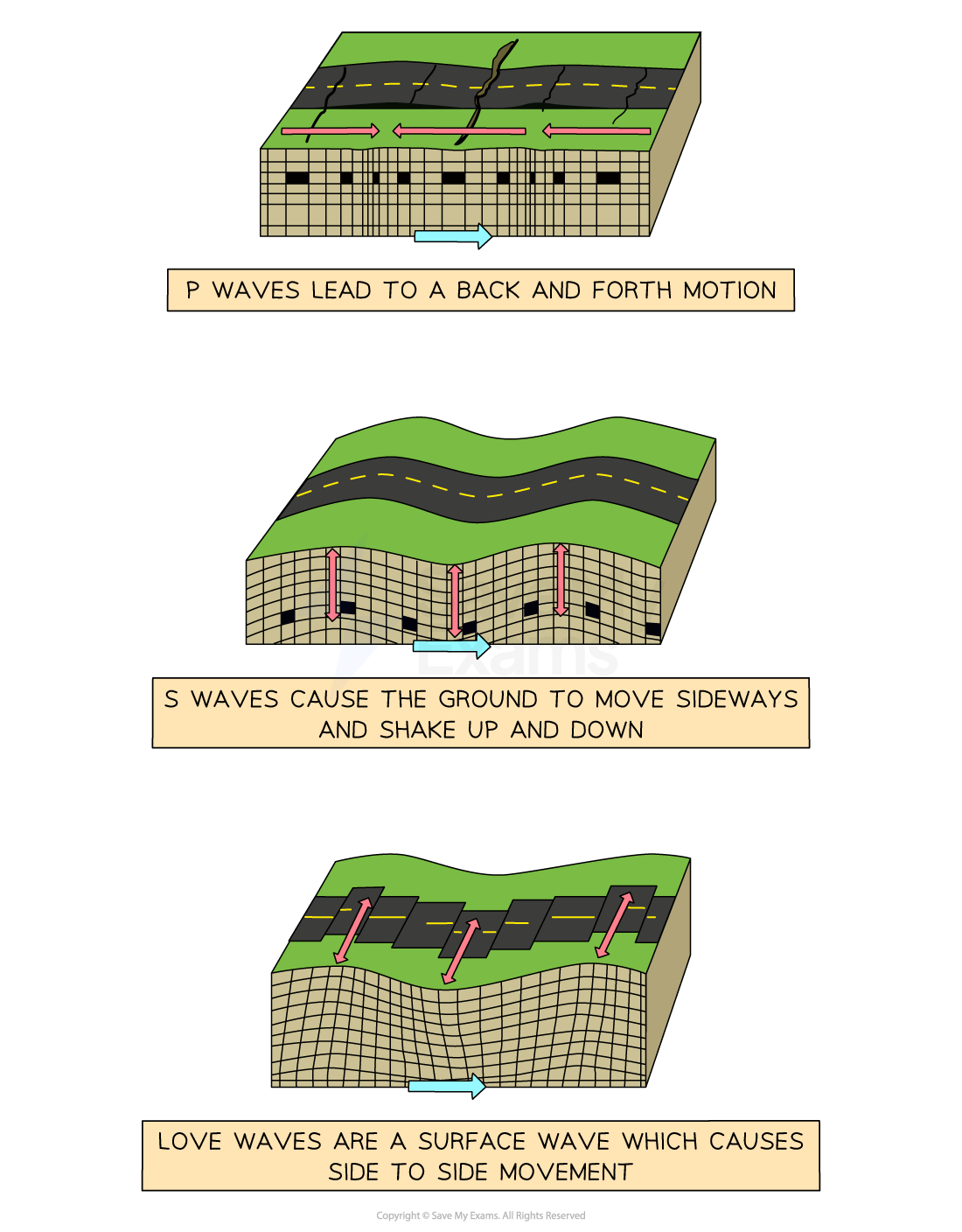
Describe shockwaves as a primary form of seismic hazard?
Wave type | Characteristics |
|---|---|
Primary - P waves |
|
Secondary - S waves |
|
Love - L waves |
|
Seismic shockwaves are released energy from the earth causing movement