7 The Blueprint of Life, From DNA to Protein
 Call Kai
 Learn
Learn Practice Test
 Spaced Repetition
 Match
Match Flashcards
 Knowt Play
1/19

There's no tags or description
Looks like no tags are added yet.
Name | Mastery | Learn | Test | Matching | Spaced | Call with Kai |
|---|
No analytics yet
Send a link to your students to track their progress
20 Terms
DNA
Hereditary material that is passed onto offspring
Characteristics of each cell is dictated by information contained within [__]
Genome
Complete set of genetic information
[__] of all cells is composed of DNA
gene: functional unit of the [__]; codes for products (protein, RNA)
Genomics
Study of nucleotide sequence
Phenotype
Visible or observable trait of that individual or cell (product of their genotype)
takes form of:
physical characteristics
enzymes that perform certain actions inside cell
made possible by expression of genes
Genotype
Genome of the organism that contains all of their genes
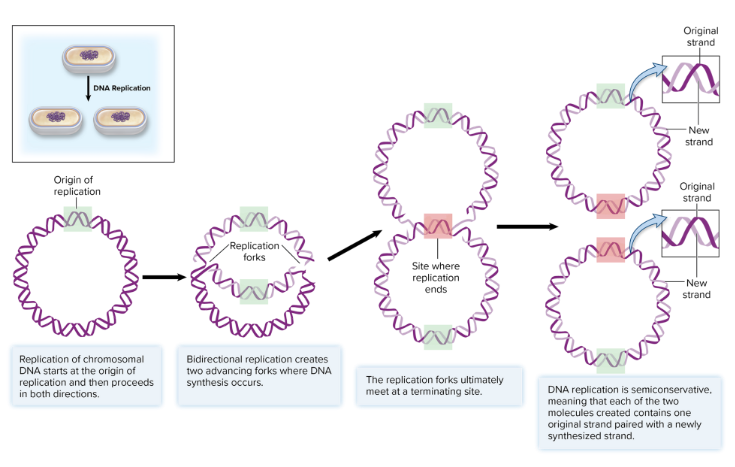
DNA replication
1/2 tasks cells must accomplish to multiply
The duplication of genome
origin of replication: distinct region of DNA molecule where replication is initiated
melting of double-stranded DNA = breaking of DNA complex apart so that strands can be used as a template for synthesis
creates “replication bubble”
creates replication forks: site where double helix is unwound to expose single strands that can act as templates; where synthesis is advancing towards
“advancing forks”
[__] is bidirectional: goes in both directions
goes till termination site » DNA molecules go apart and go into new daughter cells
![<p><mark data-color="#f4eeee" style="background-color: rgb(244, 238, 238); color: inherit;">1/2 tasks cells must accomplish to multiply</mark></p><p>The duplication of genome</p><ul><li><p><strong><mark data-color="purple" style="background-color: purple; color: inherit;">origin of replication</mark></strong>: distinct region of DNA molecule where replication is initiated</p></li><li><p><mark data-color="blue" style="background-color: blue; color: inherit;">melting of double-stranded DNA</mark> = breaking of DNA complex apart so that strands can be used as a template for synthesis</p><ul><li><p>creates “replication bubble”</p></li><li><p>creates <strong><mark data-color="purple" style="background-color: purple; color: inherit;">replication forks</mark></strong>: site where double helix is unwound to expose single strands that can act as templates; where synthesis is advancing towards </p><ul><li><p><mark data-color="yellow" style="background-color: yellow; color: inherit;">“advancing forks”</mark></p></li></ul></li></ul></li></ul><p></p><p>[__] is <strong><mark data-color="purple" style="background-color: purple; color: inherit;">bidirectional</mark></strong>: goes in both directions</p><ul><li><p>goes till <mark data-color="blue" style="background-color: blue; color: inherit;">termination site</mark> » DNA molecules go apart and go into new daughter cells</p></li></ul><p></p>](https://assets.knowt.com/user-attachments/02ec8d1c-0826-46a9-82e9-c5cc90a6fbe4.png)
semiconservative
Refers to the model that DNA divides
wherein it contains:
one original strand of DNA
parental strand → template strand
a newly synthesized DNA strand
RNA primer
Synthesized by enzymes called primases
Initiates the DNA strand for replication; Required by DNA polymerase in order to replicate as it places down a 3’ -OH end
DNA polymerase
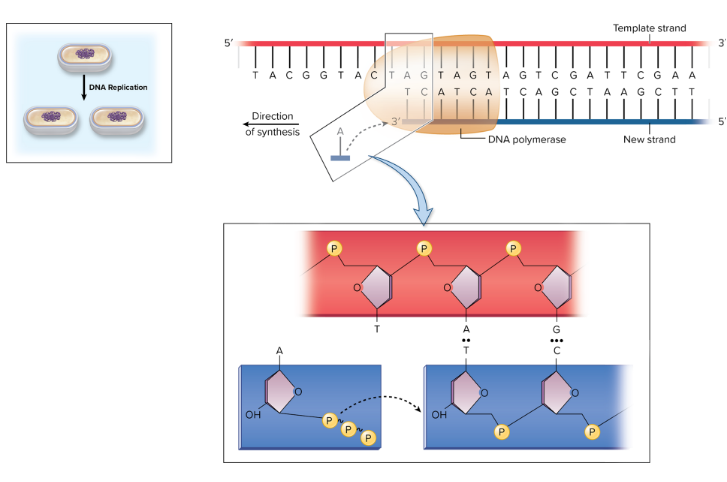
Enzyme that carries out DNA replication
Reads and synthesizes only from one direction, (3’ to 5’) and (5’ to 3’) respectively
Can only add nucleotides, not initiate
» MUST be 3’ -OH end in order to add
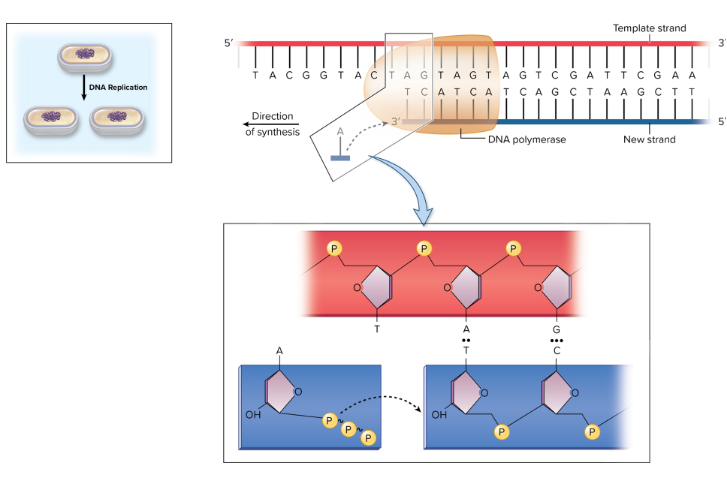
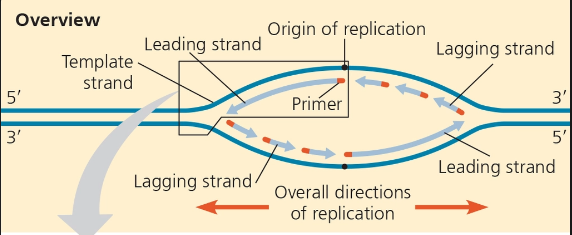
notice: lagging and leading strands occur as only portions of the newly synthesized strand goes the “right way” for [__]
synthesized strand 5’ to 3’ » leading strand
synthesized strand 3’ to 5’ » lagging strand (has fragments)
![<p><mark data-color="yellow" style="background-color: yellow; color: inherit;">Enzyme that carries out DNA replication</mark></p><p><strong><mark data-color="blue" style="background-color: blue; color: inherit;">Reads</mark> and <mark data-color="purple" style="background-color: purple; color: inherit;">synthesizes</mark> only from one direction,</strong> <mark data-color="blue" style="background-color: blue; color: inherit;">(3’ to 5’)</mark> and <mark data-color="purple" style="background-color: purple; color: inherit;">(5’ to 3’)</mark> respectively</p><p>Can only add nucleotides, not initiate</p><p>» MUST be <mark data-color="purple" style="background-color: purple; color: inherit;">3’ -OH end</mark> in order to add</p><img src="https://assets.knowt.com/user-attachments/3fdc3ee9-3958-4052-a7d8-961f243de141.png" data-width="50%" data-align="center"><p></p><img src="https://assets.knowt.com/user-attachments/b86a36c3-1b53-49bb-b37e-f776c866baec.png" data-width="100%" data-align="center"><p>notice: <mark data-color="yellow" style="background-color: yellow; color: inherit;">lagging and leading strands occur as only portions of the newly synthesized strand </mark><strong><mark data-color="yellow" style="background-color: yellow; color: inherit;">goes the “right way” for [__]</mark></strong></p><p>synthesized strand 5’ to 3’ » leading strand</p><p>synthesized strand 3’ to 5’ » lagging strand (has fragments)</p>](https://assets.knowt.com/user-attachments/cfa425f6-1a6b-46b8-83a6-becf5a329bbe.png)
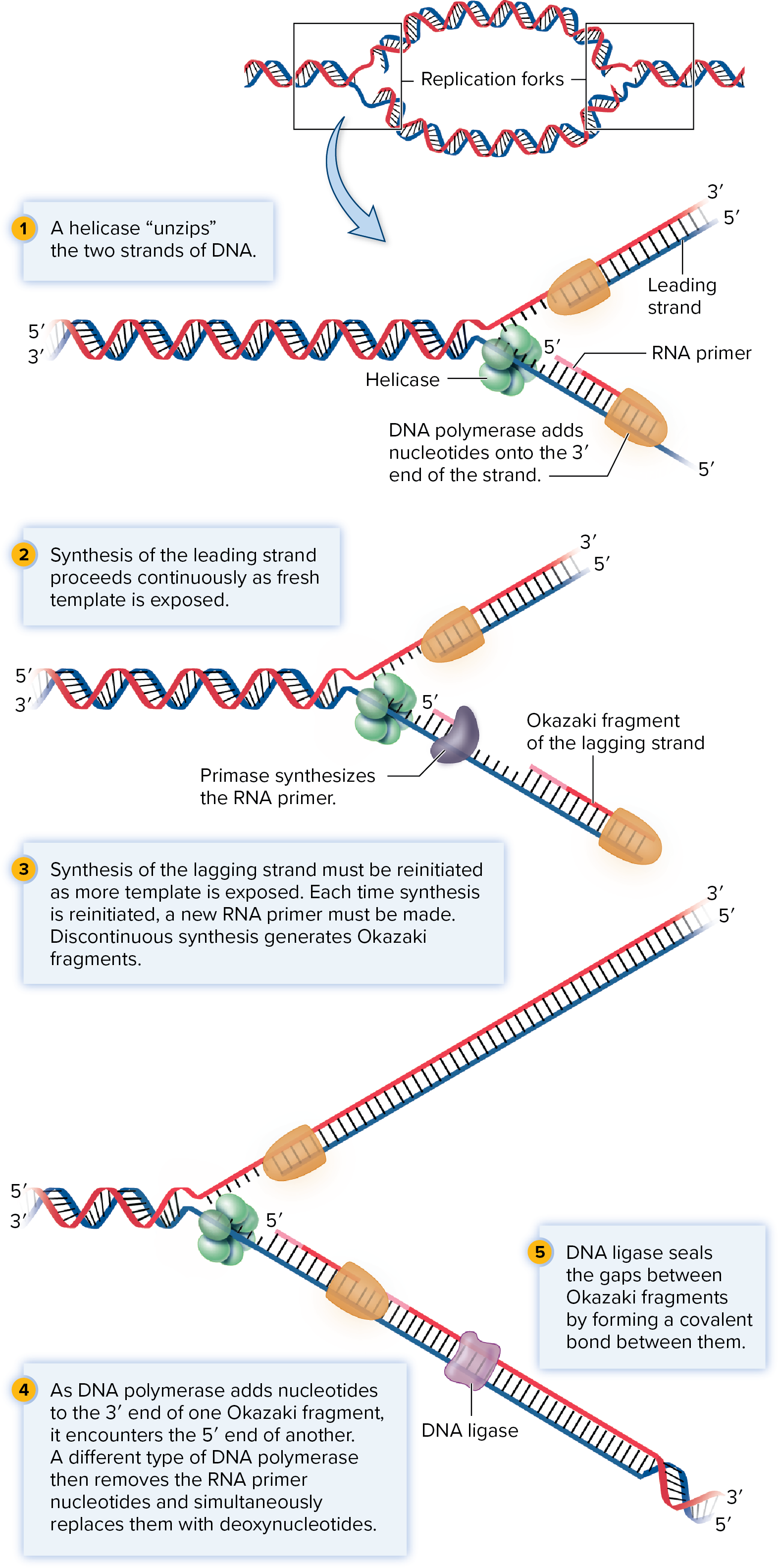
Okazaki fragments
Small fragments the lagging strand is synthesized into.
Nucleic acid fragment synthesized as a result of the discontinuous replication of the lagging strand of DNA.
origin of replication
Distinct region of DNA molecule where replication is initiated
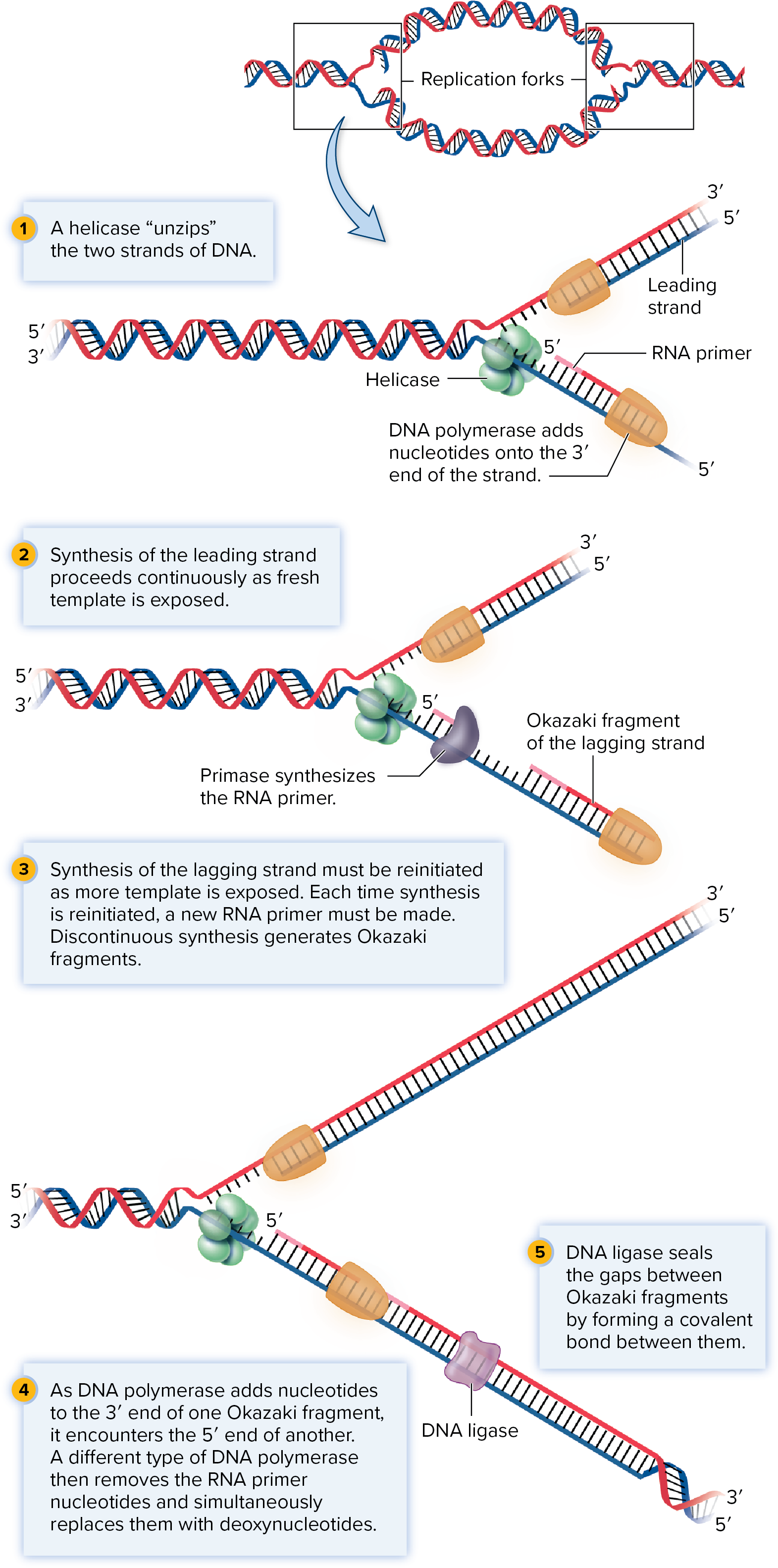
How DNA replication works across template strands from the [__] is that:
RNA primer initiates leading strand synthesis
as soon as leading strand reaches end of replication fork, RNA primer is placed down on second template strand
RNA primer initiates lagging strand synthesis
DNA polymerase finishes synthesis of Okazaki fragments and a different DNA polymerase remove the RNA primer in between the fragments
gets sealed, and the two synthesized DNA strands look identical
![<p>Distinct region of DNA molecule where replication is initiated</p><p></p><p><u>How DNA replication works across template strands from the [__] is that</u>:</p><ul><li><p><mark data-color="yellow" style="background-color: yellow; color: inherit;">RNA primer initiates </mark><strong><mark data-color="yellow" style="background-color: yellow; color: inherit;">leading strand</mark></strong><mark data-color="yellow" style="background-color: yellow; color: inherit;"> synthesis</mark></p></li><li><p>as soon as leading strand reaches end of replication fork, RNA primer is placed down on<mark data-color="purple" style="background-color: purple; color: inherit;"> second template strand</mark></p></li><li><p><mark data-color="yellow" style="background-color: yellow; color: inherit;">RNA primer initiates </mark><strong><mark data-color="yellow" style="background-color: yellow; color: inherit;">lagging strand</mark></strong><mark data-color="yellow" style="background-color: yellow; color: inherit;"> synthesis</mark></p></li><li><p>DNA polymerase finishes synthesis of <strong>Okazaki fragments </strong>and <mark data-color="yellow" style="background-color: yellow; color: inherit;">a different DNA polymerase remove the RNA primer in between the fragments</mark></p></li><li><p>gets sealed, and the two synthesized DNA strands look identical</p></li></ul><p></p>](https://assets.knowt.com/user-attachments/17ec5ff8-519a-42da-9576-7fdff1c247ec.png)
leading strand
Strand that synthesizes continuously (5’ → 3’) as it only has to add on to the 3’ end in the direction that RNA polymerase is used to (3’ to 5’)
synthesizes towards replication fork, away from origin of replication
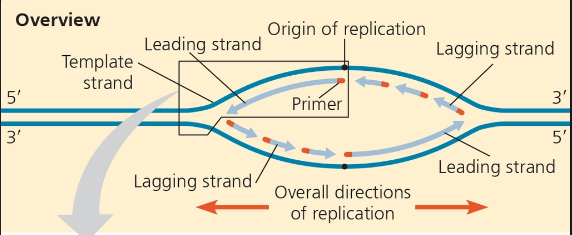
vs. lagging strand (3’ → 5’) synthesizing in chunks as it has to latch on to parental strand of (5’ to 3’) while only being able to add to 3’-OH
synthesizes away from replication fork, towards origin of replication
lagging strand
Strand that synthesizes in chunks (3’ → 5’) as it has to latch on to parental strand of (5’ to 3’) while only being able to add to 3’-OH
→ must be reinitiated regularly by RNA primer
synthesizes away from replication fork, towards origin of replication
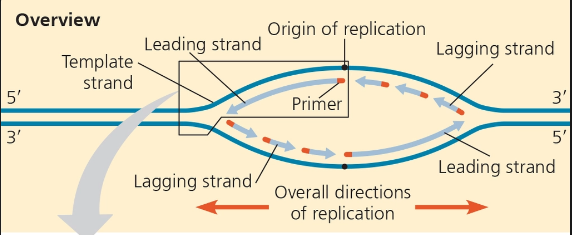
vs. leading strand (5’ → 3’) synthesizing continuously on (3’ to 5’) as it just needs to add on to the 3’ end in the direction RNA polymerase is used to
synthesizes towards replication fork, away from origin of replication
Gene expression
2/2 tasks cells must accomplish to multiply
The transcription and translation of DNA information to produce the encoded product
DNA —transcription→ RNA —translation→ protein
central dogma
The [__] of molecular biology is that information flows from
DNA » RNA » protein
DNA
Deoxyribonucleic acid. Made of deoxyribonucleotides
double-helix and double-stranded with complementary nitrogenous bases
Adenine «» Thymine
paired by 2 hydrogen bonds
Cytosine «» Guanine
paired by 3 hydrogen bonds ; stronger bond
melting/denaturing separates strands
antiparallel: runs/grows in opposite directions
one strand runs from 3’C to 5’C
another runs opposite from 5’ to 3’
note:
‘or “prime” refers to attachments to [__]’s 5-carbon sugar/pentose backbone
![<p>Deoxyribonucleic acid. Made of deoxyribonucleotides</p><ul><li><p>double-helix and double-stranded with <mark data-color="purple" style="background-color: purple; color: inherit;">complementary nitrogenous bases</mark></p><ul><li><p><mark data-color="yellow" style="background-color: yellow; color: inherit;">Adenine «» Thymine</mark></p><ul><li><p>paired by <strong>2 hydrogen bonds</strong></p></li></ul></li><li><p><mark data-color="yellow" style="background-color: yellow; color: inherit;">Cytosine «» Guanine</mark></p><ul><li><p>paired by <strong>3 hydrogen bonds </strong>; stronger bond</p></li></ul></li></ul></li></ul><ul><li><p>melting/denaturing separates strands</p></li></ul><ul><li><p><strong><mark data-color="purple" style="background-color: purple; color: inherit;">antiparallel</mark></strong>: <mark data-color="yellow" style="background-color: yellow; color: inherit;">runs/grows in opposite directions</mark></p><ul><li><p>one strand runs from<mark data-color="blue" style="background-color: blue; color: inherit;"> 3’C to 5’C</mark></p></li><li><p>another runs opposite from <mark data-color="red" style="background-color: red; color: inherit;">5’ to 3’</mark></p></li><li><p><span style="color: rgb(145, 143, 143);"><u>note:</u> </span><code>‘</code><span style="color: rgb(145, 143, 143);"> or “prime” refers to attachments to [__]’s 5-carbon sugar/pentose backbone</span></p></li></ul></li></ul><p></p>](https://assets.knowt.com/user-attachments/e61f0469-92a6-4d70-8dfb-bb46f9f7b3be.png)
RNA
Ribonucleic acid. Made of ribonucleotides
shorter, single-stranded molecule
Adenine «» Uracil
Cytosine « » Guanine
Three types of [__]:
mRNA: messenger [__] » translated and used to make a protein
rRNA: ribosomal [__] » structural [__] that makes up the ribosome
tRNA: transfer [__] » responsible for bringing amino acids to ribosome to be added to the peptide chain/growing protein
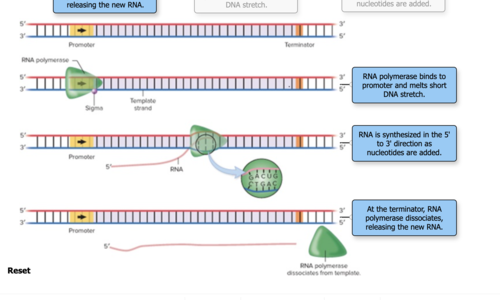
Transcription
Process of taking information from certain genes in DNA and synthesizing a complementary mRNA (sends message to ribosomes on what proteins to produce)
3 steps
Initiation: begins w/ binding of RNA polymerase to promoter; melts short portion of DNA to use as template strand
Elongation:
Termination:
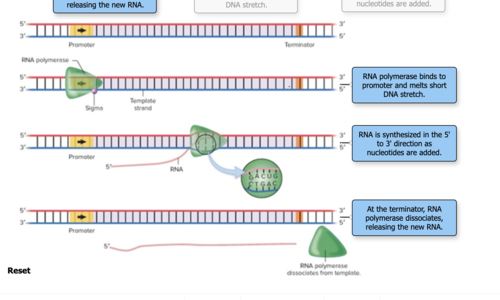
RNA polymerase
Enzyme that carries out transcription
Makes RNA while DNA polymerase in DNA replication makes DNA ; does not need a RNA primer to attach to promoter
promoter: nucleotide sequence to which [__] binds to start transcription
region “upstream” our gene
terminator: a DNA sequence that tells [__] to stop the process of transcription
![<p><mark data-color="yellow" style="background-color: yellow; color: inherit;">Enzyme that carries out transcription</mark></p><p>Makes RNA while DNA polymerase in DNA replication makes DNA ; <mark data-color="yellow" style="background-color: yellow; color: inherit;">does not need a RNA primer to attach to promoter</mark></p><ul><li><p><strong><mark data-color="purple" style="background-color: purple; color: inherit;">promoter</mark></strong>: nucleotide sequence to which [__] binds to start transcription</p><ul><li><p>region “upstream” our gene</p></li></ul></li><li><p><strong><mark data-color="purple" style="background-color: purple; color: inherit;">terminator</mark></strong>: a DNA sequence that tells [__] to stop the process of transcription</p></li></ul><p></p>](https://assets.knowt.com/user-attachments/a4de11c3-0c9d-441e-bf81-7f8ef16197c3.png)
sigma factor
In bacteria, the RNA polymerase need this molecule to guide the RNA polymerase to the promoter to start initiation