GEL 12 Lecture
 Call Kai
 Learn
Learn Practice Test
 Spaced Repetition
 Match
Match Flashcards
 Knowt Play
1/50

There's no tags or description
Looks like no tags are added yet.
Name | Mastery | Learn | Test | Matching | Spaced | Call with Kai |
|---|
No analytics yet
Send a link to your students to track their progress
51 Terms
Dinosaur
Greek: “dino” = terrible, “saur” = lizard
Clade: Dinosauria
Defined by Richard Owen (1842) to classify unusual reptile fossils
● Among other traits:
enormous size
legs like elephants
Clade
A grouping of organisms based on their hypothesized evolutionary history, consisting of a common ancestor and all of its descendants
A clade can be broken into subclades
Members of the same subclade are more closely related to each other than they are to members of other subclades
Synapomorphy
A shared trait that helps define a group, clades are defined by this
Dimetrodon [misidentified as a dinosaur]
Greek: “di” = two, “metr” = measure, “‘odon’ = tooth
Based on the number of holes in the skull, Dimetrodon is classified as a synapsid, and is more closely related to living mammals than dinosaurs
The number of holes in the head is a synapomorphy distinguishing the two major clades of amniotes
The number of holes behind the eye socket is a synapomorphy separating synapsids (mammals) from diapsids (birds and reptiles)
Dimetrodon is not part of the Dinosauria clade, but birds are
Birds are a living subclade of dinosaurs
Iguanodon: “iguana” = iguana; Greek: “don” = tooth
2nd Dinosaur to be named
Empirical
things that can be recognized by the senses (sight, touch, etc.)
Scientific laws
generalizations about the world
Hypotheses, theories, and laws have specific meanings in science that are different from common language
Law: a generalization about some aspect of the natural world that appears to be true in all cases
Scientific hypotheses: an educated guess
Hypothesis:
a proposed explanation for a set of observations about the natural world
● In science we often think of hypotheses as “educated guesses”
● The goal of science is to come up with hypotheses and find ways to test them
Scientific theories
explanations about the world
Theory:
an explanation about some aspect of the natural world that has been repeatedly tested and confirmed
● Theories are the most are the most reliable form of scientific knowledge
● Theories are always at risk of being replaced by a more sophisticated description of nature
All scientific ideas can be replaced
can never prove anything - knowledge is provisional
falsifiability: we can test ideas and discard incorrect ideas
Falsification in the Bernissart Iguanodons (1878)
Iguanodon held its spine horizontally and used its tail for balance, reinforced by ossified tendons, making it a quadrupedal animal that only occasionally walked on two legs. The upright, fragile poses in the museum are historically valuable but biologically inaccurate.
How is science different from other ways of knowing?
● It is empirical (unlike law, logic, mathematics)
● It is falsifiable (unlike many psychological and social theories)
● It is progressive (unlike art)
● This restricts the kinds of questions science can answer
How is science similar to other ways of knowing?
normative: the culture dictates how observations are interpreted and what questions are worth asking
● This impacts what questions we ask, what data we choose to collect, what counts as “statistically significant” and the norms for designing and publishing scientific research
Historic ethical issues in paleontology
Historically, paleontology is closely linked to colonialism and resource extraction
● Used to justify land dispossession
Case study: ancient proteins and DNA in dinosaurs
● In some cases (discussed next class), DNA and/or proteins can be preserved as molecular fossils
● The oldest broadly accepted DNA comes from a ~1-million year old mammoth frozen in Siberia; the oldest proteins from a ~3.8 million year old ostrich eggs.
● These examples approach the theoretical limits based on current molecular biology
Fossil
the preserved remains of a prehistoric organism
Dinosaur remains are a type of fossil
Extinct organisms occasionally get preserved in the geologic (rock) record as fossils
How does fossilization occur?
Rapid burial under sediment
● Replacement of “hard parts” with minerals from the rocks
Sedimentation
On land, erosion (the loss of sediment) is more common than sedimentation (the accumulation of sediment)
● Most sedimentation occurs along coastal regions
● We have a much better fossil record of shallow-water marine organisms than we do of dinosaurs
Primarily occurring on the coastlines, not every but most coastlines,
Most parts of an organism will not survive the fossilization process
Damage before burial
○ Disarticulation from predators and scavengers
○ Boring from insects
○ Decomposition from microbes
○ Weathering from wind and rain
all kinds of things break organism down
Mineralized bones, teeth, and shells (skeletons) are unusually resistant to destruction and decay
Most skeletons are a mixture or organic material and inorganic minerals
● Minerals are also the building blocks of rocks
Minerals
solids with a well- defined chemical composition and crystal structure
The mineralogy of bones
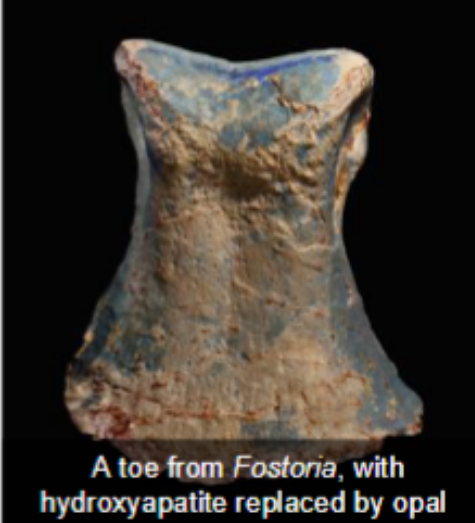
In vertebrates, the main mineral in bones is hydroxyapatite
● The enamel of teeth have an even higher mineral concentration, and are more likely to be preserved than bone
The minerals of bones are chemically reactive and can be lost too
Hydroxyapatite reacts with other minerals in the earth, particularly if there’s water
● This can lead to replacement of the original material by inorganic minerals
● The older a fossil, the more likely it is to exhibit complete replacement
Major kinds of fossils: body fossils
physical remains of an organism
● Very rare to find whole, intact skeletons
● Typically fragmented, damaged,
Major kinds of fossils: trace fossils
Trace fossil (ichnofossil): remains of an organism but not the organism itself
● Examples include trackways [footprints], coprolites (fossil poop), and bite marks
● Trace fossils provide evidence of a prehistoric organism’s behavior
Major kinds of fossils: molecular fossils
In exceptional cases, molecules can be preserved and extracted from fossils
● Examples of these molecular fossils include ancient DNA, proteins, and lipids (fats)
Rapid fossilization, organic matter made from the orignial animal
Exceptional modes of preservation can occur
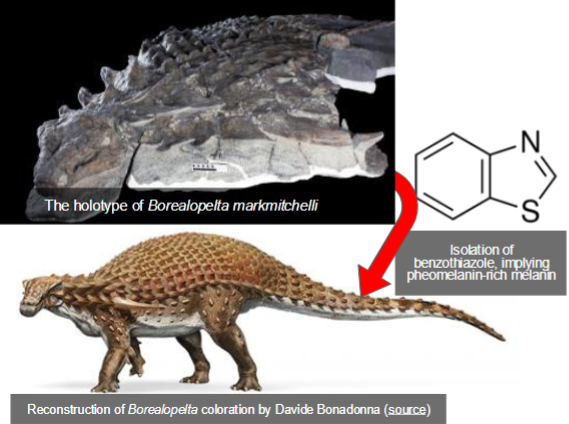
● Impressions of soft tissue can be associated with fossils
● This is more likely in arid (dry, hot) or anoxic (low oxygen) conditions, where decay is slower
Exceptional modes of preservation can occur
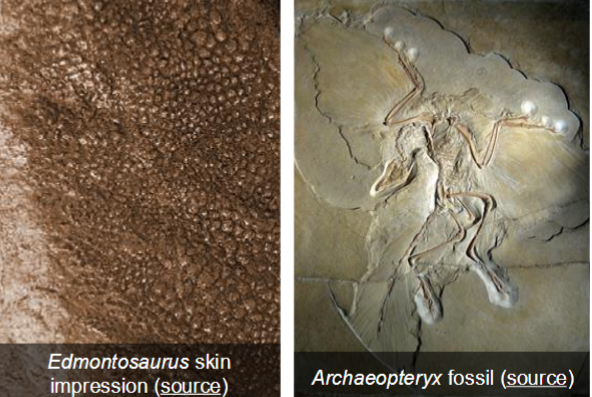
● Through soft tissue impressions, we have learned that many dinosaurs were covered in scales while some dinosaurs were covered in feathers.
Exceptional deposits: lagerstätte
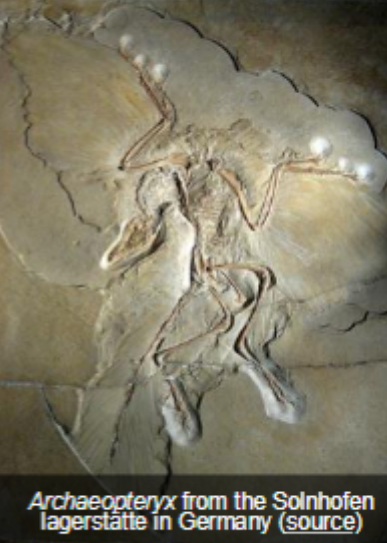
German = lager 'storage, lair’; stätte 'place'): a fossil deposit with exceptional preservation
Often anoxic (oxygen limited) environments that preserve many individuals with evidence of soft tissue
● The Solnhofen Limestone is a lagerstätte that includes dinosaurs
Additional lagerstätte that contain dinosaurs
● Cretaceous-age Santana and Yixian formations
● Cretaceous-age Myanmar (Burmese) amber
Exceptional deposits: bone beds
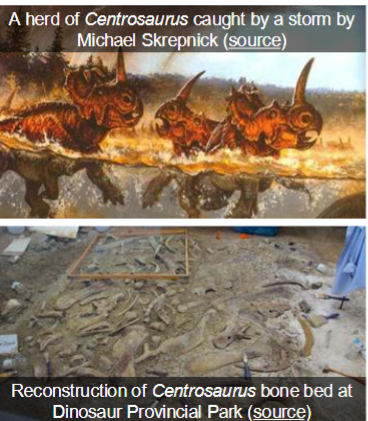
Bone beds: sites where Hundreds or thousands of fossils are preserved
● Sometimes all members of the same species, sometimes a mixture
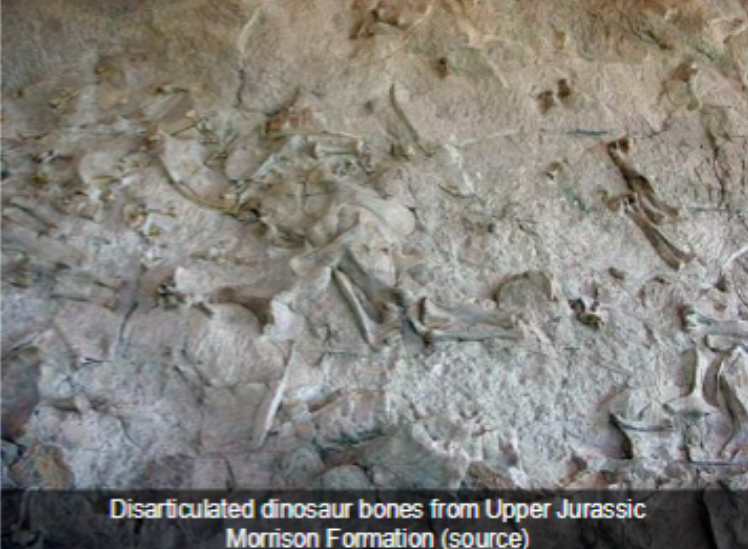
Some important dinosaur bone beds
● Triassic-age Metoposaurus bone bed from Portugal
● Jurassic-age Cleveland-Lloyd Dinosaur Quarry of Utah
● Jurassic-age Dinosaur National Monument in Utah / Colorado
● Cretaceous-age Mapusaurus bone bed at Cañadón del Gato, Argentina
● Cretaceous-age Albertosaurus bone bed from Alberta, Candara
● Cretaceous-age Daspletosaurus bone bed from Montana
Paleontology
deals with the discovery, collection, and study of fossils
Paleontologists looking for (extinct) dinosaurs: Some (not all) paleontologists specialize in the study of dinosaurs
Where have dinosaur fossils been found?
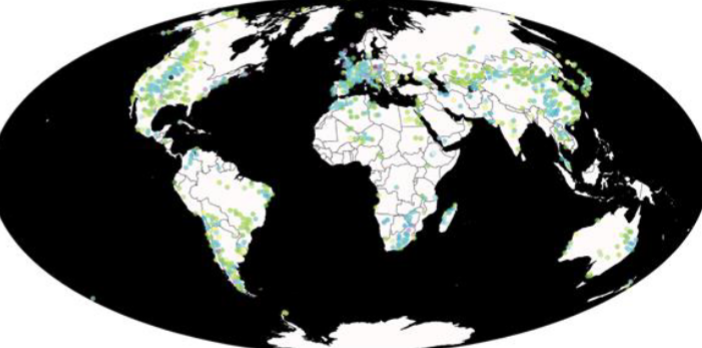
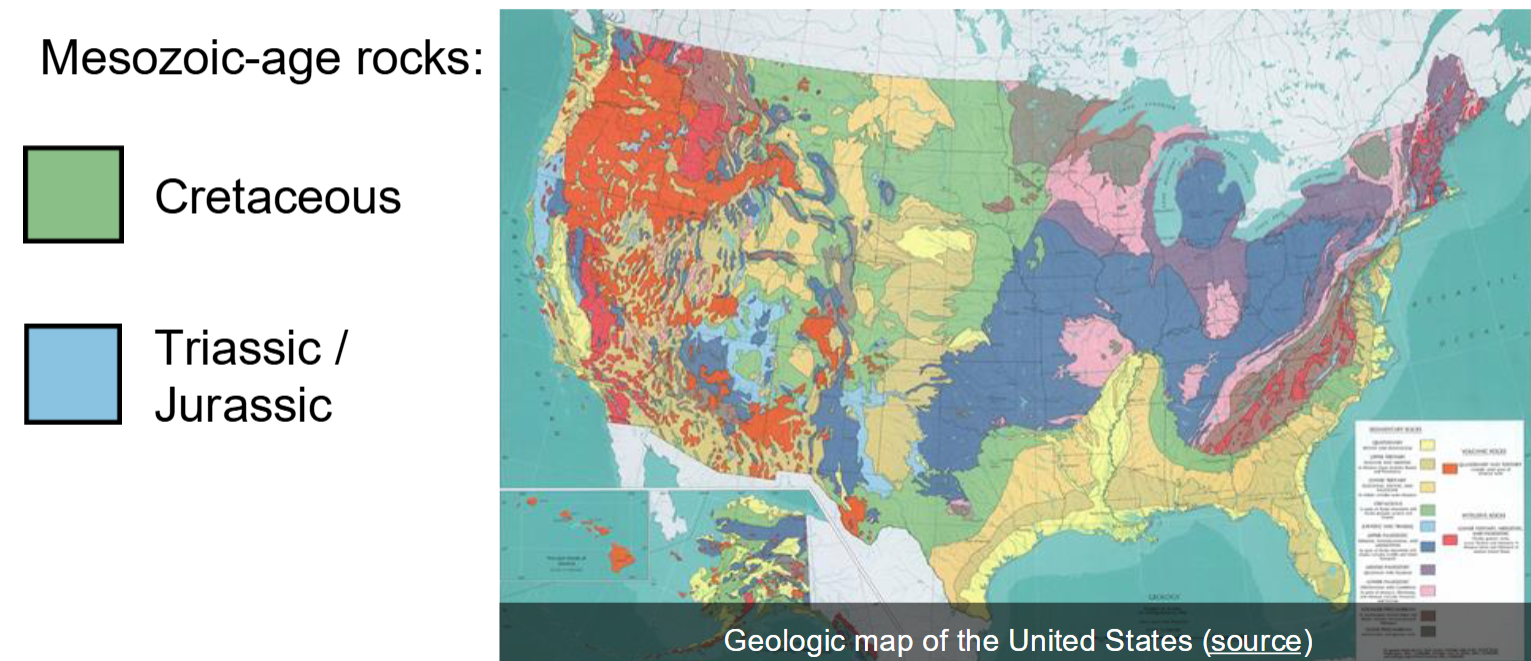
In North America, most dinosaur fossils have been found in a belt across the middle of the continent, areas associated with mountain ranges, not evenly distributed
● Why are dinosaurs only found in certain locations? global north has been more discovered than the south, where we find dinos is biased based on whos been looking, most likely find fossils buried in the ground compared to the desert
Step 1: Your rocks have to be the right age
Complex patterns of sedimentation and erosion mean rocks from different geologic ages are exposed in different parts of the world
○ Sedimentation: the laying down of dirt and mud, eventually turning into layers of rock
○ Erosion: the weathering of rock by wind and water
Complex patterns of sedimentation and erosion mean rocks from different geologic ages are exposed in different parts of the world
These ranges are plotted on geologic maps
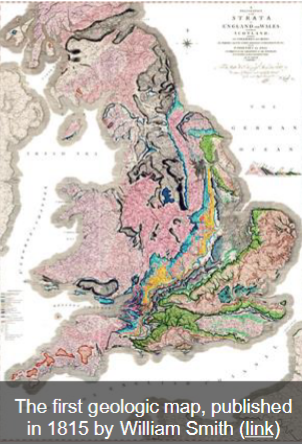
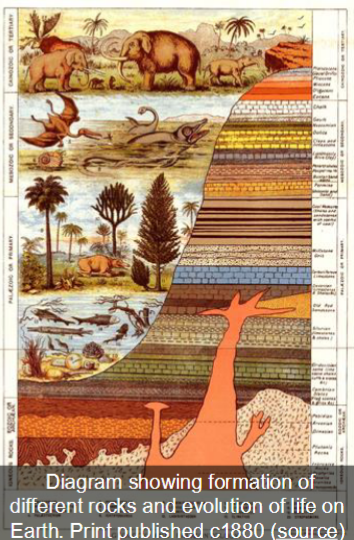
Stratigraphy
science of mapping the order of rocks
strata = layers of rock
Dinosaurs are found in Mesozoic rocks (Greek: “meso” = middle; “zoa” = life) because they are in the middle of the stratigraphic column
A geologic map of the United States
Step 2: Your rocks have to be the right type
● Geologists divide rocks into three major groups:
○ Igneous
○ Sedimentary
○ Metamorphic
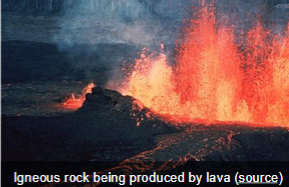
Igneous
formed through the cooling and solidification of magma and lava.
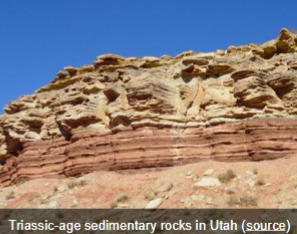
Sedimentary
formed by the accumulation and cementation of sediment at the Earth's surface
fossils most found here, and best place to find them
Metamorphic
formed by the transformation of other rocks through extensive heat and pressure
not a good place to find fossils, they get destroyed or morphed
From “the field” to “the lab”
An increasing number of paleontologists are working in labs to look for molecular fossils and other data hidden in bones
● Many use computational tools to test hypotheses about dinosaur behavior and evolution
Step 3: You have to get lucky
Even with the best knowledge, you still don’t know until you look
● Paleontologists often revisit promising field sites year after year hoping for major discoveries
● Even then, most discoveries are fragmentary and fragile
Scientific journal:
a specialized publication for evaluating and sharing scientific research between scientists
Peer review
a process used in scientific journals where multiple scientists (usually anonymously) argue for the publication or rejection of an article
Corroboration
when multiple studies / techniques support the same hypothesis.
Corroboration is a critical part of theory building.
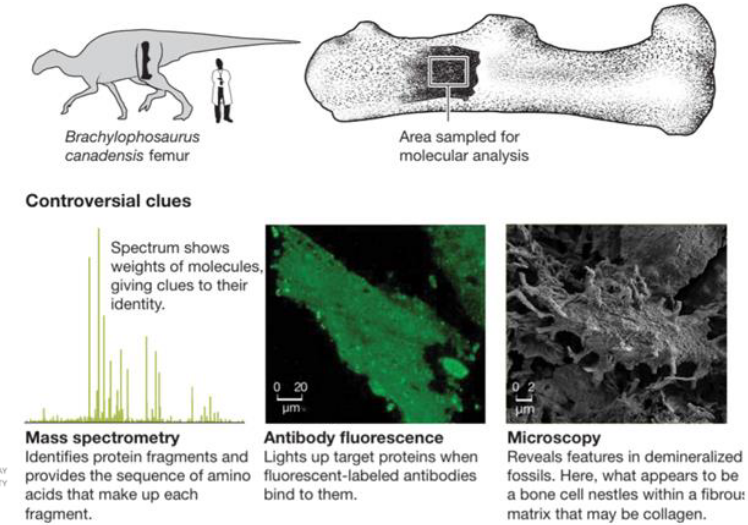
The implications would dramatically impact other fields of science
Possibility 1: proteins decay much slower than currently thought (conflicts with modern theories in molecular biology) or some unknown mechanism of preservation exists
Possibility 2: these fossil are much younger than currently thought (conflicts with modern theories in paleontology, geology, isotope chemistry)
Possibility 3: these are not actually dinosaur proteins
Arguments and counterarguments
Antibody tests can have “non-specific” responses
● The mass-spec data was cherry-picked
● Fossils are “open systems” where bacteria, fungi, and other organisms can live
● Multiple labs have been unable to replicate this work (a lack of corroboration)
● In many of these cases Dr. Schweitzer came back with new studies to test these arguments
New ideas are developed
● Corroboration from other labs suggests that some types of structural proteins (like collagen) can be preserved in dinosaur bones
● One 2024 paper proposes a new mechanism that protects collagen from breakdown
● We also now have a better understanding of the life that can exist inside of fossils