Biology 1202 Exam 4
 Call Kai
 Learn
Learn Practice Test
 Spaced Repetition
 Match
Match Flashcards
 Knowt Play
1/177

There's no tags or description
Looks like no tags are added yet.
Name | Mastery | Learn | Test | Matching | Spaced | Call with Kai |
|---|
No analytics yet
Send a link to your students to track their progress
178 Terms
Vertebrates
Organisms that have a backbone, evolved from invertebrates around 530 MYA.
Invertebrates
Organisms that do not have a backbone.
4 traits of all chordates
1.Notochord: flexible rod that provides skeletal support
2.Dorsal, hollow nerve cord: develops into CNS
3.Pharyngeal slits or clefts: used for feeding and gas exchange
4.Muscular, post-anal tail: aquatic species propelling force.
Mammalia
A class of vertebrates that includes monotremes, marsupials, and eutherians.
Oviparous
Organisms that lay eggs that mature and hatch outside the mother's body.
Ovoviviparous
Organisms that retain eggs within the oviduct; young are born after hatching within the uterus.
Viviparous
Organisms whose embryos develop within the uterus and are nourished from the mother's blood.
Swim Bladder
An air sac that controls buoyancy in fish, not present in sharks or rays.
Lateral Line
A system of organs sensitive to vibrations, aiding in the survival of fish.
Spiral Valve
An adaptation in sharks that increases surface area and slows the passage of food.
Endotherms
Organisms that can regulate their body temperature internally.
Ectotherms
absorb external heat as the main source of body heat (reptiles)
Toxin
a chemical substance produced within living cells or organisms.
Poison
a substance that can cause illness or death when absorbed or ingested.
BIRDS adaptation
Major adaptation is wings with keratin feathers used for insulation, camouflage, and courtship display.
8 Derived characters in mammals
1.Mammary glands, which produce milk
2.Hair and a fat layer under the skin for insulation
3.Kidneys, which conserve water from wastes
4.Endothermy and a high metabolic rate
5.Efficient respiratory and circulatory systems
6.A large brain-to-body-size ratio
7.Extensive parental care
8.Differentiated teeth
Anatomy
the biological form of an organism.
Physiology
the biological functions an organism performs.
Surface Area (2D) vs. Volume (3D) ratio
The rate of exchange is proportional to a cell's surface area, while the amount of exchange material is related to a cell's volume.
Epithelial tissue
outside the body and lines organs and cavities within the body.
Connective tissue
binds and supports tissues; there are 6 types: loose, fibrous, blood, bone, adipose and cartilage.
Muscle tissue
skeletal muscle (voluntary movement), smooth muscle (involuntary movement), and cardiac muscle (heart contraction).
Nervous tissue
transmission of information and processing (neurons and glial cells).
Regulator
uses internal control mechanisms to control internal change in the face of external fluctuation.
Conformer
allows internal conditions to vary with certain external changes.
HOMEOSTASIS
Steady state or internal balance, regardless of the external environment.
Examples of Homeostasis
Body temperature, blood pH, and glucose levels.
Negative feedback
helps return a variable to the normal range (e.g., temperature)
Positive feedback
amplifies a stimulus and does not usually contribute to homeostasis in animals (e.g., blood clotting)
CIRCADIAN RHYTHM
Governs physiological changes that occur roughly every 24 hours. (ex. body temperature and melatonin concentration)
ACCLIMATIZATION
How homeostasis can adjust to changes in the external environment.
Thermoregulatory processes
Form, function, and behavior.
Heat exchange processes
Radiation, Evaporation, Convection, Conduction.
5 processes to thermoregulate
1.Insulation
2.Circulatory adaptations
3.Cooling by evaporative heat loss
4.Behavioral responses
5.Adjusting metabolic heat production
Region of the brain involved with thermoregulation
Hypothalamus
Metabolism relation to thermoregulation
Metabolic reactions create a byproduct of heat.
Ways to calculate metabolic rates
1. Basal Metabolic Rate (BMR)
2. Standard Metabolic Rate (SMR)
3. M^3/4
Relationship between size and metabolic rate
Smaller animals have higher metabolic rates per gram than larger animals.
Torpor
State of decreased activity and metabolism.
Hibernation
Long-term torpor that is an adaptation to winter cold and food scarcity.
Estivation
Enables animals to survive long periods of high temperatures and scarce water.
4 Classes of nutrients
1. Essential amino acids
2. essential fatty acids
3. vitamins
4. minerals
Essential amino acids
20 amino acids that are needed to be consumed in a diet (meat, eggs, and cheese)
Essential fatty acids
Can be found in oil, eggs, salmon, avocado, fish oil
Consequences of excessive mineral intake
Can upset homeostatic balance (cause cancer and neurological disorders).
Food desert
An urban area in which it is difficult to buy affordable or good-quality fresh food.
Undernourishment
Results when a diet does not provide enough chemical energy, leading to loss of muscle mass, protein deficiency in the brain, and potential irreversible damage.
Types of feeders
1. Substrate feeders live in or on their food source
2. fluid feeders suck nutrient-rich fluid from a living host
3. Bulk feeders eat relatively large pieces of food.
Digestion
The process of breaking food down into molecules small enough to absorb.
Absorption
Uptake of small molecules by body cells.
Elimination
Passage of undigested material out of the digestive system.
Intracellular digestion
Food particles are engulfed by phagocytosis and liquids by pinocytosis (e.g. sponges).
Extracellular digestion
Breakdown of food particles outside of cells, in compartments that are continuous with the outside of the animal's body (e.g. human).
Alimentary canal
a complete digestive tract with a mouth and anus (humans specialized organs like stomach, small and large intestines)
Gastrovascular cavity
functions is digestion and distribution of nutrients with a single opening
Accessory glands
1. salivary glands: secrete saliva
2. pancreas: secrete digestive enzymes and hormones
3. liver: produces bile
4. gallbladder: stores bile
Swallowing
causes the epiglottis to block entry to the trachea, and the bolus is guided to the larynx, the upper part of the respiratory tract.
Peristalsis
Rhythmic contractions of muscles in the wall of the canal.
Sphincters
regulate the movement of material between compartments of the digestive system.
Enzymes in Digestion
1. Amylase: in saliva helps break down starch
2. Protease: breaks peptide bonds to cleave proteins into smaller peptides.
Small intestine
most enzymatic hydrolysis of macromolecules occurs here; a huge surface area due to villi and microvilli that are exposed to the intestinal lumen.
Large intestine
Includes the colon, caecum, and rectum, and completes the recovery of water that began in the small intestine. (longer in herbivores and omnivores than carnivores due to longer time needed to digest vegetation)
Surface area
Larger surface area in the small intestine creates a brush border that increases the rate of nutrient absorption.
Bristol Stool Scale
a chart that healthcare professionals can use to help identify bowel issues based on the appearance of stool.
Dentition
an animal's assortment of teeth, is one example of structural variation reflecting diet
Mutualistic adaptations in humans
Coexistence of humans and many bacteria (some intestinal bacteria produce vitamins and regulate the development of epithelium and function of the innate immune system).
Microbiome
the collection of microorganisms living on the body.
Mutualistic adaptations in herbivores
Ruminants have fermentation chambers where mutualistic microorganisms digest cellulose (food passes through the alimentary canal twice)
BMI
stands for body mass index and is used for estimating a healthy weight; it can be misleading
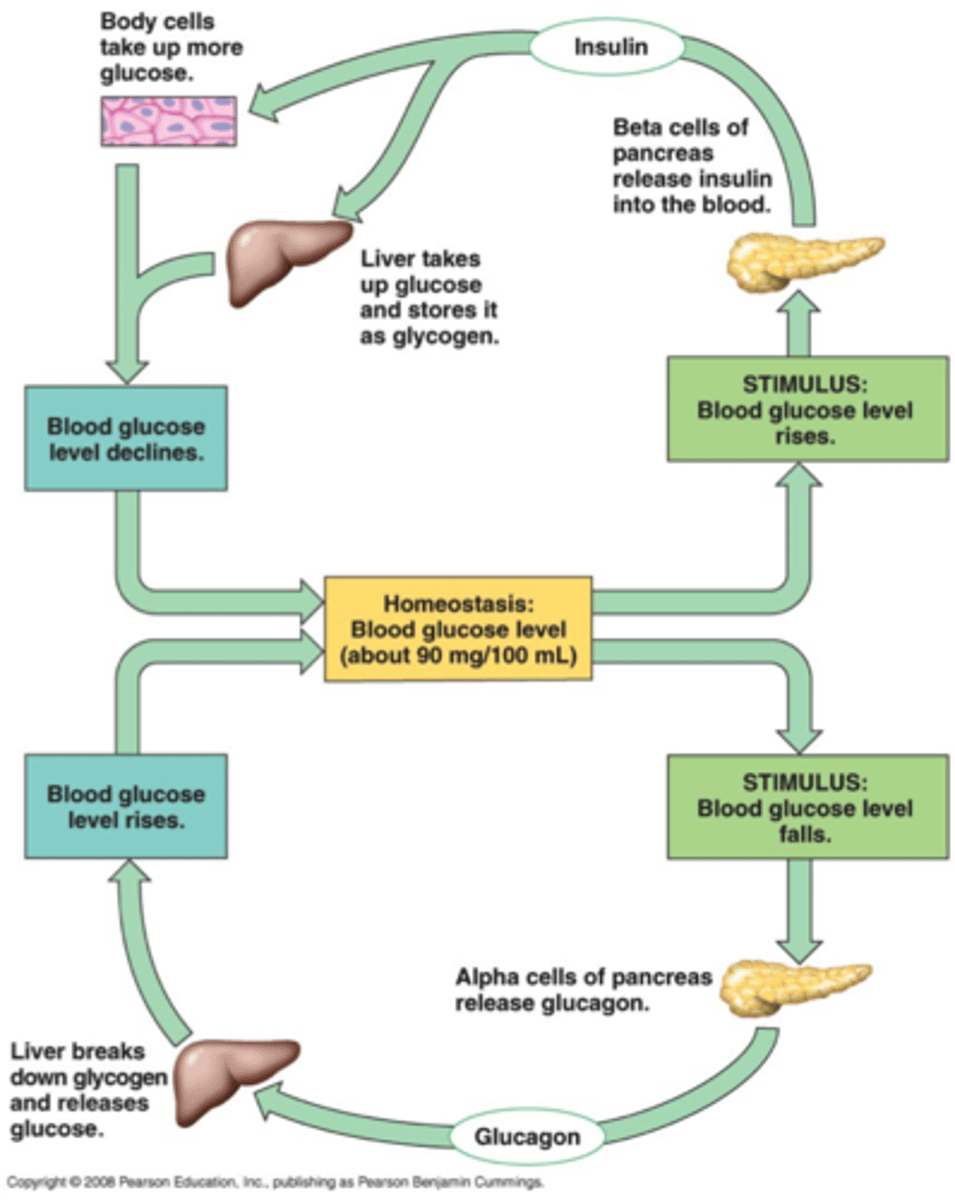
Glucose homeostasis
is an example of a negative feedback mechanism
Hormones involved in glucose regulation
Insulin and glucagon.
Elevated blood glucose levels
occur if the body is not able to regulate glucose levels.
Diabetes
Caused by a deficiency of insulin or a decreased response to insulin in target tissues. Cells are unable to take up enough glucose to meet metabolic needs.
Type 1 Diabetes
The immune system destroys the beta cells of the pancreas.
Type 2 Diabetes
Non-insulin-dependent diabetes characterized by a failure of target cells to respond normally to insulin.
Open Circulatory System
The circulatory fluid called hemolymph bathes the organs directly.
Closed Circulatory System
Blood is confined to vessels and is distinct from the interstitial fluid.
Hemolymph
Circulatory fluid that doesn't carry oxygen like blood.
Arteries
Carry oxygenated blood away from the heart.
Veins
Return deoxygenated blood to the heart.
Arteries vs. Veins
Arteries have a smaller lumen, thick walls, and muscle tissue; veins have a larger lumen, thinner walls, and valves that prevent backflow.
Single Circulation
Two-chambered hearts where blood leaving the heart passes through two capillary beds before returning. (e.g., sharks)
Double Circulation
Four-chambered hearts, where blood passes through the heart twice before making a complete circuit. (e.g., humans)
Intermittent Breather
An organism that does not breathe continuously, but instead breathes at intervals, taking in oxygen when needed and holding or suspending breathing in between.
Blood Flow Through Human Heart
Right atrium> tricuspid valve> right ventricle> pulmonary valve> pulmonary trunk> lungs (blood loses CO2 and gains O2)> pulmonary veins> left atrium> bicuspid valve> left ventricle> aortic valve> aorta> systemic capillaries (loses O2 and gains CO2)> superior vena cava, inferior vena cava, or coronary sinus> right atrium.
Cardiac Cycle
The complete sequence of events in the heart during one heartbeat.
Systolic Pressure
Pressure in the arteries during ventricular systole; it is the highest pressure in the arteries. (140-90)
Diastolic Pressure
Pressure in the arteries during diastole; it is lower than systolic pressure. (60-90)
Heart Valves
Atrioventricular valves separate each atrium and ventricle (tricuspid and bicuspid valves); semilunar valves control blood flow to the aorta and the pulmonary artery (pulmonary valve and aortic valve).
Atrioventricular valves
Separate each atrium and ventricle (tricuspid and bicuspid valves)
Semilunar valves
Control blood flow to the aorta and the pulmonary artery (pulmonary valve and aortic valve)
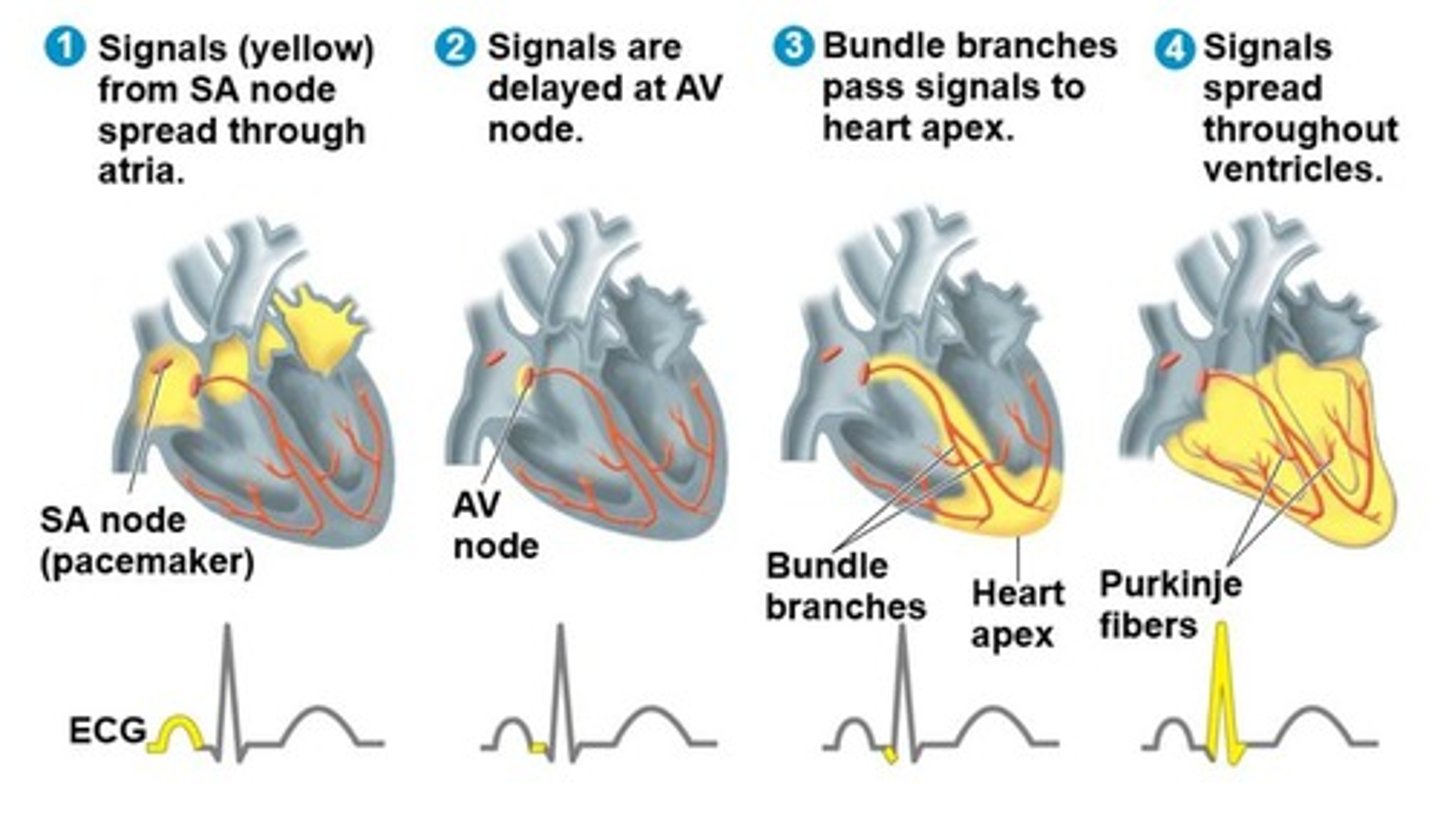
SA node
Called the pacemaker and sets the rate and timing at which cardiac muscle cells contract.
Parasympathetic nervous system
Controls rest and digest activities (e.g., constrict pupils, slow heartbeat)
Sympathetic nervous system
Controls fight or flight activities (e.g., dilate pupils, increase heartbeat)
Normal heart rate
About 70 BPM.
Nitric oxide (NO)
Gas that plays a role in vasodilation.
Blood pressure regulation (chemical)
Nitric oxide induces vasodilation, lowering blood pressure.
Blood pressure regulation (physical)
Contraction of the smooth muscle and skeletal muscle called vasoconstriction increases blood pressure (blood back to the heart)
Capillary blood flow
Blood flows through only 5-10% of the body's capillaries at any given time.
Blood pressure and osmotic pressure relationship
Blood pressure pushes fluid out of the bloodstream and into surrounding tissues (increases as it's closer to the heart), while osmotic pressure draws water into the capillaries.