Microbiology: Unit 1
 Call Kai
 Learn
Learn Practice Test
 Spaced Repetition
 Match
Match Flashcards
 Knowt Play
1/77

Earn XP
Description and Tags
Safety and infection control, specimen collection and processing, culture media, gram stains
Name | Mastery | Learn | Test | Matching | Spaced | Call with Kai |
|---|
No analytics yet
Send a link to your students to track their progress
78 Terms
What is empiric antimicrobial prescribing?
Treating before knowing the pathogen ID
What is pathogen-directed therapy?
Treating after knowing the pathogen ID, more targeted to the identity and reduces antimicrobial resistance
What is a screen culture?
Reports only specific pathogens from a specific short
What is a comprehensive culture?
Reports all that is growing, including pathogen and normal flora
What is disinfection?
Destroying pathogens, but not spores
What are methods of disinfection?
Boiling, pasteurizing, UV light
Phenol, alcohol, detergents, bleach
What is sterilization?
Destroying all forms of microbial life, including spores
What are methods of sterilization?
Incineration, dry heat, moist heat (autoclave), filtration, HEPA filter
When should microbiology specimens generally be collected?
During the acute phase, before antibiotic administration
What should be included on a proper label?
Patient name, patient ID number, room number, culture site/source, date + time of collection
What should be included on a test requisition?
Patient name + age + sex, patient location, physician’s name, culture site/source, date + time of collection, clinical diagnosis or relevant history, any antimicrobial agents patient is on
What is the preservative/transport media used for urine?
Boric acid
What is the preservative/transport media for a stool sample?
Cary-Blair, formalin/polyvinyl alcohol (PVA)
What is the preservative/transport media used for blood?
Sodium polyanethol sulfonate (SDS)
What is the preservative/transport media used for swabs?
Stuart’s or Amie’s transport medium, JEMBEC system
What specimens are included in 1st prioritization of processing?
Critical and invasive specimens (fluids, brain, heart valves, etc.)
What specimens are included in 2nd prioritization of processing?
Unpreserved specimens (tissue, sputum, feces, etc.)
What specimens are included in 3rd prioritization of processing?
Specimens requiring quantitation (urine, catheter tip, etc.)
What is homogenization in a culture setup?
Tissue grinding
What is decontamination in a culture setup?
It is used to kill normal flora in a specimen when you are looking for a certain organism, like mycobacteria
Nutrient
media that contains generic nutrients to enable the growth of most nonfastidious organisms
Enriched
media that contains complex substances for the needs of a specific fastidious species
Selective
media that inhibits the growth of selected organisms and allows the growth of others
Differential
media that can grow several different organisms that demonstrate different visual characteristics
Enrichment
media type that is designed to encourage the growth of small numbers of a particular organisms while suppressing the growth of others
Broth
media type that is used in combination with growth on agar plates and used to detect small numbers of most aerobes, anaerobes, and microaerophiles
Transport
media type that is designed to maintain the viability of organisms without allowing them to multiply
nutrient
What kind of media is sheep blood agar (SBA)?
nutrient, enriched, differential
What kind of media is blood agar (BA)?
enriched
What kind of media is chocolate agar?
selective, differential
What kind of media is MacConkey agar (MAC)?
selective
What kind of media is phenylethyl alcohol agar (PEA)?
selective
What kind of media is Columbia colistin nalidixic acid agar (CNA)?
selective
What kind of media is mannitol salt agar (MSA)?
enrichment, broth
What kind of media is LIM?
broth
What kind of media is thioglycolate (THIO)?
Cary-Blair, Amie’s, Stuart’s, viral
What are some kinds of transport media?
Inhibits growth of gram+ bacteria, promotes growth of gram-
Differentiates organisms on the basis of lactose fermentation
What is the function of MAC agar?
Inhibits growth of gram- bacteria, promotes growth of gram+
What is the function of PEA or CNA agar?
Inhibits most organisms except Staphylococcus
What is the function of MSA agar?
Differentiates organisms based on hemolysis
What is the function of BA agar?
organism that requires oxygen to grow
What is an obligate aerobe?
organism that requires reduced oxygen and increased CO2 to grow
What is a microaerophile?
organism that requires no oxygen present to grow
What is an obligate anaerobe?
organism that grows both with and without oxygen; usually tends to grow better with oxygen; majority of bacterial pathogens
What is a facultative anaerobe?
organism that requires increased CO2 to grow
What is a capnophilic organism?
organism that grows at 10-20°C; few pathogens
What is a psychrophile?
organism that grows at 20-45°C; human pathogens and most bacteria
What is a mesophile?
organism that grows over 50°C; few pathogens
What is a thermophile?
35°C
At what temperature do most organisms grow?
6.5-7.5 pH
What pH is media buffered to?
70-80%
At what % humidity are organisms usually incubated at?
48-72 hours
How long are most organisms incubated for?
5-7 days
How long are anaerobic cultures incubated for?
Utilizes room air, usually at 35°C, high humidity
What are the conditions of an ambient air incubator?
Utilizes 5-10% CO2 mixed with room air, usually at 35°C, high humidity
What are the conditions of a CO2 incubator?
Utilizes 5% hydrogen, 5-10% CO2, and 85-90% N2, usually at 35°C, high humidity
What are the conditions of an anaerobic incubator?
2 years
How long are documentation/records kept for reagents, stains, and media?
How will lactose-fermenting GNR look on a MacConkey plate?
They form pink colonies
How will non-lactose-fermenting GNR look on a MacConkey plate?
They will form clear colonies
What color will gram positive bacteria be on a gram stain?
Purple (or blue)
What color will gram negative bacteria be on a gram stain?
Pink (or red)
What is in the cell wall structure of gram positive bacteria?
Contains low lipid content, has a thick cell wall with peptidoglycan and techoic acid
What is the cell wall structure of gram negative bacteria?
Contains high lipid content, has a thin cell wall
What are the steps of a gram stain?
Primary stain: crystal violet (1 min)
rinse with water
Mordant: Gram’s iodine (1 min)
rinse with water
Decolorizer: acetone/alcohol (2-3 sec)
rinse with water
Counterstain: safranin (1 min)
Blot (do not wipe!) with paper towel
How long do you leave a slide on the slide warmer in order to heat fix?
1 minute
What 3 morphologies can gram positive bacteria be seen as?
Bacilli/rods (GPR/GRB), cocci (GPC), lancets
What arrangements can GPC form?
Single, pairs, chains, clusters, tetrads
What are the two most common species of GPC, and what arrangements do they form?
Staphylococcus forms clusters
Streptococcus forms chains
How are GPRs containing spores unique in a gram stain?
They can be gram variable, and the spores are visible
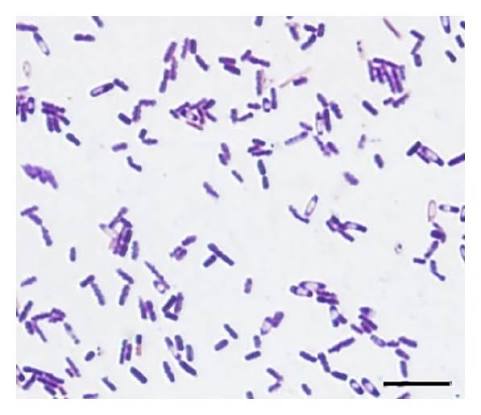
What are palisading GPRs?
Aligned side-by-side, “Chinese letter pattern,” club-shaped
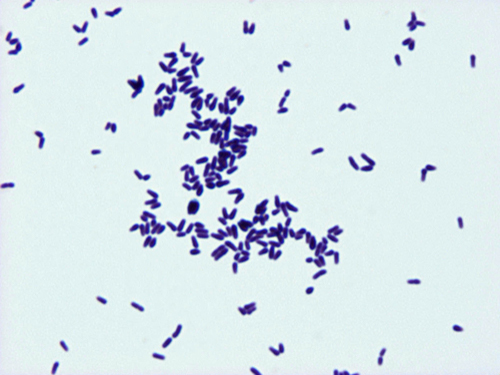
What 3 morphologies can gram-negative bacteria be seen as?
Bacilli/rods (GNB/GNR), diplococci (GNDC), coccobacilli (GNCB)
What does pleomorphic mean?
Lacks uniformity, varies in morphology; both gram-negative and gram-positive bacteria can be pleomorphic
When is arrangement clinically relevant and should be noted on the report?
When it is gram-negative cocci—need to specify is coccobacilli (GNCB) or diplococci (GNDC)
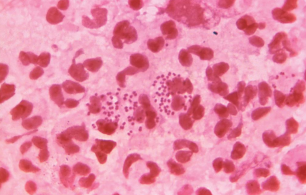
What does seeing gram-negative diplococci suggest?
Neisseria or Moraxella; trick to remember is DC (diplococci) and N-M are both coupled in the alphabet
Which gram-negative morphologies can have capsules and/or be intracellular?
Cocci: capsules and/or intracellular
Bacilli/rods: intracellular
How do yeast present in a gram stain?
Will usually stain gram-positive—but over-decolorization can make them appear gram-variable
Larger than GPC, not perfectly circular
How many fields should you scan of a gram stain?
10-30