anatomy and phys week 1
 Call Kai
 Learn
Learn Practice Test
 Spaced Repetition
 Match
Match Flashcards
 Knowt Play
1/46

There's no tags or description
Looks like no tags are added yet.
Name | Mastery | Learn | Test | Matching | Spaced | Call with Kai |
|---|
No analytics yet
Send a link to your students to track their progress
47 Terms
Anatomy
structure/shape of human body
physiology
how the body and its parts function/work
How are anatomy and physiology always related
structure determines function
pathology
study of structural changes that lead to disease
pathophysiology
study of function and symptoms of a diseased organ
gross (macroscopic) anatomy
study of large structures, that are visible to the naked eye
Examples of macroscopic anatomy
Dissection, edoscopy, Xrays, MRI
Microscopic anatomy
study of smaller structures that can only be seem with a microscope
Developmental anatomy
Study of structural changes that occur throughout an individual’s life
how many levels of organization in the human body?
6
levels of organization
chemical (atoms,molecules)
cells
tissue
organs
organ system
organism
nomonic for remembering all 11 organ systems
i L ove NERRD MUSIC
lymphatic system
function:
returns leaked fluid back to blood
disposes of debris in lymphatic stream
houses white blood cells
Ex: lymph nodes, thoracic duct, lymphatic vessels
Nervous system
control system of the body
responds to internal and external changes by activating proper muscles and glands
ex: brain, nerves, spinal cord, sensory recepter
Endocine system
glands secrete hormones that regulate processes such as growth, reproducton, and nutirent use by body cells
ex: thyroid gland, pituitary gland, pineal gland, thymus gland, adrenal gland, pancreas, ovary, testis
Respiratory system
keeps blood supplied with oxygen
removes carbon dioxide
gaseous exchanges occur through walls of the air sacs of the lungs
ex: lungs, bronchus, trachea, larynx, nasal cavity
reproductive system
production of offspring
testis produce spem and male sex hormone
ovaries produce eggs and female sex hormones
fertilizatioon and development of fetus
mammary glands produce breast milk
ex: vagina, scrotum, testis, uterus, prostate gland, ovaries, penis, mammary glands…
Dogestive system
Breaks down food into absorbable units that enter blood
indigestible foodstuffs are eliminated as feces
ex: anus, rectum, karge intestine, small intestine, stomach, esophagus, oral cativity
Muscular system
locomotion
facial expression
maintaines posture
produces heat
ex: skeletal muscles
urinary system
eliminates nitrogen-containing wastes from body
regulates water, electrolyte, and acid-base balance of the blood
ex: kidney, ureter, urinary bladder, urethra
skeletal system
protects and supports body organs
provides a framework the muscles use to cause movement
blood cells are forms in bones
stores minerals
ex:cartilage, bones, joints
integementary system
forms external body covering
protects deeper tissue from injury
synthesizes vitamin D
location of cutaneous receptors
location of sweat and oil glands
ex: Skin
Cardiovascular system
blood vessels transport blood
heart pumps blood
Ex: heart, blood vessels
what are the 8 essentail functions for maintaining life
maintaining boundaries
movement
response to stimuli
digestion
metabolism
excretion
reproduction
growth
nemonic: MMR. MD ERG
Survival needs for human body
Nutrients
oxygen
appropriate body temp
atmospheric pressure
water
Goldilocks Principle: need just the right amount of each
Homeostasis
Maintaining a stable internal environment within narrow limits, regardless of changing environmental conditions
Homeostatic imbalance
Disturbance or change in homeostasis that affects function
which control systems communicate during homeostasis?
Nervous system: electrical signs (fast)
Endocrine system: Hormonal/chemical signals (slow)
Negative Feedback
Effect of response is to reduce or shut off the initial stimulus
Moves variable back towards set point
Ex: heart rate, blood pressure, body temp
*Works like a thermostat
Positive Feedback
Effect of response is to increase/amplify or the initial stimulus
push variable farther from original value
Ex: heart attack due to restricted blood flow
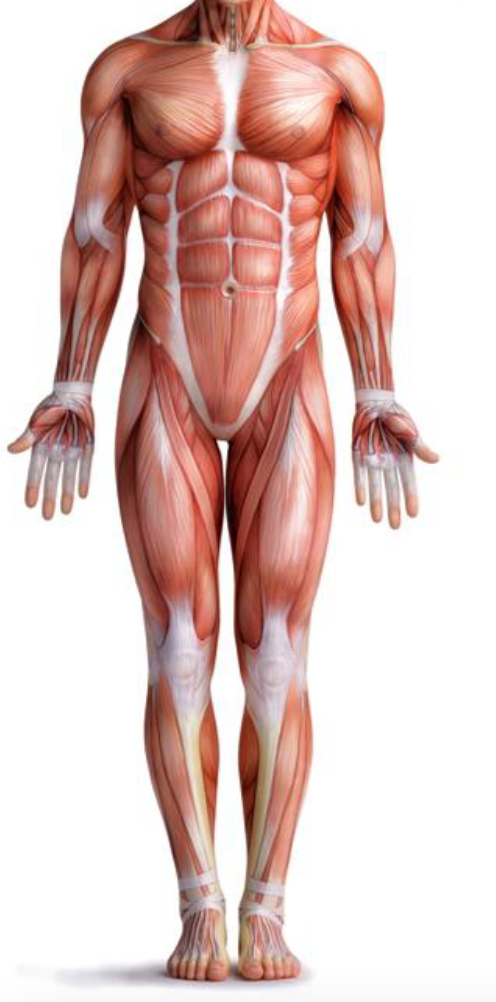
anatomical position
Standing up straight
• Feet parallel
• Hands & arms at sides with palms forward
Directional term: superior/ inferior
superior: above
inferior: below
Ex:
Nose is superior to chin
knee is inferior to hip
Directional term: Anterior(ventral) /Posterior (dorsal)
anterior: toward the front of the body
Posterior: towards back of the body
ex:
Sternum is anterior to the heart
Heart is posterior to the sternum
Directional Term: Medial/lateral
Medial: Closer to midline of the body
lateral: Farther from midline or closer to the sides of body
ex:
belly button is medial to the hips
The ears are lateral to the nose
directional term: proximal/distal
proximal: closer to the point where a limb attachesor center of body
distal: farther away from that attachment point or the center
ex:
the shoulder is proximal to the elbow because it is closer to the body's core.
fingers are distal to your wrist because they are further away from the main body
Directional terms: Superficial (external)/Deep (internal)
Superficial (external): closer to the body's surface
Deep (internal): further away from body surface or more internal
ex:
The skin is superficial to the skeleton
The lungs are deep to the ribcage
regional terms
Axial
Thoratic
Abdominal
Pelvic
Appendicular
Body section
Cut through the body or organs along an imaginary line
(the plane)
• Sections are made along planes like you’d cut along a dotted
Saggital plane
Divides the body into right and left halves
Frontal plane
divides the body into anterior/posterior (“front/back”) parts
Transverse/cross plane
divides the body into superior/inferior (“top/bottom”) parts along the horizontal plane
Oblique plane
divides the body diagonally
Body cavities: Dorsal
Dorsal: back or upper side
cranial: space within skull
spinal: From cranial cavity to end of spinal cord
Body cavity: ventral
Ventral": contains visceral(internal organs)
thoracic cavity; heart and lungs, divided from abdominal by the diaphragm
abdominopelvic cavity: Digestive, reproductive, and most urinary organs
Serous membranes
Function: produce slippery serous fluid
2 layers:
parietal: lining body cavities
Visceral: covering internal organs
named by: Lining location + cavity term
examples:
Membrane lining abdominopelvic cavity:Parietal peritoneum
Membrane covering surface of heart: visceral pericardium
Abdominal Regions
Right upper quadrant (RUQ)
Right lower quadrant (RLQ)
Left upper quadrant (LUQ)
Left lower quadrant (LLQ)
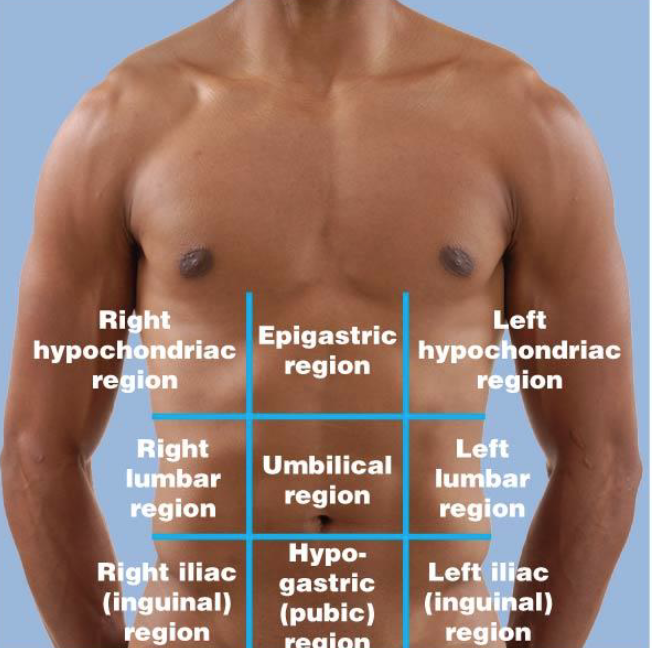
Abdominal regions
Right:
Right hypochondriac region
Right Lumbar region
Right iliac region
Middle:
Epigastric region
Umbilical region
Hypogastric (pubic) region
Left:
Left hypochondriac region
left lumbar region
Left Iliac region