macroeconomics
 Call Kai
 Learn
Learn Practice Test
 Spaced Repetition
 Match
Match Flashcards
 Knowt Play
1/79

There's no tags or description
Looks like no tags are added yet.
Name | Mastery | Learn | Test | Matching | Spaced | Call with Kai |
|---|
No analytics yet
Send a link to your students to track their progress
80 Terms
Unemployment
People of working age who are without work, available for work, and actively seeking employment.
Keynesian economics response to recession
Government spending encouraged. Deficit spending will create more jobs —> more consumer confidence —> more consumption —> more tax revenue
New-classical economics response to recession
Government spending discouraged: artificial increase in AD is met with an upwards pressure in price level —> wages increase —> producing becomes more expensive so SRAS shifts left —> creates stagflation. No gov spending: economy will correct itself in the long run
Fiscal policy
Government policy that attempts to manage the economy by controlling taxing and spending.
Expansionary fiscal policy
increases aggregate demand
Contractionary fiscal policy
reduces aggregate demand
Monetary policy
The use of interest rates and the money supply by the Central Bank to influence AD
Expansionary monetary policy
Increases money supply to stimulate economy
Contractionary monetary policy
Decreases money supply to control inflation.
Demand-side policy
Aim to change AD level
Unemployment diagrams
Interventionist supply-side
Aims to increase the quality and quantity of factors of production through government intervention
Market-based supply-side
Aims to increase the quality and quantity of the factors of production by allowing markets to operate more freely
Demand vs supply side policies
Demand-side policies change AD but supply-side policies change LRAS
Inflation
A sustained increase in the general price level over a period of time
Central bank
an institution designed to oversee the banking system and regulate the quantity of money in the economy
Base rate
The minimum lending interest rate in the economy, controlled by the Central Bank
Interest rate
The cost of borrowing money
GDP
Gross Domestic Product- the total monetary value of all final goods and services produced within an economy in a given period of time
GNI
Gross National Income- the total income of a nation's people and businesses
Expenditure method of calculating national income
the total amount spent on goods and services made in the country, minus imports: C+I+G+(X-M)
Supply-side policy
Government policy that aims to increase aggregate supply by improving the quality and quantity of the factors of production in an economy.
Output method of calculating national income
Final monetary value of goods and services - value added at each intermediate step. Only the final value is counted and the value at intermediate steps is subtracted to avoid double counting.
Price deflator for rGDP
100 + inflation r%
Income method of calculating national income
Method of calculating national income by measuring the aggregate value of final factor payments made (= income) in an economy over a period of time.
Labour force
employed + unemployed (everyone willing and able to work)
Budget deficit
government spending > tax revenue
Budget surplus
Government spending < tax revenue
3 types of government expenditure
Current expenditure, capital expenditure, transfer payments
Transfer payments
payments by the government to redistribute income to those unable to work
Capital expenditure
Long-term investment in new government-financed infrastructure. Counts as G in expenditure
Income tax
A tax on people's earnings
Determinants of Consumption (C)
Consumer confidence 2. Income tax 3. Interest rates 4. Changes to wealth
Determinants of Government spending (G)
Political objectives of the government 2. Short and long-term needs of the economy
Determinants of imports and exports (X-M)
Exchange rate 2. Economic environment elsewhere (in other countries) 3. Competitiveness of goods and services
Determinants of Investment (I)
Business confidence 2. Corporate tax 3. Interest rates 4. Level of consumer spending
business cycle
Alternating periods of economic expansion and economic recession
4 phases of the business cycle
expansion, peak, contraction, trough
Recession
At least 2 quarters (6 months) of negative real GDP growth
Aggregate Demand (AD)
Total expenditure on goods and services in a given period of time at a given price level
Laissez-faire
The invisible hand: leaving the economy alone and expecting price mechanism to correct disequilibrium
Circular flow of income
A model that illustrates the interactions between economic agents in an economy
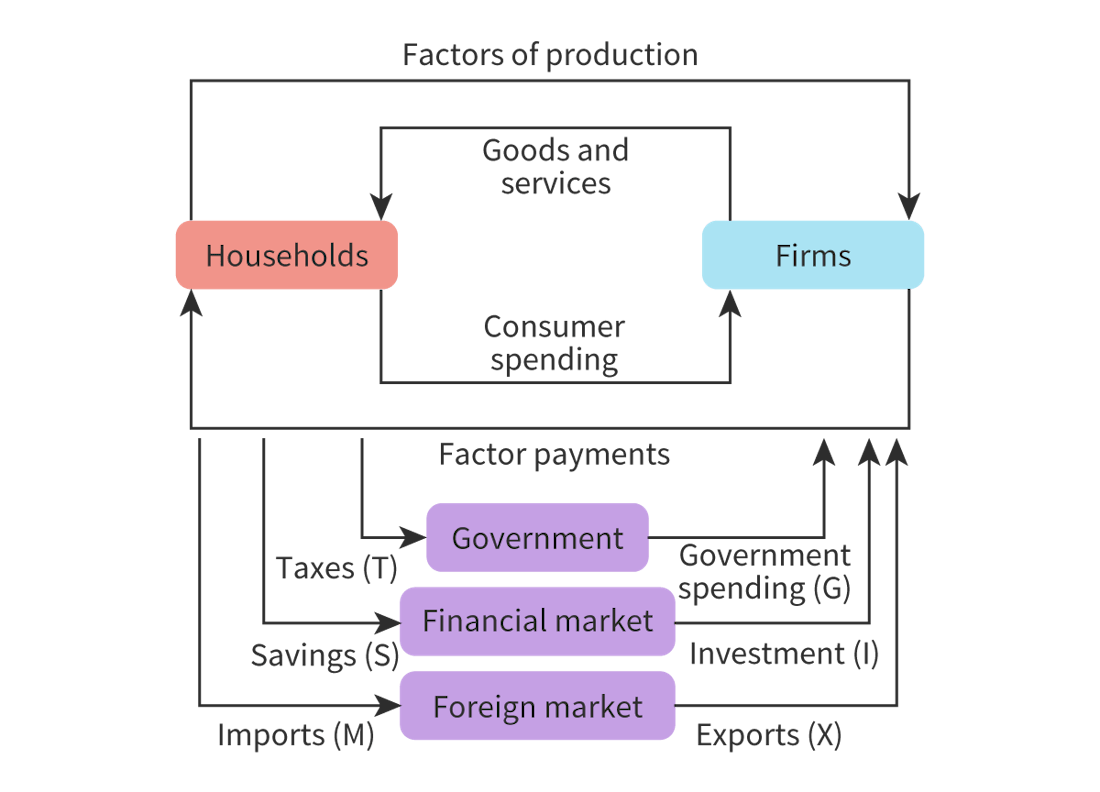
Injections
Flow of money into the circular flow of income from outside (not consumers), G, I and X
Leakages
withdrawals from an economy's circular flow, S, T and M
open economy
an economy that interacts freely with other economies around the world
inflationary gap
aggregate demand is greater than potential output
Advantages of GDP as a measure of economic wellbeing
Allows comparison between countries
Informs policymakers
GDP per capita gives indication of average income
Disadvantages of GDP as a measure of economic wellbeing
Overestimates quality of life
Does not account for disparity in income distribution
Contains inaccuracies
Does not account for improvements in quality of output if monetary value is the same
Nominal GDP
GDP measured in current prices
Real GDP
GDP adjusted for inflation
How to calculate real GDP
(Nominal GDP/GDP Deflator) x 100
Deflationary gap
aggregate demand is not sufficient to buy up the potential output
Assumptions of new classical model
Prices and wages are flexible, the market corrects itself
Assumptions of the Keynesian Model
Rigid prices and wages (sticky downwards)
Goals of monetary policy
Low and stable rate of inflation Low unemployment Reduce business cycle fluctuations Promote a stable economic environment for long-term growth External balance
real interest rate
nominal interest rate - inflation rate
Strengths of effectiveness of monetary policy
Incremental, flexible and easily reversible (Bank of England meets ~8 times a year)
Interest rates affect C, the largest component of AD, so they have a large impact
If interest rates are cut, there is a long run impact on LRAS because there is more investment I
Central banks are independent of the government in many HICs so their decisions are made in the interest of the country rather than politics
Constraints on effectiveness of monetary policy
Time lag of 12-24 months
Not effective if consumer and business confidence are already low (liquidity trap when r% is low but savings S is high)
Impact depends on magnitude of change in r%, so there is a limited scope of reducing r% when it is already close to 0
Goals of fiscal policy
Low and stable inflation Low unemployment Promote a stable economic environment for long-term growth Reduce business cycle fluctuations Equitable distribution of income External balance
Strengths of effectiveness of fiscal policy
Can target specific economic sectors
Government spending is effective in a deep recession
Constraints in effectiveness of fiscal policy
Political pressure (opportunity cost of government spending)
Debt and budget deficit
Time lags
Goals of supply side policies
Long-term growth by increasing the economy's productive capacity Improving competition and efficiency Reducing labour costs and unemployment through labour market flexibility Reducing inflation to improve international competitiveness Increasing firms' incentives to invest in innovation by reducing costs
Market-based policies
Competition: Deregulation, privatisation, trade liberalisation, anti-monopoly regulation Labour market: reducing power of labour unions, reducing unemployment benefits, abolishing minimum wages Incentive: personal income tax cuts, cuts in business tax and capital gains tax
Interventionist policies
Education, training
Improving quality, quantity and access to health care
Research and development
Provision of infrastructure
Industrial policies
Strengths of effectiveness of market-based policies
No burden on government spending
May improve resource allocation (free market)
May improve international competitiveness (production costs decrease, FDI increases)
Strengths of effectiveness of interventionist policies
Direct support of sectors important for growth (e.g. tech)
Ability to create employment (decreasing structural unemployment)
Positive effects on equity (like direct investments in lower income regions)
Constraints in effectiveness of market-based policies
Possible negative effect on equity
Less tax revenue (if taxes cut)
Negative externalities (eg from deregulation)
Time lags
Constraints in effectiveness of interventionist policies
Time lags
Cost
unemployment rate
(unemployed/labor force) x 100
Consumption (C)
Spending by households on domestic goods and services for their private use
Investment (I)
The addition of capital stock by businesses to create future production capacity
Government spending (G)
Spending by the government on capital goods and services
Aggregate Supply (AS)
The sum of all goods and services that all the industries in an economy will produce at a given price level (= to output method)
Short-run aggregate supply (SRAS)
Short-run: Period of time when at least one FoP is fixed. If firms want to increase output, they need to pay more to hire FoP.
Determinants of SRAS
Changes in costs of production, e.g. for
Change in cost of raw materials
Change in wage rates