SS final 2026
 Call Kai
 Learn
Learn Practice Test
 Spaced Repetition
 Match
Match Flashcards
 Knowt Play
1/96

There's no tags or description
Looks like no tags are added yet.
Name | Mastery | Learn | Test | Matching | Spaced | Call with Kai |
|---|
No analytics yet
Send a link to your students to track their progress
97 Terms
Treaty of Tordesillas
Treaty between Spain and Portugal over boundaries. Made a line of demarcation stating where Spain could sail and where Portugal could sail.
Amerigo Vespucci
Italian explorer who set out to find a sea route to Asia. America was named after him.
Conquistadors
“Conquerors.” Spanish explorers who took over land by conquering those that lived there
Hernan Cortes:
Conquistador for Spain. Took over the capital of Tenochtitlan, conquering the Aztecs.
Balboa
Spanish explorer that reached the Pacific Ocean
Ferdinand Magellan:
his crew was the first to circumnavigate the world. He was killed in a battle while sailing.
Circumnavigate
Completely sail around the world.
Ponce de Leon
Searched for a “fountain of youth.”
Christopher Columbus
Sailed the ocean blue in 1492. He discovered America. He was funded by Queen Isabella of Spain. He used the Nina, Pinta, and Santa Maria ships for exploration.
3 G’s
Gold, Glory, and G-d.
Hierarchy of social classes:
See chart
Peninsulares: owned land, role in government, members of the Church
Missions
religious areas often used to convert people.
New Laws:
these laws made it forbidden to enslave Native Americans.
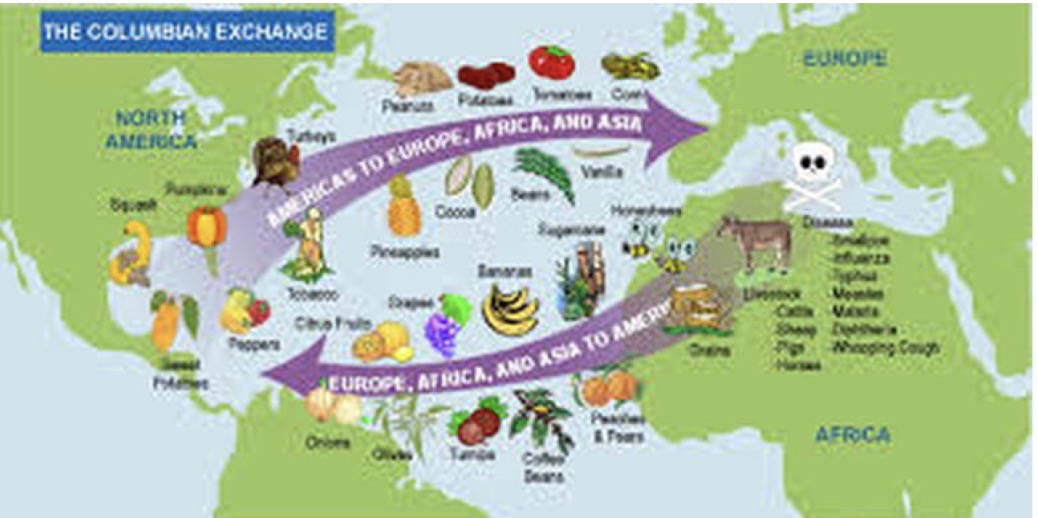
*Columbian Exchange:
Henry Hudson:
Dutch explorer who discovered the Hudson River and Hudson Bay.
Renaissance
Time of creativity. Artists emerged such as the “Ninja Turtles.” Michelangelo, Donatello, Leonardo, and Raphael.
Caravel
Was a more advanced exploration ship.
Jamestown
One of the first settlements in Virginia.
John Rolfe
Married Pocahontas and as a result there was more peace between the Native Americans and white settlers.
Chief Powhatan-
The father of Pocahontas and chief of a Native American tribe.
Mayflower
Ship that brought the Pilgrims to America.
Puritans
Wanted to reform the Anglican Church
Separatists
Wanted to break away from the Church of England
Pilgrims
Came to Plymouth, Massachusetts for religious freedom and settled there. Befriended the Wampanoag tribe.
Massachusetts Bay:
Puritans went there and invested in the Massachusetts Bay Company. John Winthrope was the governor.
William Penn:
Founder of Pennsylvania
Duke of York: In charge of New York, which was originally New Amsterdam.
Duke of York
In charge of New York, which was originally New Amsterdam.
New England Colonies:
Massachusetts, New Hampshire, Connecticut, and Rhode Island
Middle Colonies
New York, New Jersey, Pennsylvania, Delaware
Southern Colonies
Maryland, North Carolina, South Carolina, Georgia, and Virginia
Subsistence farming:
Producing “just enough” for the needs of a family.
*Triangular Trade Route:
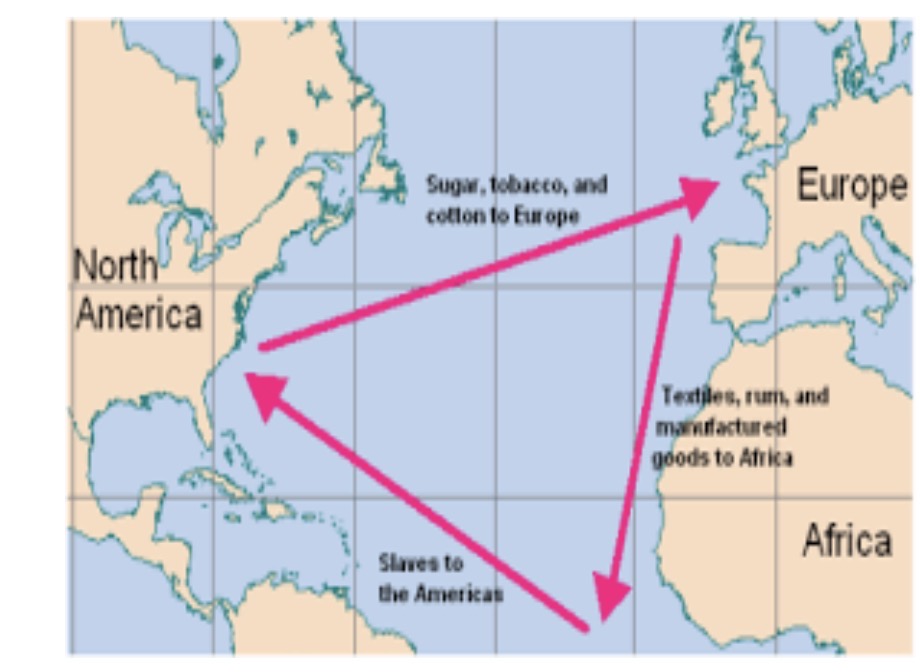
*Middle Passage:
Worst part of Triangular Trade Route where slaves were transported
Smuggling
Bringing in goods illegally.
Cash crop
Crop that makes money.
Indigo
Cash crop of the Carolinas and it’s a blue dye. “Blue gold”
Plantation
Large farm in the South.
Slavery
Slaves worked on the plantations in the South for no pay and harsh conditions.
King George III:
King of England
Olive Branch Petition:
Colonists submitted to King George III to express their desire for peace. He refused
Quartering Act
Colonists had to house British soldiers.
Patrick Henry
“Give Me Liberty or Give Me Death!”
Boycott
Refusal to buy goods.
Sons of Liberty
Group of angry colonists that protested Britain’s taxes.
*Boston Tea Party
Colonists dressed up like Mohawks and threw 342 chests of tea into Boston Harbor to protest the tax on tea.
*Boston Massacre
5 colonists were killed, including an African American dockworker, Crispus Attucks over a snowball fight that escalated.
Writs of Assistance
Need a search warrant to search a house.
Samuel Adams:
Leader of the Sons of Liberty.
Intolerable Acts aka Coercive Acts:
Britain created after the Tea Party to punish colonists further. Harbor would be closed until colonists paid back money for tea, soldiers in homes, and banned town meetings.
Declaratory Act:
Gave Britain the right to tax colonists in “all cases whatsoever.”
Lexington and Concord:
“Shot heard around the world.” Ultimately the starting point for the Revolutionary War.
Battle of Bunker Hill
First official Battle of the Revolutionary War. Even though the Redcoats won, they realized the war wouldn’t be easy against the colonists
Declaration of Independence
Gave colonists their independence. There are 4 parts. Thomas Jefferson wrote it.
George Washington
Led an army for American Rev. Later became the 1st president of the U.S. set a precedent (example) that presidents will only serve two terms. *Made his famous farewell address stating, “Steer clear of permanent alliances with foreign nations.” This means not to get involved in countries affairs because they will always expect you to help financially and physically.
Marquis de Lafayette:
French advisor that became one of Washington’s most trusted aides.
Valley Forge
Where the colonists endured a terrible winter.
Battle of Yorktown
Last battle of the American Revolution. Colonists win!!!!
*Treaty of Paris:
Ended the Revolutionary War..
U.S. was recognized as an independent nation
Boundaries would be the Mississippi River on the west, Canada in the North, and Spanish Florida in the South.
The U.S. would receive the rights to fish off the coast of Canada.
Each side would repay debts
States should return any property seized from the loyalists.
Loyalists
Colonists who fought for the British
Patriots
Colonists who fought against the British
*Advantages of the Patriots during the war:
Determination
Washington as a leader
Fighting on home turf
Redcoats/Tories:
British soldiers
Articles of Confederation
First type of “Constitution” but it was too weak. State government would have the most important powers over the federal gov’t.
Shay’s Rebellion
Daniel Shay led a group of angry farmers on a rebellion because the courts wanted to seize their land for lack of payment.
Constitutional Convention
Group of people that got together to discuss creating a Constitution in place of the Articles of Confederation.
*Virginia Plan:
Gov’t would have 3 branches of gov’t. The legislative branch would have two houses. *Most like gov’t we have today
*NJ Plan:
one house legislature, each state would have one vote in the legislature. Weak executive branch.
*Great Compromise
The Senate would give each state equal representation and the House of Representatives would be based on the population of a state.
Three-fifths compromise
How slaves would be represented. Every 5 slaves would count as 3 free people.
**Three branches of government
so one branch doesn’t become more powerful.
Executive: president and vice president. Carries out the nation’s laws, conducts foreign policy, commander-in-chief of the armed forces.
Legislative: Congress (Senate and House of Reps). Makes laws, treaties, declare war
Judicial: Supreme Court and lower courts. Make sure laws are constitutional.
**Checks and Balances:
so one branch of government doesn’t become too powerful. Each branch can veto one another.
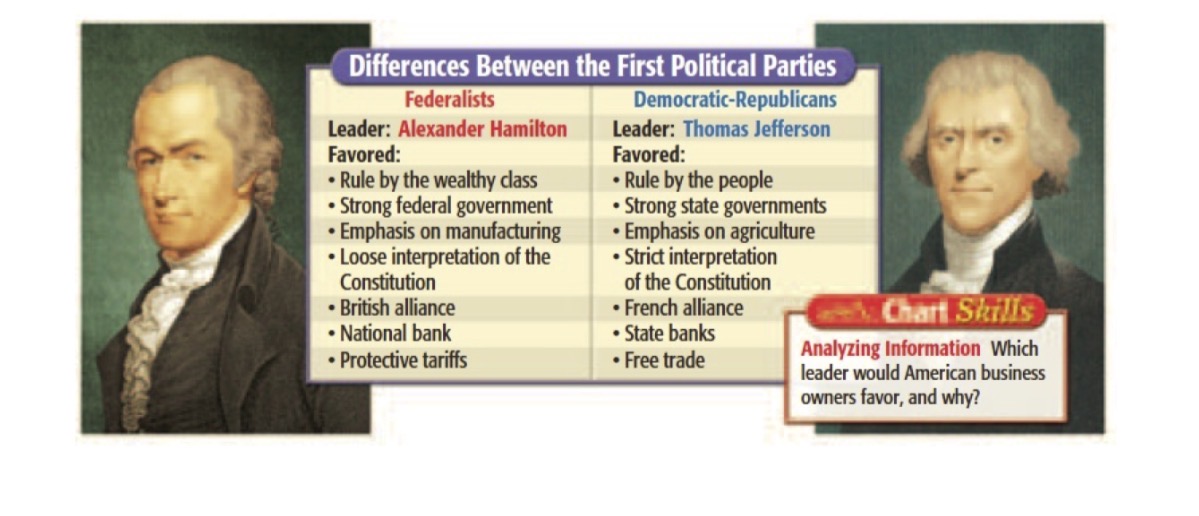
*Federalists vs. Anti-Federalists (Democratic Republicans):
**Bill of Rights:
1791 added to the Constitution. Amendments 1-10 to protect individual rights.
1- RAPPS: Freedom of Religion, assembly, press, petition, and speech.
2- Right to bear arms
3- Housing of soldiers
4- Search and seizure (search warrants)
5- “Miranda Rights” Protects against self-incrimination. “I plead the fifth.” Double Jeopardy
6- Speedy criminal trial with a lawyer and a jury of your peers.
7- Civil case trial: anything over $20 with a jury of peers.
8- No cruel and unusual punishments or excessive bail.
9- Any rights not stated in the Constitution are to be given to the people.
10- Any rights not given to the federal government are given to the states.
Constitution- 1787 instead of Articles of Confederation.
Cabinet
Group of advisors to the president
XYZ Affair
Incident where French officials demanded a bribe from U.S. diplomats. Three agents referred to as X, Y, and Z.
Jay’s Treaty
British agreed to pay damages from the ships they seized, withdrawal from American soil, and allowed some American ships to trade with British colonies.
Thomas Jefferson
3rd president of the U.S.
Laissez-faire
Hands-off” approach to businesses. The government shouldn’t interfere with them.
*Marbury vs. Madison:
Adams last night in office he tried to deliver commissions to judges he wanted on the Supreme Court even though Jefferson was taking over. This became known as the “midnight judges” but the commissions didn’t reach some people. Jefferson said they were invalid because he was now president. This case established judicial review.
*Louisiana Purchase-
U.S. bought from Napoleon in 1803 for $15 million. It doubled the size of the U.S. The United States benefited because of trade and more land. Jefferson struggled with the idea of whether to buy or not because it was not mentioned in the Constitution as to whether a president could expand or not.
*Lewis and Clark-
Led an expedition to see the Louisiana territory and report back their findings.
Sacagawea
Native American that helped Lewis and Clark.
Napoleon
Leader of France
Impressment
Policy of British seizing and capturing American ships and forcing American sailors to fight for them.
Embargo Act
Banned imports and exports to all foreign countries.
Non-intercourse Act
Repealed the Embargo Act. Banned trade only with Britain and France.
War Hawks
Favored War (Henry Clay)
War of 1812
Between Britain and the U.S. over trade and impressment. The U.S. wins.
Francis Scott Key
Wrote the Star Spangled Banner.
Treaty of Ghent
Ended the War of 1812
Battle of New Orleans-
Battle that took place when the war was technically over. Jackson became a hero. Bloodiest battle.
Capitalism
An economic system where the government does not control businesses. People are supposed to make a profit and make decisions about their business. The U.S. is a capitalist country.
James Monroe-
President during the “Era of Good Feelings.”
Sectionalism
Loyalty to a particular region.
Henry Clay
“Great compromiser” and a War Hawk.
*Missouri Compromise
1820. Didn’t want to upset the balance of free and slave states. Missouri wanted to be a slave state and luckily Maine entered wanting to be a free state or else the numbers would be off. In the future anything above the 36-30 line would be free and anything below it would be slave.
*Monroe Doctrine
1823 foreign policy. The U.S. would not colonize or interfere with existing European colonies in America and vice versa. However, no new colonizations.